
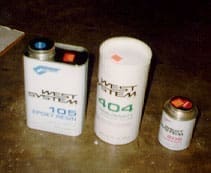
This article will explain the step-by-step method of repairing soft spots in your beach catamaran hulls. This technique uses the method of injecting thickened epoxy into a catamaran hull using a syringe.
This method is well suited to repairing soft spots in catamaran hulls. The soft spots can be found by pressing carefully with your fingers on the hull. Usually they are on the top or upper side of a hull. When you apply pressure
to a soft spot, the area will detent slightly and even give a "squish" sound.
The soft area can be a few square inches or entire areas of a hull.
The typical catamaran hull consists of an outer later of gelcoat and
an inside layer of fiberglass with a foam layer in the middle. This foam layer is
about 3/8" thick. When you feel this soft area from the outside, the foam
inside has either deteriorated and has separated from the inside or outside layers.
Some times it can even be wet.
There are a few ways how these soft spots can develop. One way
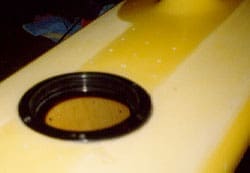
is to install access ports without sealing the raw edge of the hole with epoxy or silicon
before the port is installed. Water in the hull vaporizes and penetrates the foam
from the inside. Usually ports are installed to alleviate the build up of
moisture in the hulls, but if not done properly it accelerates the same problem you were
trying to avoid.
There are reports that 1979 Hobie 16 boats were vulnerable to soft
spots because of the inferior foam that was used that year. I don’t know if it is
true or not, but I owned a 1979 Hobie 16 that had a soft spot problem in front of the
forward pylons. This boat also had access ports installed by the previous owner
without sealed hole edges.
Ports or no ports, water left in the hull can evaporate and
penetrate the inside layer of fiberglass and damage the foam layer. You should
silicon all leaks in your hulls, drain them after each sail, and remove the drain plugs
prior to storage. If you can garage or cover your boat and open the access ports it
would be even better.
Another way that foam is broken down is to step on the top sides of
the hull. If you have to step on a hull, do so on the outside edge where it is
stronger. Or better yet, crawl on it so that your weight is more distributed.
If you have very large, extremely soft, or areas that have
delaminated so bad that the inside layer of fiberglass has physically separated from the
foam, then you would be wise to seek the help of a professional. This technique is
not suitable for severe cases of delamination.
This project was performed on my 1982 Hobie 16. I had a soft
area about 4×6" between the forward pylon and an access port. It wasn’t very
soft, but I wanted to repair it before it had a chance to get worse.
I encourage you to read the West System literature either in paper
or on-line form. The link is listed below. It will help you understand the
characteristics of epoxy if you have never worked with it before.
|
Supplies needed
|
|
|
Tools Needed
Other Requirements
Time Requirements
Approximate Costs Involved
Relevant Web Sites (with dealer locators)
Preparation Clean the soft area of the hull. Chuck the 1/8" drill bit into your |
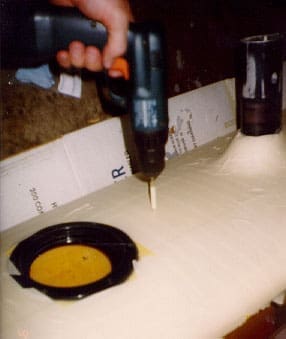 |
Take a deep breath and drill a series of holes in the soft spot. If it appears that the inside foam is wet, you may want to let the Examine your syringe for the fit into the drilled holes. |
|
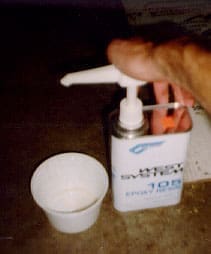
Epoxy Mix Mix up a batch of epoxy in a container. You will need to Stir the mixture for at least 1 minute. Add in 404 high |
|
|
Epoxy Inject |
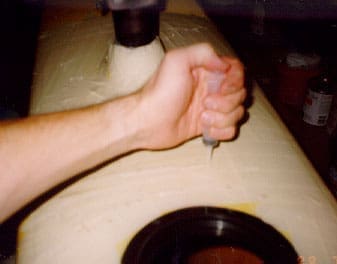
Draw the thickened epoxy into the syringe and inject into each hole. |
|
Epoxy Cure Allow the epoxy to cure for about an hour so that the tops of the |
|
|
Test and Admire After the epoxy has cured. Perform the same finger pressure
Gary Willcox
Cincinnati, Ohio Disclaimer: Attempt this project at your own risk. Every |