

Just been watching a few cat sailing video's that are going around on the web and it strikes me that so many people are cleating the main !
The only times I cleat the main sail is if I am sailing down wind with the kite up or when it is fairly light and I'm moving around doing something else - mast rotation, plates etc. I always un-cleat after this as I feel that it gives you that vital 1/2 second. When it is windy, I never cleat the main upwind.
Do you cleat your's much ?

NEVER. Except in those rare instances, like you, when I have something else to do. I have been having a hell of a time stopping my son from cleating the jib too. I think you loose that 1/2 second that is sometimes vital to going over. He doesn't see it that way. I was showing my wife some of those videos and she commented, "Why are they always flippin' the sheet?"
Good thread question Scooby.

I do after comming in off the trap..or downwind...thats about it...the wind here gets really puffy at times...and that 1/2 sec can make a big difference

I cleat all the time. Just watch the wind...
Using cleats is part of single-handing when you fly more than one sail.
Interesting, You don't cleat the main OR the jib?? I assume you sail with crew otherwise you must be steering with your toes. 
Which is why I said "except when the kite is up down wind"
Sail single handed, Don't have a Jib.
Single-hand on the 4.3, so in light air, I cleat everything (jib and main), get way forward and focus on steering. In moderate air, I'll cleat the jib and hold the main. In big air, I cleat jib and main, keeping the mainsheet in hand with no slack, and pinch like the heavy-air wuss that I am.  I need more and better practice skippering in 15 knots and up - my results show it, too. In one regatta, I went from seconds and thirds in light to moderate, to DFL when the wind picked up - proof that cleating and pinching is slow.
In moderate to heavy air I don't cleat but always wrap the mainsheet around my hand 3-4 times. If I have to let the sheet out quickly I just straighten out my hand and let the sheet out 1 loop at a time or several loops if need be.
I hardly ever worry about the jib. I adjust the slot more than the jib sheet.
??? I don't think it really matters whether someone uses a cleat or not.
Which boat are we talking about?
I for my self, on a HC16, can't bear more than 10 minutes uncleated when upwind two-trapped. It's much too physical demanding.

I cleat the mainsheet, the majority of the time.
Now how about self tacking jibs? I cleat that as well. I really do not see how a self tacking jib can make a huge diference if you are going under or not.

Self tacking jib - always cleated, obviously.
Main - never cleated above about 5mph of wind. I've even adjusted the cleat position up out of the way so that it can't be cleated accidentally. It's still possible to cleat it if I have to (say, to sort out a rudder or adjust something) but I would have to move in off the hull to do it.

Not cleating the main on my Tornado has saved me from capsize countless times. It is the single reason I have never had a capsize in 20+ years of sailing/racing. Now that I run a spinny, I do cleat the main off-wind, and hold the traveller line at the ready to depower in gusts. This has gotten me out of some tense moments.
Mike.

On the F17, I cleat the main upwind only to let my hand take a break from the grinding. On distance races, cleat for 5 minutes with 5 minutes of grinding following that sequence until the angles change. It's called pacing and the older I get the more "pacing" I do. Downwind, cleat the main and provide small inputs to either twist the main or tighten the leech. Of course when it's windy, it's never cleated except for downwind! Cleats are your friend!!(and your crew!) 
Bob
I always cleat the main and jib. I even cleat while I am out on the wire but the second the hull starts to rise I uncleat. The main sheet has to be across my legs or in my hand. The adjustment of the angle of the cleat is very important. I set it so when on the wire, I have to raise the line pretty high to cleat and a straight horizontal pull will uncleat it. Since I single hand a lot I leave the jib cleated. I seldom go over and have been sailing this boat for 20 years.
Howard
I forgot to add on the above post that I sail a Hobie 16.
Howard
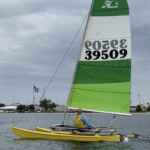
On my NAcra 5.2 I very very rarely will cleat the main. If I am singlehanding, which is most of the time, I will actually let the main luff if I have a second task that needs to be done. Of course, I wouldn't be able to do this racing, but on a daysail, I just allow the boat to slow up.
Rob
Nacra 5.2
Panama City

I race most of the time and always cleat the main. As Howard said, I have the angle adjusted so that I have to raise my hand quite a bit to cleat it. Then as the gust hits I uncleat (the slightest tug does it) - I do not ease the main unless I have to, just uncleat - then cleat again when the danger is past. If you do not have your main in tight, you will not point to well. The same with the jib - my crew would always have it cleated and only release it if a very strong gust hits, or to re-adjust it if the wind strength changes.
I always have the mainsheet in my hand, except when using the traveller downwind. I pitchpole once or twice a year, but cannot remember when I last capsized on a beat.

I single-hand a sloop-rigged G-Cat 5.7M. I keep pretty much everything cleated most of the time. The Main and Traveler are on the same sheet, which gets draped over my rear leg when trapezing. The jibsheet gets draped over my forward leg. Sometimes I'm adjusting everything and trying to steer at the same time, while flying, and that gets pretty interesting. I do have the cleats adjusted pretty high so they uncleat with just a little tug..
I mostly daysail and am not as concerned with getting every fraction of a knot out of my boat as I am with having fun and flying it high along the beach for the girls to see
Hello All,
What works best for me, as a Uni -solo sailer in the Trade Winds is CLEAT AND NEVER TOUCH IT.
I was coached to do this, and it works! The technique told me, on this forum, was 'take the mainsheet with both hands, arch your back,bend your knees, pull till it hurts, cleat it'
This is after one sets the formula of downhaul,mast rotation, d-board height and traveller.
Of course, your diamond wire adjustment has been set on the beach, for the general wind condition of that day.
There are some involved discussions on the F-16 forum about this stuff.
As I recall, there is a very in depth posting by an Aussie T4.9 Uni champ with tremendous and detailed settings. I believe he sails with the mainsheet cleat taken OFF the boat and he sets up his mainsheet blocks differently. If I have this correct, you would have to check, his exit block ( where the mainsheet exits the pully system to your hand) is set up at the boom,......not the traveller!
..whatever works for you and makes you a winner!
regards,
Bruce
St. Croix
I-17 normal
ps. The exception is the extreme life threatening condition...then anything goes to save yourself and your boat.

When sailing solo and when sailing with crew, my mainsheet is nearly always cleated. The few occasions when it is uncleated are during a screaming broad reach with main and jib set (no spinnaker).
GARY

There are several issues which affect when or how much the skipper cleats the main.
Along with the varying courses, water conditions, and wind strengths, there are some fixed differences.
Different skipper sizes and strengths.
A bigger/stronger skipper would be able to play(grind) more often than a weaker one.
Different size mainsails.
A Hobie 16 is easier to play than a Hobie 20.
Different mainsheet purchases.
A 10:1 is easier to play than an 8:1, with the same size main.
So an average strength sailor who plays the 10:1 mainsheet on an A Class would probably have to do alot of cleating on a 7:1 Hobie 20.
Ideally, in flat water and steady breeze, you could set the downhaul, outhaul, mast rotation, traveler and cleat the main and just steer the boat.
The only reasons not to cleat are needing to work(pump, grind) the main for more speed in gusty, shifty conditions and fear of flipping.

My ol' man and I both cleat our mains and play the traveller. That is to say, I may or may not cleat the traveller, but yeah I'll whang in on the main.
Advice was taken from a very experienced sailor who suggested that 'should shackle the main to the traveller and just play the traveller.'
sea ya
tami

And Glenn Ashby is his name

I handle the main on my Prindle 19 according to the situation at hand. Is my crew experienced? Is it very gusty? Am I tired after a long time in the wire fighting the heavy air? Concentrating on reading the gusts coming across the water and having an attentive crew cranking on the downhaul at the appropriate times goes a long way to allowing me to keep the main cleated when I need to give my arm a rest. However, there have been times when I wished I had arms like Hulk Hogan.
I sail alone most of the time, but even if I have someone else on the boat, I'll always have the jib (oschen blocks) cleated and will play the main (cleated) with the oschen blocks in the puffs. I'm fairly strong, but if I tried to hold my TheMightyHobie18 magnum with a 6:1 uncleated all the time in anything over 12 k, I'd be exhausted.
I'd rather concentrate on the driving and get my head out of the boat.
I've always used 7:1 or 8:1 and always play the main. Just cannot feel that I can sail may fastest without the feel of uncleated - also, it gets you fit and strong quick

on both my 14 and 18 foot cats when going to windward, jib and main both cleated, when reaching main/jib cleated, play the traveller and go for the mainsheet when things get dicey, uncleat the main for downwind in moderate to heavy air. The Aussie 14 foot Maricat was sudden death downwind if you buried a bow and couldn't unsheet in a hurry.
A comment about a previous post where the skipper wraps the mainsheet around his hand, letting loops off to ease it. A colleague fell off trapeze on his 18 footer at speed and got dragged behind the cat for some distance with the sheet severely injuring his forearm. He didn't break anything, it just felt like it. I think he got one loop over the other which effectively tied him to the cat until it stopped. I never looped the sheet around my arm as a result, but had it ready to run out through my fingers.
I had always sailed my Prindle 18 with jib and main cleated bearing off or heading up in gusts or lulls. Sunday I went out single handed on the Barnegat Bay in 10 knots with ocassional sudden gust to 15 + knots. I played the main sheet the whole time instead of altering course when the wind speed changed. I noticed a big increase in boat speed.
Thanks to all for the tip.
Doug
Yes, this thread has made me double think my technique. Now I am considering upgarding my 6:1 to a 7:1 mainsheet. Just to ease the load a bit.
