

Both on the wire, sitting in or a combination?

whatever keeps the bow from stuffing
Soooo we went for a swim on the Infusion yesterday. Mostly broken crew, broken egos, and a few chips out of the dagger board trailing edge. We flipped going downwind with the spinnaker up, it's my fault I loosened the foot straps too much and my crew went flying forward as the bow stuffed a bit.
There really is no place to climb back on. We got lucky, really lucky. While I was holding the boat down with the dolphin striker, my crew was trying to get back on the boat. She is strong but not tall enough, there is a lot of volume! She ended up getting separated from the boat (never good), I had to duck under the hull, hold the dolphin striker with one hand, get my body outside the boat, briefly let go of the dolphin striker than find the side stay and start climbing aboard. Then go rescue my crew single handed in breeze and short chop. It wasn't a pretty rescue, hence the broken crew.
In hindsight we should have stayed on the boat and gone deep. Not as fast per se but upside down isn't fast either. Talking with some of the other teams, sitting on the back of the bus may be faster than getting on the wire if you don't have a lot of butt out there. Flat is fast but flat also powers up the main more, driving the bows down more? Thoughts? My personal opinion is the wave state and crew experience level matter most. You don't gain much fore and aft moment getting the crew on the wire but it is faster if the wave state is safe and the crew is comfortable on the wire.
I'll also add that single wire jib reaching deep down in big breeze is generally much safer and faster than spinnaker reaching in said conditions, even if the big boys are carrying the spinnaker they might not be for too long. It's hard to douse once it's up!

Depends on the conditions and ability of crew. I remember on MKL where I was on the wire with my front foot braced against the rear cross bar and the crew halfway behind me. 44 miles never tacked, never came off the wire. If trapped and big waves it helps to have a chicken line.
+1 on the chicken line has saved many a crew. Not very practical in a buoy race situation though.
Ok. Can we try to quantify that for racing around the cans (no chicken wire):
1: Wind strength (should be easy).
Up to 8m/s sit in.
9-12 single trap.
13 and above double trap?
*add pucker factor as needed and inversely proportional to gust factor.
2: Seastate:
Flat -> Go for it
Chop -> keep the bows a bit up
Short waves (messy) -> Double trap
Rolling houses - single trap or sit in
I think it is a lot faster when you are on the wire and the chicken line we use you just pull out and hook on the cleat on your harness.
The rolling houses don't bother be as much as the short steep stuff. I seem to stuff more often in the short/steep.

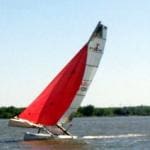
Just to give another view on the subject of jib reaching, I enclose a little vid I made this afternoon when reaching on my northsea-spot.
Extra problem was a little biassed swell direction which made the outgoing course a little slower. And the returning ingoing course a bit more tricky because of pushing waves from behind.
http:/
On the outgoing course, I was ofcourse on the wire, in my footstrap, but ingoing was too tricky for that.
I love the reach, we had a good swell with steep chop and were wave jumping on the reach at Last Sundays Rum race here in South Aus here's a bit of the reach and the transition to downwind goes well with the ACDC song
doesn't pop out of the slot when you are righting the boat (it takes a while to get it in though, I used some pliers to pull it through).
We dont capsize often, but being able to right it quickly is the difference of losing a few places instead of becoming DFL <img src="<>/smile.gif" alt="smile" title="smile" height="15" width="15" />
This inspired me, but I don't think I did the same thing you've described. I like using the track, though, and 5mm is perfect. I basically made long soft shackles with a couple 12mm nylon spacers to hold them in the track, with a few modifications to allow for a couple extra attachments.
![[Linked Image]](https://lh6.googleusercontent.com/-C3NR6nhspu0/UY8cAMCOYbI/AAAAAAAAPVc/_S0oLExJRxk/s800/IMG_20130511_175003_105.jpg)
![[Linked Image]](https://lh3.googleusercontent.com/-RECuvc3-37E/UY8cAHfDqnI/AAAAAAAAPVc/9zJEmG8eBRQ/s800/IMG_20130511_173947_335.jpg)
![[Linked Image]](https://lh3.googleusercontent.com/-DBcYOQYRcGE/UY8cAJAX_wI/AAAAAAAAPVc/qTb8Aw-lIuM/s800/IMG_20130511_174033_162.jpg)
![[Linked Image]](https://lh4.googleusercontent.com/-DL11czkmKHw/UY8cABh0YsI/AAAAAAAAPVc/IBLoiUtlWzY/s800/IMG_20130511_180701_635.jpg)
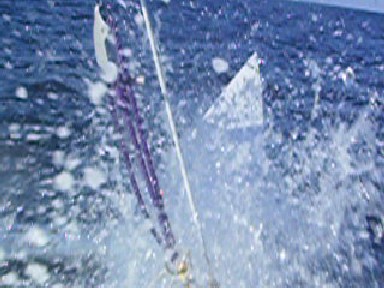
Don't know the infusion, but for all boats I sailed so far:
If the nose dives (by then you did make already an error, right? But some errors are not avoidable) push the tiller *hard* to
a) turn the nose into the wind and reduce the angle of attack of the sail's
b) pull the stern down/ nose up (if you have sufficient heel angle)
In some cases you have to drop the main too.
The trick is to use sufficient rudder
Cheers,
Klaus