

Could you Viper Drivers explain how your cunningham is run under the tramp and then up to the sail? I didn't get a close look at the GC but I heard they are very slick, easier to use and done on a 16-1 cascade system under the tramp?
Show me.
Thanks.

I have a nice diagram of it, I'll get it to you when I finally get home. You'll need a bit of space under your beam to set it up, but it is a real slick system.
Thanks Brett, sorry I never got a break to come and talk with you, you were very popular and I couldn't find you when there were not so many girls around!
Are you guys not even home yet? Wow, that's a road trip! Did your Mom make it back OK?
And is it your brother that is a pilot, or is that you? Your Dad told me his son is a pilot but I wasn't sure.
Take care and thanks for comming over, I hope you had fun.

On a standard system the cleats of the cunningham are on the mast. On the Viper the cleats are on the front beam meaning all the loads on the sail are also on the mastpin on the front beam. Should a standard beam be re-inforced to do this?

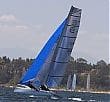
Here are some pictures from the Alinghi spy department! <img src="<>/grin.gif" alt="grin" title="grin" height="15" width="15" />
![[Linked Image]](http://open.bst.ch/alutz/ost/galleries/F16GlobalChallenge2009/photos/P1030166.JPG)
![[Linked Image]](http://open.bst.ch/alutz/ost/galleries/F16GlobalChallenge2009/photos/P1030167.JPG)
![[Linked Image]](http://open.bst.ch/alutz/ost/galleries/F16GlobalChallenge2009/photos/P1030168.JPG)
![[Linked Image]](http://open.bst.ch/alutz/ost/galleries/F16GlobalChallenge2009/photos/P1030170.JPG)

Nobody has replied and I'm surprised!!! <img src="<>/smile.gif" alt="smile" title="smile" height="15" width="15" />
I'm not an engineer, but I wouldn't think that you would need to reinforce it...
If you think about it, the dolphin striker is there to reinforce the beam... <img src="<>/smile.gif" alt="smile" title="smile" height="15" width="15" /> And we all have that...and I think the Blade's dolphin striker might be a little beefier than the Vipers....
Again, that's what I think and I'm not an engineer...
I do like the system on the Vipers pretty well, but sometimes the lines or blocks get
snagged
on something when you are trying to downhaul really hard. You just have to pull a little harder and it comes undone. Whatever that is...I do know it's not the blocks bottoming out...I make sure I do that correctly before going out on the water...
Matt or someone else would be able to answer the above question better than me..
Mike
I looked at those pics a little closer...
Just so know one gets confused...cause I do sometimes...
Those bungees are supposed be under the lines, not over the top of them....
At least that's whtat I think!

Okay I'll bite !
The Viper has a 4:1 purchase system betweent the sail and the bottom of the mast; you can see it in the 4th picture.
The total system is a 16:1 and that means that the (single) blue line that goes up from the beam to the sail will only see 4 times the load that you pull on your downhaul line. Typically a human being does pull more then 50 kg; Therefor the force in the blue line is typically 200 kg or less while the total downhaul force on the sail may be around 800 kg's.
A normal boat of F16 dimensions will quite easily see up to 1500 kg in mast step loads. Afterall the mainsheet tackle alone will already induce close to 400 kg of compression on the mast foot. The forestay and sidestay add similar amounts to the total.
Going up from say 1500 kg to 1700 kg (13%) is not a big deal at all.
Wouter
I think you just found the reason why your system sometimes hangs up !
Wouter
Is the red line the spin retrieval line? If so, it is
trapped
by the blue downhaul along the beam(Pic#2)? Even if it is not completely trapped, you will have a sawing action between the 2 lines.
Thanks for the pictures Andi, you Swiss spy!
OK, given the complexity of all the blocks under the tramp, vs. in the mast, and the added loads to the beam, vs. all in the mast, is there an
easier
way to do a 16-1 inside the mast? What is in there allready, 8-1?
I think I could stay with what I have (the stock Blade setup) and just add two blocks tied through my mainsail's tack (like the Viper), then add one to the bottom of the mast, and run it up-down-up down, that would increase the purchase quite a bit, yes?
easier
way to do a 16-1 inside the mast? What is in there allready, 8-1?
Inside the mast is a 6:1 (making 12:1 with the 2:1 outside of the mast)
However you can upgrade this very easily to 8:1 (making 16:1 with the 2:1 outside of the mast).
Open up the mast and replace the free hanging single block WITH becket (= 2nd stage) by a doubleblock. You'll end up with one loose end but you can tie that off at the bolt of L shaped plate up the mast.
Close the mast up and DONE !
Dependents a little on the specific implementation in your mast but this shouldn't take more then 2 hours to complete while working slowly and carefully, double checking everything.
Wouter
Thanks Wouter! I'll get on it right away, and replace most of the old fat lines with dyneema while I'm at it.
mmmmm, dyneema.....
That stuff is the shiznet!!!
BTW, buy a whole spool, it will save you a TON!
Mike
Tim,
Their is a very large change that it looks like this inside your mast. (See picture)
I have a L plate up my mast as seen in the drawing, but I think you have bolt there.
Want you want to do it replace the little block between the red and green lines with a double block and then tie the end that was secured to the single block off to the plate/bolt.
I have two single block attached to the plate and so I would simply replace one of them by the single block WITH BECKET just I just removed from the setup. The becket will then be the perfect anchoring punt for the loose end of the red line.
I hope this is clear.
It will help alot if you have a clear picture of what you are looking for.
It is a tight space, there up the mast.
Wouter

Their is a very large change that it looks like this inside your mast. (See picture)
I have a L plate up my mast as seen in the drawing, but I think you have bolt there.
Want you want to do it replace the little block between the red and green lines with a double block and then tie the end that was secured to the single block off to the plate/bolt.
I have two single block attached to the plate and so I would simply replace one of them by the single block WITH BECKET just I just removed from the setup. The becket will then be the perfect anchoring punt for the loose end of the red line.
I hope this is clear.
It will help alot if you have a clear picture of what you are looking for.
It is a tight space, there up the mast.
Wouter
This is exactly what is in the mast except the plate at the top is secured with t thru bolt.
To replace the blue line, just tape a new piece of line (23' of 5mm was original) to the old and pull through.
To replace the red you need to remove the plate up high. Remove the bolt and pull a piece of thin line/kite string thru the mast with the plate still in place. Then with the mast base off you can pull the whole assembly out the base and check/replace any worn lines. Simply pull the kite string taught and the bracket will align back with the holes in the mast sides.
You can not see these line to inspect, but I swap them out each year and they are in much better shape than any other exposed lines on the boat. They do not get worn and do not get sun beaten. It has been worth the trade off for a very little extra time to replace for me.
Thanks for the info Matt, and the drawing Wouter, now, where does the red line dead-end? From the drawing it looks like the red goes back up to the hanging bracket or is it to a becket on the lower block?
to a becket on the lower block.
I installed this system early 2004 and I have never replaced any internals. One time my outside line (green line) got badly chaffed from rubbing against the gooseneck and I had to replace that. I thought it would be a good idea to take everything out and inspect it. It looked like new and all lines were still very flexible; they felt new as well.
I use a 2 mm dyneema line for the second stage (red) to minimize friction; it has held up so far.
Remember I leave my boat up on the beach for 6 months a year.
Best downhaul setup I ever seen with respect to the combo of low maintaince and ease of use.
Just like Matt I take out the blue line (swiftcord) each year and wash it clean again. The Green line I wrap up and store in my trampoline pocket away from sand and UV.
For all of you wondering; there is a watertight sealing plug right above the plate so my mast is still watertight (just not the bottom 1.5 mtr)
Good luck

Thanks for the diagram descriptions Wouter and Matt.
I have been thinking of changing the downhaul system to an internal system just to maintain that clean look and feel.
How do you line up and fix the internal bracket the blocks hang off?

If you do not want to go internal to the mast; you can have a cascade 16:1 externally
![[Linked Image]](http://www.catsailor.com/bb_files/149788-downhaul1.jpg)
There is a turning block on each side of the mainsail just out of shot
I already have an external 8 to 1. I dont think I need more purchase (I grunt a lot) just I like the clean look of the internal system. But Ive never worked out how people attach those top blocks.
Pre drill holes in the plate
Lay the mast flat
Drill holes in the mast using the plate as a template (remember carefully which side goes where)
Tape the plate to a long stiff rod or beam. Broomstick worked well for me. Don't go overboard with tape it, you are not forcing up the mast.
Fiddle about with the broom stick while your helper looks through the whole in the mast to see whether one hole is about to aling itself.
If so, use a iceprick of screwdriver to
stabilize
the plate.
Increase screwdriver size as to align the plate better and better.
Keep the screwdriver in and try to aling an opposing hole. Use again some screwdriver to properly align the plate.
The plate should be aligned pretty well know, try to put blind rivets in the remaining two holes. With a bit of fiddle this works. If confident you can pull the broom free before doing this.
From then onwards replace screw drivers with rivets.
Doubt check whether everthing is at it should be. (testing operation of downhaul over full swing, no lines crossed ?)
Certain everything is alright ?
Rivet all fasteners into place.
I think it took me 5 minutes do do, but I had the whole system neatly lined up next to the mast.
It is really not as difficult as it sounds.
8:1 will do but 12:1 is better with respect to finetuning the luff tension.
Wouter
I do like the system on the Vipers pretty well, but sometimes the lines or blocks get
snagged
on something when you are trying to downhaul really hard. You just have to pull a little harder and it comes undone. Whatever that is...I do know it's not the blocks bottoming out...I make sure I do that correctly before going out on the water...
We employ the same system on the cap, the snag is the two floating blocks running along the main beam hitting each other as they pass by, only happens at a certain point and not all the time.
I have spent many sleepless nights trying to work out something better.. there must be a better way.

[quote=scooby_simon]If you do not want to go internal to the mast; you can have a cascade 16:1 externally
Scooby,
It looks like you've replaced the micro cheek blk at the very base of the mast aft, with something larger, what prompted that? What is that blk, I don't recognize it? A wire blk? How about the red twing ball in the blue line, is that your way of terminating the blue line after it's been fed thru the blk(s) at the mainsail tack? Nice! Is the red line 3/16"? Which line(Mfgr)? Thanks for the pic and post!
Dave
Scooby,
It looks like you've replaced the micro cheek blk at the very base of the mast aft, with something larger, what prompted that? What is that blk, I don't recognize it? A wire blk? How about the red twing ball in the blue line, is that your way of terminating the blue line after it's been fed thru the blk(s) at the mainsail tack? Nice! Is the red line 3/16"? Which line(Mfgr)? Thanks for the pic and post!
Dave
Micro cheek block is still there; the wire block (as you guess) is just tied to it; I wanted a larger dia block as at times the rope was rubbing on the gooseneck when I had lots of DH on.
Not sure who made the red rope; it's just what the chandler had at the time; I THINK it's 5mm; this setup is very efficient, I never really need to pull it hard; it just comes in when needed and because it's a cascade with fairly big blocks it runs out very well too.
The red ball, is, as you guess the termination of the line that goes thru the block on the sail.
I have a bit of D12 with the ball on spliced onto the forward block; the D12 that goes thru the block on the sail has a spliced loop just big enough to get the ball thru once pulled snug thru the block on the sail.
What blks are you using at the mainsail tack, and how are they attached? Thanks!
Dave
I think it's a 28mm Harken carbo, not sure....
![[Linked Image]](http://www.catsailor.com/bb_files/149788-bendy1.jpg)
Bit of Spectra line goes thru the sail and back a few times and another block on the other side; not very high tec but it works!
Shed loads of downhaul on in that pic, all with one hand and not working very hard!
Okay I'll bite !
The Viper has a 4:1 purchase system betweent the sail and the bottom of the mast; you can see it in the 4th picture.
The total system is a 16:1 and that means that the (single) blue line that goes up from the beam to the sail will only see 4 times the load that you pull on your downhaul line. Typically a human being does pull more then 50 kg; Therefor the force in the blue line is typically 200 kg or less while the total downhaul force on the sail may be around 800 kg's.
A normal boat of F16 dimensions will quite easily see up to 1500 kg in mast step loads. Afterall the mainsheet tackle alone will already induce close to 400 kg of compression on the mast foot. The forestay and sidestay add similar amounts to the total.
Going up from say 1500 kg to 1700 kg (13%) is not a big deal at all.
Wouter
Hi Wouter, All,
Is around 50Kg a value that could be expected as mainsheet force, is this a typical value for a
normal
adult man? or would it tend to be high? or low? (I am asking as I had a question from my sailmaker on how much forestay tension I would expect). I am putting a tornado rig on a monohull, boom 2,4m, 1:10 purchase, forestay same distance away from mastbase. question is what the contribution from the mainsheet would be on the forestay? Input greatly appreciated as I ordered a sail yesterday and need to give some input in order for the sailmaker to possibly adjust for forestay sag compared to a non-rotating mast setup wich could have higher sidestay tension.
Kind regards
Patrik
What is your stability like compared to a Tornado? It is not only how hard you crank on the mainsheet but also the stability curve of the boat. Less stability = less mainsheet tension. <img src="<>/smile.gif" alt="smile" title="smile" height="15" width="15" />
You probably want to look at similar boats to see what purchase they go with. 50kgs is a load you could pull from the trapeze with good footing. I never measured though.
Hello Rolf,
Thanks for the input.
The stability factor from the boat will be limited, the righting moment will mainly come from 2 crew in trapeze. Racks extending ca 2,5 from the boats centerline. The boat is intended to be sailed
completely
flat. The keel weight will be to balance the mast but not much more. This together with sail area means it will be fully powered up earlier than a T, but later than an A-cat.(if my calcs are correct).
Kind regards
Patrik