

What's the maximum
reasonable
diamond wire tension to run on an a-cat?

Tighten them until they are tight, then tighten some more, when you think they are really tight, tighten more. Important to keep measuring frequently. Tighten more until the mast snaps.
Buy new mast, take some poundage off last reading. Run them like that>
<img src=

alt=
/> <img src=
alt=
/> <img src=
alt=
/> <img src=
alt=
/>
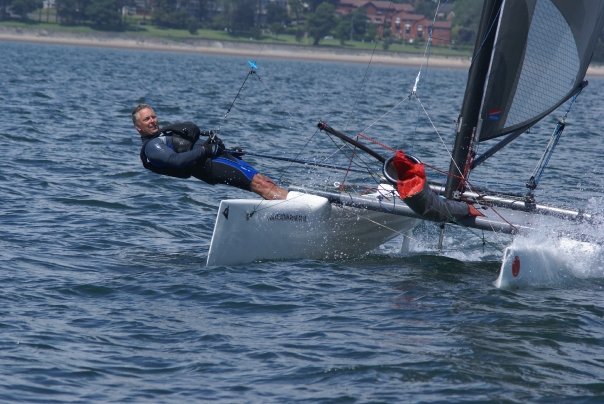
Shouldn't you ask the guy who made the mast! This year I used a saarberg mast but that had a variable control diamond tensioner fitted but the National Champ Chris Field just had the normal bottle screws. I can't be positive what the max tension would be for this particular mast but I think Chris was running with 38 on the new loose gauge but there again Saarberg masts are custom built to each individual customer as near as damit.

I would imagine just tight enough so you do not have any slack in the windward sidestay when out on trap.
I'm just trying to find a reasonable range of tension so I can start experimenting with various tensions...I don't want to approach the realm of compromising the mast structure. The mast was constructed by Allied Composites 9 years ago and it doesn't appear they're making a-cat masts anymore. Although I have both styles of gauge, If you have it, I would like the measurement in pounds tension (I know, beggers / choosers).
With the diamond wires?
I'm at 32 on the Model A Loos, Part 91
60mm sweep on the spreaders, 2 inches prebend, 45cm long spreaders.
Your ruler must be very very confused 😛

Doesn't your tape measure have both inches and millimeters on it. Mine also has a Planck length scale. <img src=

alt=
/>
I few years ago I came across a drywaller's T-square (24
X48
) and I have found in very handy for boat building.
At 8 dollars I think it's the least expensive tool I have.
The biggest problem with it is it does not have a metric scale on it. Next time I go to Canada I will have to get one there.
not really.
I am running 900-1500 lbs indicated on a stiff Marstrom mast. I use
indicated
because I have tiny rod diamond
wires
and I have never been sure of the accurancy of the gauge.
In practice I simply adjust the bolt left or right, in half turns, depending on the wind. This is written on the mast with an old grease pencil. Periodically, I set the mast to known prebend and call that zero. When I set the prebend, I mostly, measure the tension with the gauge and write that on the gauge.
indicated
because I have tiny rod diamond
wires
and I have never been sure of the accurancy of the gauge.
In practice I simply adjust the bolt left or right, in half turns, depending on the wind. This is written on the mast with an old grease pencil. Periodically, I set the mast to known prebend and call that zero. When I set the prebend, I mostly, measure the tension with the gauge and write that on the gauge.
Yeah, I would figure that the Loos gauges in use out there are not suited for checking tension on rod rigging. I also bet there is some significant variability attributable to the difference between 7x7 wire and dye-form wire with these same gauges.
Bill, do you know what the diameter of the wire is on your diamonds?
We sometimes go up to 800 or 900 lbs of tension on the I20 but I'm nearly certain that could mean death for my a-cat mast. It's currently at 350 pounds of tension and performing well in light to moderate breeze. Is 500 lbs a reasonable upper maximum? I found a website for Applied Composites - I'll check with them too.

I have a 2003 allied composites mast with a 2007 Glaser sail. I sail at 190 lbs. I am still getting dialed in with my mast settings, but my current settings are 34 on the old loos gauge and 63mm of spreader rake.
If you are getting into the range where you are worried about the mast breaking from diamond tension you are well beyond any setting that would be fast. The tightest I have seen anybody run the diamonds are 36-37. Small changes make a big difference on these boats.
Eric Marshack

Eric Marshack has numbers that work for him that are in my A-class ballpark too: I have 4 carbon masts, some of which are not yet broken.
See Landenberger-sailing.com Tuning guide A-class 2005. Landy describes that you have to match sail luffcurve to mast, mast prebend, downhaul, spreader rake, diamond wire tension: And know why all of these interact to be correct.
Briefly- 33-37 (max in a blow) on the Loos guage with usual twisted wire diamonds- these #s change with dyform, and change more with solid wire rigging.
does no one convert their numbers to pounds!? <img src=
alt=
/>

alt=
/>
Nope; 37 is easier to remember than 791 lbs (or what ever it is....)

I just set up an old Boyer Mark 3 for a friend. I had to put on new wires and did not know at all what the diamond tension should be. I went over to all the other A Cats in the yard, 5 of them. They were all between 24 and 26 on the Black Loos Guage, which I think of as the newer one. I set this one to 25.
Dan
alt=
/>
Nope; 37 is easier to remember than 791 lbs (or what ever it is....)
But
37
is meaningless unless you know the wire diameter, wire type, and have the same exact gauge (that has been calibrated).
With the diamond wires?
LOL..... Skim reading is a bad habit of mine. Thought it said stay wires.
The wire thickness is 2.5mm, dyform
Old style guage, not calibrated to anything.
My rod diamond wires are 2mm. I have been told that the rods are really stainless music wire.
I have a rod gauge but 2mm is the bottom of it's range and my
rod
is a different alloy. Mostly I use a Loos gauge and don't worry about what the numbers mean in Lbs.
If I had to set your mast up, I would match the spreaders and prebend of an existing mast and use a gauge to repeat that setting.

i run 420lbs on my mystere 5.5

how do you calibrate a Loose gauge? I've got the old style (you hook up and pull outward)
Hang known weight from a cable and measure the tension.
LOOS. Not Loose- what are you an American voter?
Loos guages in the box come with a calibration page for each wire diameter.
Conversion of Loos numbers to pounds of Kg change with the wire thickness and type. This Wire thickness can be measured by numerous means: V-groove guage, micrometer, slide guage, calibrated eyeball. You can probably get someone to xerox this page for you.
Loos guages in the box come with a calibration page for each wire diameter.
Conversion of Loos numbers to pounds of Kg change with the wire thickness and type. This Wire thickness can be measured by numerous means: V-groove guage, micrometer, slide guage, calibrated eyeball. You can probably get someone to xerox this page for you.
Whew...that was rough. Loos gauges, the one's we typically purchase, are not terribly accurate devices. To calibrate one you need to actually test it with a known condition.
[quoteHang known weight from a cable and measure the tension.
I am going to comment before somebody starts tying some old wire to a tree limb and hanging their dumbbells from the other end to calibrate their Loos gauge.
There is a procedure for calibrating deflection gauges and just hanging weights will not work.
At a minimum both ends of the test wire must be constrained like they are on what you are measuring and there are minimum wire lenghts.
I would not calibrate a Loos gauge unless I was calibrating it against the actual wire in the actual configuration. What Loos gauges actually measure deflection. How this relates to tension depends on a lot of things (alloy, hardness, style, # of strands, age etc). There is a lot of conservatism built into those charts Loos provides and you could get into a lot of trouble if your test was optimistic.
If you buy a calibrated load cell, stick it in line with your rigging, and then load it up and see what the Loos gauge shows, GREAT. However just hanging a weight from the end of a wire, might not work so well.

Since this LTHector seems to have everything else to offer, I wonder if he has some kind of Loos gauge calibration wheel...
Just asking.