

They were present during building at least..
![[Linked Image]](http://www.catsailor.com/bb_files/100776-ex-10.jpg)
Luiz have some good points. I am waiting eagerly for more news about this project and especially the self righting technique.
23 feet wide and 23 feet long.. I seriously hope they get a class going based on this. Would be seriously cool and attractive boats. But I would want Phill Brander to design mine <img src=

alt=
/>

I was talking about the bows on the exploder 20 cat that was pictured on their site.
They attend a few big regattas here in Holland and always do very well, if not better, than Tornados, Nacra20s, M20s and other Supercats (TR <=100).

Thats nice.
I don't recall saying anywhere that it wasn't fast.

The description about the righting system states that the arms each have one
quick release pin
that needs to be pulled before folding. I can't imagine a pin with shear load on it (weight and or buoyancy, and possibly rig tension) to be less than extrememly difficult to extract.
GARY

I'm pretty sure I see the slot for that board just between the
n
and
s
. I really like the concept behind this boat - but I wonder how difficult those boards are to work with when they are so low on the outside of the hull like that. I'm willing to be they have some ingenious line to control that board.
![[Linked Image]](http://www.catsailor.com/bb_files/100787-IMG_8634.jpg)
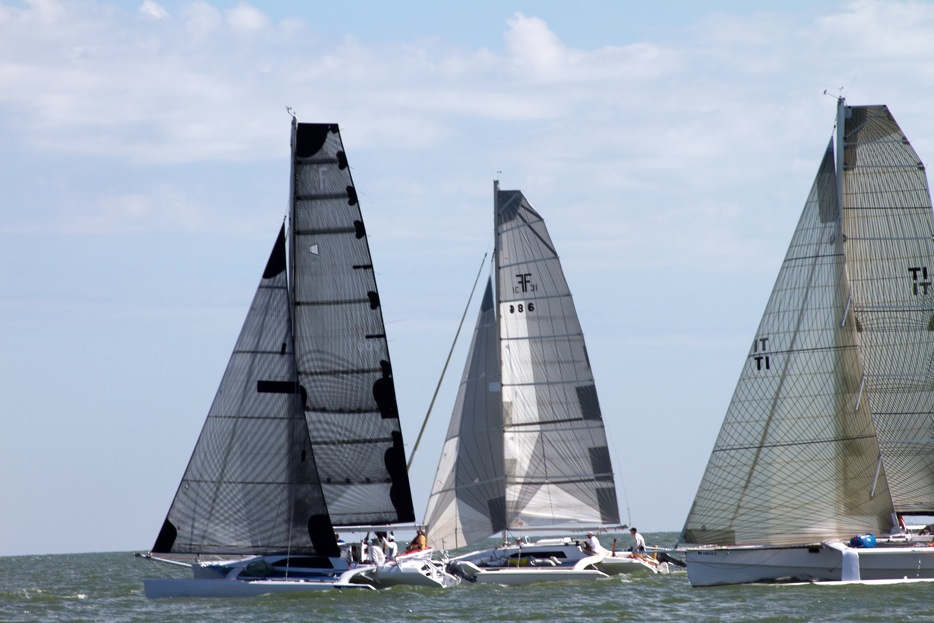
Whats with the mobile home sponsor? Doesn't seem like good marketing <img src=
alt=
/>
Although the DUO 1100 looks interesting... <img src=

alt=
/>
I think the same company makes both the boat and the mobile homes.
Jake lets go halvsies on one of these bad boys.
I was talking about the bows on the exploder 20 cat that was pictured on their site.
Sorry there, I didn`t notice this thread had migrated into a discussion of two different boats, thought we were all discussing the tri.. Perhaps I should read the header of each post more often.
On the flip side, if you`re worried about the bows going in on the cat, maybe you could just ask them to add the lifting foils ? Or am I the only one who thinks this might be a feasible thing to do on a beach cat ?
I'm pretty sure I see the slot for that board just between the
n
and
s
. I really like the concept behind this boat - but I wonder how difficult those boards are to work with when they are so low on the outside of the hull like that. I'm willing to be they have some ingenious line to control that board.
Well spotted Jake - I was looking much higher on the hull side, above the name. Didn`t expect them to be so low. Would you need to pull them up and down while sailing, or would you just put them down and leave them there for sailing, only pulling them up for beaching ?
I have no idea - my concern would be getting a big bugger on one during an Atlantic Crossing while it's blowing 30 and having to clear it.

Yea but look at the boards they must be close to two meters in length... <img src=

alt=
/>

Well spotted twice.
The bruce foils are in a very horizonal angle and seem to have no raising/lowering controls. My guess is that one would trapeze out to insert the board and move it, like they do in boats like mine to put the boards in place (although we have lines to control the boards). Those foils have to be reinfoced (= heavy) to withstand important bending loads, so the task is far from easy.
All that said, I really hope they succeed. A self righting foiled tri would be the first multihull to have real potential to send monohulls to the museum, from dinghys to maxiyachts. So lets think positive:
I hope they figure out a better way, but if everything else fails, explosive pins could solve the problem of releasing the beam locks.
The most difficult remains the system to fold the amas under the capsized boat in order to lift the mainhull out of the water.
A solution I figured out would be to lead both (syntetic) shrouds to the mainhull, where an electric winch would tension them simultaneously. That would require a strong mast, with extra stays. And I am not sure if it would work. Any other ideas?
Are there any realistic and tested alternatives to their righting method? How long a Solo~Right would you need to right this one Gary <img src=
alt=
/>

Why could you not pull them up by simple pulling them
or via the mast, pulling them towards the mast with the attachment only at 2 mtr [7ft] high
or via the mast, pulling them towards the mast with the attachment only at 2 mtr [7ft] high
The load is maximum during the first ten or twenty degrees folding, when we are starting to lift the mainhull and tramps (together with the water that entered the mainhull), from the water surface.
Now that you mentioned pulling the amas together, I guess the best way to do it would be with a pulley connecting the shrouds about 2 o 3 meters high. The mechanics of this system guarantys maximum tension in the shrouds when the pulley starts to be tensioned, exactly when we need it. Later, as the shrouds are deflected by the pulley, the tension is progressively reduced.
I'll try to sketch the idea and post it.
Don't get in front of the pins when they explode. Do we have to wear flack jackets?
GARY
That sounds alright. Pulling them together from the chain plates would probably work, although it would be an unstable geometry (a trapezoid) and would move around a lot. The risk would be damaging something with the whole boat twisting around uncontrollably.
Unless you only moved one ama at one time and then could lock it in the up position somehow.
I'm getting fatigued and ready to fall overboard just thinking about doing all this stuff, especially if it's a pulley system.
Let's see a video of it working before we speculate any further and commit the idea to the bin.
actually, if you were doing this, you WOULD be overboard...but I second the vote for a video.
Also in favor of a video.
The attachment shows a system that should work.
A pulley between the shrouds and another between the amas.
The geometry makes the first pulley extra powerfull, which is necessary to sink the floats and lift the mainhull out of the water.
The attachment shows a system that should work.
A pulley between the shrouds and another between the amas.
The geometry makes the first pulley extra powerfull, which is necessary to sink the floats and lift the mainhull out of the water.
So the mainsail would have to be down? I didn't really think about it, but that alone could be very tricky on a capsized tri.

Luiz,
I want to know who is going to swim down to pull the red pulley? <img src=

alt=
/>
Mike Hill

Beat me to that question Mike! <img src=
alt=
/>
Clayton
Godd question, I didn't think of it.
I guess the shroud's pulley would be almost aft of the mainsail. The risk of tearing the sail is reduced if the mainsheet is released, but I wouldn't bet a sail on this.
Without a vang one could pass the pulley under the boom. As the pulley is tensioned, the boom sinks, further releasing the sail. This would probably do the trick.
I guess this is a task for tha skipper who returns from the trapeze to the tramp to adjust the mainsheet... Or maybe for the crew who does the same to adjust the jib... <img src=
alt=
/>
Or run the line in front of the mast between the two shrouds...but it might have to be there all the time while sailing.
The mast could break if the chainplates for the shrouds are too far back (the pulley would make an angle in the mast) and if the boat is heavy, which would require more tension in the pulley to raise the mainhull from the surface.
Just thought of a different problem: if everything we devised works, the boat will not be righted, it will seat sideways.
After all that work, one would still have to stretch the amas again in such a way that the boat doesn't capsize again.
I thought the exploder diagram showed just that?
I didn't see it.