

I think enough time has passed for others to answer first and so I would like to give my own answer to this issue.
For a while I devellopped 2 designs next to one another a 3.66 and a 3.90 mtr long hulled design and I found the following to be the case.
The difference in hull weight between these two is 0.6 kg per hull and I don't believe you can really get a 3.66 made from less (sheets) ply then you can the 3.90. So from cost and weight point of view there isn't really any significant difference between these two hull lengths.
From the point of weight carrying capacity there is. That much had been explained in the initial posting. My design now both are buildable for 2300 Eur, incl. bought rudders/stocks and luxuries like ratchet block and Ronstan telescopic tiller extension, and the overall weights are 64.1 and 63.5 kg ready to sail. But both of these are conservative summations of the parts in weight and costs meaning that on both points the specs may be lower when actually build or when more attention is paid to weight and cost. The most interesting point is the overall weight. In my initial posting the platform weight was taken at 55 kg (the goal) and that boat could carry max 105 kg with some measure of performance (like a F18 with 180 kg crew). If that platform was really 65 kg in weight then the max crew weight would only be 40 kg. Something I think to be too low to make the boat attractive. Kids do grow and like this the boat would be outgrown with maybe 2 to 3 years. Additionally they couldn't really sail with a friend. The 3.90 mtr is much more forgiving when not build down to min spec. Afterall this boat allows up to 75 kg in crew weight if the platform was 55 kg. As such a 65 kg platform would still allow crews up to 65 kg would still include most teenagers.
From this perspective even 3.95 might even be more attractive, but I'm not sure if that length is wise in the way of storing the hull and transporting them over long distances. Pretty much 3.90 mtr is the max. if looking at those things.
But the most important issue with hull length is sail carrying capability. If I give both designs the same dive tendency then the 4.66 mtr. can only carry 7.0 sq. mtr by 5.3 mtr luff sail giving it a Texel rating of 145. The 3.90 mtr can then carry 8.4 sq.mtr on a 5.80 mtr luff and have a Texel rating of 132. Both sails have the same aspect ratio of 4.0
Simply increasing the length from 3.66 to 3.90 increases speed by no less then 13 points not because of the waterline length of the hull but because of the much increased resistance of the 3.90 mtr against pushing its bows under.
The 3.66 will be about as fast as the Hobie wave (= 3.98 itself) and the 3.90 will be faster then both the Hobie wave and the Hobie 14 (= 4.23 mtr).
My lastest design has a 9 sq.mtr sail on a 6 mtr luff and has a Texel rating of 128. I don't think the design can be pushed any harder than that. But as such it will outperform all other cats of 14 foot and less except the F14 by Darryl Barret. This includes the Wave when fitted with a jib sail and also the Hobie Teddy and Hobie Twixxy when sailed at 65 kg crew weight. And it will beat mono's and skiffs like the 29-er and Tasar. I believe this show cases the catamaran design to new sailors best especially considering the increased stability of the design with respect to mono's.
But more interestingly if the design is sailed with a 7.0x6.0 sail (kids rig) and a 35 kg crew then the rating will still be 127. In effect we can make the kids version and teenager version perform the same by adjusting the sail area. Reducing the sailarea for kids has the extra benefit of reduce the pitching over the bows significantly making the boat less intimidating. As both sails use the same luff length they can both use the same mast and also the same boom. I've read up the laser experiences with different rigs and that shows that using the same luff length is most attractive from a sailing behaviour point of view.
The added benefit of this 7.0x6.0 kiddies rig is that the laser 1 dinghy also has 7 sq. mtr. sail for the above 70 kg sailors. In effect this showcases the cats at their best as well. The kid can sail with the adult laser rig if it were fitted to the F12 AND handle it well. One could even put the laser rig on the F12 if one really wanted to or had one laying around the house.
Another benefit of the taller masts possible on the 3.90 long F12's is that in light airs they keep performance MUCH better as the top of the sail will be pointing into the higher airstreams that have significantly more windspeed. At winds under 5 knots the windspeed increases linearly from groundlevel to 5 knots at 10 mtr up. This means that the top of 6.0 mtr luffed sail (6.4 mtr mast) sees 30% more saildrive in the top then the 5.3 mtr longed luff. As such it will still perform well in the really light winds that will be frustrating to shorter masted dinghy sailors like the laser 1.
As such this longer hulled F12 just works out alot more interesting then one at 3.66 mtr.
I think this to be very important to the teenager and adult part of the F12 as then this boat will really teach them to sail by apparent wind a first feature that needs to be mastered if one wants to sail high performance boats and start gybing downwind instead of running square downwind. We all know that gybing downwind is more interesting then running square.
So both on the mechanical parts as well as psychologically or even marketing wise I think 3.90 mtr works out significantly better then 3.66 mtr.
As 3.90 = 12.8 feet I think we can still call it F12.
Wouter
I would call that a Formula 13. Or maybe they could sail in the Formula 14 class. IMHO, a Formula 12 should have 12 feet (or about 3.6 meters) as the MAXIMUM for the class. If you are going to have a Formula 13, then even the Wave could sail in it.
Also, weren't some talking about the boat being cartoppable?
I think there is a major disconnect here between the concept of Formula 12 and the concept of designing a new boat for young kids. <img src=

alt=
/>
In this post I wish to reply to the points made by others.
Gareth
The 3.66 mtr hull will only be 0.555 kg = say 0.6 kg lighter then the 3.90 mtr hull. I worked that out with the design software. So in total the longer is 1.2 kg heavier overall. So this can not be a major point.
Making the hulls wider is a solution to getting the weight carrying ability both together with the severe limits on the sail area that can be carried because of pushing the bows under it will be slower then the Hobie wave and even the laser 1 dinghy. That are serious considerations.
--------------------
Dermot
The boat will never be build out of less then 2 sheets of ply. An additional sheet of ply is less then 50 Euro's including taxes. The difference in area between the 3.66 and 3.90 is 0.157 sq. mtr. per hull. That is 400x400 mm. This suggest that unless the 3.66 only just fits into 2 sheet then the 3.90 can be made from 2 sheets as well. I think both can be made out of 2 sheets, but a more in depth analysis must still be made here. But for an additional 50 bucks (shipping is already paid on the other 2 sheets) I don't think having to use a 3rd sheet is any serious obstacle.
12ft = 3.660m, so I would go 3.7m max, I wouldn't go anymore than that, it will start getting further from the objective if you go more.
I don't think theres any need to make them comparable to F18's, F16's or whatever to terms of performance, remember theres a lot of things that they have that this F12 won't.
Regards
My objective to have a design that can also be sailed by teenagers and small to medium adults and not only kids. The reasons for this is that kids grow into teenagers and adults and they won't rif the bike with training wheels for more then 2 years either. Also it is must easier for a parent to justify buying / building a F12 is he (she) can sail it himself as well. Additionally I want to be able to have kids sail the boat doublehanded as well. And I would really love to see this boat being sailed on an apparent wind policy. All these points are much better serviced by 3.90 then 3.66 mtr.
With respect to comparable to F18's and F16's, you misunderstood my point here. The F12 is not, with the possible exception of teaching sailors apparent wind sailing. What the comparison to f18 was intended to show is that a 35 and 50 crew on a 3.66 mtr F12 will perform relative to eachother as an F18 sailed at 115 kg and 180 kg. Meaning that even relatively small weight differences in the F12 will result in performance differences quickly. This is not something older kids and teenagers will appreciate very much after they learned to sail it. Young kids may not care at all but when the grow up in only a few years then they will care. At 3000 US or 2300 Euro investment the F12 better be succesful in keeping the kids interested for more then 2 to 3 years.
I’d guess drag is not the big challenge as short boardless cats are a much more difficult to tack, especially without a jib! Rocking horse effect is another matter. What makes you think this design will be any different?
Ease of tacking is an essential element in training new sailors and one reason why the Opti is so popular (less run away boats!).
I suppose a hull design using ultra low profile boards would be make a major difference in the handling characteristics.
Different style of rig and as of yet I'm not using skegs on the hulls. This F12 is much more like the Supercat line of boats (like SC15 and SC17) then skeg boats. Without the skeg the hulls should tack noticebly better. Additionally my F12 isn't using sharp V-ed keel lines, it is much flatter on the keel. The rig will move forward when releasing the sheet and move back when sheeting tight. In effect the load on the rudders will be less during a tack when the sheet is released. The movement is the result of the flexing of the mast and not of any mechanical setup.
Currently my version of the F12 doesn't have a trapeze and I'm not looking at adding one. This makes quick tacking alot more viable thus spotting shifts and tacking is a more serious consideration then on a larger cat.
Ultra low profile boards are called skegs I think. But indeed short permanent stubs can put on the keel. Running a ground is not a real problem as short stubs will be very strong. But as of yet I want to try the no skeg or stubs approach. Afterall the Supercats aren't regarded as slow boats.
By the way, has anybody ever heard of a
shoe
? An exremely low-profile
keel
that has been used on cruising catamarans? When I say
low profile,
I mean it is only a few inches deep below the bottom of a 35-foot-long boat. It has kind of a fat, upside-down-T shape. The boat we sailed pointed very well with VERY little leeway, and it tacked on a dime. Would that work on a smaller boat, too?
I sailed several hobie cats that had them. The Pacific (rip-off tiger) was aweful to tack. The shorter versions like the Dragoon where actually quite alright in tacking.
I spoke offline to another forum user, who to is interested in introducing a more modern 12ft cat for trainers, for their junior fleet, as we had said earlier, we would prefer and his own kids would prefer to have the option of a trapeze, and probably an optional jib to allow their friends to continue to sail with them after they get the hang of it. We didn't really discuss hull shapes or profiles, ...
Regards
The paper tiger is long still and by much more then the 3.90 is longer then the 3.66 (compare 240mm to 370mm). But the F12 I see it is not so much different in the hulls but in all other things like the rig and the dolphinstriker less mainbeam, not having stays and the sleeved sail. As such it will always be much different (and I suspect much simpler as well) then the paper tiger and Arrow. Afterall the Paper tiger is also a VERY technical boat to sail with the baby stays and such. I don't think your comparison does justice to what we are really looking at here with the F12.
Adding a trapeze involves alot more then just adding a steel cable with a handle and ring. Most inmediate result will be that the mainbeam will have to be fitted with a dolphinstriker setup. And more volume needs to be moved to the bow to prevent the boat from pushing its bows down under the increased sail forces. In effect having a trapeze on the 3.66 mtr hull is having the worst of both worlds. I'm not writing off the trapeze completely but there are a few very serious points arguing against it. One of which is my own experience with the Hobie dragoon. At 80 kg I couldn't trapeze as it would immediately put its bows in. To kids at 40 kg trapezing would have nearly the same result. Also the trapeze is serious obstacle to quick tacking on shifts (coaching ?). I'm far more interesting in making the boat a little wider then adding a trapeze. Also we musn't forget that the F12 sails are much smaller in area and luff length. It will require alot of wind to even have to trapeze.
Wouter
Yes, isn't this far more determine by platform weight then length ?
Currently the platform (now rig and rudders etc) is 40 kg with stirdy hulls. Again a optimist hull is 35 kg and alot of parent car top that.
Please elaborate.
But also note that from the beginning a large part of the group didn't specify YOUNG children as the target group while another part did. Personally I don't see much point at all in having YOUNG children (6-11) singlehanding a sailboat. I think they much rather sail doublehanded and even a much smaller boat like the optimist isn't very suited to them. And then to top things off they grow into full sized (thrill seeking) teenagers in the span of only a few years.
If the F12 is aimed (solely) at young kids then it will be a bad feeder into larger cat classes as they will come off it at age 12 and 50 kg which is too young and light for the larger cat classes like the Hobie 16 etc.
Even you yourself wanted to sail an F12 to catch up with the kids on their waves. That is impossible if the F12 is optimized for 6-11 year olds. You will need a powerboat to catch up with them then.
All that for only 10 inches difference in hull length. I'm not sure if that is a wise decision.
Wouter
That is an excellent post John !
Good info. I can really use that.
Can you elaborate on that please.
Why is too much too handle ? What are the problem points ? What goes wrong ?
Wouter
Bear with me, I haven't had a play to work the quote jigger on here, but I refer to the reply a couple of posts back to my paper tiger/arrow post.
I think you missed my point, Wouter. The original idea, I thought, but correct me if I'm wrong, because I am more often than not, was to introduce or design a 12ft cat, 13ft is around the 3.95m mark, etc..
I don't think changing the length of the boat is the answer, if it doesn't suit your design, or the parameters you set for yourself earlier, such as sail area, etc..
If I were to design a boat, then found it optimal at 4m would I be able to call it an f12?
I'm not trying to be critical, but goal posts seem to be moving.
And I have seen a young woman, I would estimate to be 50-60 kg, sail an Arafura Cadet competitively (i.e national level) and the boat had no problem with her being on the wire, and boss's son and a friend who owned the same Impara at different times, were on the wire as much as any other class.
Regards

Wouter,
I don't know if this has been discussed or if it belongs in this thread, but will the rig be without stays and similar to a windsurfer (obviously without the the universal joint) or more traditional? I ask because of ease of set-up. Also, the sail material for windsurfers looks sexier, and probably is, faster.
Thoughts?
Bill Nieuwkerk

I can reply for him. The stock F12 would have an unstayed mast like the class 5 land yacht. This is comprised of sections of Al tubing. Sort of like a laser mast. An optional configuration/mast would be to use a windsurfing rig. The front beam would have a stub that would secure the windsurfing mast.
It wasn't.
The idea was to have a really simple and inexpensive cat that kids and youths (like teenagers) could sail, thus providing an feeder class toward catamarans as the Laser and optimists are tp dinghies and skiffs. Later an extra was added after noticing that kids were more drawn to cats then mono's. Several posts by Phill and somebody else also refer to that.
The idea for a 12 footer was derived from the initial feeling that that would probably be a good length for such a goal.
Of course after doing numbers crunching one finds the initial parameters set for the project validated or not.
I think that is what happened to the 12.00 foot length with respect to the 12.78 foot length. The difference is still pretty small though. We're not talking about adding something like adding 2 feet. It is only 9 inches.
What are you trying to say here ?
There have been a surfboard brand that called itself F10, short for force 10 because that was when the real surfboarders went out. No way the boards were 10 feet long.
Maybe F12 stands for formula 12 as in ready made for 12 years and older. Give it some spin. anything will do for me. I'm just trying to get to be best design possible considering the goals. If that happens to be at 4.00 mtr then that is what I will go for personally. Sticking with 12 feet solely because that was our initial gamble at the hull length doesn't seem to be beneficial.
This is pretty normal when a design develops and may not be a bad thing at all. One gets more data on which to justify or disguard earlier assumptions.
Maybe after more info they move back again.
However my design goals really haven't changed much.
Maybe it is your expection of what they were that is now more clearly to be show to at odds with the goals.
I still don't really understand what the aussies around you (and yourself) want out off this design.
Maybe you can elaborate on that further and we can get to the bottom of this.
Can you provide me with the specs for the Arafura. As many as possible. I could find them on the net.
Regards
Wouter
Thanks Bob:
I'm assuming that the sail slip on like a windsurfer's sail and wouldn't require hoisting - correct?
Bill
Bill,
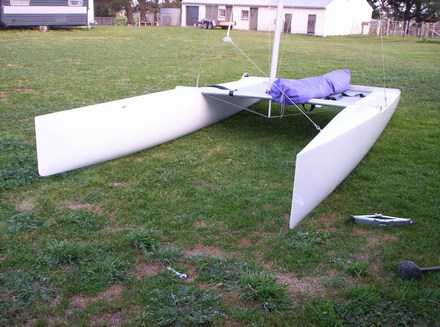
Is this good looking enough ?
![[Linked Image]](http://www.catsailor.com/bb_files/96611-fedart.jpg)
Indeed the sail just slides on.
Thanks for answering that question for me, Bob
Saves me time.
Wouter
Wouter - Yes it does.
While probably not important from a performance perspective, the material does lend itself well to hot graphics - just the stuff kids are looking for!!! <img src=

alt=
/>
Thanks for the picture,
Bill
Bill
![[Linked Image]](http://www.catsailor.com/bb_files/96621-F12_and_F18.jpg)
wouter
Nice!!!
This is where I thought (hoped) you were going with the design of the rig. Modern looks and easy to install.
Thanks for the visual.
You might want to check out these sails. This particular site will show the progression of Ezzy Windsurfing sails from 1994 to 2007...the newer sails have a much
cooler look
as well as superior performance. http:/
Regards,
Bob
Well what is F12 refering to then? One could only assume that F12 meant 12ft, F14 meant 14ft, F16 meant 16ft and f18 meant 18ft.
So maybe I should wait then til we work out what the 12 means, 12ft, 12 years or older, only sailed after 12.
I apologise then, I'll wait til you tell us how long the F12 is going to be.
Regards
Matt,
The F18 is longer then 18 feet. (by almost 2 inches)
The F16 is longer then 16 feet. (by 5 inches)
Hell, even the F20 was longer then 20 feet. (by an inch)
We'll have to ask Darryl Barret about how long the F14 TRULY is.
Agreed the proposed F12 is longer then 12 feet by 10 inches and thus relatively more then the others but still it won't be the odd one out.
Again, what are you exactly trying to say here.
Wouter
Matt,
I know the original intent was to build a class of boats 12 feet long for kids. However, it seems that there are some benefits in making it slightly larger which seems to make sense.
The only downside to making it slightly longer is definitional (Is it an F12 or F13?). If a strict definition were used in naming the class, what are the stakes or issues in calling the class an F12 or an F13?
Thanks!
Bill

I know the original intent was to build a class of boats 12 feet long for kids. However, it seems that there are some benefits in making it slightly larger which seems to make sense.
The only downside to making it slightly longer is definitional (Is it an F12 or F13?). If a strict definition were used in naming the class, what are the stakes or issues in calling the class an F12 or an F13?
Thanks!
Bill
Bill & Matt,
I agree the name is purely semantics, or has evolved to that point. I think tying this boat to the most current (developmental) and popular Formula catamaran classes, through it's name, (and class structure) is an opportunity to lend stabilty and flow of sailors to the larger boats. Not to say that any other boat (PT, arufa) can't do the same thing.
The H20 is 19.5 and H16 is 16.58, we're splitting hairs here. Issues? Can't think of any real issues.
F13 is not a good choice for name, IMO.
I won't consider the name F13 for as long as whole societies refuse to have a 13th floor in high rise buildings.
Wouter
and Wouter asked to make a choice, and reasoning behind our choice, of 3.66, 3.90 or 4.00
Will the water line length of the F12 be equal to its length overall? Waterline length is commonly used by some power boats to define length…On the huge SKA circuit (Southern Kingfishing Association) they have a 23’ and under class…but it goes by waterline length, not length overall…so some of the hulls end up being well over 26’ even though they are called the 23’ and under class.
If the bow of the F12 were a bit more sloped back aka “wave piercing” and had a transom that slopes forward, maybe you could steal a few inches of increased length where it counts, underwater. If somehow the
loaded
(that is including the defined designed crew weight)static waterline length could fall into the 12’-6” range (3.65 mtr) would that be enough to satisfy the group that is concerned about it not technically being 12 feet? That is, could they then be comfortable in defending the F12 as being rounded down to the next nearest foot?... which is 12 feet?
What we are really talking about is playing with words…Wouter has made a strong case for increasing the length to 3.90mtr, the numbers don’t lie. This is one of those times were it only costs a dime more to go first class (actually it's free)…why ride in the back of the bus? You can always “dumb the boat down” with a smaller less efficient rig.
By going to more performance oriented hull, the boat will allow a wider spectrum of users as Wouter has been saying from the get go. Simply by changing out the mast and sail…just like we do for windsurfing…each sailor could pick the right size and style sail for their weight, strength, and sailing experience. No one could gripe that they were being treated unfairly because everyone could choose exactly what works best for them.
To recap…a waterline length of 12’-5-19/32” (3.80), an overall length on the bottom of 12’-9-17/32” (3.9 mtr) the difference between the waterline length and over all length would only be 3-15/16” (.1 mtr) Surely a creative designer could tweak this design to get 4 more inches of length below the water line. We could have our cake and eat it too.
Regards,
Bob
Re using waterline length: For powerboats and bigger sailboats, it is an advantage to use the shortest possible length in their boat names, because they pay dockage fees and sometimes ferry fees based upon boat length. (I can picture a great cartoon for this -- like a DoubleX 23 that has a 23-foot waterline but is 50 feet from bow to stern. <img src=

alt=
/>
alt=
/>
Good point. We co-owned a S-21 Sea Ray Sorrento power boat. 21 feet, right? Wrong, 19.5 feet tip to transom but was taxed at 21 feet despite argument with State authorities. <img src=

alt=
/>
Girls at age 10, 32kg
Girls at age 19, 57kg
Boys at age 10, 32kg
Boys at age 19, 69kg
Interesting also at 13 years old girls and boys are about the same weight 45 and 46kg.
I translate this roughly into :
Average singlehanded crew weight Boys and girls 10 - 19 years of age = 50.5 kg's
As it is better to sail underweight then overweight the F12 should be optimised for 55 kg.
My 3.90 mtr design is now down to 65 kg when build light but stirdy (55 kg was/is planned) and has an optimal weight of 53 kg with a competitive range of 38 kg to 62 kg.
Of course it will carry ALOT more weight in a recreational sense.
I think the initial choice to develop a 3.90 parallel to the 3.66 is turning out to be a smart one.
Making the hulls out of unglassed 3 mm ply will make the platform around 58 kg ready to sail and make it have about 70 kg as max crew weight limit.
I seem to remember A-cats used to be made out of 3 mm unglassed ply so a shorter F12 should hold up if they did. Of course these would require more care when handling on the beach and trailer.
Currently I'm also below the laser-1 as cost price (that does include several bought items like rudders, sails, blocks etc).
I'm trying to get close to the optimist cost price. I won't be able to get down to the lowest cost price that is of the Topper dinghy as that is 2000 US$ and that is darn cheap but it is also as slow as a snail. So that is alright.
I've looked at little a rotomoulded materials and found some very interesting info from a knowledgeable source.
If these F12's are ever mass produced then I starting to prefer Twinex and corematt material over rotomolded. Stiffer and is more durable over hard use. With core matt I mean two layers of glass on either side of a layer of sprayed on resin with 50 % microballs. Should be the same weight as ply I think. Please correct me if I'm wrong here anybody !
As the middle layer is resin itself (no foam) the hulls should both be impact resistant and stiff. The latter because of the glass fibre cloth on both sides.
Spraying should really cut down on labour costs.
Wouter
Reading the 58kg is your target weight for prototypes, shall we go ahead and make orders today for 3mm ply?
Allowing a few weeks for delivery? <img src=

alt=
/>
I have not been able to figure out what weights of the kids have to do with anything. <img src=
alt=
/>
Well,
I think I've got it all done now. Last items seemed to have come down pretty quickly. Of course building the prototype is alot of work but the basic design is pretty much done. I even got some tricks that could allow making the hulls lighter, just in case. I also was pretty conservative with the weight calcs so you can drop some extra resin here and there.
I even got the costs sorted out to a large extend. If you really want to save cost then you have to build your own sail. Paying a sailmaker to do it for you at 610 Euro's is quite alot when the basic boat without a sail is only 2250 Euro's. And this last quote still includes the dotan rudders a 712 Euro's. If you are going to build this yourself then the ready to sail boat could be as inexpensive as around 1500 Euro's (1950 US$).
When you got more stuff laying around like blocks and shackles the price drop a little further.
I guess that soon the next stage will be to prototype the hull in cardboard at a 1:4 scale, trying to find the right panel layout and then prototype it in real life size.
I think the panels can be twisted quite alot, this should improve hull shape without having to go to compound curves or steaming the ply. It will allow a more pronounced V on the keel at the bow and have it run much flatter near the sterns. But also the sides can twisted a little bit to give hull a raked back bow and a modern wavepiercer bow section. And ofcourse the sterns can be twisted in a little bit as well if that improves looks. The deck is just curved in one plane, should be easier to close the hull off that way.
Yeah I think that with a trick here and there a pretty nice multichine hull can be made. Still I propose a square box shape like the arrows and arrafura's to test the rig and mast setup. These need to be prototyped first to see if the design works as intended. There will be no need to start right away on the more complex (and better looking) hull.
And then spend some time working out the right sail cut.
Wouter
Made a mistake here. The Topper is sold at 3294 USD in the US.
The cheapest dinghy in the US is the optimist from vanguard at 2450 US$
The Byte dinghy is the second cheapest in the USA at 4000 US$
The come the laser dinghies and the more modern boats like the 29-er. I haven't found any US specific quotes on that.
Also, does anybody know what a new Hobie Wave or Hobie 14 costs in the USA ?
Wouter
2006 pricing - Bravo $2,800, Wave $4,400
The 14 went out of production in the US quite some time ago.