
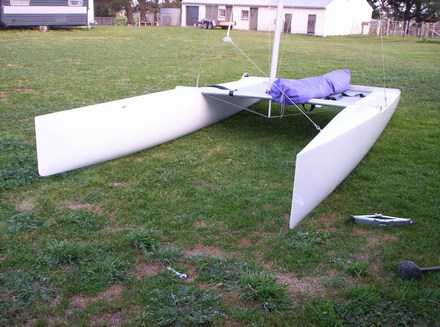
Righto, go your hardest!

Can I get a scuba set with it? <img src=

alt=
/>

Folks,
The simplest and easiest ply hulls you can build would be deep skinny symetrical bannana shaped hulls.
No c/b and no skegs and bugger all tooling up.
Windrush produced a 12ft surfcat in glass with spade rudders that sailed quite good (even upwind) with this style hull and the kids at my sailing club and some of the parents used to have a ball on them. Sometimes sailing 3 up.
Dead simple to do in wood.
If I was doing it in timber I would glue 2 lengths of ply to a 2 inch wide keelson of cedar.
Halfway up the hull sides would be a stinger each side full length.
Cedar props between the stringers to give only slight curature. (As perfectly flat panels are not very stiff.)
The deck would be sold foam with a layer of glass laminated underneath. Shape the top of the foam to a preset deck curve and a couple layer of glass on top.
This would not only be a deck but also provide floatation.
The way you shape the deck will dictate how asthetically pleasing and modern the boat looks.
I've not done the calcs but my guess would be maybe 12kg per hull. Just a guess.
One off would probably take several weekends but if you set up production line style you would probably average a pair of hulls per weekend.
Quick , easy , dead simple and dirt cheap.
BTW:- As the panels are essentially flat you could build these from any material you like but some materials may need a bit of tooling.
Regards,
Phill

I started sailing on a 12 ft surf cat(windrush) When I was still in nappies.
31 Years later I got another one($250)and took my two year old out on it. The one I started on (sailing every school holidays) is also in the back yard. These were great boats. I have two boys 3 and 1 and the boats are there waiting.


On the subject of simple fast build hulls, this is something I put together this time last year, never got round to making it, maybe I will this year. The idea was a 10ft boat hull that could be built from a single sheet of 3m x 1.5m ply, it could easily be scaled up to an F12 , in fact I have a parametric CAD program that will produce drawings of any size you want.
![[Linked Image]](http://4hulls.googlepages.com/F10.gif)
The hulls are asymmetric and shouldn’t require a daggerboard. The nice thing about it was the minimum amount of cutting required to make the panels.
The attached PDF file is a hull template that you can print off and make yourself a model. The two sheets contain identical panels, just layed out on the sheet in different ways. The first sheet is meant to show that the same cut produces both side panels, i.e. two sets of side panels (for two hulls) can be created with just 5 cuts instead of the usual 8.
The second sheet is to aid model building out of a material that can be folded such as card or paper i.e. the three horizontal lines in the centre of the panels should be folded not cut. All the panels are flat with the exception on the four outer leaves of the side panels which require some gentle bending.
Print it out and try it <img src=
alt=
/>
http:/
Gareth
www.fourhulls.com
Some more views
![[Linked Image]](http://4hulls.googlepages.com/F10_front.gif)
![[Linked Image]](http://4hulls.googlepages.com/F10_side.gif)
![[Linked Image]](http://4hulls.googlepages.com/F10_top.gif)
![[Linked Image]](http://4hulls.googlepages.com/F10_tri.gif)
And an edrawing file that you can view a 3D CAD model with a free download from
http:/
http:/
Gareth
www.fourhulls.com
The beams would spend a lot of time trying to drag extra water up wind.
Smaller Paper Tiger would do job and use less than one sheet of ply amd beams are just box section bolted.
This desgin could easily be shrunk to ten or twelve but realy we want to use what advances are appropriate since '75.
I have been thinking about this alot and talking to an older neighbor who usually has alot of good ideas about alot of stuff.
Here are a few things that he pointed out.
-The boat must be simple ( we already know this, but simple to us isn't simple to a mother trying to put this boat together for their kid.)
-The boat needs to be storeable in a very small area. And it needs to be able to fit through a gate so that it can be put in a backyard very easily.
- It doesn't have to be fast, just give the sense of speed. Also it needs to be able to be sailed in very shallow water.
- Every connection needs to be done with the quickest thing possible. No pins and split rings, they are difficult to use for anyone with bad eyes.
-The sail needs to be rugged. If it gets left outside for a couple of days it still needs to be okay.
-If we are going for car toppable then we will have to make sure that a rack is made that is very easy to use.
He has some other ideas and comments about the idea of a small cat. He has a few grandchildren and said that if some company starts making this boat he would be willing to buy one or two. Granted he has alot of money and likes to spoil his grandchildren but I think more of these would sell then some people think will be.
Thanks Gree2056,
I've not mentioned how to transport the F12 yet but it is under consideration.
I would really like to keep the hulls, beams and tramp attached at all times as then rigging and unrigging will be very easy indeed. I'm hoping that a 12x6 foot platform will be small enough to be left fully assembled. It will pass through a gate I'm sure, especially if the gate is low and the boat is on top of the car. <img src=
alt=
/>
Seriously I'm thinking about a setup where the dolly remains under the sterns of the boat while it is loaded onto and off the car. The bow can then be layed on rollers fitted to the roofrack and the boat can be push onto the roof by the rearbeam while lifting only 15 kg as the bows/rollers carry the other 15 kg. In the garage the platform could be hoisted to the roof with roofrack remaining attached.
Stuff like that. It is under consideration.
Again the rigging is very simple, currently there are no pins or rings. Blocks stay on the sail and boom and you only need to run the sheet through the blocks after stepping the mast with sail.
Plain dacron will hold up for many years despite heavy abuse.
Wouter
Actually what I meant by getting it through a gate is that these people who buy the boat are going to have to store the boat somewhere. In alot of neighborhoods they do not allow you to store a boat beside your house, so most people will have to store it in the backyard. A boat on a trailor will not go into a backyard. I was thinking that this boat might break down in to something pretty small but after thinking about that it makes things a mess during assmebly.
I like the rollers idea, that would allow almost anyone to haul the boat. What made me start thinking about the transport was the kids that live across the street. Their mother is raising them alone, she is always hauling them around to soccor games and what not, so if she is willing to do that she and other mothers would probably be willing to haul the boat out to the lake. Single mothers have to be able to get their kids on the water without much more trouble than they take them to soccor practice.
If this boat is really going to take off and kids all over start sailing it we will have to think out every angle.
I am glad to see people working on this. More people out on the water will create a higher demand for performance boats. Hopefully this will cause some companies to create inovative new designs.

I think that a 12ft version of Jon Montgomery's Catapult would be very suitable. It would be quite narrow with the hulls deflated, but not taken off the beams. A quick pump, mast up, sails on and away you go <img src=
alt=
/>
This is quite a fast design - I used to beat Condors and Hobie 16s to the windward mark, racing a standard 5m Catapult. http://www.catapultcats.com
So everything we say keeps coming back to these inflatable cats. Is that the way to go? It would be really nice and be super light and simple. But for some reason I don't see it winning over tons of people.
Also the aquacats might be okay. I know they look so bad they don't even catch crap on here but when push comes to shove they are cheap light and easy, maybe a different rig on one would do it.

My interest in building from scratch is land yachts. Something that could be built and used during the winter. The more I thought about it the more I realize I'm a warm blooded person. And if it's warm enough to sail, may as well be on the water.
For me building a three sailed boat is somewhat selfish, cost prohibitive, would end up not being finished before summer, and probably not a smart move for someones first boat. But a simple 12 footer seems doable.
I've got enough parts laying around for a rudder system. I see the sail as the largest single item expenditure and I'm hopeful to be on the water for less than $3K.
I think aiming for three thousand is a little high. What if we started shooting lower. I understand that the sail and other hardware is going to be expensive but it seems like this thing could be built cheap.
Here a first part listing.
I made this to get a feel for were I was in the way of weight, but it may also give you some idea of the costs shall be.
It must be noted that I have 0.5 kg reserved for shackles, rings and other chandlery stuff. However at this moment my design has not used a single one of these yet and it is pretty far developed. Amazing what you can do with lashings, beads and figure 8 knots.
The only part not further specified are the hulls themselfs. I really don't know how much money is involved there.
![[Linked Image]](http://www.catsailor.com/bb_files/95376-F12_parts_listing.gif)
25 kg for everything other then the bare hulls. We are on a right track here. I think I can reduce the weight of the mast a little further as well. But I'll have to check that.
Wouter
Wouter I would like to say that what you are doing is impressive.... but remember we are going to have kids sailing these things. Those hulls are going to be very light which I hate to say it but light hulls are usually not as tough as heavier ones. I am not saying that they couldn't take racing and stuff like that but I am not very far gone from those younger years and I know that kids are hard on stuff that they own.
You are corrert of course.
At this time my main focus is to get the stuff other then the bare hulls as light as possible. Any savings here can directly go into heavier hulls.
I would like to make the hulls out of glass layers and core-matt material. Looked briefly at twinex, but just like rotomolded hulls these are practically out of the reach of homebuilder or even a small company make a small serie of hulls (start-up)
On the other hand, don't underestimate the strenght and dent resistance of 4 mm ply on such short hulls. Especially if covered with a single layer of glass it will be surprisingly abuse resistance. I'm sorry to say that my crew did test that aspect on my F16 with her trapeze hook. Hitting the deck with the hook first will all of her weight and then sliding off with hook scratching at the deck still carrying all her weight. Now she is pretty light 58 kg I think, but still the damage was mostly visual. I now have a 100x5 mm scratch on my decks that you can feel be moving your fingers over it but the true depth is probably only 0.5 mm. The boat is fine beyond that.
It is also my intention to cover the keel line with a strip of aluminium to prevent wear of the hulls being dragged along the beach and stiff. With a V-ed keel this should also protect the hulls against most submerged rocks. In addition I'm looking to make the hulls easily repairable so small holes are hopefully not a serious issue.
And at some time we have to trust the kids not to use the boats as bumper cars. I've seen 8 year olds being exceptionally attentive to optimists overhere. I guess it all comes down to how you raise your kids. Lasers and optimists aren't bullet proof either.
And like I say all though this thread. lets give it a try and see how it works out. There is no point in giving up on something before you really do know whether it will work or not.
Everybody keeps saying this and that won't work, but do we really know that ?
Wouter
I don't quite understand why, if you are coming up with a whole new design that is for children, you would want to make it a Formula instead of a One-Design. One key to success for kids' boats is that all the boats be identical so they know success is dependent entirely upon their skill, not on their boat being a little bit better or lighter or faster than the other boats.
And since parents will be building the boats (theoretically), it would just become an adult competition to see who can build the fastest boat. How does that benefit youth sailing? And wouldn't it be sending the wrong message to the kids?
And since parents will be building the boats (theoretically), it would just become an adult competition to see who can build the fastest boat. How does that benefit youth sailing? And wouldn't it be sending the wrong message to the kids?
That is an excellent point Mary.
I'd envision a scenario such as this. A group of sailing club parents pick a home build design of a degree of difficulty they want to attempt, within a certain budget, such as a simple cookie cutter design, of hulls being built over a weekend specifically for the purpose of having three or four similar boats for the youngsters, within that club, to play with.
As you have eluded, nothing is keeping another group from expending considerable effort and time in building a more complex design.
That in itself precludes the two neighboring groups from getting together for a competition. Wow, we're really taking a LOT for granted here and moving this forward quickly.
As one primarily on the side lines of this I can only hope for a hull design that is modern and performance oriented, but is easy to build, definitely that is a trade off.
I can also predict some argument here on the degree of difficulty involved before a first
kit
, if you will, is decided on.
What is to preclude naming specific hulls, and emphasizing not letting adult thinking to spoil children's competition, allowing competitions to be of specific kit designs within the formula? A part of class association rules? Possibly the box rule can somehow limit physically the capability of the hull, i.e. large radii and such? But how would you measure this? Is there a
junior
F12 set of rules and an
open
, traditional, developmental, F12?
Whew!!! Again thanks.
This is easy to answer.
For the sake of the argument I shall not press home the point that the F12 is not specically for kids, but more for any person in the range 40-65 kg. This will also include teenagers and small adults.
But back to just youths.
One-design boats simply aren't fair to youths.
First of all how One-Design are youths anyway ?
If they aren't then why should the boats be ?
Allowing some freedom in adjusting the stiffness of the rig and sail cut will allow some of the inequalities between kids to be corrected. It has been shown many times that the classes with the highest sensitivity the crew weights are the OD classes.
It is in my personal opinion a downright myth that differences in material (under formula rules) are significant when compared to differences in crew skill. It is incredibally easy to show how different designs result in maybe 1%-3% difference in performance while differences in crew skill will easily result in up to 30% difference in performance. And we should not forget that aging boats will sails older then 2 years will also be about 1%-3% slower around the course. In short, if your kids needs to sqeeze out those last 1%-3% of performance then he needs to by new gear every two years anyway, irrespectably whether he is sailing in a formula class or OD class. If that is the case why then accept the downsides of OD classes which are :
-1- expensive replacement parts, sometimes even of mediocre quality.
-2- not allowed to source your own (local) suppliers of parts or make them yourself.
-3- no continued (but slowed down) development, meaning the class will grow outdated in 10 to 15 years time.
-4- less builder support as only one builders needs to do everything. Why do formula classes come up so strong ? Because several builders and suppliers are pushing it in one coordinated effort.
-5- A nightmere scenario when having to check boats for compliance at events. EVERYTHING needs to be checked.
-6- Either the design is very good but impossible to homebuild or it can be easily homebuild but everybody is sailing bathtubs.
-7- OD doesn't allow quick and dirty homebuilds to allow easy and inexpensive acces to sailing.
-8- Problems when US builders are not using the SI unit system. Is 1/16 steel wires the same as 3 mm steel wire ? Ask the Hobie 16's how such a thing lead to a right protest frenzy at one event. At one event in the 80's the crews were checking eachother boats with caliphers trying to spot US stays and protest the owner out of competition. That will be a good behaviour for your kid to learn.
That may be true to some small extend, but how is this different from your kid chosing the right tennis racket for himself or the right mountain bike or even the right track shoes or skis/snowboards?
Why do we in sailing land think that chosing the right gear for your body setup and preference shouldn't be a normal part of competing ? In by far most sports it is. A top level tennis player will replace his racket 4 times during a game ! If you choose the wrong mountain bike gear setup for the course then you have a problem.
How many one-design cycling events do we have ? If you go and play tennis, do you make it a point to play with the same racket ?
As such having to choose and optimize your gear to suit your body and way of sailing is actually sending the right message to your kids.
And it does benefit youth sailing by being.
-1- cheaper
-2- better available
-3- better developped
-4- better promoted by a bunch of builders (future)
But I think that this has been discussed many times over Mary. You do seem to ask this question a few times a year.
Doesn't the wave class allow different mainsails ?
Wouter
Thanks Wouter,
Something in the back of my mind was saying how could only the hull shape have that great a significance in speed, when weight and size of the sailor will be varying wildly.
Of course us adults can get all wound up in thing such as whether 800, 1200 or 2000 paper is sufficient for our boards, when the nut on the tiller has exponentially more affect on performance.
OF COURSE, we do. The Wave is a one-design boat. So just as with most one-design sailboats, you can get your
motor
cut flat, medium or full to accommodate your crew weight and/or your normal sailing conditions.
I don't see how that has anything to do with modifications in platforms.
You have an opportunity here to create a little, one-design catamaran for kids, that ALSO can have sails cut to suit weight -- just like the Tornado. And the home-builders could make their own sails, too, and try out different fullnesses and shapes within the class sail measurements.

I understand both points of view on this issue, but think that if you are going to get parents and more particularly yatch clubs and kids racing programs involved and
buying
into it, OD is probably an easier sell than a formula approach. The Tornado itself is still a development class, just with tight restrictions as to the development progression. The hull shape is closely defined, but there is around a 5-10mm varience that can be used to alter the shape and performance of the hulls. As to the fact that 99% of the boats raced are from one builder, it is virtually OD. Back to the point though, OD for class development is an easier sell to youth programs.
I wonder if that is the variance allowance that was put in the original rules when the requirement was that the catamaran for the Olympics would have to be able to be home-built. Obviously, it would be more difficult to build a boat in your garage to the same tolerances as in Marstrom's factory. So maybe they allowed a little slack in the rules for the people who could not get their plywood bent quite to the right shape?
We need to decide what group we are aiming for. I have heard everything from youths to teenagers and small adults. IT will be hard to market to both of these groups.
As for OD vs Formula, just think about it if it is OD. Some kid buys this boat cheap and has to replace some worn out part. To buy this part new costs 100 dollars while he can go out and find one that works at the local hardware store for 15. Now he can't race, that isn't what we want. I have heard horror stories of people being turned away from Hobie events because of tiny little pieces that didn't match.
Also I think that a glass over ply seems like the best idea and with the strip of aluminum along the bottom of the boat it should be fairly resistant to most things.
No, no, no. <img src=

alt=
/>
Don't confuse one-design with one-design-single-manufacturer. Those are two different things entirely.
Interesting thread but I'm not sure that it will catch on. Kids want bang for bucks, that means hopping onto a fully rigged boat and stepping off at the other end, now you and I think that may or not be the case but from experiance of the kids of today, thats the sad truth. If the set up time takes longer than their Play Station then you are onto a loser. Parents are mainly to blame as we have become so used to a service led society that with our too limited spare time, we want to just get out there ourselves and pay somebody else to teach our kids.
As much as we would like to think that people will spend many hours building a boat I can tell you that only the dedicated parent will make them and he / she will be mainly in it for the thrill of
making the finest and best design
he can, which lends nicely to the freedom of a Formulae class. Kids are going to be only the end user product of a parents desire to build a boat.
As to halting the general decline in sporting activity in our kids then I'm afraid we need to look at our lifestyles first, sort out that and give ourselves more time to paricipate with our kids and I would bet that the kids would then be willingly to go sailing as there are a lot of good times to be had whilst sailing.
gree,
Check the parts list. The Dotan stocks and rudders will be about $1K or better for the pair. A new sail may be $800. All will add up fast. Conversely, I have several Hobie rudder assemblies from dead boats, will they be as easy for a ten year old to operate as Dotans? No, but they're
almost
free. Some searching the windsurf clubs may net a suitable sail for next to nothing as well.
You're right, it could be built cheap.
I understand that the stuff will add up fast. But if this boat is going to be a boat for the masses then it has to be cheap!
The designers of this boat need to aim very high (low price) that way if you miss the mark the boat is still cheap.
This is what needs to be done if the boat is to be successful.