

Just finished the weight study for mine with the foam/glass panels and I'm looking at around 53-54 kg.
Cheers
RG

Just finished the weight study for mine with the foam/glass panels and I'm looking at around 53-54 kg.
How much weight is saved or added building with the rotomolded honeycomb?
...why exactly do we need a max luff dimension?
Maybe the intention is to leave reasonable headroom under the sail.
If the luff length is not limited, the highest aspect ratio (best performance) is achieved using the entire mast length for the luff. This reduces the headroom necessary for kids to move on the tramp, making the boat uncomfortable, less fun and potentially unsafe.
How much weight is saved or added building with the rotomolded honeycomb?
Luiz,
right now I'm guessing till I get a sample panel made but I'd guess that if the numbers I've been told are correct, then it will only add somewhere between 3-4 kg to the boat. The weight is not the real issue, its the time to manufacture them that will see the real gains plus the drop in price.
Cheers
RG
Maybe the intention is to leave reasonable headroom under the sail.
If the luff length is not limited, the highest aspect ratio (best performance) is achieved using the entire mast length for the luff. This reduces the headroom necessary for kids to move on the tramp, making the boat uncomfortable, less fun and potentially unsafe.
Luiz,
yes there may be a performance gain, so Im all for that but I seriously doubt its unsafe....the opposite in fact because there is no boom to whack them on the head.
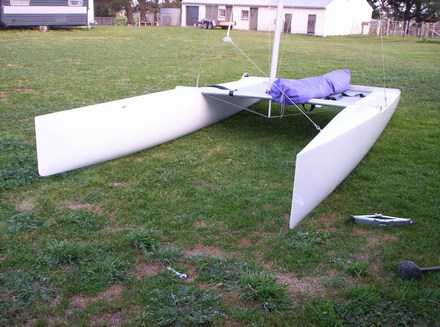
Attached pic is of the boomless rig on one of the LR2's which gave a ton of room to to get thru safely.
Cheers
RG
![[Linked Image]](http://www.catsailor.com/bb_files/127369-boomless.jpg)

Now thats hot! do those dinky little rudders and centreboards work? Wheres the holes for the centreboards? regards

Okay, can we now official fix the maximum length of the hulls as defined ... to 3.80 mtr ?
Luiz, you are the official leader so you are the one to strike down the hammer and make it official.
Wouter
Setting the max luff length has nothing to do with ruling out boomless rigs. I actually don't even see how those two are linked in any meaning full way. Please explain to me how you think that they are, maybe I'm overlooking something here ?
The true reason for the max luff length is equality in performance, equality in perception, equality to Laser standard rig, good view to the leeward side of the boat, ease of tacking and with respect to my design it is a critical measurement to stiffen up the unstayed mast without increasing mast and boat weight.
Without a luff max limit I strongly expect a run for the lowest Boom/Foot height possible (see A-cats) to gain maximal (perceived) advantage. I think this to be undesireable from several aspects while fixing a max luff length doesn't really have any significant drawbacks.
A more detailed analysis follows now :
-1- Performance
Sails that share the same overall area and luff length will have largely an equal potential for producing sail drive forced on them. Only variables left will be amount of draft, position of draft and overall shape. Our proposed sail area with that luff length will already force a squaretop design as sailshape to such an extend that the variable of sail shape is not a significant discriminator anymore. That leaves draft and position of draft. I would like to get this open in order to have crew suit the sails to their body make-up and sailing style. I think this has been proven to work well other cat classes; in fact this seems to further equalized performance when only one sail per event is allowed to be used. But maybe more importantly the sails will now look very much the same from design to design, with only very small differences that are difficult to spot. I feel this will install alot more confidence in equality of performance in persons who are otherwise not educated technically = youths and most parents.
Basically, the less obvious the differences between rigs are the less cause for parent or crew related
concerns for inequality
. And rigs are very important in this respect, even more so then hullshapes.
Drawbacks of a fixed MAX luff length ? The only one I can name are loose some very small amount of performance relative to say a luff the length of the mast. But this is not really a disadvantage as long as everybody is limited to a single luff length (=equality). I just prefer to fix this limit to a measurement smaller then the full mast length and I think the above benefits are sufficiently prefering 5.30 mtr as this will allow sail with aspect ratio of 4 which is already high.
F18/F16 have 4.25 ; hobie 14/hobie wave = 3.2 and 3.5
-2- Equality in perception
This is already partly covered in the paragraph above. Differences in rigs and sails are very easily spotted. Alot more so then any other difference between boats like hulls. Sail that are fixed both in area and luff length will look alot less different, even when fitted to masts of different lengths or when their drafts are significantly different. I also think that to take out this easily spotted difference is good for younger sailors as I expect them to feel more equal to eachother.
-3- Equality to Laser standard rig
I'm intending to have the F12 be very similar to the Laser dinghy in important specs like the waterline length (which is equal now with our max 3.8 mtr hull length limit). Same with respect to masts (5.9 mtr in laser although class allows 6.16 mtr) and sail area (=equal already) and luff length (laser = 5.260 mtr.) The difference in laser mast specs in mostly likely due to some people including the part that is in the pod and below decks. Our 6.00 mtr mast length above
deck
= beam would be highly similar.
Basically I just rounded off the number to these or what I had determined to be very attractive specs. Again, sail aspect ratio of 4 with a 7.00 sq. mtr. rig requires a 5.29 mtr luff length that I rounded off to 5.300 mtr.
I'm after laser equality in these specs for marketing purposes. F12 will definately beat the laser, especially the youth versions of the laser, and by keeping the specs pretty equal we avoid this performance difference being explained away by mono fanatics by refering to some
significant
differs like a
taller sail
. I want the F12 to proof the cat design strong points in relation to a mono and partly increase acceptance of all catamarans in the larger fraternaty of sailing.
Again the benefits of fixing the luff length to another limit (like mast mast length) too small to outweight these benefits.
-4- Good view to the leeward side of the boat
I do indeed think this to be a safety issue. I also want to avoid sails with windows in them. The laminate that these windows are made off is sensitive to abuse and rips easily. It is also another thing to do to a sail by a sailmaker and will add cost. I think it is better to be able to look under the boom/foot-of-sail. Mostly I'm unimpressed by the view through these windows anyway, especially in rough weather when lots of water droplets deteriorate the view.
Having a minimal boom/foot height that is sufficiently high (at least shorter then the mast length)is an easy and cheap solution. I know from measurements that 0.5 mtr is pretty much a minimum and the 0.7 mtr boom/foot clearance given by the laser-equality and sail-aspect=4 criteria would therefor be sufficient too.
I also think that having this clearance near the mast is important as boats travelling upwind at equal speeds and equal relative positions (= collision) are to be spotted in this area. Boats that are to be seen further back along the boom will pass behind and boats seen in front of the mast will pass in front.
I don't think this aspect of the design should be discarded without a careful analysis.
-5- Ease of tacking
Low booms are a pain in the neck on a catamaran especially when their hulls are boardless. In order to come close to tacking the F12 much like a laser the F12 crew needs to roll tack. And you'll need to be very quick but smooth in crossing the trampoline as bobbing the boat around slows a lightweight boat down very quickly and being to slow capsizes you. I fear that on the short F12 there is not alot of room to have the boom/foot angle upwards quickly enough.
I want the F12 to be a really well behaved boat, after all it will be compared to modern dinghies which have a few significant strong points here, boom clearance on the laser and Open Bic is one of these. I don't think a very low boom is any benefit that isn't outweighted heavily by its drawbacks.
So for this reason a mas luff length shorter then the max mast length is to be prefered. I know from many measurements and test sailing on a score of boats that 0.50 mtr is very much the minimum.
-6- It is a critical measurement for my own design.
I shall make no secret off it. The push rod setup needs a max luff length shorter then max mast length for ease of raising the mast, stiffening up the mast sufficiently, lowering the stresses on the parts and hulls AND safety !
Safety because I'm counting on my design being able to completely weathervane the rig. When a kid gets surprised by a squal he just unthreads the mainsheet and the rig will completely weathervane itself. If he needs to sail downwind to safety in a blow he can over rotate the rig so the boom is angled forward by 45 degrees and loose all capsize moment (!) and most of the pitchpole moment. For upwind and reaching legs he can of course let out the sail with the same results. As such a kid can always sail to safety on any course with a very calm and easily controlled boat.
On the beach the rig can also weathervane which makes boats tipping over a thing of the past as well as dumb mistakes like slam gybing the boat on the beach by turning it the wrong way.
For the weathervane property the boom/foot needs to be above the push rods. And I'd like to have the push rods as high as I possibly can without compromising looks and performance too much. 5.3 mtr luff length on a 6 mtr mast does the trick for me.
Stiffness of the unstayed rig. The difference in the top of the mast flexing off between my push rod design and Phill pod design, when using the same mast, is 40%.
In effect, the difference is between the top flexing off 0.85 mtr or 1.20 mtr; a difference of 0.35 mtr. and this is alot. (Phill, remember my
feel the need to tell ...
moment ? That was this (and some more I may tell later).
With a max luff length of 5.3 mtr on a 6.0 mtr mast I can have a homebuild mast from basic alu tubing that weights less then 9.00 kg and has sufficient stiffness to not look to bendy and not pump to much. Without it we can probably kiss the unstayed mast principle good-bye.
Seen that way NOT having a max luff length rule (or minimum boom/foot clearance rule) is the same as effectively ruling out unstayed rigs. These already have a performance disadvantage to stayed rigs, with no such limit the disadvantage is getting worse.
Having an unstayed rig is also a critical element in my design; the whole concept of simplicity is designed around it. From the free hanging boom (no fittings) and cheap mast production to the ease of car roof transport and shed storage.
Wouter
Agreed. Headroom will not be a problem if the sail is well designed. Also, I forgot that the Supercat 17 is using this configuration for decades...
Someone recently suggested something along this line for a boat using the push rod mast support system, like the Hobie Bravo.
The idea was to double velcro the lower part of the sail around the mast support tube below the bars (gooseneck) so that the entire mast length could be used for the luff. It seems to makes sense after all... <img src=

alt=
/>
(couldn't resist... sorry! <img src=

alt=
/> )
Sorry, none of this make much technical sense. Later more on this.
But also the reasons for having a max luff limit are the same for both boomed and boomless sails.
Booms only
smack over
on slow mono's as the boom only comes over very gently when a cat at normal boat speed is gybed. Remember which direction the apparent wind is coming from on a cat.
That still doesn't allow the rig to weathervane or even to achieve large boom angles as the rods will hook the sail then at 45 degree angle. This max angle could make the boat hard to control on courses between beam reaches and broad reaches in a blow.
In addition this flap makes no aerodynamic sense. Many believe that it does, but it really doesn't.
- first technical reason
All area used up by the flap needs to come out of the total sail area. So low above the watersurface the windspeed is only a fraction of the windspeed higher up the mast. As such the same area is MUCH more effective when used higher up in the sail.
- second technical reason
Because of the relatively low windspeed so low to the watersurface and the fact that the flow here is largely disturbed or even blocked by the hull makes any lift gains here negligiable and any drag looses when not having the flap to small too matter. The loose flap and felcro are more work for the sailmaker (more labour costs) and more stuff to get broken without any measureable benefits in performance or simplicity of design. I've used a similar setup on the 49-er I sailed for a while and I would have gladly removed that whole flap. It was the first part of the sail to crack up and once the velcro is gone it undoes itself and flutters in the wind. By the way, Nothing is as draggy as a fluttering piece of cloth, even if only the leech flutters then that increases airfoil drag by 20-40 % No amount of sail drive of the same piece of cloth can every correct for that.
- third technical reason
For an airfoil to work in unstable flow (as we see all the time while sailing) it needs to have a sufficiently large cord. Wind is basically an unstable airflow that is made more unstable by waves, chop and macro turbulance induced by the wind rubbing against the ground/watersurface or passing buildings, trees, hills, dunes, other sailboats and whatever else was in its way.
Very short cord foils stall very easily and have trouble reattaching the airflow. The flap is basically a very short cord foil unless it reaches back very far along the boom. This can of course not be had for other reasons.
A short cord foil also stalls at significantly lower angle of attacks then a longer cord airfoil. Of course you'll set the boom angle for the lower portion of the sail (= long cord) and the flap (short cord) is set accordingly as well. By any analysis it will be suboptimal. If you are lucky (!) its lift will cancel out its drag and the drag of the mast (but still lower the effective sail drive area of the sail that is above the boom, probably losing some performance)
- forth technical reason
Alot of people think that the flap will smooth out the flow around the mast and thus lower the drag of that part of the mast.
Even if it does that (and it most probably don't) then the drag of that part of the mast must be sufficiently large to matter, which it most definately is not. A 50 mm diameter round tube of 0.750 mtr length (my exposed mast below the mainsail sleeve) produces at max 0.50 kg of drag when sailed at 15 knots on a 45 degree upwind course in 20 knot of winds. It is probably significantly less as the wind so close to the watersurface is travelling significantly slower then the windspeed readings that are officially taken at 10 meters altitude. Additionally you can never remove the total amount of drag of this portion of the mast, even with the flap a portion will remain. So the total drag amount is less then 2% of the total already.
But this assumes that the flap actually smooths out the flow over the mast here. If a round mast with a sleeved flap is used then this won't happen to any significantl extent. Even if the flow was laminair before it reaches the mast (unlikely) then it will become turbulent and detach from the mast+flap BEFORE the side of the mast is reached. When teh flap is properly aligned then the flow will reattach some distance behind the mast. If the flap is too small then flow will not reattach at all and the flow pattern around the mast will be the same as with the flap (foil) completely stalled. In that situation there will be hardly any lift created and the drag of the mast+flap setup will not be less then just the mast alone. In fact, it will mostly likely be more because as a due to the angle of attack (20-25 degrees) a larger portion of the flow will be disturbed.
In effect it is better to have a very small area operate at a bad drag coefficient then a large area operating at a mediocre drag coefficient. A flap is alot larger in area then just the round tube of the mast.
It is interesting to note that flapped mainsails are not found in EU. Any design that had them like the older Nacra's and supercats had these flaps removed because the measurement based rating systems like Texel and SCHRS counted this area with the same weight as area higher up along the mast. It was found that it was better to remove the flap and make the sail above the boom a little larger.
Other area's using yardstick systems still see these flaps as here these systems don't not look at the total amount of sail area just at the performance that is achieved.
For these reasons I see no technical reasons to have flap below the boom to try to maximize luff length. It is either a full sail going down closer to the mainbeam or just cut off the foot along some horinzontal. The jury is still out on the
angled upward booms
, but I'm personally skeptical of them as well.
Wouter
Wouter,
all your reasons aside you seem to have forgotten that no one else but you is going for the support tubes and with the exception of Phil's boat the ones starting to build right now are all stayed. I should also point out that the boomless rig was the idea of the people building the boat and they are paying for it, so I guess it's their choice.
BTW, your analysis of the small flap at the bottom is just plane wrong, I have recently done a lot of CFD work on just this subject for the A-Cats in the form of a mini sweeper (about 400mm chord) and it is extremely beneficial even without a seal to the tramp an I for one will be adding them to any design that the owner allows me to.
Cheers
RG
Hi Jeffs
Look on the leeward hull behind the trap wire, you can see the centercase there, and yes the boards and rudders work fine and you can out point most people most of the time.
Cheers
RG
Just to add my 2 pennies worth, I know that RG has 4 boats up north that will all be boomless plus our 2 will also be that way, not sure about the other 3 that are just starting, but I suspect they will go that way so we are all the same down here in NZ and just as a personal observation, I think Wouters arguments while probably meant well just look like rubbish to me.
Aerynt
angled upward booms
, but I'm personally skeptical of them as well.
Wouter, does this description (
angled upward booms
) apply to the LR2 photo that RG posted.
I appreciated the effort Wouter went to to explain his thinking about the aerodynamic properties of the flap. Agree or disagree, since this is a community effort (right?) it would be nice if we had some dialog about the substance of his comments, rather than just dismissing them on the basis of some computer modeling that none of the rest of us have seen.
That said, my understanding is that leaving the luff length unrestricted will not actually penalize Wouter's design, since his argument I believe is that aerodynamically a design without the flap is more efficient.
BTW, on the issue of support tubes, I would be careful about making an argument just on the basis that noone else is using them. Don't forget Chris's
McDonald's
story. Eliminating diversity unnecessarily may not be doing the class as a whole a favor.
Okay, can we now official fix the maximum length of the hulls as defined ... to 3.80 mtr ?
Luiz, you are the official leader so you are the one to strike down the hammer and make it official.
What makes it official is that all four boats will comply with 3,80 m length limit. A hammer in my hands only serves to open a hole in the head to make room for all that data.
I totally forgot about feathering. Optimists feather their sails when being towed and when rigging. Lasers do it when rigging. This is a usefull feature even for kids who prefer to wait in the capsized boat when things get rough (for quietness).
While we are at it, Optimists around here use a snap shackle (or similar) to fast-release the mainsheet block from the boom to feather. I guess we should copy this feature.
I like Wouter's mast support system. It makes sense from the structural point of view and others. My daughter justified her preference for the chined hull shape because
it is easier to grab in order to climb back to the boat
. Those bars certainly help too. Also, the capacity to feather makes it easier to rig and tow. Both are important for kids.
Great ! Lets get into it. How did you model it, how was the flap modelled, what approximation routines did you (or the software) use. How did you model the wind flow. What variances did you use, if any. Does the software allow stochastic modelling at all or just lab style deterministic models.
Can you intepretate the data for us, as in explaining why the flap works when the flow detaches from the round mast section before it reaches the point where the sleeve seperates from the mast tube. This detachment is broadly documented in a score of scientific publications.
I'm really interested in being proven wrong cause that is the way we learn and progress design.
I'm also aware that no single person (including myself) can cover a whole field in engineering like aerodynamics. There is just too much detail there.
If I make a mistake here then I want to know about it.
Wouter
Ohh, I'm perfectly happy to race against any flapped design while sailing a non flapped design myself. It is just the perception thing that worries me and the fact that I do believe the flap obstructs critical visualbility in collision situations.
It is also my believe that without strickter F12 class rules then we have now we'll end up with mini A-cats. Which in my view is the same as the other expensive boats (F16, F14, A-cat) but then with less less performance and robustness. That is in my opinion not the right balance to strick with respect to the entry level cat that the F12 was intended to be.
But I'm happy to have the others decide to go down this route if they really want. I will however keep the orginal F12 concept going on the background just in case.
Wouter
A very large part of my scepsism against the flaps below the boom (and even the angled up booms) is derived from this :
![[Linked Image]](http://www.catsailor.com/bb_files/127537-Laminair_and_turbulant_winds.gif)
Sailing is basically harvesting energy from the wind. If the wind at a lower altitude above the water contains less energy per kg (or volume if you will) then there is less energy to harvest there (less sail drive to produce)
Now compare the energy content at 1 mtr. above the watersurface to that of say 4 mtr above the water surface. The latter being at the centre of the mainsail luff when the boom is 1 mtr above the water.
In laminair winds (below 5 knots wind speed at 10 mtr altitude) the ratio is 1/15th, meaning that 15 times more energy is to be harvested at 4 mtr altitude then at 1 mtr altitude.
In turbulant winds (above 5 knots wind speed at 10 mtr altitude) the ratio is still a tad lower then 2/5th meaning that 2.65 times more energy is to be harvested at 4 mtr altitude then at 1 mtre altitude.
Of course a peice of sail area can never harvest more energy then 100% of the energy content of the given altitude layer (the real theoretical ratio is actually max 52 , but I won't bother you guys with that). So basically the same area of cloth at 4 mtr altitude can be several times more inefficient and then still outproduce the flap in the amount of harvested energy/saildrive. So why have the area (that comes out of the total) being
wasted
in the flap that way.
The only reason to justify that is when the flap reduced the overall drag of the design to such an extent that this amount is larger in absolute terms then the same cloth area placed higher up can compensated by produced sail drive.
I also contest that possibility but that is for a later posting.
By the way, the wind can only blow in two mutually exclusive forms, one being the laminair flow pattern and the other being the turbulant flow pattern. The transition from one to the other is abrupt and complete. The typical borderline between these two forms is found on average at 5 knots of wind (as measured at 10 mtr altitude).
The graph were developped by me based on data found in
High Performance Sailing
by Frank Bethwaite and various documentations that were used during my courses on fluid dynamics. The flow approximation is a 5th order fluid approximation. Reynolds numbers are not of interest at this time as we have explicitly modelled the laminair and turbulant flows. Of course the Reynoulds number is normally used to distinguish between these two situations, but experimental data had already fixed this transition at 5 knots of windspeed at 10 mtr altitude so using the Reynolds number at this time would be pointless.
Wouter
Silence ?
I was planning to post the follow-up messages to complete the arguing but it seems everybody has left.
Wouter

It's the holiday season... <img src=

alt=
/>
Waiting on my kit to arrive, Scarecrow is reworking it to fit the change in length. Wont have my new shed up this summer so had to clean out my other one, no point taking a photo now. Theres nothing so depressing as a clean shed.
regards
My guess is the silence in an indication that people have
decided to back up some of the many words with a bit of real work.
In my case I now have the ply required for the build and as my F16 arrives in a couple of weeks I'm putting up a 12mx6m carport which will allow me to move some of my other projects out of my workshop under cover with my F16 while I build the Blade 12. I just need to make sure I get all the materials in before the extended Christmas close down.
Hey Jeff. Good luck on the build.
Looking forward to hearing about your progress.
Regards,
Phill
decided to back up some of the many words with a bit of real work.
Yeah, that must be it !
We're in the middle of setting the F12 framework and suddenly people decide to run ahead of schedule and do stuff that can actually be ruled upon later. I thought we just had agreed to set at least a few limits that suit everyone before people we are locked in by having build boats.
I'm beginning to understand why multihull sailors are looked down upon by the larger body in the sailing world. We couldn't organise our own rescue if our lifes dependent on it.
Wouter

The Youth catamaran effort has finally moved from just a discussion to an actual concrete effort. With so many personalities and agendas there are bound to be conflicts.
Various parties have chosen a path to take...Some are Leading, some are Following, and possibly some need to....
Regards,
Bob
Come on Wouter if we don't get organised and start now we wont have enough boats on the water for next summer. How do you get enough people excited without putting a boat in front of them. I have to build at least 2 boats, work, sail, maintain my current cats, repair the sailing school mono's and keep a family happy. I think your the only designer on the forum who hasn't moved to build yet, didn't you read in an earlier post how many boats were commencing the build, the race is on to build, then we need to get those cats together for a fun comp.
regards
have just finished cutting out all of our jig frames for our 2 boats, hope to have it all assembled and lined up sometime in the next week.
Talked to RG last night and it looks like some of the contacts I gave him might actually build some more also. He also mentioned that 2 guys up north are hoping to start their 4 boats early in the New Year, so all up NZ should have at least 9 boats building by the end of January 08.
As for the class fee of $50 per design, is anyone in charge of collecting that yet?
Aerynt
How long does it take to all agree on the rules. A day maybe or a week ?
We can't even wait with building that long ?
You guys have been avoiding this subject for months now. If you didn't then you could even have commenced with building months ago.
So please don't insult me with these stupid arguments.
Wouter
Then tell us, how you would like to be insulted?
The way you insult us? or do you have something else in mind?
Aerynt,
That is good news.
Possibly you could post some building posts/pic on the catsailor building forum unless you have a web site or blog where you will be showing off your handy work.
Good luck, I hope you enjoy the work ahead.
Regards,
Phill