

RG,
If possible, I would like to know the following:
1 - Plan's prices (both versions) and royalties for serial production.
2 - Estimated construction times (hulls only and complete).
3 - Do you think the additional speed and handling difficulty of the round bilge version would scare kids away?(or parents!)
4 - Considering your answer to item 3, what version would you choose if you were to build the first boat in wood, take the molds and then (try to) build a fleet from those?
Thanks!

Luiz
I plan to get the plans out using http:/

alt=
/> LOL
For the hard chine boat I'd guess 8-9 weeks would be a reasonable time and the round bilge one because its a strip planked foam build, probably another 2-3 weeks on top of that. This assumes that your just doing it in the evenings and on the weekends. If I can get someone to scarf the sheets and precut the panels like Scarecrow is proposing, then you might be able to cut the build time down by a few weeks.
The round bilge boat is only just over 1 knot faster at the top end, so I doubt that will scare anyone. As for handling, I hope it turns out like some of my other recent designs which were all pretty benign. This version btw will be more pitch resistant that the hardchine version.
As for your last question, hands down I'd do the round bilge boat because I like it more, but in trying to sell a few of these, most of the kids tend to like the hardchine one....go figure? Think the choice is up to those who like one or the other design better.
Cheers
RG

G'day Matt you'd have PM too but the computer says youre not accepting it <img src=

alt=
/>. I hopefully sent a message to the e-mail address in your profile yesterday. Since our clubs are not far apart ( relatively ) I'd like to have similar cats.
I already piggyback a 420 on my cat trailer so I'm hoping to get 2 youth cats on instead
regards Jeff
Hi Jeff
No email, I just had a look my correct email is the profile, tiffmatt(at)bemail(dot)com.au
I've just changed the accepting private messages, I didn't realise it was on 'no' I bought a new computer a few weeks ago, and must have done something when I logged back on.
Regards
Thanks!

Maybe that is not so suprising if you look at modern sports cars, chines are in fashion <img src=

alt=
/>
![[Linked Image]](http://autocult.com.au/img/gallery/QR95YGRP.jpg)
![[Linked Image]](http://blog.raduceuca.com/wp-content/uploads/2006/10/ferrari2.jpg)
Gareth
Maybe that is not so suprising if you look at modern sports cars, chines are in fashion <img src=
alt=
/>
Let's follow the trend and make them MULTI chined... <img src=

alt=
/>
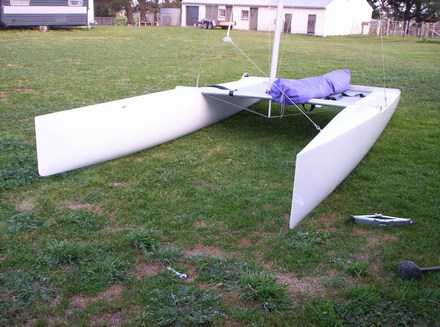
After reviewing the designs once again, it is clear (to me) that the stayed rig is unnecessarily expensive and complex. The free standing strut supported version simplify the rig, transport, assembly, storage, construction and structure. The struts are a good grab point and add safety for children. They make the evolution to a smaller or larger rig inexpensive and easy - if and when the class decides so. Mothers could even rig vinyl spray deflectors there for dryness and shade. I like them.
In the free standing rig version, if we place the gooseneck in the main beam, the sleeve could leave a gap where the struts are welded to the tube and be double velcroed around the mast below that point. This would solve the gooseneck problem and allows a small reduction in mast height.
Does it make sense to you?

What gooseneck problem are you refering to ?
Personally I would strongly prefer to have the boom above the attachment points of the push rods as then the rig can rotate fully around the mast which is very advantage (performance) when sailing deep. It also is a safety feature as any kid can let the rig weathervane completely when surprised by a squall or something.
A freehanging boom (possible with a fork at its mast end) is possible and most easy solution
Wouter
Not sure a reduction on mast height gains us much as its such a small triangle at the bottom that you gain, and that doesn't lower the COE very much. And I tend to agree with Wouter about letting the sail weathervane if required.
Also, don't see that the stayed rig is that much more complicated, but do agree that the freestanding is faster & easier to rig.
Too my surprise, most who I have talked to so far have elected to go after the stayed rig because it will allow trapezing, and these are the kids talking, not their parents who don't seem quite as sure about the whole thing. In the words of one kid.....why should I hike all day when I can trap and go
zoom
Cheers
RG
The following attachments should give you an idea of how I think the hull jig should go together, this drawing is not yet complete....if any of you want changes, speak up.
Pic #1 the base box, made of 2x4 or 50x100mm, kiln dried so it won't warp and nice and heavy so it won't move.
Pic #2 plywood wrap, 25mm on top and 12mm on the sides
Pic #3 12x15mm cleats screwed to the box to attach the frames to
Pic #4 Frames get attached (12mm thickness)
Pic #5 Upper cleats are attached, these could actually be attached prior to attaching the frames
Pic #6 Frame beam is inserted
Pic #7 Hull in the jig
The front 3 frames that aren't attached to the base, I'll explain how that works once I get the rest of the drawing done.
The next 3 frames moving aft will be detachable and can slide aft when your ready to lift the hull off. This is required because of the tumblehome.
The rear frame is notched so you just have to sit the transom sheet in place to get it aligned correctly, all frames are notched on the outboard edge to help hold the side panels in place correctly.
Cheers
RG
Pic #2
Pic #3
Pic #4
Pic #5
Pic #6
Pic #7
BTW, forgot to mention that the frame beam has some fore & aft supports that are not shown yet so that the whole arrangement stays rigid.
Cheers
RG
I think this is extremely important feedback from your market. It would be interesting to know the ages of the kids you're getting these comments from, RG. It seems that most here have been fairly resistant to the trapeze idea, but I believe that clearly differentiating your product in the market is an important element of success. It's one thing to say
it has two hulls, two hulls are faster, you'll like it
, but another for kids to actually see that there's something quite different and exciting about the experience of sailing this baby from their buddy's monohull. I understand the argument in favor of the unstayed mast, but I don't think you should ignore this issue.
A freehanging boom (possible with a fork at its mast end) is possible and most easy solution.
Not sure a reduction on mast height gains us much as its such a small triangle at the bottom that you gain, and that doesn't lower the COE very much. And I tend to agree with Wouter about letting the sail weathervane if required.
Also, don't see that the stayed rig is that much more complicated, but do agree that the freestanding is faster & easier to rig.
To my surprise, most who I have talked to so far have elected to go after the stayed rig because it will allow trapezing, and these are the kids talking, not their parents who don't seem quite as sure about the whole thing. In the words of one kid.....why should I hike all day when I can trap and go
zoom
You are both right. Besides Optimists, I sailed with fork type goosenecks in Penguins back in the 70's - with rotating wingmasts! It is very simple, efficient and inexpensive for small boats exactly as you say. Note that it was not possible to weathervane the Penguin due to the shrouds (unlike the Optimist), so the fork solution is ideal for the free standing rig only, not so for the stayed/trapeze rig.
Two divergent conceptual paths (trends) emerged and are being followed:
a) Simplicity oriented, with chined hulls, free standing rig, hiking straps, cheaper price. It is essentially the original F12, but I'll call it F12 One Design.
b) Performance oriented, rounded bottomed hulls, stayed rig, trapeze, normal price. It is essentially a Mini A Cat.
I guess it is ok to follow both trends until a clear winner emerges. Still, we already know that the Mini A Cat will end as a scaled down A Cat, so we could just as well follow the F12 One Design path only and in the end compare everything to a scaled down A Cat - including the class rules.
I made my own spreadsheet to rationalize the decision process and it indicates that the F12 One Design wins by a small margin, basicaly due to simplicity and costs. The other differences more or less cancel themselves. Sorry, could not upload the spreadsheet as is, just its picture.
It might not be necessary to assume that a trapeze version goes with the round hulls and higher construction skill.
I note that your spreadsheet indicates a target age range that spanning both Wouter's original target and the younger kids that others favored. Not sure if this is generally agreed by everyone else. Still interested in knowing the ages of the kids RG is talking to.
Also curious whether
one design
is still the consensus. My impression was that Chris and RG are both pursuing separate designs with the expectation that they will both fit into the box rule defined by the measurement form they put together.
Agreed. The end of the process is to add all positive features we can to the best concept, regardless their origin, but sticking to the chosen concept.
Yes, but note that I am spanning the original age range with two up.
As Wouter wrote, a cat that is optimal for 12+ year old kids is also a very good choice for a couple of kids under 12. This adds a very important marketing feature to the class, for then it will be a strong replacement/competition for both the Optimist and the Laser - while interfering little with the original goals.
Also, note that this is a tough feature to replicate in a monohull class: a Laser can be sailed by two small kids, but it is hard for them to keep the boat upright when tacking and jibing (have you noticed the high beam of the Optimist? It's no coincidence).
The cat's high initial stability makes life a lot easier for the small ones. I think we must use this advantage in our favour as much as possible, if anything because we can't get read of the inherent disadvantage: the tendency to go to irons when tacking.
The trapeze is a source of interference with the original goals. If we accept that it is indeed advantageous for the class to target this segment (startup boat for ages 7 to 12), we'll have to analyse this feature carefully, for it leverages the advantage that kids over 12 have against two smaller ones.
one design
is still the consensus. My impression was that Chris and RG are both pursuing separate designs with the expectation that they will both fit into the box rule defined by the measurement form they put together.
Good point.
The problem with a formula is that parents start competing to see who spends more on the kid's boat. This forced the Optimist to become a strict one design. Even with the narrowest possible rules, parents still find ways to spend a lot on their kids to give them an edge (buying high tech lines, gore-tex clothes, multiple foils, sails and hulls, etc.).
This is another interference caused by the increased age span. Younger kids' parents require strict one design rules, while older kids (and their parents) can live with a formula - and possibly have more fun with it.
As a consquence, first we must discuss if the
two up under 12 startup
use is a desirable feature for the class or not. Needless to say, I favour this feature. Here's why:
Even with Internet, I don't see a group of teenagers managing a Formula class. In most of the cases it will be their parents doing the work.
If parents must be involved, why not catch them earlier, at the same age kids start sailing Optimists? It is easier and it makes more sense to me.
If the class is sailable during a wider age span, the class organization becomes stronger. Parents managing the Optimist class usually help for 6 to 10 years, maximum. If the same boat was good for a couple more years (as would be our case), they would help for 8 to 12 years. We all know how difficult it is to find people to help, so this is a great benefit for the class.
I'd like to hear what others think before continuing, because I may be trying to convince the converted...
Kids I've spoken to range from 7 to 14, but most would be 10 and up
RG
Right now based on what parents and kids are telling me, I'd say that the only person who wants the round bilge design is me <img src=
alt=
/>
So, if I follow exactly what those interested want (not counting those here), its a hard chine design, with boards, that can fit an age range from 7-8 thru 16+, that can accept either rig, although the majority appear to want a stayed rig.
To be fair, most of the kids Ive spoken to come from sailing families, most own or have sailed opti's (and are really bored with it) and one or more of the parents sail multihulls.
Just from my personal perspective, I see the ability to swap from one rig type to another as a design plus that gives the designs more utility over the age range and beyond, perhaps the easiest way to deal with it is just cap it around some age limit?
RG
Kids I've spoken to range from 7 to 14, but most would be 10 and up
RG
Im looking at exactly the same age spread also hoping that some will go on to crew for adults or go to F14 from there on. I think I'll be able to get novice adults (read parents) out on these boats. My preference is multi design so that if a parent wants to get excited in the sport encourage them, I hope we can come up with a simple handicap system to encourage young enthusiastic sailors to strive for their maximum potential and nurture the ones just doing it for the fun. I can see two 7 year olds doing a roll tack and cackling the whole time.
regards
Just got a call from a father who sails an A-Class who has a 7 year old who wants a boat and his suggestion was use a boomless pocket luff rig with a curved (decreasing radius) traveller (so it cambers up automatically as you travel down) and this way kids can't bang themselves on the head with the boom if they aren't paying attention or it gybes on them when they aren't expecting it (which will happen). The cost difference for getting a slightly longer bent traveller is more than offset by not having to purchase the boom and it will speed up the rig/derig time.
cheers
RG
Had forgotten to give you people some floatation numbers, with a 65 kg platform and a 45 kg kid, on both hulls it will float approx 29mm below the tip of the bow, on one hull its exactly at the nose. With a 75 kg crew, it will sit down a further 36mm when on 1 hull. And for those extreme conditions where all the neighborhood kids pile on the boat and its sunk to halfway up the transom (110mm above DWL) it will support 221 kg on one hull .... thats almost 5 45 kg kids or 10 of them when it's on both hulls. Not sure the beams or the rig will standup to this punishment, so just don't tell the kids it can do it <img src=
alt=
/>
Cheers
RG
I guess the design could be made to accept either rig, obviously at the cost of adding specific structural reinforcements.
Can you estimate the weight increase, if significant?
The two configurations are:
-
School
configuration - free standing mast / two kids under 12 / hiking straps.
-
Competition
configuration - stayed mast / one kid over 12 / trapeze.
The question remains about the type of class rules: one design, formula or split? (split meaning one design for the
school
version and formula for the
competition
version).
If the class rules are made different for each configuration, two classes will be born - and in the end one will be a strict one design and the other a Mini A.
I guess this alternative can be excluded because (as I see it) we want to converge to one optimal class rule and/or design.
If one rule covers both configurations, it's one class with two purposes, much like the 420 (a one design class with two configurations:
club
and
competition
).
I prefer the club and competition versions and to that end I have started to modify the way it's set up so you can run either configuration on the same platform, with the same mast and with a hybrid sail so you can use the same sail for both configurations as a
cheap
option for growth. Need to change things a bit, but should have some pics showing how its done by late tomorrow or the next day.
Cheers
RG
Luiz,
think I can get the weight penalty for the above to about 0.5kg or less, will know more after I have calculated the changes. Will let you know soon.
Cheers
RG
If you want the excel sheet uploaded to a website then send it to me and I will place it on :
http://www.xs4all.nl/~whijink/F12/
Wouter