
Reword for Rule 7
7. Unballasted retractable seat or trapeze shall be allowed for the forward hand when two-up or adult skippers when solo only. Solo junior (under 13) skippers cannot use a trapeze for F12 competition.
I think this covers most ppls point of view, the wording needs some work though. The risk of a solo junior getting into trouble is reduced, 2-up juniors can have a single trapeze for fun and adults can do whatever they want. The age can be moved around if desired.
Another idea is that juniors (under 13 or similar) must race 2-up. Again this is a safety related issue.
Sorry for bringing up so many new ideas, most of them are being stolen from the Sabot, an Australian junior class.
Rewording of Rule 17
17. Hydrofoils are not permitted. Atleast one hull shall be in the water while sailing. To this end, centreboards and rudders are to be essentially straight with a maximum camber (top to bottom) of no more than 25mm. They are to be essentially vertical with the distance between the bottom of the boards, when both are deployed, within 100mm of the distance between the top of the boards in the same position.
Diagrams required.
A bit wordy but should avoid any confusion.

Makes sense to me. Maybe:
pocket luffs are allowed if the sail can be lowered at sea without removing the mast.
I'm against the trapeze. It makes unstayed rigs slow (not competitive), the boat becomes more expensive, everything bcomes more complex and difficult, kids can get tangled...
For the standard F12 class KISS is better. Adults may add a trapeze, jib, kite, hydrofoils and sail just for fun.

Thats what I needed, the proper wording for each point. I don't think we can make lowering the sail at sea mandatory because it rules out the sleeved sail unstayed versions already planned.
regards
I don't have a problem with unstayed pocket luff rigs, only stayed pocket luff rigs like moths and mainsails that can't be dropped with the boat upright. So long as the kid or a rescuer can drop the sail easily.
Only other consideration with unstayed rigs is that there is a device to keep the rig in the socket during capsizes. A simple rope and sister clip arrangement would be enough. Not sure if this should be in the rules, maybe a separate clause is needed to cover these safety issues.
Safety - Sails must be able to be dropped easily in all conditions while on the water, mast must be attached to the boat, etc.
Just a little history for those wondering where this stuff is coming from, I used to umpire junior teams racing and being able to drop the sails in ALL conditions while on the water was a necessity.
That's a valid point, allowing trapezes and unstayed rigs conflict with each other. Sure you can put a trapeze on the unstayed rig but it would be nasty or require a very big stiff mast.
Along with this is that installing pocket luffs and trapeze connections is a hassle from a rigging point of view. From a rescue point of view I don't want to contemplate pulling the main down on a stayed pocket luff rig with trapeze wires on the water in 25 knots and some chop.
Sure it can be done and performance may be increased slightly, but is it worth it at the cost of some basic safety measures?
We can exclude traps and seats unless someone else pipes up in support of them.
regards

RG my understanding is that the kiwis intend on fitting them. Is this the case?

Traps and seats were not intended from the start, so we can exclude them.
The pocket luff sail was I think intended for the unstayed rig where the sail can windwane can we keep it at that
As the sailmakers here seem reluctant to make pocket luff sails, Billy has already decided to change to a sail with a boltrope and Im not hung up on having a pocket luff sail.
Sent out an email to those who have paid for designs asking if they were happy with this and all who have replied with the exception of the Chinese will go with it. While I wouldn't like to lose the Chinese boats, I think we should just outlaw the pocket luff on a stayed rig in the interests of safety. Traps I see no reason to outlaw, and all the kids I've talked to want it, period.
cheers
RG
So, pocket luff ok on unstayed rigs.
Shall we have traps from the start or later, I have the feeling they will come soner or later anyway.
I have no problem with traps for the older kids or for the crew in 2-up mode. Although it practically rules out unstayed masts.
The traps will not make this cat any faster . It can be sailed in almost all conditions without them even by a child of 35kg with the 7m2 sail.
This is good to know.
Note that if the F12 racing rules exclude the trapeze, it does not mean that one can't be fitted on some boats for fun or club racing (for instance). We have our own special local rules here for club racing. This also covers a jib, kite, hydrofoils and any other innovation.
I just think it is prudent to keep the INITIAL F12 configuration as simple and cheap as possible.
Home builders will certainly try modifications of all types. If a given modification becomes popular, the class can certainly add it to the class rules later.
By the way: I will probably install a trapeze, kite and hydrofoils on my daughter's boat just for fun...
Still, for the class I consider more prudent to adopt the simplest and cheapest configuration possible to foster growth.
When my daughter decides to compete, all she has to do is revert to the basic configuration. No big deal.
I agree with Luiz. We can always make a F12HP for the older kids (dads) later.
I agree.
Third
LOL....already designed mine, will post some pics later
cheers
RG
It would maybe be good to keep those pics as a teaser and only show them when we have finished the draft for the rules... <img src=

alt=
/>
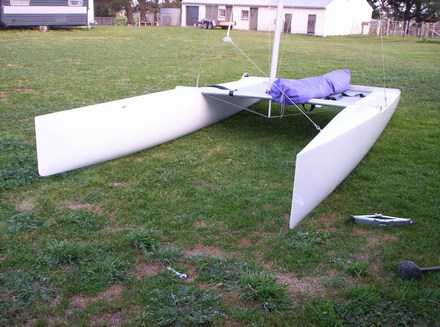
I was going to keep my trap shut until I actually got mine at least to the hull built stage. But I'm with RG and some others on this.
One of the main attractions to this class is that it has to be heaps of fun. In my own opinion, to exclude the traps, would be taking away a fair chunk of fun.
I realise its been said that they could possibly be added later, but do you really want to stuff around with it later? If your design includes them, have them, if it doesn't, don't. Banning them or restricting them at this stage, when designers or builders have already committed to their design, I think its too late for such a rule.
The ship has sailed, so to speak.
Heres my latest offering
F12 CLASS CATAMARAN MEASUREMENT GUIDELINES
Prologue: The Formula 12 class
The Formula 12 catamaran exists with the sole purpose of introducing young, novice and disabled sailors to the thrills of sailing high performance catamarans. With this in mind the following rules endeavor to outline a cost effective, safe and enjoyable class of sailing boat that can also be used for close racing across a range of designs.
The Formula 12 Design Box Rule
1. In case of doubt, the intention of the rule makers, which is referred to as the spirit of the rule, shall take precedence over the letter of the rule. For construction, all materials and methods are allowed when these do not imply either an unacceptable risk of bodily harm or the operation of an unseaworthy craft. It is the responsibility of competitors to ensure their craft are safe and seaworthy.
2. A catamaran is defined as a two-hulled sailing boat with essentially duplicate or mirror image hulls, fixed in parallel positions.
3. Sail area shall not be more than: 7.00 square metres. There is no restriction on how sail area is distributed. Sails must be able to be dropped easily in all conditions while on the water or land with mast attached to boat, pocket luff sails may not have sidestays. Where a pocket luff sail is not used, half the mast area shall be included in the total sail area. “The girth measurement shall be taken as the distance from the centreline round the surface of the spar to the same point on the centreline. The resultant dimension shall be divided by two to give the half girth measurement.”
Boom measurement is only included in the sail area if the profile height of the boom is more than 1.5 of the width and shall be taken as per mast measurement.
When undertaking the sail measurement the following points should be noted.
Sail to be measured on a flat surface and laid out in terms of IYRU Measurement & Calculation of Sail Area Instructions. i.e.
“With battens set in their pockets the sail shall be pegged out on a flat surface with just sufficient tension to remove waves or wrinkles from the edge rounds and to spread the sail, as far as possible, substantially flat. Once the sail has been pegged out in this way all the required measurements shall be taken and no alterations to the tensions shall be made.”
4. Mast construction and rigging shall be un-restricted.
A contrasting measurement band shall be located on the mast no higher than 6metres above the top of the front beam. At no time shall any part of the main sail with the exception of a halyard lock or shackle or pocket luff sail cap be located above this measurement band. Unstayed rigs must secure the mast ensuring that during capsize the mast remains attached to the boat.
5. The overall length of the catamaran shall not be more than: 3.80 metres.
The length shall be measured between perpendiculars to the extremities of the hulls with
the catamaran in her normal trim. The measurement shall be taken parallel to the centre
line of the craft and shall exclude rudder hangings, but if the athwartships width of a
rudder within 153mm of the bottom of the hull is more than 76mm, the length shall be taken to the aftermost point of the rudder.
6. The extreme beam width shall not be more than: 2.00 metres
The beam shall be measured at right angles to the centre line of the craft at the widest point and including all fixed or adjustable apparatus, this may be at some point down the sides of the hulls, especially if hulls are angled. It may also be possible that the maximum width is at the bottom of centerboards when fully down.
7. Unballasted retractable seat or trapeze are not allowed.
8. Each hull shall have at least one inspection hatch.
9. Each hull shall carry at least 30 litres of flotation, which may be provided by solid closed cell foam, solid blocks of compacted foam granulate, air bags or sealed air compartments.
10. The platform shall be equipped with a maximum of two rudders.
11. In addition to the rudders, the platform may also be equipped with one or more daggerboards or centerboards.
12. It is not permitted to adjust the following items while racing: the rake of the mast, the tension of the standing rigging, the angle or length of the spreaders (if fitted).
13. It is the responsibility of the crew to ensure that the boat is equipped with a righting system that will enable the crew to right the boat without any outside assistance.
14. The Formula 12 Class authority may demand that a crew demonstrate their ability to right their boat, but only at a time when doing so does not directly affect the fairness of racing.
15. There will be no other restrictions on crew weight apart from the requirement that the crew weight must be sufficient to right the boat unaided under all encountered sailing conditions.
16. The F12 Division emblem shall be carried on the mainsail over national letters and sail numbers, Sail numbers shall be allotted by the Class Association.
17. Hydrofoils are not permitted. At least one hull shall be in the water while sailing. To this end, centreboards and rudders are to be essentially straight with a maximum camber (top to bottom) of no more than 25mm. They are to be essentially vertical with the distance between the bottom of the boards, when both are deployed, within 100mm of the distance between the top of the boards in the same position.
18. Minimum weight in full sailing trim shall be not less than 50 kilograms. The boat must be weighed in a dry condition and any weights attached to bring the boat to a minimum weight of 50 kilograms must be permanently affixed.
Class administration
19.1. Voting rights
Voting rights are only available to people that have designed or built a dedicated F12 catamaran. Whilst other designs that come within the rules are most welcome to compete in F12 races they have no voting rights regarding F12 design.
The following people are each entitled to one vote on class matters.
o Designers who have provided a free design of a dedicated F12 for others of which at least one has been built.
o Builders who have built at least one dedicated F12 boat ready to sail.
o Owners of a ready to sail dedicated F12 cat
19.2.a Changing of rules
A change to these rules requires affirmative votes from 2/3 of all people entitled to vote at the time of the poll.
19.2.b Rule changes may not preclude from competition or grandfather currently sailed dedicated F12 catamarans.
19.3. Applicability of rules
These rules exist as a draft only until being ratified or changed by vote after the launch of the 10th dedicated Formula 12 catamaran.
19.4.a. Governing body
Initially the Formula 12 catamaran class shall be run with all those entitled to vote having equal voting rights. Upon the launch and measurement of the 49th vessel the class association may with a 2/3 majority vote choose to implement a governing council which will be empowered to handle the general running of the class.
19.4.b. Where a governing council is adopted they may not make changes to the measurement box rule or voting structure, with out first receiving 2/3 majority support for any changes.
regards
1. In case of doubt, the intention of the rule makers, which is referred to as the spirit of the rule, shall take precedence over the letter of the rule.
Excellent!
I'd feel better if we made sure the
spirit of the rule
is clear. Maybe something like this:
1.In case of doubt, the intention of the rule makers, which is referred to as the spirit of the rule, shall take precedence over the letter of the rule. [color:
red
]It is the intention of the rule makers to set a reasonably fixed drag, relating to a reasonably fixed saildrive, resulting in level performance over many different makes, so as to achieve a fair and effective formula class.
Or probably a rewritten version of this, if my english is too bad (as usual).
F12 CLASS CATAMARAN MEASUREMENT GUIDELINES
Prologue: The Formula 12 class
The Formula 12 catamaran exists with the sole purpose of introducing young, novice and disabled sailors to the thrills of sailing high performance catamarans. With this in mind the following rules endeavor to outline a cost effective, safe and enjoyable class of sailing boat that can also be used for close racing across a range of designs.
The Formula 12 Design Box Rule
1. In case of doubt, the intention of the rule makers, which is referred to as the spirit of the rule, shall take precedence over the letter of the rule. It is the intention of the rule makers to set a reasonably fixed drag, relating to a reasonably fixed saildrive, resulting in level performance over many different makes, so as to achieve a fair and effective formula class. For construction, all materials and methods are allowed when these do not imply either an unacceptable risk of bodily harm or the operation of an unseaworthy craft. It is the responsibility of competitors to ensure their craft are safe and seaworthy.
2. A catamaran is defined as a two-hulled sailing boat with essentially duplicate or mirror image hulls, fixed in parallel positions.
3. Sail area shall not be more than: 7.00 square metres. There is no restriction on how sail area is distributed. Sails must be able to be dropped easily in all conditions while on the water or land with mast attached to boat, pocket luff sails may not have sidestays. Where a pocket luff sail is not used, half the mast area shall be included in the total sail area. “The girth measurement shall be taken as the distance from the centreline round the surface of the spar to the same point on the centreline. The resultant dimension shall be divided by two to give the half girth measurement.”
Boom measurement is only included in the sail area if the profile height of the boom is more than 1.5 of the width and shall be taken as per mast measurement.
When undertaking the sail measurement the following points should be noted.
Sail to be measured on a flat surface and laid out in terms of IYRU Measurement & Calculation of Sail Area Instructions. i.e.
“With battens set in their pockets the sail shall be pegged out on a flat surface with just sufficient tension to remove waves or wrinkles from the edge rounds and to spread the sail, as far as possible, substantially flat. Once the sail has been pegged out in this way all the required measurements shall be taken and no alterations to the tensions shall be made.”
4. Mast construction and rigging shall be un-restricted.
A contrasting measurement band shall be located on the mast no higher than 6metres above the top of the front beam. At no time shall any part of the main sail with the exception of a halyard lock or shackle or pocket luff sail cap be located above this measurement band. Unstayed rigs must secure the mast ensuring that during capsize the mast remains attached to the boat.
5. The overall length of the catamaran shall not be more than: 3.80 metres.
The length shall be measured between perpendiculars to the extremities of the hulls with
the catamaran in her normal trim. The measurement shall be taken parallel to the centre
line of the craft and shall exclude rudder hangings, but if the athwartships width of a
rudder within 153mm of the bottom of the hull is more than 76mm, the length shall be taken to the aftermost point of the rudder.
6. The extreme beam width shall not be more than: 2.00 metres
The beam shall be measured at right angles to the centre line of the craft at the widest point and including all fixed or adjustable apparatus, this may be at some point down the sides of the hulls, especially if hulls are angled. It may also be possible that the maximum width is at the bottom of centerboards when fully down.
7. Unballasted retractable seat or trapeze are not allowed.
8. Each hull shall have at least one inspection hatch.
9. Each hull shall carry at least 30 litres of flotation, which may be provided by solid closed cell foam, solid blocks of compacted foam granulate, air bags or sealed air compartments.
10. The platform shall be equipped with a maximum of two rudders.
11. In addition to the rudders, the platform may also be equipped with one or more daggerboards or centerboards.
12. It is not permitted to adjust the following items while racing: the rake of the mast, the tension of the standing rigging, the angle or length of the spreaders (if fitted).
13. It is the responsibility of the crew to ensure that the boat is equipped with a righting system that will enable the crew to right the boat without any outside assistance.
14. The Formula 12 Class authority may demand that a crew demonstrate their ability to right their boat, but only at a time when doing so does not directly affect the fairness of racing.
15. There will be no other restrictions on crew weight apart from the requirement that the crew weight must be sufficient to right the boat unaided under all encountered sailing conditions.
16. The F12 Division emblem shall be carried on the mainsail over national letters and sail numbers, Sail numbers shall be allotted by the Class Association.
17. Hydrofoils are not permitted. At least one hull shall be in the water while sailing. To this end, centreboards and rudders are to be essentially straight with a maximum camber (top to bottom) of no more than 25mm. They are to be essentially vertical with the distance between the bottom of the boards, when both are deployed, within 100mm of the distance between the top of the boards in the same position.
18. Minimum weight in full sailing trim shall be not less than 50 kilograms. The boat must be weighed in a dry condition and any weights attached to bring the boat to a minimum weight of 50 kilograms must be permanently affixed.
Class administration
19.1. Voting rights
Voting rights are only available to people that have designed or built a dedicated F12 catamaran. Whilst other designs that come within the rules are most welcome to compete in F12 races they have no voting rights regarding F12 design.
The following people are each entitled to one vote on class matters.
o Designers who have provided a free design of a dedicated F12 for others of which at least one has been built.
o Builders who have built at least one dedicated F12 boat ready to sail.
o Owners of a ready to sail dedicated F12 cat
19.2.a Changing of rules
A change to these rules requires affirmative votes from 2/3 of all people entitled to vote at the time of the poll.
19.2.b Rule changes may not preclude from competition or grandfather currently sailed dedicated F12 catamarans.
19.3. Applicability of rules
These rules exist as a draft only until being ratified or changed by vote after the launch of the 10th dedicated Formula 12 catamaran.
19.4.a. Governing body
Initially the Formula 12 catamaran class shall be run with all those entitled to vote having equal voting rights. Upon the launch and measurement of the 49th vessel the class association may with a 2/3 majority vote choose to implement a governing council which will be empowered to handle the general running of the class.
19.4.b. Where a governing council is adopted they may not make changes to the measurement box rule or voting structure, with out first receiving 2/3 majority support for any changes.
Well 8pm came and went in my part of the world so thats my offering if anyone wants to make any changes and post it here just copy the rules paste it on a Word doc and modify it. The font is Times new roman, size 12.
regards
You have done a great job, I hope we can adopt the draft as it is, for my part it is YES.
I second that.
1. In case of doubt, the intention of the rule makers, which is referred to as the spirit of the rule, shall take precedence over the letter of the rule. It is the intention of the rule makers to set a reasonably fixed drag, relating to a reasonably fixed saildrive, resulting in level performance over many different makes, so as to achieve a fair and effective formula class.
[color:
red
]
The fixed drag and fixed saildrive are not possible over various designs, I suggest we use
similar
instead of
fixed
so that we don't have some wennie saying the drag on one is not the same as another....which it never will be
Still dissappointed that you threw out the traps...and over 12 knots of breeze they will make the boats faster (so my VPP says anyway).
Cheers
RG
I was waiting to hear from you RG, you seem to have the bulk of boats on order, your delivering them all with traps, Mine will have traps, Matts have traps, even Luiz says he's going to put traps on them but not for racing, Scarecrow didn't mind.
The class will be split with nearly everyone intending to build putting traps on and not being legal in the hope that a novice will build one.
I say put traps in and let parents work out what they want, if they want a nice easy cat to sail build an unstayed rig then upgrade to a stayed trap rig later as the confidence grows.
Whats the point of rules if nearly all the builders say stuff em.
F12 CLASS CATAMARAN MEASUREMENT GUIDELINES
Prologue: The Formula 12 class
The Formula 12 catamaran exists with the sole purpose of introducing young, novice and disabled sailors to the thrills of sailing high performance catamarans. With this in mind the following rules endeavor to outline a cost effective, safe and enjoyable class of sailing boat that can also be used for close racing across a range of designs.
The Formula 12 Design Box Rule
1. In case of doubt, the intention of the rule makers, which is referred to as the spirit of the rule, shall take precedence over the letter of the rule. It is the intention of the rule makers to set a reasonably similar drag, relating to a reasonably similar saildrive, resulting in reasonably level performance over many different makes, so as to achieve a fair and effective formula class. For construction, all materials and methods are allowed when these do not imply either an unacceptable risk of bodily harm or the operation of an unseaworthy craft. It is the responsibility of competitors to ensure their craft are safe and seaworthy.
2. A catamaran is defined as a two-hulled sailing boat with essentially duplicate or mirror image hulls, fixed in parallel positions.
3. Sail area shall not be more than: 7.00 square metres. There is no restriction on how sail area is distributed. Sails must be able to be dropped easily in all conditions while on the water or land with mast attached to boat, pocket luff sails may not have sidestays. Where a pocket luff sail is not used, half the mast area shall be included in the total sail area. “The girth measurement shall be taken as the distance from the centreline round the surface of the spar to the same point on the centreline. The resultant dimension shall be divided by two to give the half girth measurement.”
Boom measurement is only included in the sail area if the profile height of the boom is more than 1.5 of the width and shall be taken as per mast measurement.
When undertaking the sail measurement the following points should be noted.
Sail to be measured on a flat surface and laid out in terms of IYRU Measurement & Calculation of Sail Area Instructions. i.e.
“With battens set in their pockets the sail shall be pegged out on a flat surface with just sufficient tension to remove waves or wrinkles from the edge rounds and to spread the sail, as far as possible, substantially flat. Once the sail has been pegged out in this way all the required measurements shall be taken and no alterations to the tensions shall be made.”
4. Mast construction and rigging shall be un-restricted.
A contrasting measurement band shall be located on the mast no higher than 6metres above the top of the front beam. At no time shall any part of the main sail with the exception of a halyard lock or shackle or pocket luff sail cap be located above this measurement band. Unstayed rigs must secure the mast ensuring that during capsize the mast remains attached to the boat.
5. The overall length of the catamaran shall not be more than: 3.80 metres.
The length shall be measured between perpendiculars to the extremities of the hulls with
the catamaran in her normal trim. The measurement shall be taken parallel to the centre
line of the craft and shall exclude rudder hangings, but if the athwartships width of a
rudder within 153mm of the bottom of the hull is more than 76mm, the length shall be taken to the aftermost point of the rudder.
6. The extreme beam width shall not be more than: 2.00 metres
The beam shall be measured at right angles to the centre line of the craft at the widest point and including all fixed or adjustable apparatus, this may be at some point down the sides of the hulls, especially if hulls are angled. It may also be possible that the maximum width is at the bottom of centerboards when fully down.
7. Trapeze is allowed.
8. Each hull shall have at least one inspection hatch.
9. Each hull shall carry at least 30 litres of flotation, which may be provided by solid closed cell foam, solid blocks of compacted foam granulate, air bags or sealed air compartments.
10. The platform shall be equipped with a maximum of two rudders.
11. In addition to the rudders, the platform may also be equipped with one or more daggerboards or centerboards.
12. It is not permitted to adjust the following items while racing: the rake of the mast, the tension of the standing rigging, the angle or length of the spreaders (if fitted).
13. It is the responsibility of the crew to ensure that the boat is equipped with a righting system that will enable the crew to right the boat without any outside assistance.
14. The Formula 12 Class authority may demand that a crew demonstrate their ability to right their boat, but only at a time when doing so does not directly affect the fairness of racing.
15. There will be no other restrictions on crew weight apart from the requirement that the crew weight must be sufficient to right the boat unaided under all encountered sailing conditions.
16. The F12 Division emblem shall be carried on the mainsail over national letters and sail numbers, Sail numbers shall be allotted by the Class Association.
17. Hydrofoils are not permitted. At least one hull shall be in the water while sailing. To this end, centreboards and rudders are to be essentially straight with a maximum camber (top to bottom) of no more than 25mm. They are to be essentially vertical with the distance between the bottom of the boards, when both are deployed, within 100mm of the distance between the top of the boards in the same position.
18. Minimum weight in full sailing trim shall be not less than 50 kilograms. The boat must be weighed in a dry condition and any weights attached to bring the boat to a minimum weight of 50 kilograms must be permanently affixed.
Class administration
19.1. Voting rights
Voting rights are only available to people that have designed or built a dedicated F12 catamaran. Whilst other designs that come within the rules are most welcome to compete in F12 races they have no voting rights regarding F12 design.
The following people are each entitled to one vote on class matters.
o Designers who have provided a free design of a dedicated F12 for others of which at least one has been built.
o Builders who have built at least one dedicated F12 boat ready to sail.
o Owners of a ready to sail dedicated F12 cat
19.2.a Changing of rules
A change to these rules requires affirmative votes from 2/3 of all people entitled to vote at the time of the poll.
19.2.b Rule changes may not preclude from competition or grandfather currently sailed dedicated F12 catamarans.
19.3. Applicability of rules
These rules exist as a draft only until being ratified or changed by vote after the launch of the 10th dedicated Formula 12 catamaran.
19.4.a. Governing body
Initially the Formula 12 catamaran class shall be run with all those entitled to vote having equal voting rights. Upon the launch and measurement of the 49th vessel the class association may with a 2/3 majority vote choose to implement a governing council which will be empowered to handle the general running of the class.
19.4.b. Where a governing council is adopted they may not make changes to the measurement box rule or voting structure, with out first receiving 2/3 majority support for any changes.
That looks pretty final to me Jeff, thanks for the effort you put in 🙂
Cheers
RG
Everything is fine with me, as long as we get the rules, but the orginal intention was not to have a simple and cheap cat just to play with but to be able to race with (the F14 is only 2 feets away and that one has everything...) It start to be time to get some of those cats in the water, 10 birds in the forest makes a very thin soup...