

There was an ealier post with a photo of a F16 with the kite up, showing the rig moving forward.
Any ideas on what the forces would be on the rigging?
For example ! Would it be the same as lifting a 500 kg weight with a fork lift by the rigging?
Regards TJ
Tony,
How is the synthetic rigging experiments coming on?
Sorry I can't answer your question but If you don't already have it, the following may help.
1x19 316 2.5mm stainless wire breaking strain is 500kg.
1x19 316 3.0mm stainless wire breaking strain is 720kg.
1x19 316 4.0mm stainless wire breaking strain is 1285kg.
It would be interesting to develop a table that will give breaking strain in kg versus strands of the material you are using.
Regards,
Phill

On the static calculations that I have performed in the past on my own boat I found :
The forestay can see 600 kg loading, the bridles are much the same
The sidestays are loaded up less to about 450-500 kg. (when both crew are sitting on the hull in a blow. )
This assumes that you can pull on the mainsheet line with 50 kg and are using a 8:1 tackle setup. It also assumes sailing hard in 2-up mode.
When the crew is double trapezing then the side stay load drops to about 350 kg. As such the sidestay loads respond differently to going double trapeze then the forestay. You unload the sidestays by going double trapping when you load up the forestay even more (max about 600 kg). However by far the most of the forestay loading comes of the mainsheet system. Pulling harder on that increases the forestay load, the sail forces on the sails are not a large component in this setup. Going into a violant dive actually decreases the forestay load and increases the sidestay/mainsheet loading. As such this is a positive thing as the latter can easily take the increases when the forestay can not.
I've chosen to use 4 mm steel 1x19 all around. Basically because I had to choose between 2.5 mm dyform (625 kg), 3 mm 1x19 (720kg )and 4mm 1x19 (1200 kg). I found the breaks strengths of the first two unnervingly close to the real loads and I couldn't get 3 mm dyform (900 kg) that I really wanted. I also planned to race my F16 doublehanded hard and my calculations were based on that.
If you are only sailing singlehandedly then 3 mm 1x19 may well be enough but for hard 2-up racing I would choose 3 mm dyform or 4 mm 1x19 for the forestay and bridles. I feel that on the sidestays you can take some more risks.
In engineering it is common to use a factor of 150-200% as a safety margin.
I also discussed this with Greg Goodall in the past and he mentioned that they could get away with the older 1/8th inch 1x19 wires on the Taipan 4.9's. That was before they started using 3 mm dyform. However, he was convinced that any smaller diameters would break.
The older stype 1/8 wires are actually a little stronger then the new metric 3mm 1x19 wires. These tow sizes are very close together as 1/8 inch = 3.175 mm, but this difference still allows the older wires to carry 12% higher loads before breaking. 720kg (new) to 810 kg (old) and everything helps. This also makes clear how attractive 3 mm dyform is (900 kg).
It must be noted that the F16's, with the large squaretops, need more leech tension then the older Taipan mainsails. As the mainsheet is such a large component of the whole I would not take to much risk on the forestay.
Difference in weight between 20 meter 3mm 1x19 and 20 meter 4mm 1x19 = 1.060 kg - 1.885 kg = 0.825 kg.
I think the difference between 20 meter 3mm 1x19 and 3mm dyform is about 0.350 kg
Those are the downsides of 4 mm 1x19
The advantage being of course that you are totally secure about this wire not breaking AND more importantly having a stiffer rig !
If indeed keeping the spi luff tight is so important and the mast movement is sufficiently large to upset this then the 4 mm 1x19 wire will by far have the least mast movement of all the alternatives discussed below. Similar things will apply to the forestay stretching and sagging (=upwind pointing ability). 4mm 1x19 is still 50% stiffer then 3mm dyform.
I hope this helps.
Wouter
Good info Wouter! I also want to try synthetic stays and even bridles/forestay <img src=

alt=
/> (Wouter have strongly adviced against it)
There is an exception to that I think, and that is when you stuff the bowsprit and snuffer into deep water. At least that was when we broke three out of eight strands on our dyform forestay. This is just anecdotal evidence, but I tought I should mention it.
Did I ?
I'm sure it can be made to work, but I do have an uneasy feeling about them on the following points :
- Stretching
- UV protection and degradation
- Dependability when hit by a sharp object when under high tension. (say a trapeze harness buckle with a badly finished egde.
But then again I've been hanging on synthetic trapeze lines for 10 years now. Never failed on me once.
Wouter
Rolf,
If you only broke 3 out of the 8 strands it is obviously over designed. You only need one left provided it gets you over the line.
Regards,
Phill
Stretch, creep, mechanical failure (from bending over the mast when it rotates), how to adjust it, stretching under load, stretch before the fibers in the core have aligned and a whole load of other issues have made acceptance slow on small boats. But the stays are heavy, so I think there is a gain to be made. It would also make it easier to build your own rigging without special tools. It should also make visual inspection of their condition easier.
UV degradation should not be too bad as long as there is a cover over the core. Cutting the stays by accident sounds like a freak occurrence. If you see it the other way, stays you can cut with a knife could be a safety measure.
You could under doubt accept fibre sidestays, but not a fibre forestay in earlier discussions <img src=

alt=
/>
Thanks for the excellent info.
I have decided against using carbon and Iam trying aramid.
The carbon was stong but frayed too easy and brittle.
On the other hand the aramid is more plyable. The experiments are home grown and ugly, but I will post some pictures soon.
TJ
Tony,
Don't worry about the pics.
It is the numbers and spec that really count.
Regards,
Phill
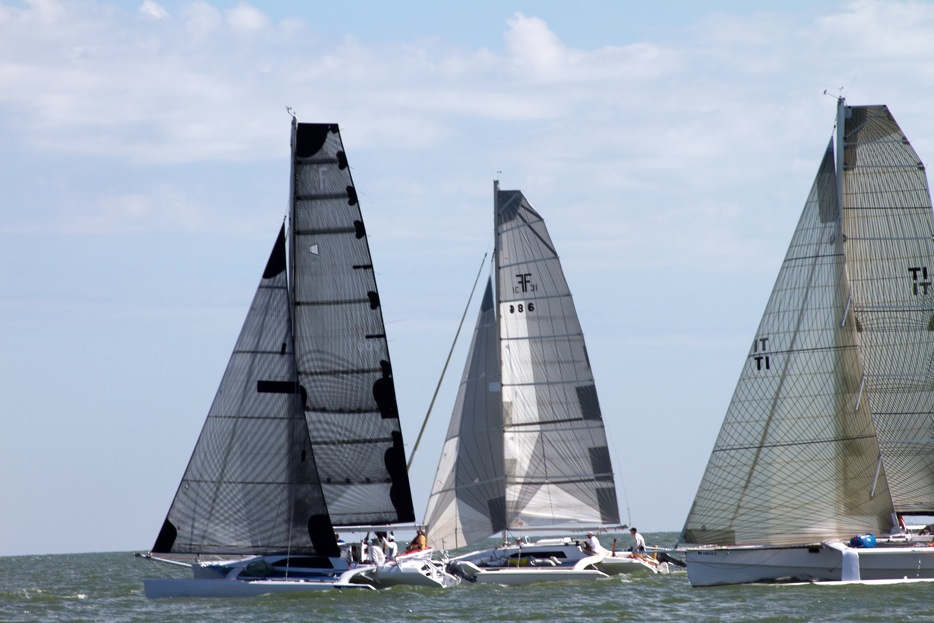
I have been meaning to do the synthetic stays also. I would use 4mm ultrex with a breaking strength of 3150lbs for the forestay and 1/8 for the sidestays.
I was sailing my old HT with my previous co-owner after the RTI in June and we had just gotten off the beach (the fad happened to be there also) and were getting into the groove when he sheeted in the main and BLAMMM... the foresay parted. (fad did not even offer to help, but then again, a power boat graciously towed us back to shore). This was more-or-less brand new 1/8 7x19 wire (why 7x19 you ask? why not?) which we put on when we replaced all the standing rigging when we got the boat. Thankfully it broke when we were near shore, rather than the day before when he was in the Gulf.
It didn't break at the swages- it broke in the middle. He then put the original back on and used it for a few sails then realized some of the strands on that were breaking!
I made a forestay with closed thimbles for him out of 5/32 ultrex and it has worked so far (not a lot of use) but it is difficult to tension correctly because of the creep. But it is easy on the HT to adjust for this with lashings to the bow tangs for the bridle wires.
From that experience I now understand how much tension the forestay is put under. Clearly the highest loaded line of all the standing rigging - esp with max sheet tension and 400lbs on the wire near the back of the boat.
I've been using Excel D12 3.5mm now for 4 years on the Stealth, yes it has stretched a bit initially when first made, it does abrade slightly around the bridles where the spinnaker constantly rubs, and it does look a bit dirty after a while, but the advantages are so many that I cannot understand why more experimental boats are not using it.
What are the advantages, very easy adjustment of length of stays to the extent that I no longer have adjusters, its quicker to simply resplice the stay, extremely light in weight, doesn't snag and rip clothes, very cost effective if you take into account the need for any alteration of length and I can go on and on. Give them a go you will be impressed. <img src=

alt=
/>
Can you post pictures of your setup on this forum ?
Seeing is believing and I sure want to believe this.
Wouter
Wouter,
I am wondering how accurate your calcs are. The reason being I used 2.5mm dyform on the Aus Blade at Zandvoort & its worked fine. No sign of failure obviously & I was getting about 110 - 120 degrees of rotation down wind.
Do you know what the breaking strain of 2.5mm dyform is.?
Marcus
690kg
690kgs?? thats just about the same weight that you carry
in your pants
isn't it Marcus?
Actually I just re read Wouters post, he states 625kgs.....so which is it 625/690??
Wouter - how did you incorporate/calculate the shockloads that go thru the hull & rig like what we saw at Zandvoort & the image of matts boat.?
Maybe both ? Different companies different publized specs ?
Surely there is more then one company in the world make steel wires ?
However, I've written most of my post from memory, I haven't done a detailed check-up on the facts. Although I'm pretty sure about most specs used in the posting.
Good question, How would anyone go about that ?
Such a calculation would require a much more elaborate model and in depth knowlegde of the causes of such shock loads like wind gusts, sea-state and sailor behaviour. And even then it can only be made to work after making a whole lot of assumptions. Such a model will easily take 1000's of hours in research and implementation. Even when using some of the modern software simulation packages. These packages make creating pictures and nice looking graphs easy, but they do not do the modelling for you or finding all the parameters for the variables involved in such an elaborate model.
Basically this is the reason why engineers use safety margins so much. And it is the prime reason I don't want to skim on these. I made a static calculation assuming perfectly stable conditions and flat water. The result was that the forestay would see 571 kg (rounded off to 600 kg) tension already under these conditions. A 720 3mm 1x19 wire only had some 26 % safety margin on that. Apparently 2.5 mm dyform has less then that. I felt that considering the
perfect
nature of my model that that was too little. So I went for 1235 kg for 4 mm 1x19 with a safety margin of 116%. A little bit too much but it was the only alternative I could find. No-one could sell me 3.5 mm 1x19 or 3 mm dyform, both of them would have better.
Wouter
Years ago I had a small, quite inexpensive, instrument specifically for measuring maximum rig loadings under actual sailing conditions (read in lb’s or maybe ft lbs I can’t remember back that far). It was a small gauge that I used to attach between the rigging wire and its anchor point either at the hull or at the hounds up the mast, and it would show the maximum loads that the rigging at that point had been subjected to. It had a graduated gauge and the reading would stay at the maximum that it had been subjected to. To use it again it was a simple press point reset back to zero. It was very interesting initially but as the max’ readings never ever approached the safe loadings given by the wire manufacturers, I stopped using it and like most unused things it has gravitated to that “unknown place” where all such similar things seem to disappear to.
I also used at that time a “pressure pad” that I would place under the base of the mast to show, similarly the maximum compression generated down the mast. I also stopped using that years ago as well. Actually from memory, unlike the loadings on the wire, which were quite disappointingly low, some of those mast compression loadings were quite horrendous.
We still regularly receive “industry” advertising literature offering for sale a whole range of suitable instruments for measuring every conceivable loading on every conceivable material in every conceivable position, the big difference “now” from “then” is that they all cost an “arm and a leg” to buy now. BUT THEY ARE ALL DIGITAL (which obviously makes them better and worth more, although they still only do the same job with no apparent greater accuracy if you can believe their data)
Darryl,
The mast base is not only subjected to compression loads as the mainsheet angles on most cats put a lot of pressure on the goose neck to aid the mast rotation. I am not stating the boom bressure to be higher than the compression load, but you would want to consider all aspects.
Somehow I dont think there is gauge that could do both.?
Wasn't really interested where the loads were generated from at that time Marcus, only interested in the sort of loads that were acting on the front beam. It was a time back in antiquity when there was (strangely as we would see it now) great argument as to whether a dolphin striker was or was not needed and what if any effect the inclusion of one would have on a boat.
Would you now believe that there were many people who were adamantly opposed to Dolphin strikers for all sorts of “off the wall” reasons – they were dangerous to swimmers (mind you off the beach sailing “back then” WAS conducted amongst hundreds, even thousands of swimmers, no concerns with UV then), people argued that a striker would make the boat too rigid between the hulls and it wouldn’t sail as well as it would “bounce” across waves instead of “walk”, with the distinct possibility that the extra rigidity would some how make the cat “shatter” if hit by a big wave instead of “flexing” to absorb the shock. I remember one “expert of the time” telling me in a very Ernst manner (I won’t say who as he is still around and may not want to be reminded) that the drag incurred when the striker hit the water at speed was known as a fact to have caused the death of some sailer some where or other by flipping the cat high into the air and landing on top of, and impaling him on the mast??? The Hobie 14 (and early 16’s) were held up as the example of good beam design as the early ones never came with a dolphin striker (soon changed when repeated non striker beams failed)
It’s amazing how adamant “proven expert fact” can change over time isn’t it.
here here.
My Windy 14 and my Hydra have not had dolphin strikers. It is a pain when righting. The Hydra especially is high sided and no strikers does not make getting back on any easier.
The Windrush front beam extrusio is maybe 6ml thick on the high and low side to compensate.
It is a clean look though.

Interesting comments on dolphin strikers. Anecdotal evidence tells me strikerless is best... The co-owner of my Nacra 6.0 suffered the loss of the dolphin striker, and hence the front beam, due to corrosion in the striker (i.e. where it was drilled for the bolt to connect one end to the beam). On another occaision, I lost a large chunk of flesh from my shin to the same dolphin striker when my helm hurled me forward off the boat as we hit a deep trough while trapezing, with the inevitable result as I swung back in towards the beam (actually quite hilarious, and a source of many a laugh - he refused to slow down while I recovered myself, and more to the point gave me a good tongue lashing for abandoning ship without permission. His face was a picture when he finally saw my leg! Also, as we were in Aruba, plenty of tales abounded about getting out of the water quickly, to escape the sharks attracted by the blood! - and before anyone asks - no, there weren't really sharks - but our wives didn't know that!).
Anyway, by comparison, my Spitfire is strikerless, and has proven itself to be robust and leg friendly. Guess which I prefer!
Do you remember the purchase on the mainsheet system the boom length, hull length and wire thickness that was used on that boat ?
With such data a surprising simple but accurate way of estimating the rig loads exists. It goes something like this, for all you home builders and home modifiers out there.
Pitching moment mast =
(pull in mainsheet line * purchase mainsheet * length boom - righting moment crew+craft * 0.40
+ righting moment crew+craft/0.5*width boat * distance the sidestays are back from the mainbeam
This coveres respectively = moment due to mainsheet - moment due to sail drive + moment due to sidestay (only in centreline plane)
then
Forestay loading = Pitching moment mast / distance bridle points hull to mast step
Side stay loading = Righting moment crew+craft/0.5*width boat
Mast step load = mainsheet pull * purchase + forestay loading + side stay loading + weight rig
Bridle loads = forestay loading ; when the bridle wires are under a 30 degree angle (typical cat rig)
else
Bridle loads = 0.5 * forestay loading * length bridle wires / bridle strop height
Note that the highest stay loadings are achieved not with the crew trapping but with the crew hiking. For a trapezing crew an additional factor (deduction) needs to be added and that lowers the load in the sidestay significant which in turn lowers the forestay load.
Righting moment of a crew hiking can be estimated by :
Weight craft * 0.5 * width craft + crew weight * (width craft + 0.5 mtr)
Example : For a Taipan F16 with a 150 kg hiking crew (no trapezing) and 7:1 mainsheet purchase :
Righting moment hiking crew = 107 * 0.5 * 2.5 + 150 * (2.5 + 0.5) = 584 kgm
Pitching moment mast = 50 kg * 7 * 2.15 - 584 * 0.40 + 584/1.25 * 0.70 = 846 kgm
Forestay loading = 846 / 1.37 = 618 kg
Sidestay loading (hiking crew) = 584/1.25 = 467 kg
Mast step load = 50 * 7 + 618 + 467 + 25 = 1460 kg
Bridle loads = 0.5 * 618 * 1.22 / 0.7 = 539 kg (my Taiphoon has a larger bridle angle of 35 degrees)
This means that if all sailing conditions are perfectly stable (no dynamic forces c.q. gusts, shock loads, crew moving aroun) that the force situation needed to just keep the mast motionless on the vertical REQUIRES the above loadings. Without them the mast will fall down. Of course, dynamic forces will both increase and decrease the above loadings. A typical safety margin is to choose wires that can withstand 150% to 200% of the above calculated loadings.
The accuracy of the above numbers is around 5% from the modelling perspective. I've neglected the angles the stays make relative to the vertical and the pressure on the boom. These are however very small contribution. An example, A boom loading of 100 kg will only increase the mast step load by a mere 3.4 kg (=0.23%)!
I made a excel sheet with a more complex model then above and the results there don't differ by more then 5%. Making a similar model in some fancy designers software isn't going to produce more accurate results. Mostly because the same assumptions need to be made anyway and these are most limiting on the accuracy achieved.
Now all you homebuilders can design your own rigging.
Wouter
Ahhh, a dolphinstrikerless setup can be made to work, some of the earlier Stealths had these as well.
The downsides are :
- A heavier boat (by about 5 kg at least, most often by a shy 10 kg)
- Trouble keeping the mainsail leech tight (even with a much heavier beam)
The above two reasons are the causes why any formula based racing boat has a dolphin striker setup or (dolphinstrikerless) carbon beams. However, there are also a good number of examples were carbon beams are also fitted with a dolphinstriker setup for additional stiffness.
These issues became increasingly more important when the craft becomes wider. A dolphinstriker setup scale well to a wider width, a dolphinstrikerless setup doesn't. The latter means that the beams must become disproportionally heavier to maintain the same overall stiffness under mast step load.
I think the Spitfire is the only wide design with a dolphinstrikerless aluminium beam setup. All others are more narrow or use specially reinforced carbon beams.
Wouter
Thank You.
Easy to understand (for the most part).
This aprox 100 strands of Aramid (Kevlar) holding 217 kgs.
Dind't look like breaking. Just tied knots in each end (they slipped), no protection from fraying.
Further experiments are iminent, along with some specs.
TJ
Thank You
Easy to understand. (for the most part)
TJ
Image isn't complete.