
Then it seems that a normal rudder system would work if the trim fins can be articulated so they stay level even when the rudder is tilted in a halfway up position. Gotta keep you engineers busy. 

Bear in mind that cassette rudders have been a Stealth feature from the time the boat was put into production - which was some time before the T foils were added to the boards. I've always looked at it from the point of view that if you're going to hit something with the rudders, you'll have already hit it with the dagger boards....

Hi all,
is scratching of blades a big problem, many cats in OZ use to use dagger type boxes, but I thought one of the reasons they stopped was scratching of blades. As far as kick up is concerned this is easily fixed as Darryl Barrett suggests.
Many cats I have seen have deeper rudders than centreboards, I know on the mossie I have hit rudders on bottom without hitting centreboards. Mind you kick up rudders are not of upmost importance, I sailed a Contender dinghy with a 3' deep fixed rudder for years and survived, mind you a cat is harder to steer to deep water without the rudder than a dinghy.
Regards Gary.
It seems that everbody thinks the Stealths "T" foils are only a down wind advantage - NOT - Just to clarify things i had a chat with Jon Pierce (Stealth Designer) and this is what we came up with. Going upwind with the "T"s the boat adopts a rather "different" feeling about her, when a gust comes and the boat heels/accelerates and whereas before you had that feeling through the rudders that she was trying to "screw up" into the wind now you dont. Jon reckons that its a combination of a) by keeping the bow up you reduce the forward wetted area thus leaving the centre of effort and the centre of pressure pretty much where they were designed and b)because of the angle of inclination of the "T"s as the boat heels they operate like mini-rudders and try to keep the bows off the wind. All i know is that it just improves the overall feel of the boat.
Is it possible to design T-foils that are removable -- clamp on somehow?
Those T-foils are kind of wicked-looking. What happens to your body if you are on the trapeze and slip off the back of the boat and are trolling in the water right by or behind the rudder?  I know...leave it to a woman to think about a thing like that -- but men might have more to lose.
This was in Scuttlebutt:
HIGH PERFORMANCE SAILING
(Following is a brief excerpt from a feature on The Daily Sail subscription website presenting an update on the International 14 class from the UK perspective.)
Like the Moth class, the International 14s are entering a 'period of consolidation' after inclinable rudder T-foils became de rigeur a couple of years ago transforming the performance and the necessary technique required to sail the boat. After attempts at putting foils at the bottom of the rudder, the class norm is now to fit the foil half way up and there is a general trend towards thinner foils. At present there are still essentially two systems for altering the pitch of the rudder T-foil: the Paul Bieker set-up which contains an internal push rod, the foil moving independently of the rudder blade and the RMW Marine/Morrison system where the foil and rudder are one part that is inclined in its entirety relative to the hull. Bieker it seems may be moving towards the RMW system as at the Worlds he was trialing a one part system - the advantage of this is that with no moving parts to squeeze in and the foils can have a thinner section.
At present 'period of consolidation' does not equate with the 14s following the Moths in going fully foiling. At the Dinghy Show we spoke to the class' Dave Spragg who in fact has successfully tried fully foiling his 14 using the exact same gear as the Moths (lifting foils and the wand made by John Ilett's Flatacraft company in Perth) but all of it 50% bigger. "I've got one. I've flown it, but I don't think it is way forward for the class in the short and medium term," says Spragg. - The Daily Sail, full story and pictures: www.thedailysail.com

Marcus, Wouter and all,
Thanks for the info and pics.
If possible, could one of you provide a measure of some sort?
For example, the width of the rudder ( fore and aft) at the bottom.
From that data, we could approximate the rest of the dimensions.
Thanks again,
Bruce
I17
St. Croix 
MAry and All,
1. The idea of 'removable' was interesting.
2. IF one were to make a fitting with rubber grommets and a 'pin'(s) to attach. Of course, it would have to be a nice job design to reduce induced turbulence.
3. IF this was possible, the one could fit to a rudder and/or a d-board.
..thanks again for a great line.
regards,
Bruce
St. Croix

in a word yes. David Lugg's fully foiling I 14 had plug in foils. Simply put two 1/4 inch rods into the foiling foil and two corresponding female 1/4 sockets. If the fit is tight enough you shouldn't lose the foiling foil. When one isnt using the foiling foil just put a piece of tape over the holes.
I guess locking grub screws could be used on this princple if one wants surity the foiling foils arent going to drop off in surf.

Hello All,
Once again, thanks to the sailing 'minds' out there....here comes a 'daaa' question,
1...does the foil need to be at the very tip of the rudder?
2. ..could it be ( say 25% up) and still function? (..for example, with a 2 foot rudder, could one place the foil at
1 foot 6 inches,..or 6 inches from the bottom?)
...this discussion will lead to another point..
regards
Bruce
St. Croix
Brobru,
See the post about high performance sailing (five or six posts back). International 14's are putting the foils halfway down the rudder.

Bruce
I would put the foils at the bottom.
Gives you just a little further to lift them out before you loose all "bite"
I've been told that sailing with them is fantastic untill you put the bows in so far that the T foil comes out of the water, at this point you instantly loose all the benefit of them and Splat, you are swimming.
Hello to All,
Mary, thanks for pointing me to the I14 post ( and answer),..I guess I should read closer.
Here is my question;
Could these folis be put on standard articulating rudder systems?
Granted, cartidge is best.
And, excluding braking beach wave condions.
I moved my boat from the y.c. beach back to a public beach this week. It was about a mile. I did not raise a sail, just threw the beach wheels on and floated down witht he wind. I sat on the rear crossbeam, pushing off with 1 leg when it got shallow.
Here is my observation. The rudder was locked in 'up' position. The rudder was horizontal. It was never more than 30-40% submerged ( I would steer with it).
Seeing where the foil is attached to the rudder, the aft aspect, in the 'up' position, the foil would safely not come in contact with the water ( get ripped off, etc). So. one is ok there.
I do not know about you, but when I launch, my rudders stay up until I clear the mooring area or until I have a 'clear path', or deep water( in the locked up position, and weight to the back, enough of the rudder is in the water for steerage)......when I do set the rudders, the boat is stopped or at a crawl,...down goes the rudder, then I check that they are 'locked',....and I power up and go.
Knowing this,.....could one safely use the foils on a standard 'articulating' rudder system?
I respect your ideas, comments and opinions.
regards,
Bruce
I-17
St. Croix
Bruce
I think the answer to this is no, the only way I can see is that you can fit them to kick up rudders is if you pin them down before you go out, so you must have the boat in deep enough water to be able to have the rudders fully down before you get on. I doubt you will be able to get enough rudder in the water to steer with the T completely clear of the water.
I can see no way that you will be able to steer the boat with these on unless the rudder is fully down.
If you do manage to make it work, you will have to pin them down, the loads get quite high when they are working hard, it would be a disaster if the rudders kicked up just when you were flat out and the only thing stopping you from pitchpoling is the foils.
1...does the foil need to be at the very tip of the rudder?
2. ..could it be ( say 25% up) and still function? (..for example, with a 2 foot rudder, could one place the foil at
1 foot 6 inches,..or 6 inches from the bottom?)
Depends on what the reason is for the foil. If it is to create a negative wave. Then it needs to be high up on the rudder.. Im sure Bieker has a mathematical model as to exactly where..
If the foil is anti-pitchpoling then a long as it is in the water it will work. Remembering that the base of the rudder means you have only one drag creating interface. Higher up and up and you have two.
I want it all. I want cassette rudders, but I want the whole cassette to be able to kick up (like the new Farrier system). And I want T-foils, but I want them to be removable and movable to different locations. And I want the T-foils to be able to be angulated up or down depending upon what works best in different conditions and points of sail.
Am I asking too much? 
I want it all. I want cassette rudders, but I want the whole cassette to be able to kick up (like the new Farrier system). And I want T-foils, but I want them to be removable and movable to different locations. And I want the T-foils to be able to be angulated up or down depending upon what works best in different conditions and points of sail.
Am I asking too much?
Nope, not if you intend building them yourself ! 
While you`re at it, Mary, I`ll have a set. Make them black, please.
What you`re asking for is probably do-able, with a huge amount of engineering, design and fiddling. Once you`ve built 7 prototypes and tested them thoroughly in all sorts of conditions, you`ll probably end up with something remarkably similar to the Stealth foils as the best solution. Everything has a beginning and an end, and they`re usually in the same place.
Cheers
Steve

Am I asking too much?
Except for the T-foils, you might take a look at the Topcat rudder design. This might not the most fancy but has excactly what you want. I attach a page from the F2 page showing it.
Mary
You are not asking too much, but you might think that I was if I gave you a quote to build your rudders. To give you an idea, the int. 14 rudders that have been talked about cost in the region of $2000 each and you will need 2 of them, and these rudders don't have all the features that you want.
"I want it all..." OK Mary, now you are sounding like MY wife!
Timbo, your wife is interested in rudders? How lucky can a sailor be?
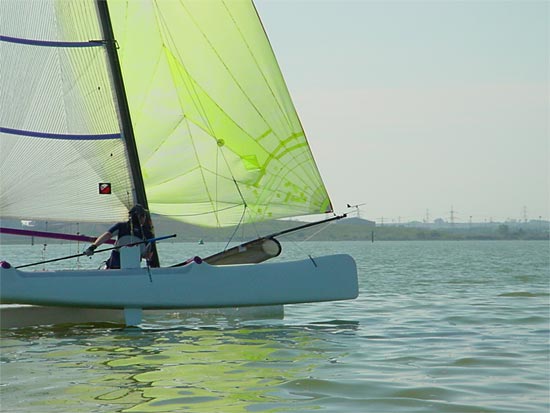
Just thought I'd add my two pence worth to the debate. Having sailed a Stealth for two seasons on tradition rudders I've recently purchased the new Stealth F16 with T-Foils. It was noticable from earlier light wind outings that the boat is very stable for/aft particularly downwind. A very planted feel with no noticable side affects.
However last weekend saw some decent wind and the chance to see what they could really do. Twin trapeezing everywhere, try as we might we just could get the boat to stuff the bow in. On one occassion when lossing my footing downwind and swinging forward into my crew I was sure it was cartwheel time and would have been on my old boat but nothing more than a slight bury with no water over the top of the hull.
There is another Stealth F16 at my club who has been racing with the standard rudders while waiting for his new T-Foils. There is no difference in performance between the two setups. Until it gets scary downhill that is!
John Pierce took a load of photo's and some video of the weekend so will post when we get organised.
Wouter - If you're there, I've very regretably had to pull out of Texel. Maybe see you next year.
Aaron,
Are you going to Marconi for the ECPR ?
I'm planning to be there
Cheers
Simon
Simon,
Yes, should be there for both days hopefully. John Pierce mentioned he may be going and a couple of other Stealth's from Datchet as well by the looks. I'll probably only manage Colne Pt as sailing 1-up.
See you there.
Aaron
Got a CD in the post today from John P with 150+ photo's from the weekend. Won't bore you with all of them.
Aaron
2
3
4