

I've been sailing my F18 (2004 Nacra) for a few months now, including a 70 nm raid. The learning curve is steep indeed on those boats, but I still have a few unresolved issues mostly dealing with how to manage the boat under spinnaker (F18 people actually call it a jennaker here in Italy).
Anyway, my first fundamental question is: how to react to a puff, when the windward hull starts to fly a bit too much? I've been experimenting a bit lately and find easingthe main traveler (let alone the sheet) almost uneffective. The only viable way to flatten the boat is to bear away, but the change in direction is very substantial and the boat looses speed a lot. What am I doing wrong?

You should already be bearing away as the gust hits. Also in these conditions make sure both centreboards are all the way up and your crew is trapping off the transom. You should also experiment with the crew sheeting the kite on in gusts to flatten it and reduce power. Its counter intuitive but in some conditions works a treat.
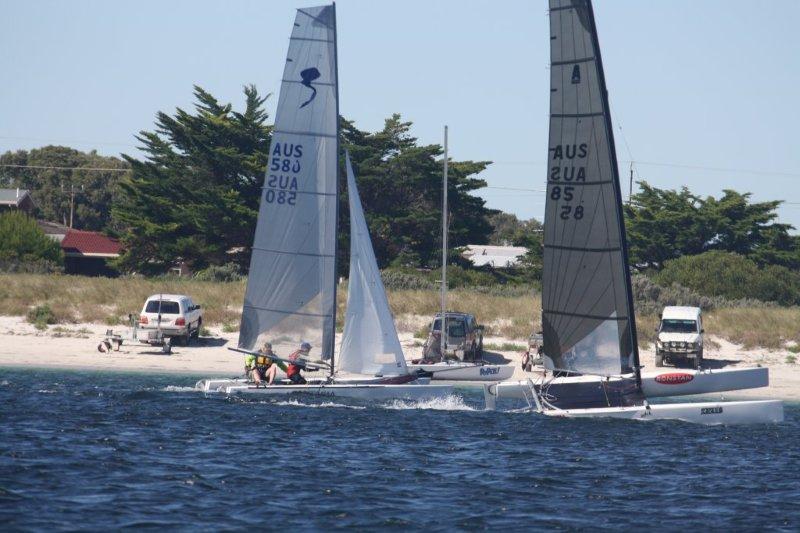
i would be very careful about letting mainsheet off when you have the kite up, the mainsheet tension works as a backstay, if you it off during a gust with the kite up you run a good chance of losing the top of your mast!!!!. keep your weight back and be aware when the gusts are coming and dont pull away too hard, your probably being too aggressive on the rudders and using them as brakes rather than steering.
good luck!!

You can ease the main traveler and it actually does have a depowering effect, but it's not fast to play it and you should only use that as a last resort, like in HUGE puffs. If it's crazy windy and you feel like you have no control, leaving your traveler down around 6 inches will help.
You should be playing your mainsheet downwind, it is your backstay, so don't let it completely off (or drop it while it's uncleated), but the F18 masts are strong and can handle the abuse. That being said, make sure your mast rotator is out, almost at 90 degrees, or just completely off, this will help support your mast better, give you a better sail shape, and use your mast more effectively. Ease your main from your upwind setting then as you get puffs ease it as your bear off, if you need to bleed some power ease your main a bit more than the optimal sheeting and it will spill air off the head. As you head back up (after the puff) sheet in again. The windier it gets, the less you ease from your upwind setting to the point that your almost just easing a few inches. If it's really crazy, oversheeting the main will also depower you downwind.
Also, not sure if your doing it, but make sure to ease your downhaul downwind, it can be tough to stay in a groove if you don't.
As you get a better feel for the boat you will learn to steer in a groove that the hull is constantly skimming and when you feel it getting too high you can bear off a bit to keep it just skimming. If you don't anticipate the puff in time and the hull does pop up, remain calm (unless your actually going to flip!) and bear off smoothly.... you will waste the puff but you will keep moving forwards fast and stay in a groove. It's not the end of the world to pop up high, but if your doing it too often you are probably heating your boat up too much in the lulls and not sailing a low enough course. Also, if your hull is consistently up or popping up, make sure your crew is on the trapeze.
Don't pull your boards all the way up, just 2-3 feet, more as it gets windier.

Every now and again in a blow (particularly in short chop) sometimes the boat feels very bound up down wind and can't get any speed without shoving the nose straight down. In those situations often letting out a few inches of traveler settles the boat right down and lets if fly.
As others have suggested - don't ease the main. That will end it tears one day.
Tiger Mike
Have you actually seen a Tiger mast break where you were sure it was the mainsheet eased too much? I've seen half a dozen masts break for one reason or another, and there was always something else... spreader failure, mast rotated in, downhaul on, etc. I've dropped the mainsheet on my boat on my N20 and on my F18 and the mast was fine. Plus, we have insurance for a reason, sail the boat fast, worry about breaking stuff when it happens.
Look at this picture of Mischa going downwind at Canadian Nationals... this is pretty much the most you'd ever want it out, his head is just on the verge of twisting off and bleeding some power, the most you'd want to let it out would be another 6 inches, plenty of support still there for your mast.

Sound words from everybody, but i would like to ask my usuall question.. How old is the spinnaker?
If it is more than a season old, the leech may be tight and not letting the air accelerate out of the sail.
A bad/old spinnaker is always most obvious in a breeze
The spinnaker is indeed quite old. I have a brand new one but am still using the old set of sails for my training... here's a recent picture:
![[Linked Image]](http://www.raiddellamagnagrecia.it/2010/album_fotografico/raid/vin0009b.jpg)
It doesn't even fit the boat!
Get rid of that thing and put the decent one up - then report back on the difference
Paul, what do you mean by
fitting the boat
? It's a F18 spi for sure...

fitting the boat
? It's a F18 spi for sure...
Luff looks waaaay too short.
Compare the picture of Mischa with yours; you have a lot of Spi halyard showing
Hmmm that could be due to our (mine and my crew's) limited experience on these boats, so maybe the bowsprit was not set at the correct height and/or the sail was not properly set. COnsider that by the time that picture was taken (July this year) that was probably our third or fourth time out with that boat. Anyway this is a very good point. Since I'm here: what are the golden rules to properly set the spi on an F18?

Clew and Tack swapped arround?

Pole too low, crew too far forward, mast rotation not let off, spin halyard too lose. looks like you are having fun though and thats what counts.
To set your pole height lay the boat on it's side (can be done upright but you'll be stressed and you want to take tuning slowly and carefully). Pull your kite all the way to the mast. Now set your pole up so with the halyard tight you have and 50mm (2 inches) of tack line visible between the tack of the sail and the pole.

Looks like the luff is at least a foot too short (maybe even 2 feet), hence, doesn't fit the boat. Check rigging manuals for the boat type, but usually the luff distance should equal (or around) the distance from the hoist point to the spin pole.
Anyone google or have the rigging manual for that boat, should be some indication on pole height / luff length, I'm doubtful that the pole is two feet low...
Looking at the pic, that kite almost look symmetrical with an offset douse patch... I'm with Paul on this, that ain't an F18 kite.
Here is a photo of our old boat and it looks like the spin is about a foot from the top of the mast. I think the old Nacra F18 were set up that way. facebook
My boat is the 2004 model. The spi is indeed an F18 spi but I understand that the official sail shape was modified in the last years, so the boat was set up for the new spi dimensions which required lowering the pole. I'll check with the new one and will report here.
You should be playing your mainsheet downwind, it is your backstay, so don't let it completely off (or drop it while it's uncleated), but the F18 masts are strong and can handle the abuse. That being said, make sure your mast rotator is out, almost at 90 degrees, or just completely off, this will help support your mast better, give you a better sail shape, and use your mast more effectively. Ease your main from your upwind setting then as you get puffs ease it as your bear off, if you need to bleed some power ease your main a bit more than the optimal sheeting and it will spill air off the head. As you head back up (after the puff) sheet in again. The windier it gets, the less you ease from your upwind setting to the point that your almost just easing a few inches. If it's really crazy, oversheeting the main will also depower you downwind.
Also, not sure if your doing it, but make sure to ease your downhaul downwind, it can be tough to stay in a groove if you don't.
As you get a better feel for the boat you will learn to steer in a groove that the hull is constantly skimming and when you feel it getting too high you can bear off a bit to keep it just skimming. If you don't anticipate the puff in time and the hull does pop up, remain calm (unless your actually going to flip!) and bear off smoothly.... you will waste the puff but you will keep moving forwards fast and stay in a groove. It's not the end of the world to pop up high, but if your doing it too often you are probably heating your boat up too much in the lulls and not sailing a low enough course. Also, if your hull is consistently up or popping up, make sure your crew is on the trapeze.
Don't pull your boards all the way up, just 2-3 feet, more as it gets windier.
May I sum this up?
Usually the traveller is centered, the main sheet is tight (at about 2/3 of the upwind position?) and gets tighter when wind increases. When wind is really strong, you ease the traveller a bit. Is this correct?
When you are midst in a pichpole, is opening the traveller fast (leaving the main cleated) the solution to depower, apart from easing the spin?
The only other situation you open the traveller is when you have oversteered the downwind-mark and have to point higher. But how much and what happens to the main?
Actually my question is probably even more basic: when the spin is up and a hull comes up too much, what's the best way to lower it gradually:
1) bear away
2) ease the mainsheet (no no, I understand)
3) ease the traveller
4) ease the spin
or a combination of the above?
pray!!!!
bearing away ( gently, without ripping hard on rudders, if you slow you down to quickly, you change the apparent wind and it will push you over more)
easing the kite is also good at same time
OK, that makes much sense. Thx!
Look at this picture of Mischa going downwind at Canadian Nationals... this is pretty much the most you'd ever want it out, his head is just on the verge of twisting off and bleeding some power, the most you'd want to let it out would be another 6 inches, plenty of support still there for your mast.
I broke a Tiger mast once. Almost certainly caused by insufficient main tension. Note it was very high winds - 25+ knots + a gust. Spreaders, diamond wires etc etc etc were all in tact when it came down.
Tiger Mike

Note though that this thread has yielded two opposite answers for what to do with the spinnaker sheet when the windward hull starts to lift to much:
A good skipper tells me that oversheeting the kite is a better way to settle the boat back down because he doesn't have to steer down so much. This struck me as backwards, but he would certainly know and I'll be trying it next time we're out. Can anyone explain to me why this works, or in what kind of conditions it works? I guess once you start to stall the kite you've got a lot less force sucking the mast over (and the boat on its ear)? Thanks.
if you think of the scenario, wind is behind you.
same with mainsail, if you let main sail all the way out,ie sail is 90 degrees to the wind, you are exposing the maximum amount of sailarea to the wind. therefor, if you sheet in,sail is 0 degrees to the wind, you are exposing the least amount of sail area to the wind, therefore more in control, less healing leverage is applied to your rig.
when i said easing the kite, i meant more than enough so it gets to a point where it can spill wind, not just easing a foot or so.
That works in my Laser going DDW. But at 19+ kts downhill in an F18 the wind is practically in my face, and it stays there unless we start to stuff it (at which point it quickly clocks back). Assuming we keep the front from digging in and the boat keeps moving, the last thing my gut tells me to do when the puff hits is sheet in on the kite. But I'm told this works great.
the trick is to be able to change direction without slowing down too much, apparent winds etc. be subtle, but do it very quickly
Well, I'm enjoying this. BTW, this thread is slowly becoming
F18 downwind steering
. I was at the beach this morning. No wind at all, so plenty of time to discuss with the others. The discussion went on how to steer an F18 downwind with the spin up: I know, luff to gain speed, bear away to gain ground. Yes, but how often are those corrections made? Every 5 seconds? Every ten seconds? Once in a while?
It should be your aim to keep the hull in the same distance from the water surface the whole time. If it flies to high, bear away, if comes down, point higher. All this very subtle, depending on the wind changes in speed and dirction.