

AHPC late 2005 ?
Most probably a full kevlar laminate hull.
Bill was looking at an older hull
Wouter
Ok Here is Wouters post from the F16 Forum
I actually did a wrote up on securing the mast a while back, try a search on the forum. By now we have 7002 postings and I don't exactly remember when I wrote it down.
But in summary. The mast on the Taipan is not a stiff pole by any stretch of the imagination. You'll need to secure it very well for it to survive any harsh winds. Problem is not strength but resonance. Even a mild wind with the right exiting frequency can seriously vibrated that mast.
However I found that some very simple mods can make your mast totally resistant to anything the wind and weather can throw at it. I've tested it for many months out here on the beach at my local club and we had a few storms since then. Of course the platform needs to be tied down very well and rather tight, absolutely no slack may be in the tying down. The platform is only 55 kg and if it has room to move about then it will dig itself into more room and finally escape.
The mast when supported with only the three stays has a resonance frequency that is very common in normal wind patterns. Very bad for mast up storage. However if you use your mainsail halyard and spi halyard to stabilize the top of your mast in addition to using your mast rotation and boom to stabilize the rotation then you mast will stand straigh and still as a telegraph pole. By stiffening up your mast like this the resonance frequency has been place well outside the range that are encountered in wind of any type.
Roughtly
-1- tie teh start of your mainsail halyard off on the mast; the other end (which goes up and through the small block at the top) you tie off to the end of the boom near the outhaul line. Use the outhaul line to prevent the halyard from sliding along the boom towards the mast.
-2- Now use your mainsail traveller control line to pull the boom down. You do this but graping a loop (between the cleat and the car) and throwing this over the end of the boom. Now pull the traveller line tight and cleat it. Your mainsail halyard is now tight and pulls the top of the mast slightly backward. Also the boom and car are now centred and can't move to either side.
-3- Now pull in your rotation limiter towards the boom thus securing the mast in the way of rotation as the boom is well secured by the mainsail traveller line and cleat
-4- If you have a spinnaker setup then. Tie both ends of the spi halyard off to one another and pull the halyard through its cleat till the spi hayard is tight and its acts like a second foresay. This will go all the way up to the spi gate on the mast. Now the mast is completely secured in the fore and aft plane and the fixed rotation will prevent oscilations over its minor axis (side to side)
When things get really dicy then use the trapeze line to secure the whole boat to the ground in addition to the ties on the platform itself. If the mast can't move than the the platform can't either. I have adjustable trapeze line with a jam cleat and I use them to put some tension on the trapeze lines so the boat has absolutely no play anywhere.
I only use two tie downs for my platform. Coming up next to the hulls and I tie them off to my side stays. I then pull a peice of tough foam underneath the lines to get some real tension in them and to prevent the lines from rubbing on my hulls and layer of paint.
In the past I used to stabilize my spreaders with an extra line as well but found that that really wasn't necessary.
So my advice =
- 2 ties on the sidestays.
- Main halyard, boom, mainsail traveller line, mast rotation and spi halyard triangles to further secure the mast
- when required additional tie down using the 2 or 4 trapeze lines to fixed points on the ground neary
Fixed points in the ground must be really secure as the wind can pull out alot of simple stakes or poles. Easiest and best is just a planck or pole that is burried horinzontally at say 2 to 3 feet deep. Tie a line to the middle of it and use that as a secure point.
Good luck,
Wouter
--------------------
Wouter Hijink
Taipan F16 (one-off; homebuild)
The Netherlands

Pete:
If you decide to get a A2, Pete Melvin suggested I contact Ben Hall and have him make a spar based on my weight and sailmaker and have it sent to Performance Cat before boat was put together and add any extra support needed for a spinnaker.
Doug
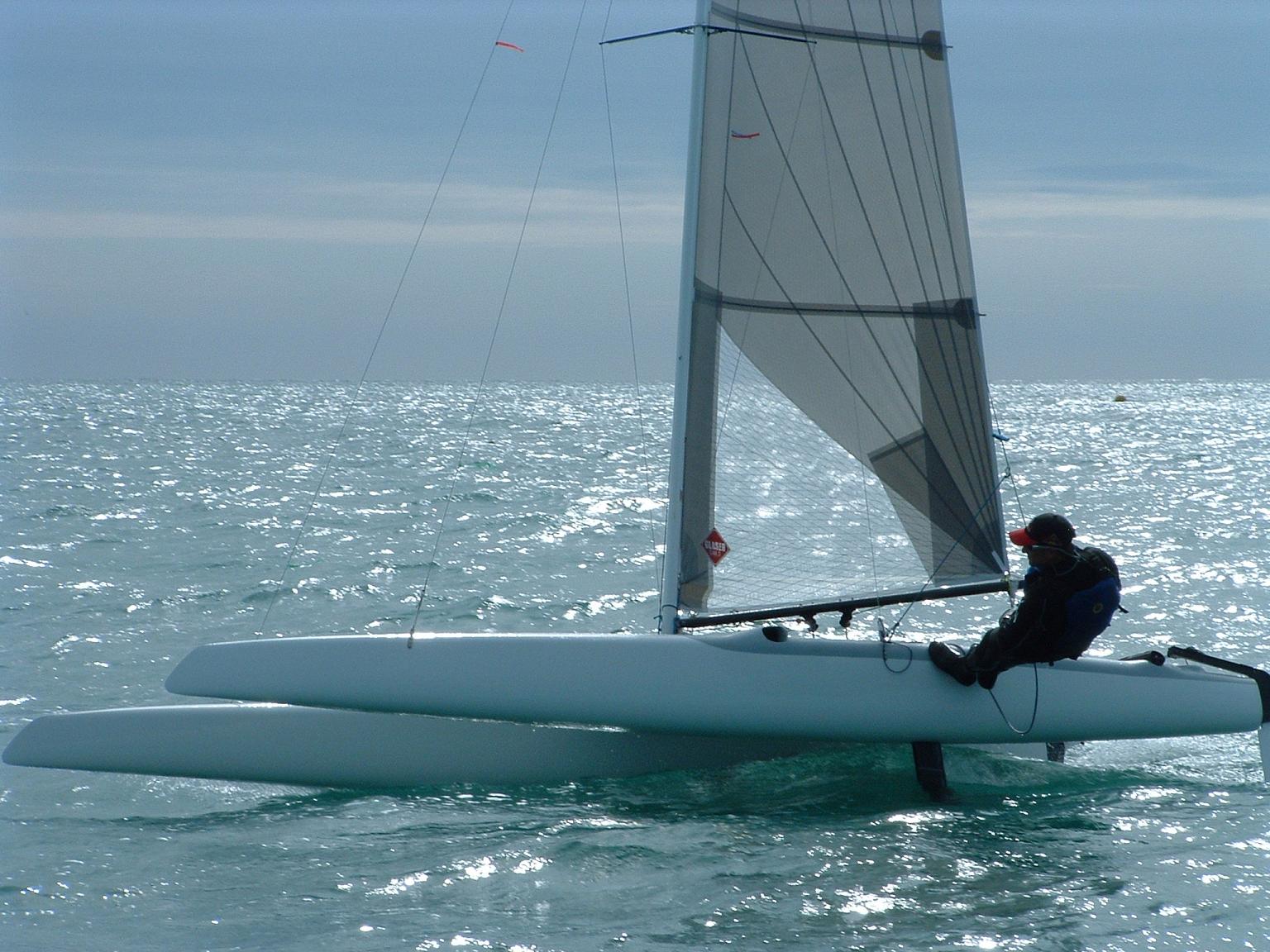
Colin's new Flyer is beautiful. It looks like he got it with the glued beam option and the execution of that looks quite good.
AHPC, A2, and Bimare are vinylester boats. Vinylester is stronger than polyester, a bit weaker than epoxy (but less toxic than epoxy). I think AHPC is using Nomex core based on the skin imprint I saw on my Mk. V but it may have been different for the Flyer. Marstrom and A2 both currently use Nomex.
I think first Flyers built by AHPC were all carbon but their website now lists construction as carbon and kevlar. My guess is Greg Goodall is now using an outer kevlar skin for impact resistance and inner carbon skin for stiffness and strength. My previous Mk. V was all Kevlar construction and had more more bulkheads than the Flyer (which has only 2). I don't think it gave away anything in platform stiffness.
Marstrom platform (epoxy pre-preg, Nomex core, autoclave cure) is probably the strongest construction. Others are vacuum bagged with the resin infusion system used on the A2.
Many have thought the best competitive weight range for the A-cat is 160-185 lbs but I've seen light sailors like Pease Glaser finish quite well in 14-16 knots of wind and bigger sailors like Woody Cope and Doug Graf finish quite well in light air. It's still about time in the boat and getting your rig and sail trim numbers right no matter what the platform. All of the recent platforms including the A2, Marstrom, Flyer, XJ, Auscat Mk. V, and Auscat Mk. IV are capable of winning races which is a good thing for the class. We don't see any significant performance improvements in hull design in the near future. We think more performance evolution (that will be subtle at best) will continue with sail planforms and foil plans and shapes.
If you get into the class and want to win races, you still have to get out and sail the boat and sail the boat a lot  .
.
Bob Hodges
A2 USA 230

Bob:
Thanks very much, hope to be on the water soon.
Bob:
Was nice meeting you this weekend. Yea I can't wait to get the A2 and get time on the water. Hope to see you at Deep South, if not maybe Wayward winds.
Doug Snell

Hi Bob,
> Colin's new Flyer is beautiful. It looks like he
> got it with the glued beam option and the execution
> of that looks quite good.
Piet Saarberg did that. He imports the hulls then glues them using a custom made jig. The boat has Saarberg foils and hull tweaks done by AHPC to take his narrower dagger boards; I believe his rudders are slightly thinner too.
I've always liked the idea of an A Class and it is everything I'd hoped for. I work pretty strange hours, so I'm looking forward to the Summer when I can go sailing in the day without searching around for a crew...
Thanks for the info...
Here some updates :
Full kevlar hulls are produced significantly more lately. There are various reasons for that. That is all I can say at this moment.
AHPC has been using infusion for a while now. Nacra makes a big fuss about their boats being the first to use resin infusion (especially with the F18 infusion) but they are just wrong. Several other were already using this methode even in the F18 class.
WOuter

Pete
BIMARE sails are made by "Bim sail", the internal sail-loft of BIMARE. Differently from other catamaran builders such as Hobie Cat, which have sails made by "external" sailmakers with their logo, BIMARE has been producing for over 30 years all the mainsails and asymmetrics which fit its range of unirigged boats "in house".
Have a look at: http://www.bimare.net/saile.htm
The development of Bim sails is carried out by Valerio Petrucci, the elder son of BIMARE founder, and other top notch Italian A catters.
Moreover let me add that they are not too bad:
in 2005 they got a 6th at the A Class Worlds, a 1st at the Italian National, a 3rd at the German Nationals.....
Colin,
Regarding the pictures of your boat, the tramp looks extremely clean. How are you leading the tails of the rotator control and downhaul? In the pictures, it looks like they are led under the trampoline. Mine are kept on the top of the boat which is not as clean.
Again, beautiful boat!
Bob Hodges
I highly recommend the Hall Spar, they will make you a custom mast based on your weight, and the amount of fore and aft bend specified by your sailmaker. This along with your sailmakers specs on prebend, spreaders, etc should get a very nice mast/sail combo.
Hi Bob,
Again, beautiful boat!
She is pretty...! In the photos, the control lines are coming from the cleats through the tramp eyes and then tied together underneath across the boat. I tried variations on this theme including using bungee to take up the slack but they still end up getting trailed in the water at some point (lots of downhaul for example). I think I need to splice bungee to the lines such that the join will go through a block - then it can all be hidden under the tramp by routing to the opposite diagonals a few times. Actually I was going to ask what method you more experienced sailors find best...?
It's a bit weird having such a simple boat after the F18, but it is quick to rig! Piet S always goes for the simple option if there is a choice; for example my outhaul just has a knot in the end of it that feeds into a simple little strop - I never thought it would work, but it does...
The first time I set up my boat by myself, this is exactly the process I used, right up until I was about to put the pin in the last (port) shroud. I was trying to make sure the shroud was not tangled in the trap line when a gust came from a different direction and took the mast forward and dropped it over the top of my starboard hull, destroying the mast.
I thought I would explain this so you might also like to do something to stabilize the mast (trap line to the rear beam or traveler?) once you get the mast up and until you can get both shouds attached.
I was devistated, as I had never sailed the boat! I purchased it after Pete Melvin had won the 2004 North American Championships on it in Traverse City, Michigan in September. This was the first Nacra A2 and I trailered it to Annapolis for Boat of the Year evaluations. Thank God that Tony Ahrens (Racer X Sails) loaned me his mast and sail for those trials, and the boat subsequently was awarded Boat of the Year.
I run a small line around the front of the mast through the tang on the hulls to the shrouds. When the mast is raised I pull them tight and tie them off so I can go around to pin them without the mast accidently coming down. Also it keeps the shrouds from swinging about and getting tangled up as you raise the mast.

Sparky:
Sorry to hear about your accident. For a safety you could tie the shrouds to the cross bar at the hull while lifting. This would keep the lateral forces out of the equation. As the mast goes up those lines will just act to keep the mast in the center. If you would like to take the safety to the next level you could loop a line on a trapeze handle. Run that line back around the rear crossbar, under the boat and back to the front. When the mast is up you pull the line tight and tie it somewhere convenient to where you are (at the front crossbar). This will give you a nice three point stance for the mast. I think this is what Gordon was saying. Then you will have plenty of time to attach shrouds as the mast will go nowhere. I think that this whole plan will take no more than about an extra 2 minutes to implement.
Later,
Dan

Colin,
I route control line tails on the Stealth through eyes or blocks and take up the slack by sewing bungee onto the ends. There is no real downside to this as you just have to think through where/how you can dereave the lines when derigging. The upside is that everything is neat and tidy. The two exceptions on my boat are the trapeze return bungees which are simply knotted to the trapeze lines and the main downhaul which is on VERY small S/S hooks that pass through the mainbeam endcaps.
This is because I found that I have to take off ALL the tension on the purchase to be able to unhook the tack of the main.....
The only thing I still have left to do is create a tunnel under the tramp (in tramp material) to tidy up the underside.
As you've already spotted, taking up the slack on large purchase systems (downhaul etc) requires a lot of bungee! 
See you at Mumbles during the F16 Nations Cup?
Thanks Dan! Good ideas! I like the idea of running a line through the trap handles and feeding it around the rear beam and under the boat so I can tension it when I have the mast up. This is similar to what one of our club's sailors did when raising the mast on his N5.5 Uni. He supported the end of the mast on a simple tripod in front of the boat, put the bottom of the mast on the pivot ball and put the pin in. When he raised the mast, he took up the slack in the safety line (these went through the trap handles and kept them out of the way of everything else) to hold the mast in place until attaching the side stays. Then he removed the safety line and attached the trap line to the bungees and he was done! He always did the process single handed. I should have learned!
I don't feel too bad about the mast because insurance took care of getting a new one (less deductable) and I had it before the next sailing season started.
Les,
Did you get to keep the old mast?
Can I have it? Did it break right in the middle?
Bill
Hi John,
Definitely going to try that (sewing) - it'll make a really neat tramp... something I've noticed on other As is routing the downhaul to a block on the shroud before going into the tramp hole; presumably so it's a little closer to hand; it also means you can pull post-block and you know it's going to stay cleated...
> See you at Mumbles during the
> F16 Nations Cup?
I'll be there - if I can't disguise the A as an F16, I'll be in the bar...
Bill,
I still have the mast. You cannot have it (well, maybe, for the right price). I have a friend who used to build DN masts and he looked at it and thought we could make a pretty good back-up mast from it.
It broke closer to the base than the top. It is a Hall spar and is mostly unidirectional carbon in the area, so most of the breaks are multiple splits going vertically, lots of vertical splits. I thought about making trophies out of the tube (I already removed all the hardware and have purchased another Hall spar to build into a spare mast), but after talking to my friend, I may repair the damaged spar, reassemble it for a spare, and sell my undamaged spare Hall spar. I haven't decided yet.
I was thinking it would make a good moth mast.
If you decide to sell it, let me know.
How long is a Moth mast? I will measure the undamaged length to see if it would work.
Moth
Max mast lenght is 6.250m
8m2 max sail area.
Max luff 5.185m
If it was me, I'd fix it and keep it as a spare. if you do decide to cut it up, I'll make you an offer on it - before you chop it into little sections.
I bet the bend charactoristics would be too far off for a DN mast, thats a very unscientific judgement based on how much DN masts seem to bend. Would the A cat mast bend that much without breaking (again)?
Les:
Going to get Ben Hall to make me a spar based on my weight with I order A2. How do you like it?
Doug Snell
Hobie 17
Soon to be A2
www.tcdyc.com check out our site guys
Les,
How about a trade
Bill
Bill:
Did you get the email about Bimare's new 11 meter autoclave?
Pete:
Did you get the video I sent you on Javelin?
Doug
Doug:
I did get the Javelin video; and sent it to every one I know! 