

I'm 85 kg (188 lbs) and 1.85 mtr (6'1) and I have no problems what so ever.
I also race the boat doublehanded at 150 kg, no problem there as well with me being the crew
The boom on the F16's is actually rather high, as is typical with spinnaker boats. Good clearance under the boom is important in spinnaker sailing. The fact that the hulls are shorter than most boats out there doesn't means that everything is smaller. As a matter of fact we have the same boom height (sometimes even more) then the F18's and F20's. Boats like the A, 18HT and M20 typically have very low booms near the mast.
Wouter

got me curious- what happened when you did the RTI? I am going to do it again this year with the spin.
By "painfull" I meant mentally. Our spinnaker was strangely untied at the tack and the clew overnight on the beach (we had been out practicing the day before) so when we set with 10 seconds to go on the downwind start...you can just imagine. By the time we got all that sorted out the back of the pack was turning the corner to go under the first bridge. We gambled and went for the rumbline and it actually paid off (I don't recommend this tactic unless all hope is lost) and we entered the P'cola cut (some 10 hours later) in front of all the 'normal' beach cats. Only lost a couple of spots running back to the beach through the night and ended up, I think, 8th overall finishing at 3am.

I have read a strong case that purchase decisions are first made on emotion, then after that, we build a rational case of fact to justify our decision. That is just the opposite of the way most people perceive their decision making process.
I would like to go out on a limb and say that in ten years (probably closer to 5) one of the most popular classes of catamarans will be the F16. Not because of some marketing genius, but because it’s merits.
The only viable answer to why sailors are putting up with 400# Catamarans is the racing popularity of particular classes or brand. I have noticed that as “radical” as catamaran sailors perceive themselves, they are very conservative, one might argue nostalgic, in their selection of boats and the materials they are made out of. There seems to be an apprehension in moving to something new/better (F16 in this case) because it is still in its growth stages, and growing it is! And will continue to grow. Why? For the same reasons that have been listed ad-nausea.
The F16 fills a vacuum that is screaming to be filled. It gives top level performance, while being able to be easily tuned up or down depending on the use and the user.
Dad/Mom can buy one boat… one he/she can seriously race on the course solo, or with crew (wife/husband/neighbor/child). He/she can take the wife/girl friend/husband/boy friend out for just for a fun day on the water and let her/him relax (self taking jib) … or be as involved in the sailing as she/he wants (spinnaker). One that his kids can go out in light wind and sail with just the main to get their feet wet in sailing…and add jib and spinnaker as they grow in size and experience.
One boat to buy, one boat to store, one boat to insure, one boat to maintain. Yet it, for all practical purposes, replaces an F18 for serious racing with a crew (for all but the largest competitors), an A-Cat for Solo Racing. And while arguably not as resilient to abuse, the potential for advancing racing skills if off the scale when replacing a Hobie Wave for the kids to use.
I guess it all boiles down to that emotional decision…where do you invision yourself in the catamaran community…
Do you see yourself as living in the “glory days” when the Hobie cat 16 reigned suprime?
Always trying to recapture the feelings you experienced when it was all about “Having a Hobie Day.”
Or …Do you see yourself as fierce competitor? Ready to do battle on the water, it’s all about the win and the boat is simply a tool to get the job done…doesn’t mater what the weapon is, as long as everyone is using the same one… Although you tire of having to change from boat to boat as the wins of change blow thru the racing community, you do it because …well …you have to follow the competitive sailing scene wherever it goes to spar with the best.
Or do you see yourself as one with an eye on the future, you have stepped back and looked at what has been in the past…appreciated it for what it was and the valuable contribution it made, but have now moved on.
You look at what is now considered the standard in the industry, and find it uninspiring…just a re-package of the same old, same old… (Often a new design built with 1970-1980’s construction methods/materials) …a little change here…a little change there…but nothing to get really excited about. Tired of changing boat brand or model just to fit into the racing scene. Wanting more freedom of choice…choice of what particular boat you want to sail...not the one dictated by the “majority.” Tired of sitting on the beach because of the lack of a crew for your two man boat…or tired of wanting to take out another person on you solo boat but not being able to without taking it outside the boundaries of its structural design.
There now seems to be a better way…
Following the F16 idea from its infancy, I would like to state some observations. The F16 is one of those simple concepts that make so much sense, that it is astounding that it didn’t happen long before now. Love him… or hate him… much of the credit has to go to Wouter (Not in any way diminishing the major contributions of Phill, and Kirt) without his tireless effort in concert with Phill and Kirt, this concept could have had major setbacks like the 18HT. Committed leadership, who believe in what they are doing, motivated by love for the sport, is the catalyst, that is going to make F16 a landmark catamaran class… It’s not only possible…if it stays it current course…it’s pretty much inevitable.
Regards,
Seeker

![[Linked Image]](http://www.midasmiami.com/mm/stationery/DetailA/worrell.jpg)

How come "Das Boot" isn't flying their chute? Wussies...
That would be an example of wave piercing bows.
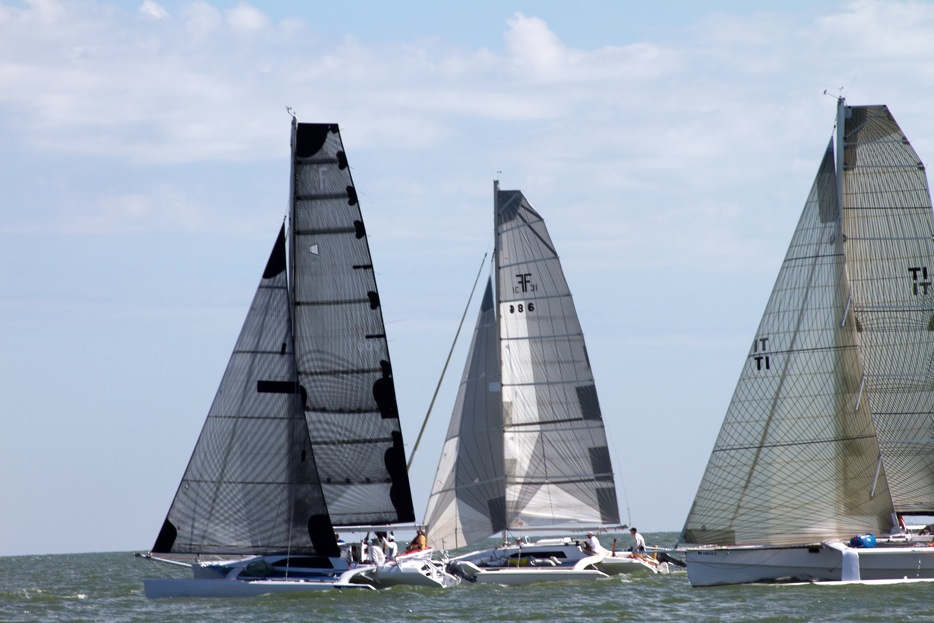
looks like photoshop to me.. but then again, what do I know
That was shot during the Worrell 1000 in 2001 at Jensen Beach (I think it was Jensen; I KNOW it was 2001). I was there; that was the day that 12 Inter-20's crashed and burned in the surf trying to get out. I think 5 masts were broken that day, including Castrol's about 4 seconds later.
I just thought this thread needed some ocean-racing influence.
Preferably done by giants.....
Wow!!!
If I could I would... Have an F16. I like the fact that it can be sailed solo or with crew, that it is small enough and light enough to be moved around, and righted by one person. I'll leave those long ocean races to the 20s! Though I'd like to see a shorter distance race, something like the last "Buzzard" up here, and would like to race in that! I think an F16 could do pretty well...
I'm curious as to what the minimum crew weight is in the F16 class?
The biggest reason we moved from the Hobie 16 class was weight. 45lbs over the minimum crew weight of 285 was way too much to overcome on that boat.

I don't think there is a min crew weight. Like the A-cat, sails are made to fit your weight. I'm at least 40lbs heavier than Paul, with whom I have often competed one-up. We're pretty even in boat speed, just have our rigs tuned differently.
No minimum crew weight, only a miniumum weight for the boat. Number of sails carried is determined by the number of humans on the boat (1-up can max out at main + spi, 2-up can max out at main + jib + spi).
See http://www.formula16.org/ for details.

I have in my notes (from where/what post exactly, I didn't write that down)
"Optimum crew weight = 295 to 308".
I think these number come from the statistic analysis that was done on the Taipan 4.9 boat; read the full article here :
http:/
About 135 kg to 140 kg (298 lbs - 310 lbs) was found to be in the centre of the competitive range of crewweights over a wide range of conditions. The competitive range is a little larger than the 135 - 140 kg range, which is only a measure of where the balance point is, the centre. With the newer designs (Blade F16) and based on new experiences it appears that the competitive range is larger although its centre is still somewhere in 135 kg to 140 kg's.
Let me reword this. The ideal weight (centre of the competitive range) seems to be around 138 kg (305 lbs); the competitive range itself runs from 120 kg (265 lbs) to 155 kg (345 lbs). When you are at the extremes of this range then you have to order a custom cut mainsail to compensate for disadvantage. Crew in that are relatively close to 138 kg (305 lbs) can just use the standard cut mainsail and be fine.
For many people it is new to have a mainsail cut for their crew weight. One-design classes didn't allow that and this is one reason why OD classes can have rather narrow competitive weight ranges. The formula classes however allow you to adjust your mainsail cut to your crew weight and thus equalize yourself to the benchmark level of 138 kg. This works surprisingly well and formula classes generally show a significantly wider optimal crew weight range. And this all doesn't cost you any more money, just specify your crewweight to the builder when ordering your boat, he will forward this info to the sailmaker and he will adjust the cut slightly for no extra cost.
Don't make the mistake that lighter is always at an advantage or that heavier is always at a disadvantage. By changing the cut of the mainsail you can largely compensate for any disadvantage EVEN IN LIGHT WINDS. This seems contraditionary but it isn't.
So just make sure that you adjust your cut and settings to your crewweight and be competitive.
Don't ever convince yourself that being underweight by a significant amount is an advantage on F16's. A crew of 120 kg will be just as disadvantaged with respect to 138 kg crew then a 155 kg will be. And neither is disadvantaged by really significant amount. The F16's can be made into powerful boats and this keeps the heavier crews in the game while requiring extra skill from really lightweight crews.
You have far more tuning options on the F16 boats and all can be used to bridge the gap pretty effectively. With the additional freedom of sail cut you must be able to make the boat work very well for your 330 lbs (149 kg). Especially if you sail a more modern F16 design. I sail my Taipan F16 at that crewweight and I'm doing well; notice that the Taipan is more sensitive to crewweigt then the newer F16's like Blade and Stealth. I actually raced the Stealth in a series of 11 races together with another guys. We were combined 168 kg (370 lbs) and sailing in 6 to 11 knots. In a competitive 40 boat f18 fleet we consistently finished betwee 21th and 13th spot. We never raced together before this series. I call that a surprising good result, considering the conditions and the crew weight.
Another example. For a while I had the wrong prebend in my mast. Even at 20 knots double trapezing was tentative with 150 kg crewweight (different crew then now). I was lacking in all out speed so I started fiddling about with spreader rake and diamond wire tension. Now I got an rather good setting and I'm double trapping at 10 to 12 knots, pointing higher and going alot faster. So by adjusting the tuning of the mast you can achieve such great differences. Now If I suddenly start sailing at 130 kg I can do the adjustment in reverse. These adjustments is something a OD class around a rather simpel design and using standard sails (one cut fits all), like the H16, can not do.
Wouter
Wouter,
In the first scenario did you decrease the prebend and vice versa for lighter crew?
Just trying to figure if I am thinking about tuning correctly.
Initially I reduced prebend to increase draft in the middle of my sail and have the leech stand up better there as well. This allowed me to stand double trap much sooner when at 150 kg. I placed more power in the rig (that helped me get on the trap much sooner) and that propelled the boat alot faster.
So initially my prebend was TOO curved for the luff round in my mainsail, thus in effect depowering the middle of my mainsail TOO much for a 150 kg crewweight. At 150 kg I could harness alot more grunt then I initially had.
If I were to decrease me crew weight from 150 kg to say 130 kg I would increase the prebend a little again, making the middle of my mainsail a little flatter. With some additional downhaul tension I can then flatten my top and induce some extra flattening of the middle section as well. When the prebend is increased just by the right amount I should end up at close to the proper curve for a 130 kg weight.
But to make things more complex. If I would also derotate my mast a little more when going from 150 kg to 130 kg, reducing mainsail draft that way, then I should reduced my prebend a little less. This because the derotation would make my top become fuller which I will have to downhaul out again by extra downhaul tension. This tension has a side effect on the middle of the sail making it flatten still more. So in order to prevent overdoing it I would need to make it a little too full at zero downhaul tension.
This is the rough guide to it. As you can also play with spreader rake, spreader arm length and diamond wires tension etc. It can get complicited as there are some interdepenceis, but this also means that you have a wide range of adjustments.
I'm still keeping it relatively simple as I would like to find simple adjustments that I can make between races on the beach. Under these circumstances I very much would like to avoid adjusting spreader arm rake and length. So I'm trying to find a good base setting for these and then make do with the thigns that I can easily adjust with the sails hosted and the next racing starting in 10 minutes.
Wouter
Thanks for the explanation-
I am thinking about it from a depowering perspective on 6.0 because I am trying to do more sailing with my wife (120lb) instead of my normal crew (230lb). I have been thinking about increasing pre-bend a little to let the top twist off more. BUT, tightening the downhaul will do the same- if I uderstand it all correctly. But alas, that is not the subject of this thread. I can't wait until Rick's seminar in april

Me niether. I will be there. 
Robi-
Sweet... I am hoping that I can get some of this confusion out of my head regarding all this stuff.
I look forward to seeing your boat- I am seriously thinking about the F16.