

Take a look at the
Basic Principle of Sportsmanship and the Rules
, which states:
Competitors in the sport of sailing are governed by a body of rules that they are expected to follow and enforce. A fundamental principle of sportsmanship is that when competitors break a rule they will promptly take a penalty, which may be to retire
.
If a boat breaks a rule, she is expected to take a penalty whether another boat protests or not. Protest Committee is the arbiter of the rules, not the enforcer.
Regards,
Eric
Without a protest hearing, there is no finding of fact, so without getting into that, allow me to propose another
take-away
.
If a boat entitled to room or mark-room by rule 18, 19, or 20 breaks rule 10, 11, 12, 13, 15, 16, or 31 (the basic right-of-way rules, acquiring r-o-w, changing course, and touching a mark) while sailing within that room (or mark-room), then she is exonerated under rule 21. If that boat is not entitled to room or mark-room, or if she is sailing beyond the room (or mark-room) to which she is entitled, then she does not receive exoneration.
Therefore, a boat may maneuver within the mark-room she deserves, but may not take more room than that.
I hope that helps,
Eric
US Sailing Judge,
Chair, SAYRA Appeals Committee

Regards,
Eric
THIS.
Too many sailors [in my opinion] know they've fouled someone but don't do turns unless PRTOESTED.
So to encourage better sportmanship, I propose the ALS Challenge here within the forum and on the water:
Always Live (by) Sportmanship.
Govern yourself and don't be afraid to take someone to
the room
.
tback

Spot on, we probably just need to take a couple to the room here to get it sorted

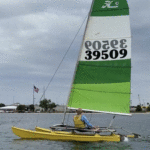
The picture distorts the distance. I was the boat with the smoke colored sails coming in with a pretty good view of what was happening. All the port boats had understood the mark and were coming in dead down wind. The 16 was coming in hot on starboard. We slowed down seeing that this was going to be ugly and figured they would all be past the mark by the time we got there. It looked like the H16 was within the 3 boat length circle when he jibed. With the wall of boat coming at him it appeared that he jibed early to avoid mayhem. Being that everyone was going dead down wind the only safe out for the F16 was to go inside the mark douse the come back to round. I don't think he could have gone deeper without jibing. With the surf and everyone doing dead down wind none of the boats had any real maneuvering room.
Think about how ugly it would have gotten if the H16 had decided to not jibe early and pressed starboard tack another 20 feet(where he should have jibbed for a proper rounding). All the port tack boats would have had to jib to avoid.

certainly that (H16 holding starboard gybe longer) would have caused mass chaos amongst the downwind boats. But would have made for dang good TV to armchair sailors... <img src="<>/smile.gif" alt="smile" title="smile" height="15" width="15" />
Think about how ugly it would have gotten if the H16 had decided to not jibe early and pressed starboard tack another 20 feet(where he should have jibbed for a proper rounding). All the port tack boats would have had to jib to avoid.
From the little bit of umpiring I've done, I fully agree that the viewing angle is the absolute worst place to be to determine the zone.
Assuming the H16 was in the zone, he did nothing wrong (other than maybe gybed too soon; or went too far with his gybe, but one could argue that the passing boat did not keep clear).
Assuming that the H16 was outside of the zone, he gybed in a bad place, right in front of the other boats.
Coming into a mark on port is a risky move, especially in a tight group. If the H16 stayed on starboard, as he had every right to do, the port boats have to avoid. That is 100% on them, not the starboard boat. Of course, without mark room involved, you can't just gybe in front of anyone. With mark room involved, you're expected to sail around the mark as Eric mentioned, so a gybe in that area would be expected.
Mike

Think about how ugly it would have gotten if the H16 had decided to not jibe early and pressed starboard tack another 20 feet(where he should have jibbed for a proper rounding). All the port tack boats would have had to jib to avoid.
From the little bit of umpiring I've done, I fully agree that the viewing angle is the absolute worst place to be to determine the zone.
Assuming the H16 was in the zone, he did nothing wrong (other than maybe gybed too soon; or went too far with his gybe, but one could argue that the passing boat did not keep clear).
Assuming that the H16 was outside of the zone, he gybed in a bad place, right in front of the other boats.
Coming into a mark on port is a risky move, especially in a tight group. If the H16 stayed on starboard, as he had every right to do, the port boats have to avoid. That is 100% on them, not the starboard boat. Of course, without mark room involved, you can't just gybe in front of anyone. With mark room involved, you're expected to sail around the mark as Eric mentioned, so a gybe in that area would be expected.
Mike
I thought we concluded that rule 16 was violated if he was outside the zone.
Bump the link in case you all, like me, are tired of having to go back to page one to re-look at the video.
Philip, I agree, is that not what I said (without the rule reference)?
Mike