

Out sailing the F20C on Saturday in 15 knots, 4 ft waves, clocking 17-19 knots downwind, crew trapped back and chickened in, both of us grinning from ear to ear. Bear away on a 6ft wave, speed over 20 when suddenly BAM, the leeward rudder breaks away. Crew comes in, chicken attached and slightly entangled in the sheet, so can't jump forward to lower the chute. I tell him to grab the rudder and move towards the chute, only to hear the shocking reply: there is no rudder !! Quick look back, and indeed both transoms have been freed of their burdens. <img src="<>/shocked.gif" alt="shocked" title="shocked" height="15" width="15" />
The boat slows to about 11 as the chute is released, and heads up a bit as I douse. She feels nice and calm, and steadies to about 7 knots on a beam reach as we release the sheets. Good thing we're about a mile from shore, because it really doesn't look like she wants to stop. Adrenaline does wonders to the thought process, basics step in and we release the jib (as far as possible with the self tacker) and sheet in the main. OOOPS – she bears away 30 degrees and speeds up to 15 knots. <img src="<>/shocked.gif" alt="shocked" title="shocked" height="15" width="15" /> <img src="<>/confused.gif" alt="confused" title="confused" height="15" width="15" />
Quickly prepare the drogue we store in the tramp pocket, but realize that at 15 knots I can't deploy off the bows… hold on tightly to the shroud, lower feet into the water to windward, and gradually she rounds up a bit and slows, enabling me to deploy the drogue over the bridle, at which point she sits calmly head to wind. <img src="<>/smile.gif" alt="smile" title="smile" height="15" width="15" />
In the meantime, my partner discovered that the rudder assembly was being towed behind us by a loop of shockcord, and raised it aboard as we were slowing (we have a loop of shockcord run through the hole in the upper casting and around the gudgeon so the rudder arms don't flip over when we capsize. A while ago we passed the cord through the chickenline attachment shackle on the gudgeon, and that saved our rudders). A quick inspection showed both rudder castings had sheered at the attachment points, and could not be reconnected.
Although it seemed like ages without any control at high speed, it took 4 minutes and 800 yards from breakage to stop.
A quick call for a tow, lowered the main, released the jib and we were back ashore safely.
Several observations and questions:
We have been suffering from intermittent lee helm both up and downwind. The mast is raked correctly for our weight, and we had just adjusted the rudder rake as far back as possible, which helped a bit, but the helm was still neutral at best – a bit of weather helm is not only easier to control, but would have made a real difference without rudders (remember that youtube movie of the X40 losing rudders and running straight into a wall ??). Is neutral/lee helm a common problem with other F20C boats? Could there be interaction between daggerboard height and lee helm?
The collapse process is reasonably clear – the bottom casting broke at the lower attachment point, rotated the casting around the pivot screw until it tightened, at which point the upper attachment point broke. The leeward rudder pulled back at high speed on the windward rudder, broke the lower casting attachment point, and the upper point flew off the gudgeon. But, why did a reasonably new casting break?
We reaffirmed our policy of always sailing with a drogue and cellphones.
Damage summary – 2 rudder castings, 1 small tear in the chute from the slow takedown on a beam reach, 1 short length of bungee – could have been much worse.
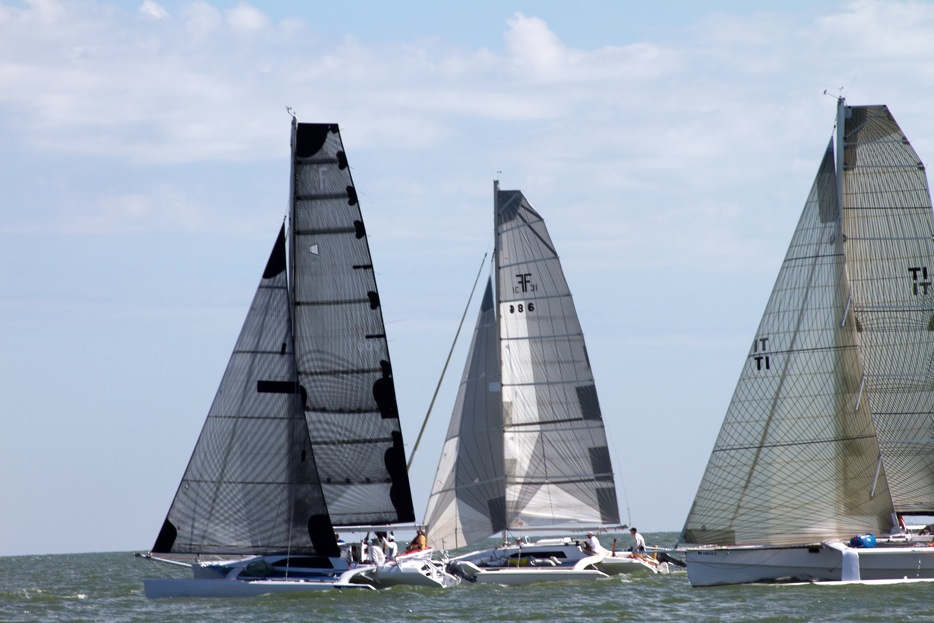
covered under warranty I would hope

Good save!

If the F20C rudders are attached in a similar fashion to the old N20, then another possibility is that the castings had vertical play/slop in them. When this happens its possible for the top eyebolt to come off the gudgeon and then torque the bottom casting on the pin. The new pins are double welded and pretty robust so it wouldn't surprise me that it could break the casting instead of the gudgeon like they used to.

If the F20C rudders are attached in a similar fashion to the old N20, then another possibility is that the castings had vertical play/slop in them. When this happens its possible for the top eyebolt to come off the gudgeon and then torque the bottom casting on the pin. The new pins are double welded and pretty robust so it wouldn't surprise me that it could break the casting instead of the gudgeon like they used to.
Mmm, I don't think this is possible unless the F20c castings are significantly lighter than the N20 castings (possible). We had the incident Undecided describes happen to my weather rudder on the N20 during the 2010 Tybee 500, the top of the casting popped off the upper gudgeoan and bent my lower double welded gudgeon. The weld doesn't break, the gudgeon post just bends instead. Since I don't have a F20c to evaluate the loads myself, I can't say the same thing would happen on that boat.
Glad to hear you made it back to shore in one piece!
Mike and I had the leeward casting break off on his F20c during the GT 300, but we thought it was from going through the surf. The castings are the same as the N20 and the F18 and the arms are the same as the F18 which is what we used to replace the bent arm and broken lower casting to finish the race.

So just a
bad batch
or is it that the F18 parts were not designed to handle the additional load?
I honestly do not believe the F20c could even get to finish line of Tybee 500..;)
If the F20C rudders are attached in a similar fashion to the old N20, then another possibility is that the castings had vertical play/slop in them. When this happens its possible for the top eyebolt to come off the gudgeon and then torque the bottom casting on the pin. The new pins are double welded and pretty robust so it wouldn't surprise me that it could break the casting instead of the gudgeon like they used to.
Mmm, I don't think this is possible unless the F20c castings are significantly lighter than the N20 castings (possible). We had the incident Undecided describes happen to my weather rudder on the N20 during the 2010 Tybee 500, the top of the casting popped off the upper gudgeoan and bent my lower double welded gudgeon. The weld doesn't break, the gudgeon post just bends instead. Since I don't have a F20c to evaluate the loads myself, I can't say the same thing would happen on that boat.
Glad to hear you made it back to shore in one piece!

the lower casting is a pretty solid piece of aluminum with two thinner flat arched arms that attach to it. Where exactly did it break? I would really be interested to see a picture or two.
We were left with 4 pieces from the port leeward casting - the 2 flat arms (which stayed attached to the board) and the 2 solid pivot blocks which remained on the gudgeons. I will post pictures tonight. The gudgeons remained straight, and we replaced the castings the same day with castings off our trusty N20..
We are indeed expecting the warranty to cover the new castings...
Anyone with insight to solving the lee helm issue?

Its amazing just how a few knots more speed can induce huge additional loadings on lever points. Maybe the F20C is repeatidly going just that bit faster than the F18 designed casting can cope with.
It could be a casting quality issue. The early lower castings were flat on the sides and didn't have the rib on them. Nacra saw the problem and mad changes. Possibly they need to beef them up a little more with the 20C. The boat is wider with more sail area and the center of lateral effort moved back, much more so than the N20. A few years ago in the GT300 we were single trapped spin reaching when the leward assembly let loose. It ended up being the upper eyebolt had snapped off. The amount of leverage being put on the castings and rudders is actually pretty impressive. I just think the F20C has out grown the current casting design. Hopefuly Nacra will beef them up again.
We have broken rudder castings on the N20, F18,F20c and I would say it was from stress from the surf launchings. We did sail the rest of the GT300 with the castings off our F18 with no problems.
As far as the comment about the F20c not making it in the Tybee I would disagree. The only problems we had in the GT300 were the boards breaking
which was do to a first generation of board with only one stringer(now the boards have 2 stringers) and the spin pole breaking going out through the surf. The pole is just to light of gage and is not supported out far enough to handle the large waves. We tied a line from the forestay bridle intersection to the spin pole in front of the snuffer ring to help give support to the pole which worked for the rest of the GT300. Mike now has a distance racing spin pole that is a heaver gage. The boat seems to be plenty strong and really well made it just needs to work some bugs out which is the case for all new designs. The first year we did the Worrell 1000 on the I20 we broke rudder castings and gudgeons,rudders,boards and most of the boats were getting holes in the bottoms from beach landings. All those items were addressed to make the N20 what it is today.

The problem here is the boats are built too heavy. Build them lighter and more expensive and people will buy them. <img src="<>/grin.gif" alt="grin" title="grin" height="15" width="15" />
We are indeed expecting the warranty to cover the new castings...
Anyone with insight to solving the lee helm issue?
Seems to me you need to rake to balance the sail plan over the boards not for your weight. I would rake back a bit more till you eliminate the the lee helm upwind. Then adjust the rudders.
what he said
I think you are probably right, although we felt underpowered with the mast further back, and were a bit slower than our nemesis F20 until we raked forward a bit.
We have been sailing quite a lot for half a year on her, and haven't had any serious breakages
Attached are photos of the casting parts that remained on the gudgeons when we got ashore.

I think the curved boards give greater lift vertically and shed some of the lateral stability on to the rudders which in turn loads the casting. Any N-20 owner knows how susceptible to failure that part is. I broke 3 in ONE beach start( Hatteras leg) during the Worrell. 5 total THAT race. They beefed them up with a side strake but for the price of the F-20C now I guess they should be Titanium. The curved board program is going to have some speed bumps for sure, this very well may be a by-product of that.

Warranty!
We have had bottom castings breaking on the Mk11 rudder castings in Australia. These have broken under normal sailing conditions.

Nice job on the safety equipment.
Nice job on the failure eval also.
Glad you're well
Just out curiosity, what position were your dagger boards in? Have you experimented with board position?
Thanks, Todd
The boards were up about a foot. We usually raise them a bit downwind, 6
-8
in light winds, more as wind strengthens. We are far from certain that we have it right.