

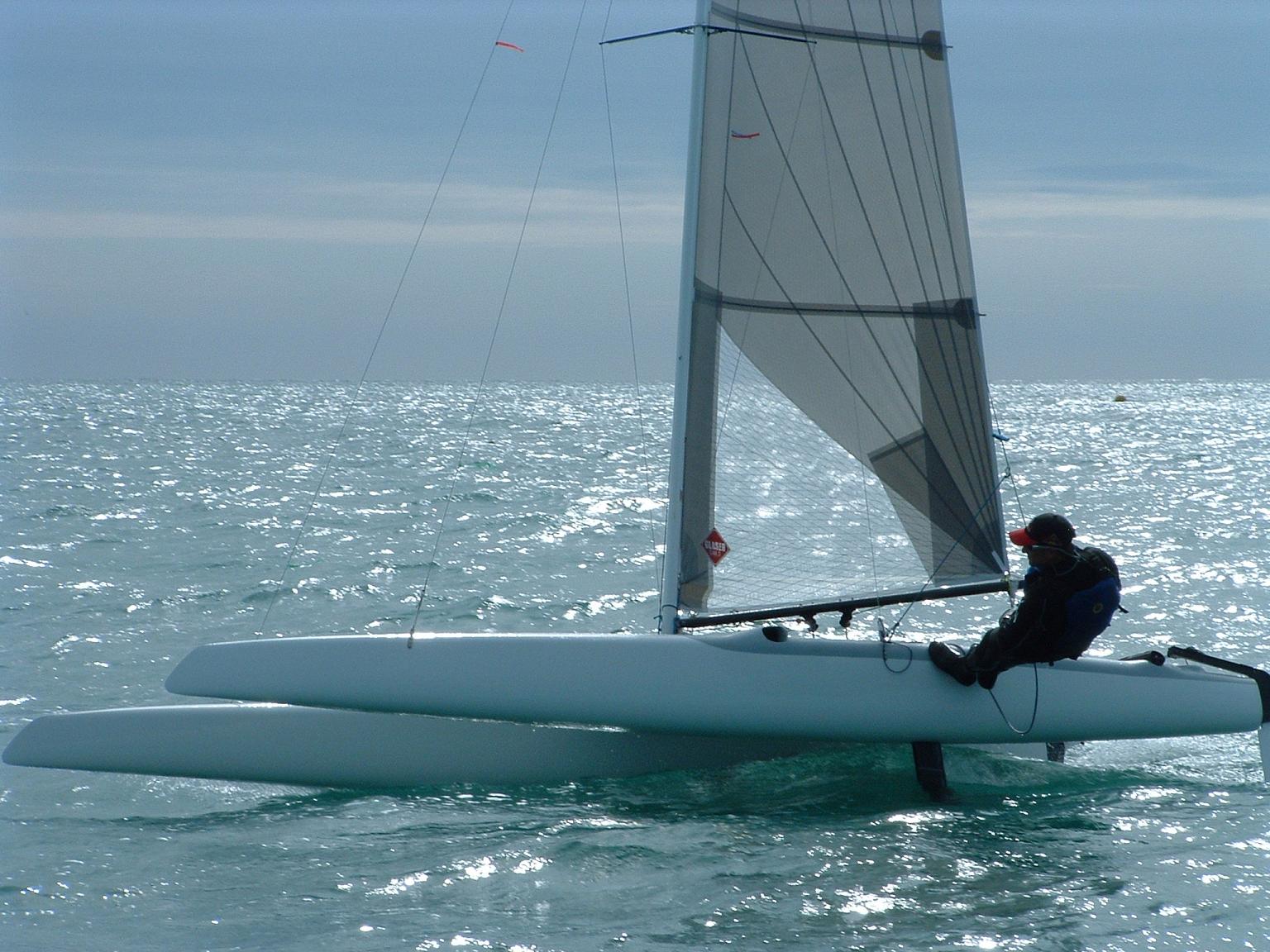
OK...so I'm watching the ratings post, and Wouter put up some specs from the Shark catamaran that was designed in 1962. For anyone that hasn't had the pleasure of witnessing one of these beauties in real life, they're a 20' x 10' cat with classic timeless lines. They are still relatively fast and constructed of all wood. Even the 'trampoline' is wooden. I've admired several of these at the last few Tradewinds Regattas but I always thought they looked heavy. However, what really struck me in the post is that they weigh only 450lbs....450lbs!!! How come, 42 years later, my 18' modern foam core constructed catamaran (2' shorter, 2' less wide, and with a poly mesh trampoline) only weighs 55 lbs less?
![[Linked Image]](http://www.sharkcatamaranclass.org./what0002.JPG)
Good question, Jake.
Personally, I think technology is destroying catamaran racing right now, but I am hoping it is just a phase and that eventually you will all come to your senses and realize that one-design racing is the ONLY way to race.
Otherwise, we are going to come full circle and a small group of designers with their wonderful catamarans are going to end up on a beach in New England analyzing each other's wonderful inventions and then having races to see which boat is fastest -- just like in the late 1950's.
Regarding the Shark catamaran, if it could be built as light as the Tornado, it would probably be unbeatable against most if not all modern boats.

Take a look at this F-18, buildt in plywood and epoxy. The sails are cut on a sailmakers cutter, but designed and assembled by the boatbuilder..
The builder of this boat, thinks he can build a plywood Tornado to be quite competitive with Marstrøms boats.
Ref: http:/

Rolf, tell them about the stifness data !
They'll be really impressed then.
To all who think OD racing is king. This ply boat would never have been designed if all we did was sailing strict OD classes.
Afterall if no real development was achieved over the last 40 years, of which the largest portion was OD-time, than it is the result of having OD classes and no insentive to improof on anything.
Wouter

Technology has kept me alive.
Mary,
Please allow me to ask you to once more look over your believes and determine wether what you are saying is realy the result of an objective deduction.
>>I think technology is destroying catamaran racing right now
What do you mean here ? F18 is the best thing since H16 and P16 of the 70's and early 80's
Tornado class was revived by the upgrade package. The F18 class is even reviving the US cat scene.
>>but I am hoping it is just a phase and that eventually you will all come to your senses and realize that one-design racing is the ONLY way to race.
For me personally, here in Europe, F18 is the most sensible class to race in. Best crews, best boats, most events, largest fleets. I don't really understand the "Just a phase" thing. If several thousant sailors are in this "PHASE" doesn't it cease to be a phase or hype and become the "sensible thing" ? As for OD sailing, We only have H16 and Dart 18 OD sailing left. And these numbers that are attracted to those are smaller then the F18's. Wouldn't this mean that H16 and D18 were a phase themselfs ? Of an earlier time ?
You know, if a hobie 16 sailor would currently play big and call F18 sailing "merely a phase" on the beach he would get laughed off the beach and be given a newspaper hat to wear so he can play Napoleon more convincingly.
>>Regarding the Shark catamaran, if it could be built as light as the Tornado,
It CAN be build as light as a tornado if the used the new technolgy ply and epoxy methode. Really, you can build a 16 footer in ply at 102 kg's. Surely you can build a 20 footer for 160 kg.
Would such a shark be unbeatable ? Only if the rig was further devellopped as well. At a certain point getting more speed out of a boat is not about having more power but being able to operated efficiently at small angles of attack.
Without being disrespectful I would actually turn the claim "technology is destroying catamaran racing right now" around.
The lack of formula racing destroyed the cat sailing scene. We were given poor designs for premium prices. I heard the prices for the EU I-17R (F17) and Hobie 16 just recently. I was speechless. Sure OD is fun but for those prices I rather have formula boat and blow the doors of both of these boats. Going by the succes of formula class I guess I'm not alone at this.
Modern boat One-design then. Over here there simply is NONE. The last OD races (nationals) with the 17 foot singlehanders attracted 3 boats or less ! That is not racing ?
Only the Tiger design seems to attract some participations as a modern design, mostly because it is a spin-off of the F18 class. Mind you its Dutch nationals saw 2 OD tigers racing. That in a Nation the size of New York State containing some 5000 catamarans.
Formula and technology may not be perfect but it sure beats current day OD racing. At least over here in Europe. Going by the recent developments in US and AUS I think we are seeing the same situation develop there as well.
So maybe the OD fans can start to face the music and realize that their PHASE is winding down. So that they can come to their senses and stop claiming that THEIR way is the ONLY way for us all.
With kind regards,
Wouter
Rolf,
That's a great link - I've come to know and admire Phil's work although I hadn't heard of that project! (I thought the "Blade" was only an F16 project).
One design, class, or formula racing aside, what has modern construction methods done for me and my F18? I know Wouter built his own tortured ply F16 and I imagine it's competitive.
Is my boat that overbuilt?
Is the foam core molded construction cheaper to manufacture?
Does it yield a stiffer platform?
Does it last longer?
Perhaps it's in the economies of scale - foam core composite construction yields a more consistent and cost effective way to manufacture higher quantities of a hull. Complex shapes are easier to produce (Phil may argue that point). What do you think it is? Would it be more expensive to manufacture 20 tortured ply Tiapans or 20 molded composite versions?
Jake,
>>(I thought the "Blade" was only an F16 project).
It is both.
Blade started out as a F16 design and that is the one that two companies are trying to build commercially. Then the unique scaling relation of the F16's to the F18's was used in reverse and the Blade F18 was designed. So now the Blade design line encloses two models; one F16 and one F18.
And this may not be the only design to have travelled this "scaling" path. There are rumours of one more design doing it in 2 years time or so.
>>One design, class, or formula racing aside, what has modern construction methods done for me and my F18?
It gave you a boat that will run circles around a Prindle 18 and Hobie 18, designs of the late 70's. To give you one example. Now maybe F18 is not the best showcase of technology, despite its progress relative to older designs. However there are other designs that show what technology has done over the last decades. A-cats and 100 kg doublehanders with F18 performace are the result.
>>I know Wouter built his own tortured ply F16 and I imagine it's competitive.
The boat maybe just that, however I'm not sure about the crew sailing it ! 
>>Is my boat that overbuilt?
A little.
>>Is the foam core molded construction cheaper to manufacture?
Good question. I may well turn out that a all glass F18 hull is cheaper, easier to build and better in performance. God knows that the F18 class minimum weight is high enough to allow such a construction. Afterall both Capricorn and Blade designs are made using cores that are much heavier then foam and come out at minimum. This construction allowed AHPC to put the bridle much lower on the baot thius lengthening the jib luff, without worrying about stiffness and strength.
More and more I find that tradition is the deciding factor in much boat building and designing. I for one don't expect ply/epoxy to be any heavier than glass/epoxy as a laminate.
>>Does it yield a stiffer platform?
Good question. Foam is all about relativety. You can often get a stiffer platform for a given weight. However this is not the same as saying that such a platform is stiffer in absolute sense. We all know a tube has a superior stiffness/weight ratio but the solid staff of the same diameter is still stiffer in absolute sense.
Now if class minimum weight is high enough than a solid skin hull may well be stiffer and stronger without any performance related drawback.
>>Does it last longer?
Foamed hulls dent for example. There is not much bad I can say about solid laminate hulls from a contruction point of view. The material stresses are lower because there is simply more fibre to carry the loads. Also you have much less delaminate risk that is associated with the boundery layer between glass and foam. All that sort of stuff.
How knows, we may be in for a surprise.
>>Perhaps it's in the economies of scale - foam core composite construction yields a more consistent and cost effective way to manufacture higher quantities of a hull.
That may be true but with resin infusion and improved vacuum curing these advantages may be out dated by now.
>>Complex shapes are easier to produce (Phil may argue that point).
Yes but foam less hulls are even more free in shapes than foamed ones. Afterall you need to curve the foam as well and that it a big factor as well.
>>What do you think it is? Would it be more expensive to manufacture 20 tortured ply Tiapans or 20 molded composite versions?
To produce 20 ply hull is definately more time consuming and probably more expensive when a certain minimal production demand is reached. But then again, sailors pay top dollar for glass boats as well.
Wouter
As pr. Wouters request, here are the stiffness data (Supplied by Marcus):
87 reg white 110mm
Hobie tiger 90mm
Nacra F18 95mm
Blade F18 Home build 20mm
All boats had the sterns supported & we lifted the bow of each boat with the rigs in place with similar tension & took the measurement when the other hull lifted of the ground.
The thing about foam/glass, is that it is easier to produce a identical product every time. Timber as an material can differ some between lot #'s. Besides, how many would buy a wooden boat today, in what is marketed as a high-tech sport?
Regarding the F-18 class, I think it was Gøran Marstrøm who said that they made the boat to heavy, he tought it should have been lighter..
Looking at the positive side of it, if the boat is overbuildt, it should last a long time 
Wood has excellent cyclic loading properties, better than fibreglass unless the fibreglass panels are overbuildt (the fibres works loose from the matrix).
I think 20 fibreglass taipans would be cheaper to build than 20 timber taipans. You would not need to pay skilled and meticoulous woodworkers, but have them cut glass and infuse (or wet layup) resin in finished moulds..
I think the greatest development has been in sails and sailcloth. That is where new technology really has produced superior results. Dacron cross-cut sails was good, but CNC'd plotter/cutters gave us good tri-radial panels and really good sails. If Contenders MAXX cloth delivers on its promises, perhaps we will see cross-cut cat-sails on top-level boats again?
Replacing wire with spectra or dyneema also gives me a warm, fuzzy feeling.

I think the catamaran classes are starting to strike a nice balance where there is something for everyone. We have strong Hobie 16 fleets for people who want one-design racing on a simple platform. The A cat fleets are growing and present a great option for those who want a high-end development class (and can afford to pay for it). The Formula 18 presents a boat for those who want something in the middle of the road, and or a spinnaker boat. There are other boats out there (N20, H17, H20, I17R) but I think these three classes represent the core of catamaran racing in the US night now.
When we are talking about participation in the sport the biggest numbers will always tend towards boats that are affordable and easy to sail, that's the way things go in North America at least. The Hobie 16 is still the biggest catamaran class for this reason. We had between 500 and 600 class members racing Hobie 16s last year. By comparison the A class and the F-18 have under 100 class members last I checked. I can't remember the exact numbers but I did get them for a Sailing World article I wrote last year. All of these classes probably have more people racing than they have class members.
I think that if we continue the way things are going we will have some consolidation in catamaran racing and the result will be growth in class racing. By consolidation I mean less classes and more boats in each class. The Hobie 16 has managed to maintain its niche very well but I think the faster boats have had problems. The people who are drawn to these faster boats don't have class loyalty and tend to move to the next "cool" thing every few years (very uncool in my opinion). If speed is king class-racing takes a back seat. The Nacra 20s are starting to gain some class strength but will you see all these guys moving to Marstrom 20s next year? If it's all about speed they will. As a group I think catamaran sailors need to recognize that the speed culture is limiting the potential for class growth. If we can get past this and develop a range of strong classes I think we will see more mono sailors jumping the fence and getting catamarans and we will enjoy better racing.
This will NOT limit technological development because there will always be the tinkerers out there. You will never see complex, expensive cutting edge boats in large fleets but they will always be out there.
Great assessment of the situation, rhodysail.
Wood and timber ; somebody once told me that if Wood was discovered today it would mean a revolution in terms of use of materials.
The funny thing is that wood is afterall a Carbon laminate with a high resistance to fatigue processes. The tree needs to survive several 100 years bobbing and weaving at different frequencies and amplitudes all the time depending on the winds of the moment. And it needs to be strong to resist the huge loads on its base when a summer storm hits it cannopy filled with leaves.
I addition to the numbers provided about the F18's I can give you numbers on un glassed timber hulls (Ply epoxy). Of course the Blade F18 has a layer of glass on the inside and outside. A timber Taipan platform (no glassing except on the seems) flexes by about 63 mm. Still seriously close to the 92 Marstrom Tornado and superior to the F18's.
Actually the design of the beam landings is very important in the overall stiffness and the Blade F18 has some really good beams and beamlandings. My own Taipan F16 would also be noticeably helped by having a beam setup like that. A number of 45 mm should certainly be attainable, we know that from other tests.
Wouter
I would hate to see the H16 class go. Just as much as hate to see F18 fail (if it still can do that)
I think indeed that the combo is the best situation imaginable. And I truly believe that.
We need the easy, inexpensive and just do it entry of the H16
We need the Formula's to work of coolness and projection to the future. Afterall we quite a few of us drive family cars but watch nascar on T.V. But we would still be driving T-fords if racing like F1 and nascar wasn't around.
My optimal scene would enclose :
Tornado (Olympic, so can't beat that)
F18 (best next thing)
H16 (to train up new blood and young talent)
A-cats (Where did the carbon masts etc come from ? all out development class)
F16 (the best compromise between the triangle of Tornado/F18 on one end and the H16 and A-cat at the other two corners)
I really believe the curtain is falling on most other classes excluding the F20/I-20's.
I for one expect a great future in a scene like that. Also for the Builders ! It would mean more turnover in each of the 5 or 6 classes and thus leads to economy of scale.
Wouter
I think Jake's question can only be accurately answered in terms of technological developments that have taken place over time in specific classes, and by asking how those developments have affected those classes of boats, for better or worse.
The two classes that have evolved over a long period of time are the A-Class cats over more than 45 years, and the Tornado for more than 35 years.
List all the changes that have been made in design, construction, rigging, sails, and somehow determine whether, and how much, these changes have actually improved that particular class in terms of performance.
The unknown factors in this assessment are the knowledge, skills and ability of the sailors and the sailing techniques now being used, as compared to 30 years ago.
I guess the only way to really determine how much technology has improved a given class of sailboats is to have a regatta that brings together boats of many different ages and manufacturers throughout that class' history, sail them as they were rigged at the time, and have all the current hotshots in that class race them round-robin for a week and take copious notes during the event.
And, even if the modern boats are clearly superior, you still would not know for sure what development made the biggest difference. Unless you took another week and started switching rigs around, putting old rigs on new boats and new rigs on old boats, and taking even more copious notes.
It could be a very interesting event. 
P.S. In the Sunfish Class it would be a no-brainer. It took years for them to get approval for their new and improved daggerboard, but it has made a huge difference in the performance of the boat. And the difference is readily apparent because it is such a strong one-design class. Technological improvements in catamarans are not as individually apparent because there are so many changes going on these days, in every aspect of the boats, and there are so many different classes of boats, so it is hard to compare and hard to determine what really works and what doesn't.
What has technology done for me?
To me the biggest advances in technology have led to products that are much more enjoyable to sail. Nowadays I race 2 classes of boats, A cats and DN Ice yachts. Both are fairly open to innovation, but have some things in place to limit costs.
In both classes there have been 2 big improvements. 1. Dynamic response in sail plans. 2. Overall weight reduction.
Both DN’s and A cats are significantly lighter then they were 30 years ago. This leads to better acceleration and tiller feel. This is also great in allowing 1 person to wheel or carry them around.
The biggest advance is in developing wing masts with automatic gust response. The modern composite wing mast has made the DN a joy to sail in puffy conditions. The difference between an older stiff mast and a bendy one is unbelievable. They are faster, easier to sail, more fun, and safer. The A cat is much the same way in the ability for the rig to absorb puffs without needing to sheet out or adjust downhaul.
The bottom line is that I find modern lightweight boats a hell of a lot more fun to sail. The fact that they are usually faster is not as important to me.
What really amazes me is that in 2005 people are still happily buying 400 lb 18 ft boats. I am all for formula or one design, but who wants to drag those beasts around
Eric Anderson
A- class # 28
DN Us 5193

Wouter, Rolf.
The "stiffness data" you are presenting says almost nothing about the stiffness of the hulls themselves, i.e. the difference between using wood or some modern high tec composite. It is nearly all about the other bits like beams, trampoline etc., in fact as Wouter ponted out its almost certainly to do with the beam connection to the hull. It is noticable that the older boats are less stiff. This is more likely to be wear than construction.
Gareth: The numbers does say something about platform stiffness, and the argument was about what advantages time&technology has brought. I think those numbers says something about the 'old technology' beeing adequate today as well. At least, the timber hulls does not appear to be less stiff than the space age Marstrøm Tornado..
Your argument about beams, beam attachment and trampoline are of course a good one, but not exactly new technology.
Unless the hulls are measured in a scientific way, or we are willing to trust the sailors statements, we will probably not know how stiff the hulls are.
Jake,
I strongly agree with Eric Anderson's response. I started racing cats in 1992 when I purchased a Prindle 19. Initially I loved the performance but I was disappointed in the poor quality of the fittings used and how heavy the entire platform and rig was. Understand that I came from racing high end sailboards for the previous six years. Sailboard technology was WAY ahead of multihulls in the use of carbon and kevlar in board construction and soft wing mast/sail development with carbon fiber masts and booms and camber inducers used in luff sleeves. I could not believe how heavy my P-19 mast was!
I always wanted to move up to the Tornado class and in 1994 I got my wish when I was able to purchase a new Marstrom Tornado. Going from the P-19 to the Tornado was like going from a Chevy Cavalier to a BMW M3. The Tornado was lighter, faster, stiffer, and much more durable than the P-19. In terms of value, it was a lot more "bang for the buck" as in the six years I owned the boat, it never leaked, never broke, and seemed to stay as tight and solid as the first day it hit the water. I never again enjoyed sailing my P-19, it just seemed like a heavy loose slug and I felt I could never spend money on a boat like that again.
In 2001, I switched from Tornados to A-Cats. Like Eric said, the transformation to sailing a platform like this from even the Tornado was dramatic. The boat defines "a joy to sail". And those who still beat the "but it's fragile" drumbeat are simply ignorant. My Boyer Mk. IV performed beautifully before I sold it to get my current Mk. V. That boat is now 2.5 years old and is as solid as the day I bought it and it has been raced hard. It is still very competitive proven by placing 2nd in two races and 1st in one race at the September North Americans (6th overall). I hope to pass this boat on to another new A-catter in 2005 and purchase a new A2. IMO, that boat is the next subtle evolution as I believe Pete Melvin has done a great job trying to make the Flyer/wave piercer concept perform even better over a broader range of conditions.
Like Eric, I cannot believe that someone has not put together a production two man boat in the 18-20 foot range that weighs less than 300 lbs other than the F-18HT. I can tell you now that the current evolution of that boat is faster (and I am not talking a little faster) than any F-18 sailing today. If you could take the current F-18 designs (that by the way look beautiful on paper) and employ the technology available to reduce the weight by at least 100 lbs, you would have something to talk about. But until then, my opinion is these boats are outdated (technology wise) and overpriced for what you get. Many will argue that the extra weight makes them more durable. That is simply not the case if the lighter weight technology is employed correctly.
My last comment is regarding the evolution of spinnaker launching systems. The current state of the art on Tornados using a carbon launch tube is simply fantastic. We used a Marstrom system with a beautiful carbon tube with every edge and surface smoothed out on the F-18HT. Launching and retreival is probably 4-5 times physically easier than the systems I see on the F-18's and Inter 20's.
Merry Christmas,
Bob Hodges
A-Class USA 147

This is a completely different line than everyone else, but time and technology have made performance boats that are a little older afordable enough for people on a low budget to buy. I think if it weren't for the switch to the prindle 19 MX I might not have been able to afford a prindle 19. So in that manner, the rendering of some boats as absolete helps to get people into the sport by creating a surplus of affordable boats. I'm not sure this is somethign that helps a majority of people, but I'll be thankful that the latest and greatest keeps coming as long as I can't afford it. Cause that means I might be able to afford what used to be latest and greatest, and is an improvement for me.
I don't quite agree with Eric and Bob.
I usually sail Hobie 16s but last summer I went to an 18HT regatta an while I did have a lot of fun (thank you Peter) I left wondering; did I have any more fun than I usually do racing my 16? No way! I was going faster but the name of the game was the same, trying to go a little faster than the guy next to you. The only difference was the 18HT cost about 30k by the time it hit the water and my 16 costs about 7k. That and the fact that I can race the Hobie 16 in 30 boat fleets all the time.
Different strokes for different folks I guess.
BTW I found those class membership numbers from 2003
Hobie 16 was about 550 (hard to tell as its a % of the Hobie class)
A class was 131 members
Formula 18 was 45 members
Actually the toe-in stiffness says alot more about the build of the hulls with respect to material. However the fact that the home-build timber hulls with a proper beam landing design can outperform the glass boats with their beam landings does suggest that Timber is not so old fashioned and nearly everybody thinks.
The simple fact that an skillful but amateur boat designer (Phill) and two amateur "gone semi professional" builders can produce a superior boat by a factor of 4 in (beam landing) stiffness when compared to the big boys says a whole lot more then nothing ! The use of low tech ply makes it all the more interesting. No high tech fibres or special new high pressure infusion proces with high end product quality. Just sheets of ply glassed over.
Lets face the music guys the, Marstrom 1992 Tornado showed no less than 2.5 times the flexing this home build boat did ! Sure old boats flex more but they don't deteriorated that much. Besides everybody claims how good Tornado's keep their stiffness over many years of sailing.
Now either Marstrom 1992 boats are [censored] (but still significant stiffer than much newer Tigers and Nacra F18's by a factor of almost 2) or the Blade boys did something very right.
Looking at the numbers I say they did something very right.
We just have to ask Marcus for the toe-in stiffness to see how much is the result of timber as the material or just the superior beamlanding design.
But no matter what the cause the platform is way stiffer than the measured competition and THAT is what you'll notice on the water. Who cares if it is cause by little gobbling insides the hulls or whatever.
Wouter
>>>Like Eric, I cannot believe that someone has not put together a production two man boat in the 18-20 foot range that weighs less than 300 lbs other than the F-18HT.
Any particular reason why you explicitely exclude 240 lbs 16 foot doublehanders ?
Besides would you classify the Marstrom M20 as a production boat or not ? At 265 lbs, 20 foot length and being a double hander it sure fits your definition.
Come to think of it even 70's Dart 18's doublehanders come in at 309 lbs and therefor end up nearly level with you guys.
And than of course we have the Taipan 5.7 at 300 lbs and is a sloop rigged doublehander with spi at 19 foot length. Talking about taking much higher loads then a uni-rig. Halve of the US 18HT doesn't even beat the 300 lbs limit themselfs.
I'm sure that if I put my mind to it that I can find 1 or 2 other production designs that would equal or beat your specified condition. Ohh I got one already : Stingray 18 footers in Australia. And so on.
Take it from me; You may think you are something special but you guys really didn't set a new benchmark in light weight production.
This is nothing against any class or sailors; I'm just amazed that you simply overlooked these doublehanders while all except the Stingray 18 are well known boats in the US.
Wouter
With regards to the stiffness test - that's not a very scientifc way to go about it. Were the beams on the Nacra seated? I removed my hulls and bedded my beams in epoxy (mostly to get rid of the squeeking noises! ). However, most of the flex measured by lifting the hull is generated within the beams themselves, very little the hull to beam joint, and practically none of it by the hull itself. You should see practically no hull flexure on any cat by lifting the bow. This kind of flex characteristic indicated by your test has to do with the length and type of cross beams. Impressive, yes...but still not the whole picture.
Remember Wouter the hulls are hundreds of times stiffer than the beams, even if you were to double the stiffness of the hulls you would probably only see a few % increase in the "(beam landing) stiffness" on those tests.
So dont waste your time looking at the hulls for the increase in platform stiffness.

Hi Rhodysail
One factor that must be taken into account is team size.
I am 6' 3" and weigh 205 buck naked.. so.. to race a H16.... I need an 80 lb crew...
To race an 18 foot spin boat... I need a 130 lb crew (I personally don't know ANY guy who weighs in at 130 lbs)
To race a 20 foot spin boat... I can get away with a 160 lb crew. (I still don't know many guys who fit the bill much less can sail)
So... no matter what the local sailing scene is...racing a Hobie 16 or a F18 are not viable options for me.
My point is that simply looking at the numbers of racers in a class in a region won't give you much guidance unless you happen to fit the profile of the class. Likewise... simply pointing to the number of boats on the line is not the complete story (unless you are at that ideal weight that gives you options for any boat out there)
IMO, a tremendous advantage of the F18 class was the ability to race the boat at Hobie 16 type team weights with smaller sails in the F18 class.
Final point, Of the I20 owners in the area... I can think of only 1 owner who weighs less then 190 lbs... Almost every I20 team is routinely sailing at least 10 percent over the optimal weight in a region where 15 knots is an atypical great day!
Take Care
Mark
PS (The particular 18HT that you reference was a unique circumstance and most of the boats fit between the F18 and Tornado in price (EG: Chris B's boat that won the LAC competition was not significantly upgraded from the stock Bim F18HT)
Yes, team size will definitely be a factor in determining what class is right for you. What I’m pointing out with those numbers is the simple fact that making your class of boat afordable is more important than covering it in carbon fiber when it comes to class growth.
Yes the particular 18HT I was racing on was more expensive than the rest but isn’t this the way the class will go if it gets more popular and more competitive? The new A cat is $19,200. and evidently that is a special promotional offer. Now if you have the money that’s great but a price tag like that will limit class growth. Some people love carbon fiber and to them it’s worth having smaller fleets. Will the A cat go the extra step and allow hydrofoils? What will happen if all those expensive new boats become obsolete? I don’t think the class will go that far because they know that there needs to be a balance between affordability and technology. Will the Formula 18 add a carbon mast? Where you draw the line depend on what niche your class is going to fill.
Lance Armstrong wrote a book titled “It’s Not About the Bike”, never read the book but I guess my point is it’s not about the boat for me it’s about the sailors.
Hi Rhodysail,
I agree with your basic point... Its' not about the bike.
I would argue that the social (people aspects) are probably the most important factor in a class or clubs's long term success.
Nevertheless, Lance is not tooling around on my 1975 Schwinn either. My point is that there is a fundamental difference between the simple 16 footers... and the technology embodied in any of the other formula boats listed below. People are attracted to one or the other. I don't think you can compare the mindsets of the two very different groups of sailors here. (and you can't really judge their choices either) For the Formula sailors.... it's not about the bike..... SO LONG as it has the bells and whistles that make sailing the boat fun, exciting, and easy... (See Eric Anderson's comments) I think the sailors recognize that it will cost a bit more to play in this game. However, they get large dose of enjoyment by sailing a finally tuned machine compared to a boat that is clunky (See Bob Hodges comment about his P19). After you factor this wow factor in... then you have the class issues (popularity, dedication to going racing, convenience, social structure, etc etc) that one design fleets and ANY sailing club deal with.
Personally, I think that we as the catsailing community should be very clear how the fleets below fit together and make sure a prospective racer understands their choices and the costs involved.
You mentioned the costs to go play as an important factor. I ballparked the prices.
H 16 7K
F16 12.5K
F18 15K
F20 17 K
A Cat 19K
My point would be... Those are the costs!.... What you value in a sailboat will determine what you are willing to pay for. I would not tell anyone to compromise solely on the basis of money... They won't be happy and we could loose them in the end.
PS... I believe you highlighted a fleet building notion that came up in the one design forum. The idea was that one of the fleet rock stars would debrief the racing of that day for an hour over beers at the end of the day.
I instantly remembered Wally Myers and Jim Glanden (I think) running just such a talk after a Gunpowder regatta. They talked about the days racing and preperation for a 16 nationals. The following year John Holmerg did the same kind of thing. The tent was packed both times and even the experienced racers took home some insights.
We forget the great ideas that work so easily. Thanks for the reminder.
Mark

Mark;FYI division 11 has adopted a new H16 class for the 05 season. The new class is the brainchild of Chris Begrow. It is call payload 700 and basically means that the total weight of boat and crew is greater than 700lbs. Im sure the guys would love to see you come out and sail in the 700 class. Consider it cross training for your T.
On the technology question I agree with Bob, Faster doesnt mean more fun. Before I came to the US I sailed in the 505 and Tornado classes. When I got here I was disappointed to discover no active Tornado class in the area. After a few years racing Prindles I ended up in the Hobie class. Its not about the boat for me. I will sail in whatever class is best organized and offers the best access to good OD (and I consider formula OD) racing. In this area that means a Hobbie. Sure I would like a lighter boat but until one comes along that offers better racing opportunities than I can get with my H17 it no going to happen.
And as a follow-up, Mark... I weigh 130 pounds, but I wouldn't want to see you sailing buck naked... or even regular naked.
Another boat in the mix - the Mystere 4.3 is reportedly the largest one-design fleet competing in Ohio, there are 50 boats in the US with a possible 2005 nationals, it is a spinnaker boat that is fun and easy to sail, and they cost just over $4,000 new. Guys bought them initially as a second boat, because it was too good a deal to pass up, or to teach their kids to sail. I had hoped the Dragoon would be the US equivalent, but they cost more than a new 16.
I'll put my horn down now.
My favorite tech advance? Firstly sail controls - line and blocks (thank you Gotfried Maffioli and Olaf Harken!). Close second - Gore Tex... I'm having an affair with my dry suit. Much better than the wet suit I used to wear.
A few things :
You can get a new Hobie 16 for $7000 in the USA ?
Overhere we pay around 12.000 Euro's for a new one. Makes the difference to other Formula boats alot less.
I do agree fully on the need to have a significant and attractive class structure.
That but also to the WOW factor as mark described. I sailed a clunky 16 footer (Prindle 16 from 1975) for years and loved it to bits. Loved the simplicity. Now I sail the other thing, a highly tuned technology boat and again I'm thrilled. The new boat just moves and handles so beautifully. Even graciously.
Would I race in OD H16 races if I was asked to crew ? Yes, for sure.
Would I want to miss my technology boat. No, it is the next step for me and that is the reason why both stay around. The simple boats introduce people to catsailing without much hassle and after a while the technology boats allow sailors to grow further.
I do fail to see how these two approach conflict with eachother and how one class or line of thinking is desroying cat sailing as we know it. I think this is all misplaced fear. No beginner is going to lay down 15.000 Euro;s for a new formula boat, hell they WON:T even lay down 12.000 Euro's for a new Hobie 16 (or stealth F16). I really don't think the two classes are in much conflict. That is at a reduced cat scene because we had to many OD classes. However I truly believe one or two OD classes will survive next to 3 Formula classes and the Tornado. Will make everybody happy.
Wouter