

I just found some You Tube videos from
World on Water
that show the boys practicing in Bermuda.
This is from yesterday and it also shows the pedal power training for ETNZ, they are going to use their feet instead of their arms to grind the hydraulic pressure.
I'm wondering why they are using big heavy guys over 200lbs with big upper bodies instead of some out of work Tour De France types that only weigh 135lbs and can pedal harder, all day?
https:/
easy - bicyclists are afraid of the water
but now my baseless guess would be that they need
power lifters
vs.
endurance guys
World on Water
that show the boys practicing in Bermuda.
This is from yesterday and it also shows the pedal power training for ETNZ, they are going to use their feet instead of their arms to grind the hydraulic pressure.
I'm wondering why they are using big heavy guys over 200lbs with big upper bodies instead of some out of work Tour De France types that only weigh 135lbs and can pedal harder, all day?
Look at how bow down they all seem to be when they are on the foils. At the beginning of that video you see the Brit team stuff a bow during a tack/gibe. At first I thought it was a Brit boat only thing, but later in the video you see all the boats are sailing like that, almost all the time when they are foiling. I wonder why.

I was curious about that bow-down hull attitude as well.
Perhaps it is the best way to keep the mast as vertical as possible? I presume with a wing you don't have as much mast rake as you would with a sail since the draft profile would be much different.
in something totally not related (cuz i'm the king of hijack)... Timbo I've got the Naples - Key West race this week (Thursday down, Sunday back), so I could use your help next year if you can keep your calendar clear... & Carlos if he's still alive

How does the bow-down attitude surprise you? Did you all forget that these are sailed by non-catsailors???
All kidding aside, don't forget that the platform (including crossbars) is another important foil at these speeds. I'm willing to bet that plays a role.
Mike
if you look real close ... you can see a fat bastard on the bows
he's probably weighing it down
<img src=" https://www.thebeachcats.com/galler...

The bow down attitude is the result of restrictions in the angle of the rudder foils and the different speeds upwind vs. downwind.
Upwind, the boats are relatively level; the boats are moving 25-30 kts. A higher angle of attack is required on the rudder foils to lift and stabilize the back of the boat.
Downwind, the speed increases to 35-40 kts; a lower angle of attack on the rudder foils is required to achieve the same lift, so the boats assume a bow-down attitude.
Remind me to bid it off next year, tell me around April 5th, when our May bidding opens!
I just saw Carlos last Saturday, he's now in Miami going through 737 school, he'll be flying for Miami Air, and he's looking to move to somewhere down there. He might be available next May, heck, he may be retired, again, and again by then! <img src="<>/grin.gif" alt="grin" title="grin" height="15" width="15" />
Upwind, the boats are relatively level; the boats are moving 25-30 kts. A higher angle of attack is required on the rudder foils to lift and stabilize the back of the boat.
Downwind, the speed increases to 35-40 kts; a lower angle of attack on the rudder foils is required to achieve the same lift, so the boats assume a bow-down attitude.
I wonder why they don't change the rudder foil angle of attack by raking the rudders just a little bit, like they do the main foils, unless changing the rudder rake is prohibited by the new rules.
There's your answer. Limited to 3 degrees of movement.
Any ideas on why it's so restricted?
Mike
Yeah that seems like kind of a dumb rule considering they want a balls out foiling catamaran going as fast as possible, why restrict the rudder rake when so much other stuff is made for going fast?
For a detailed answer to the bow-down attitude watch this short video by Slingsby. Sign up for the Oracle Facebook page and get regular news videos from them. Really well done and some great video of them flying (and of Jimmy falling off ...again!).
Facebook link to Slingsby explaining bow-down
Latest news (May 10)...Oracle just capsized (again!) but no damage and nobody hurt.
Link to video: https:/
Mike
There's your answer. Limited to 2 degrees of movement.
3 degrees according to that video, but my question is, why are there any limits?
I'm sure part of the box rule that the defender put together. The question of
why
is probably best left to them.
Maybe to limit the design options (and part of the arms-race)? In doing so, they may limit the wide variety of performance between boats/designs and therefore keep the racing somewhat close?
I am looking forward to the possibility of watching fleet racing at 40+ kts downwind.
Can you imagine flying toward C-gate with 4-6 other boats and closing speeds on opposite gybes approaching 70 knots? yeehaw! Talk about the tactician having an anyerism
These cats are what, 45 feet long?
And they are making nearly the same speeds as the 72' cats from 3 years ago!
Wow.
It used to be that a longer waterline made for a faster boat, but once they get up on the foils I guess it comes down to weight and sail area for determining max speed. Foil mechanics and control are becoming more important than waterline length.
More importantly than just momentary boat speed is the total time up on foils. Jimmy, Dean, and Ben have all said in recent interviews that foiling the entire race is possible. In recent practice races you could see examples of where one boat fell off foil and slammed down, slowing let's say from 40 mph to 20 mph, that the other boat picked up so many boat lengths that the race was basically over. That speed difference would give them 10 boat lengths in just 15 seconds of
down time
.
Fast and steady wins the race.
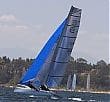
50 footers and not nearly as fast, they are way faster that the 72's around the course.
seems that the rig and hulls are not as important as the foils
And they are making nearly the same speeds as the 72' cats from 3 years ago!
Wow.
It used to be that a longer waterline made for a faster boat, but once they get up on the foils I guess it comes down to weight and sail area for determining max speed. Foil mechanics and control are becoming more important than waterline length.

Upwind, the boats are relatively level; the boats are moving 25-30 kts. A higher angle of attack is required on the rudder foils to lift and stabilize the back of the boat.
Downwind, the speed increases to 35-40 kts; a lower angle of attack on the rudder foils is required to achieve the same lift, so the boats assume a bow-down attitude.
I do realize that's what Oracle said about their bow down...but it also stands to reason that they would want to rake their rigs more vertically when sailing downwind and rake them back upwind...all I'm sayin. There is no advantage for everyone to spill their techniques - trust nothing any team says at this stage <img src="<>/wink.gif" alt="wink" title="wink" height="15" width="15" />

Interesting interview
https:/
The smaller bicycle racers do the best in the mountains only because they have less weight to lift all of those meters. Their power goes into overcoming wind and rode drag AS WELL AS lifting their own weight up the mountain. The best sprinters are usually bigger guys with more raw power but they fade badly in the mountains due to the extra weight that has to be carried up the mountain. So good sailboat bike riders (that's gonna take some getting used to) use ALL of their power only to pump hydraulic fluid so the focus is on only who can produce the most power; any lifting is provided by the boat, making them more like the sprinters - bigger and stronger. Oracle is looking at converting the tactician station into a bike so that he can keep his head up, produce more power, and be well stationed to talk to the helm.
This whole bike thing has a tinge of
absurdity
to it.
Cap'n Don says it's a hoax.
Cap'n Bob says it's a fad.
But NZ has a long memory of yelling
Hydro, hydro...!
back in San Francisco when pressure went down. I bet it was high on their
never again
list.
![[Linked Image]](http://www.sail-world.com/photos/sail-world/Photos_2013_7/Alt_AcKiwicapsize.jpg)
Listen in at about 1:48
NZ f-up
I love watching these old videos of SF. Would someone post once again how to embed a video, please.
absurdity
to it.
Legs have more power than arms (well, except for kenny), so I would have thought a recumbant type setup with proper gearing could do the trick.. I hadn't thought about in-line bicycle style pedaling. But I guess you could stand up and crank (can't do that in recumbant format)
Cap'n Bob says it's a fad.
But NZ has a long memory of yelling
Hydro, hydro...!
back in San Francisco when pressure went down. I bet it was high on their
never again
list.
Listen in at about 1:48
NZ f-up
I love watching these old videos of SF. Would someone post once again how to embed a video, please.
Dave, I don't see it anymore = perhaps when Damon made the upgrade (march) the feature to embed a video has disappeared and all you can do is post it as a link

I think it is supposed to work with only the share url
Let's try
That doesn't seem to work, let's try the video page url
https:/