

I want to improve the ability to of my boat (P18.2), not to mention her helm & crew, to sail closer to the wind. I was advised one way would be to bring my mast forward by tightening the fore stay (and loosening the side stays if necessary).
Does anyone have any comments or additional suggestions? I'm interested not just in any rigging changes, but also sail trim and anything else that enables a catamaran to cut a line closer to the wind.
Thanks.

The general rule of thumb is to rake the mast aft for improved upwind performance, but that is very general, and my not apply to your specific boat. You don't mention in your post about what the specific issue is that needs to be improved with the helm, but personally, I would adjust the mast rake so that you have a slight weather helm and then leave it there.
My recommendation for improving upwind performance would be to install and use telltails on both your main and jib, particularly at the top of the main (2nd and 3rd panels from the top). If your boat is not performing upwind as well as you think it should, the first thing I would look at would be sheet tension. If you're not sheeting in all the way and the top 3rd of your mainsail is blown open, the boat isn't going to go upwind. Having telltails at the top of the sail will tell you immediately if you need to sheet in (as well as if you're over-sheeted). Telltails are probably the least expensive and most effective tuning aids you can install on your boat.
Also, don't get too hung up on pointing angle. Upwind performance is all about VMG, not just angle. If you're pointing 3 degrees lower than other boats, but going 25% faster, you'll still have better VMG.
sm

+1 for all Dogboy said
as far as the mast position - i agree with using it to set weather helm but sometimes i will adjust up or down 1 hole in my sidestay chainplate to adjust for crew weight vs wind (i.e i will rake back 1 hole to depower when solo, in med - heavy air) -
other things to consider:
weight placement is critical for all points of sail
old (blowout) sails will have an effect on your ability to point

Dogboy wrote:
Also, don't get too hung up on pointing angle. Upwind performance is all about VMG, not just angle. If you're pointing 3 degrees lower than other boats, but going 25% faster, you'll still have better VMG.
sm
+1 for dogboy and +1 for mn
I have given a lot of monohull sailors their first rides on a catamaran and most of them struggled with the concept of VMG (Velocity Made Good). Some never get it and continue their monohull habit of pinching upwind like crazy while everyone passes them to leeward.
Here is a basic explanation of VMG:
http://lagoon-inside.com/2012/01/faster-thanks-to-the-vmg-concept/
And an advanced one with lots of math:
Once you understand VMG and can execute it well in a variety of conditions.....then go buy new sails and enjoy the 3-5 degrees higher you can point and maintain the same VMG.
Brad
Stiletto 27 on a 2 year plan
Edited by bradinjax on Oct 15, 2018 - 06:09 PM.

CatFan57,
Good advice here. You cannot change the laws of physics, if I may paraphrase Scotty.
In any beachcat, you are doing well to sail 45 degrees off the true wind direction. Closer than that requires a hybrid sailing craft. National 18-2 champion sailors like Richard Loufek (the designer of the Two), and Jay Glaser used to pump the mainsail and the tiller going upwind- using the waves if possible. They did this because the sails for the Two are cut for off-wind sailing, at which it excels.
In my experience, having difficulty going to weather in my Two has been a problem with my main sail. I had trouble with the controls, I thought, in flattening out the main for upwind sailing. The truth was I needed to replace the bolt rope sewn into the luff of my mainsail, as it had shrunk a lot and would not allow the luff to stretch enough, even though I increased the purchase in the downhaul. After I replaced the bolt rope (and the bungee inside the boom for the outhaul), sail control became a pleasure again - and sailing to weather with it.
Other considerations on the Two are the amount of mast rotation, loose vs. pre-tightened diamond wires, and are you constantly watching the luff on your jib to see if you are pinching, either unintentionally or on purpose?

CatFan57 wrote: I want to improve the ability to of my boat (P18.2), not to mention her helm & crew, to sail closer to the wind. I was advised one way would be to bring my mast forward by tightening the fore stay (and loosening the side stays if necessary).
Does anyone have any comments or additional suggestions? I'm interested not just in any rigging changes, but also sail trim and anything else that enables a catamaran to cut a line closer to the wind.
Thanks.
Grashopper.... if it is knowledge on the Prindle 18-2 that you seek, your thirst shall be quenched with files in this folder....
https://www.thebeachcats.com/pictures?g2_itemId=119159
Enjoy
Wow, what a great set of replies all around! Many thanks to each and all who replied, and my apologies for not responding sooner. I have some replies/questions, but I think I'll break them up in separate posts.
Dogboy wrote: The general rule of thumb is to rake the mast aft for improved upwind performance, but that is very general, and my not apply to your specific boat. You don't mention in your post about what the specific issue is that needs to be improved with the helm, but personally, I would adjust the mast rake so that you have a slight weather helm and then leave it there.
Ok, so it sounds like the suggestion I received to move my mast forward was exactly the opposite of the standard advice. As I said in another thread, I think my helm is neutral, so I better rake the mast back a little to get some weather helm. Actually, I checked my owner's manual and noted there is a procedure recommended for setting your mast rake (by leveling your boat, then using a plumb line from the mast to measure rake), so I should probably start by following that, since I didn't do so setting up the boat.
The specific issue I'm seeing is that, even recognizing that catamarans don't point as well as other types of sailboats, I still think I'm not pointing high enough. I'm watching other cats sail closer to the wind pretty effectively compared to me. And I'm not just talking about new designs.
Dogboy wrote: My recommendation for improving upwind performance would be to install and use telltails on both your main and jib, particularly at the top of the main (2nd and 3rd panels from the top). If your boat is not performing upwind as well as you think it should, the first thing I would look at would be sheet tension. If you're not sheeting in all the way and the top 3rd of your mainsail is blown open, the boat isn't going to go upwind.
I do have tell tales on the main & the jib. I don't claim to be an expert on them yet, but I know I want the windward and leeward tell tales streaming back, and I watched these and other videos to get up to speed:
Main tell tales:
Jib tell tales
I've tried various sheet tensions and combinations, and I've definitely sheeted in all the way on the main (with traveler all the way in) and jib, and still don't think I'm getting sufficient upwind performance.
Dogboy wrote: Also, don't get too hung up on pointing angle. Upwind performance is all about VMG, not just angle. If you're pointing 3 degrees lower than other boats, but going 25% faster, you'll still have better VMG.
sm
I am aware of the general idea of VMG, although I definitely don't claim to be accomplished at making it happen. However, when I noticed my boat seems to excel at making high speeds in high power conditions when sailing off the wind (as compared to when sailing closer, where it doesn't seem to excel), I adjusted my sailing to start taking more off the wind lines and hoping the speed would make up for my lower lines. Nevertheless, it doesn't seem to be working that well for me (especially in low/moderate wind conditions), so by now I'm pretty convinced I should be able to do better sailing closer to the wind.
(Next post I'll reply to other comments, maybe get into what I've been trying regarding adjusting the jib sheet blocks location....)
Edited by CatFan57 on Oct 17, 2018 - 03:27 PM.
, when I noticed my boat seems to excel at making high speeds in high power conditions when sailing off the wind (as compared to when sailing closer, where it doesn't seem to excel),

One thing to remember with the 18-2, 19, Tornado, etc; those boats have centerboards and pinching is even worse in them than on daggerboard boats.
Edited by wlrottge on Oct 17, 2018 - 05:51 PM.
My Gcat 5.7 was a dog to windward, I just thought it was an older, boardless boat and that was life. I got some brand new sails and it really gave the boat life. The downhaul became much more effective. The jib also had a slightly shorter foot for some reason, not sure what impact that has had technically speaking but she sails to wind like a new boat. Not saying spend $1000 or more on sails, but the bolt rope may be a could start
The downhaul became much more effective. The jib also had a slightly shorter foot for some reason, not sure what impact that has had technically speaking but she sails to wind like a new boat. Not saying spend $1000 or more on sails, but the bolt rope may be a could start
Upwind, a larger jib is not really needed - think about all the high performance boats that have a self tacking jib (very small) - off/down wind size is king (those self tackers race upwind/downwind races these days and have a spin for the downwind leg)
it is pretty common for main sails, the boltrope and the fabric that wraps around the bolt rope to stretch in places and shrink in places too: making the bolt rope/luff to need either "releasing" or replacement.
I have had my bolt ropes resewn/replaced a few times in each of my main sails that are over a season or 2 old
MN3 wrote:
The downhaul became much more effective. The jib also had a slightly shorter foot for some reason, not sure what impact that has had technically speaking but she sails to wind like a new boat. Not saying spend $1000 or more on sails, but the bolt rope may be a could start
Upwind, a larger jib is not really needed - think about all the high performance boats that have a self tacking jib (very small) - off/down wind size is king (those self tackers race upwind/downwind races these days and have a spin for the downwind leg)
it is pretty common for main sails, the boltrope and the fabric that wraps around the bolt rope to stretch in places and shrink in places too: making the bolt rope/luff to need either "releasing" or replacement.
I have had my bolt ropes resewn/replaced a few times in each of my main sails that are over a season or 2 old
How do you guys determine when your sails are tiring or shot? Is it just assessment of their performance? Or is there stuff you can see just looking at them?
klozhald wrote: CatFan57,
the sails for the Two are cut for off-wind sailing, at which it excels.Other considerations on the Two are the amount of mast rotation, loose vs. pre-tightened diamond wires, and are you constantly watching the luff on your jib to see if you are pinching, either unintentionally or on purpose?
Thanks for the reply. I do watch the jib luff so if it starts to luff I back off. For mast rotation, I've been following what my P18.2 owner's manual says, which is:
"For most sailing, this rotation should be set between 60 and 75 degrees from straight back. A good rule of thumb is to have the wishbone pointing at the shroud when you are sailing to weather. ... When sailing to weather, an increase in rotation will flatten the mainsail, while less rotation will make the mainsail fuller."
So I've been setting the rotator so it points at the shroud when sailing to weather, and basically leaving it there the whole session. Not sure if I should be doing anything else when trying to point as close to the wind as possible. Someone recommended to me to have less rotation when trying to sail close to the wind(?). I don't quite understand if the last quoted sentence is telling me to do anything different than what I'm doing. I do generally understand that a flattened sail is de-powered and a fuller sail is more powered.

Keeping the flow smooth across the mast onto the sail is key. If the angle is creating a detached flow, wrong angle I am afraid.
JohnES wrote: Grashopper.... if it is knowledge on the Prindle 18-2 that you seek, your thirst shall be quenched with files in this folder....
https://www.thebeachcats.com/pictures?g2_itemId=119159
Enjoy
JohnES, thanks a lot for pointing me to these. I tried downloading the first one earlier this week and kept getting a "download failed" result. However, now it just downloaded, so I am looking them over, and can see they contain a "boatload" of valuable knowledge I really wanted to get into.
In fact, the first page says when sailing upwind in light air, I should have the "rotator pointed at the shroud chainplate," so that answers the question I just posted above - looks like I was doing that much right.
Another great thing I see is how to adjust the location of my jib sheet blocks fore/aft and athwartships. I was playing with those adjustments last time out, but having a hard time reaching conclusions in the light air conditions prevailing that day, so this is a real help.
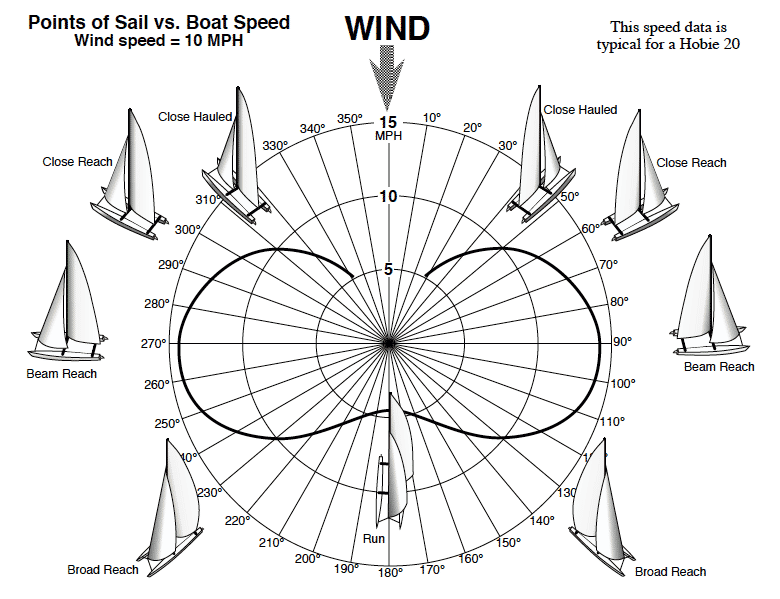
One question though: the three guides are broken down into "Upwind", "Close Reaching" and "Downwind". What's the difference between "Upwind" and "Close Reaching"? I'm looking at the document MN3 posted above and the points of sail it's giving are "Close Hauled", "Close Reach", "Beam Reach" and "Broad Reach". I'm not seeing an "Upwind".
PS, by the way, thanks to MN3 for posting that document. Looks like it is saying a Beam Reach is the fastest point of sail on a catamaran(?). I didn't know that - thought broad reach was the fastest.
Edited by CatFan57 on Oct 20, 2018 - 03:31 PM.

Close Hauled is upwind..the others are different angles of sail off wind with Broad Reach being downwind.
saltlife77 wrote: Close Hauled is upwind..the others are different angles of sail off wind with Broad Reach being downwind.
i have to disagree a bit, there are other terms/angles that are still upwind

How do you guys determine when your sails are tiring or shot? Is it just assessment of their performance? Or is there stuff you can see just looking at them?
Lots of factors:
for me, i can tell if my leach is flapping
if my draft has moved forward and it's harder to flatten my sail
if i can't point as high as a new sail does (this newness is very short lived)
ALso, materials age / change differently:
dacron sails can live for "ever" if they are cared for and don't have chafe or rips but will continue to stretch forever and become less efficient/optimal ... etc with use and wind
more modern laminate sails often stretch (very little) and lose their race value pretty quickly but can be used for recreational sailing for a long time. the material will just fail at some point but can be patched and used (again very non optimal for racing) but can last for a long time - proper cleaning and storage will greatly extend their life
It's a bit hard to explain how to tell when your sails are blown without being very technical but basically what happens is the draft of the sail becomes deeper and moves forward (if i understood and remember correctly) and this has negative effects on the controllability of the draft
not a problem at moderate winds but a real issue in strong to crazy-strong winds
IF you ever purchase a new set, and they are made correctly to your boat .. it's like a great tune up and very noticeable.
we used to purchase used professional sails from Robbie Daniel (olympic level sailor/coach) at a heavy discount and modify them if needed to fit our mystere's. the sails were either experimental or races a few times and no longer new enough to be competitive - miss those days
Oops, posted in wrong forum.
Edited by klozhald on Oct 23, 2018 - 12:07 AM.
Short answer. Your orignal sails are shot.
Long answer. The sail loses its shape. Look at the trimmed sail, does it look to have a shape like an airplane wing? A worn sail the max draft will begin to move back and resemble the shape of an inflated pillow case.
Sails can last a long time, but they loose shape rather quickly. Racing the F18, we see a difference in a single season. A new jib with good shape will likely really be beneficial to you club racing.
CatFan57 wrote: [quote=MN3]
The downhaul became much more effective. The jib also had a slightly shorter foot for some reason, not sure what impact that has had technically speaking but she sails to wind like a new boat. Not saying spend $1000 or more on sails, but the bolt rope may be a could start
Upwind, a larger jib is not really needed - think about all the high performance boats that have a self tacking jib (very small) - off/down wind size is king (those self tackers race upwind/downwind races these days and have a spin for the downwind leg)
it is pretty common for main sails, the boltrope and the fabric that wraps around the bolt rope to stretch in places and shrink in places too: making the bolt rope/luff to need either "releasing" or replacement.
I have had my bolt ropes resewn/replaced a few times in each of my main sails that are over a season or 2 old
How do you guys determine when your sails are tiring or shot? Is it just assessment of their performance? Or is there stuff you can see just looking at them?
bacho wrote: Short answer. Your orignal sails are shot.
Long answer. The sail loses its shape. Look at the trimmed sail, does it look to have a shape like an airplane wing? A worn sail the max draft will begin to move back and resemble the shape of an inflated pillow case.
Sails can last a long time, but they loose shape rather quickly. Racing the F18, we see a difference in a single season. A new jib with good shape will likely really be beneficial to you club racing.
[quote=CatFan57]
How do you guys determine when your sails are tiring or shot? Is it just assessment of their performance? Or is there stuff you can see just looking at them?
Ok, thanks to Bacho and MN3 for the replies on this question. Having some aviation experience, I understand that the shape of an airfoil has the max draft forward. So to confirm regarding draft changes you see when sails get older, it's when the max draft moves aft.
And MN3's comment that he sees his leech flapping was very spot on regarding the jib. In an effort to reduce that, I was playing with moving my jib sheet block forward in the track and sheeting in hard - but I was not seeing it produce the results hoped for. (One of the vids I posted above mentions how you tighten the jib leech by moving the jib car forward; while moving the car aft tightens the jib foot.)
Bacho said: "A new jib with good shape will likely really be beneficial to you club racing." Well, coincidentally, I was thinking about maybe starting by getting a new jib, and seeing what that does. (Obviously would be a lot cheaper than getting a new main.) Any particular reason you focused on the jib though? Are you thinking a new jib would possibly play a bigger role in helping improve my sailing-closer-to-the-wind issues than a main?
Also, do you guys have suggestions for where to look to get a jib at the best value? Someone suggested SLO sails was good, but their website is saying "we cannot currently make this product." I saw one other website with somewhat cheaper prices, but it's like shooting in the dark for me since I don't know the mfrs. My sails were made by Ullmann, but they don't list the product on their website, and I don't know that I necessarily need to go back to them, even though I understand they're a great sailmaker. Actually, the club is closing here in 14 days, so maybe I'll save my $ til the spring, but it would still be good to know where to go.
Edited by CatFan57 on Oct 24, 2018 - 09:42 AM.
deleted
Edited by CatFan57 on Oct 24, 2018 - 09:08 AM.
I have used Schurr Sails in Pensacola FL. Great sails, great service, great price.

I've received quality sails from Elliot Pattison and Glaser Sails. Chip at Whirlwind is less expensive and good to deal with.
Any particular reason you focused on the jib though? Are you thinking a new jib would possibly play a bigger role in helping improve my sailing-closer-to-the-wind issues than a main?
I don't want to speak for Bacho (and his input is very good/valuable) but imho - a jib gets blown out faster and probably a bit more severe than a main will (lots of abuse from tacking/whacking the mast) and when replacing a jib people typically go with a very similar shape / material so there is no new learning curve compared to going from a 10 or 20 year old sail design/material to a modern one
also a jib is kinda like a turbo that "forces air" into the engine (main) and when blown out ... disrupts this
so putting a new/modern turbo on an old engine will improve performance even if the engine is worn
and the cost is 1/4th of a new main (give or take)
and lastly - a new jib (ceteris paribus) creates less disruptive air to the main vs an old jib that will cause disruption to the main ... so even if the main is new, it has already had it's air flow effected
Also, do you guys have suggestions for where to look to get a jib at the best value?
I have used Doyle - I do not recommend them (they are a franchise so any given location can be very different)
I have used Sail Technologies for repairs and liked their work
I know many people LOVE Glassier sails
I know many people have lots of success with landenberger sails and i owned a main from them - very well built
As mentioned above: Schurr Sails,Elliot Pattison and Glaser Sails and Chip at Whirlwind all have good reputations
I worked with chip a decade ago to build me a sail - it didn't come to fruition but he was wonderful to work with and i THINK i am gonna contact him for a new jib or 2
interesting read on jib's performance - even though its for a mono ... still interesting data
https://forums.sailboatowners.com/index.php?threads/jib-size-and-pointing-ability.134628/
CatFan57,
You'll find some useful data and photos for your Two here:
https://www.thebeachcats.com/pictures?g2_itemId=123714
Edited by klozhald on Oct 24, 2018 - 03:34 PM.
Okay guys, thanks to everyone who responded with recommendations on where to get a jib, much appreciated. I'll be looking into it. Just wish had done it sooner so could have had it for the season and seen what it could do.
Also, thanks to MN3 on the good info/ideas as to (a) why a jib's likely to get blown out sooner, and (b) why it might be more critical to replace, i.e., since it sets the air for the main -- I find those points completely convincing and logical - especially for a boat like mine w/ a relatively large jib.
Klozhald, thanks for the link to the P18.2 pages. Lots of good info in there I've started reading. Am impressed by the photo of Bob Martinez solo-trapping the P19 in the Santa Barbara channel (respect for you solo ocean sailors), and liked the photo of you single-hulling the P18.2 in Roosevelt Lake in AZ (which I'd never heard of) in 1987. Looks like you've gotten many years of pleasure out of your boat.

You could sell both sails and have enough money to buy a jib. But then you’d need to buy a new main. But you would not feel guilty about it because you can’t sail with only a jib...

traphappy wrote: You could sell both sails and have enough money to buy a jib. But then you’d need to buy a new main. But you would not feel guilty about it because you can’t sail with only a jib...
Brilliant strategy!