

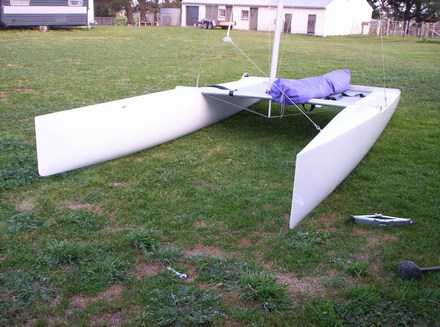
In order to guarantee that everyone wanting to develop a kids F12 is moving in the same direction, I've put together a prelim set of class rules. This document is intented as a starting point and I would welcome any feedback and be willing to change pretty much everything.

Great start Scarecrow but please re-write Rule 1.3.1.
Hull panels shall have a weight of not less than 1.2 kg/m2 (equal to 3 mm Gaboon)
Sounds like something a New York lawyer would dream up....Keep it simple and just state in plain English what the minimum weight is... you can calculate that based upon the general box parameters built out of 3 mm Gaboon ply, just give a minimum finished ready to sail weight and everyone will know where they stand.
Thats fine by me..
My original hulls had approx 20kg (10kg each) of ply in them including bulkheads, longitudinals centre case sides etc. The newer design has much less.
Where do people think the minium weight should be set? 45kg? (100lbs)
Id rather just see a minimum beach weight as its quite hard to get a panel weight without cutting cores from the boat. I think we need to look at least 55-60 kg to make sure we end up with a durable boat, and to also allow the rotomolded crowd an even shot at producing a competitive boat as well.
Also, the sail area measurement needs to differentiate between conventional rigs and pocket luff rigs, not quite fair to add the mast area to their sail area calc. I'll knock out a sail measurement spreadsheet that will take care of this.
In the interest of getting as much racing as possible for the kids, perhaps we might look at the existing designs out there to make sure the rule is as inclusive as possible of what already exists.
Under daggerboards and rudders, skegs should also be allowed as some existing designs have these.
Other than that....great start
RG
I agree, however, do we really want to set a minimum weight heigher than the Paper Tiger (50kg)
Also, based upon my perception of sentiment on the forum I've pulled the length back to 12 ft. Are the majority happy with that?

Take a look at the weight analysis I did last earlier this year :
http:/
I can't get it down to less then 63 kg ready to sail when using 4 mm ply.
A rotomoulded version will be heavier by at least 15 kg according to my data.
Even when using 3 mm ply (which is rather weak) you can't get it down to 45 kg overall while limiting yourself to only using simple materials and building methods.
Wouter
Also, based upon my perception of sentiment on the forum I've pulled the length back to 12 ft. Are the majority happy with that?
The 50kg limit for a Paper Tiger is sans mast, boom mainsheet and sails, so its probably closer to 70-75kg with all the gear on it, so 55-60kg is still pretty agressive for something thats homebuilt or commercially produced. Another thing to think about is that if you set it too low, then a lot of creative people are going to start building carbon hulls which sort of defeats the purpose of trying to make these affordable.
I know that if I got aggressive, I could probably build one under 50kg rigged but it would have no end of expensive stuff on it to get there. These are not A-Class cats, just a better performing Opti that hopefully a bunch of kids will want. Wouters weight estimate is reasonable within the bounds of keeping it reasonably cheap/affordable.
As for the 12 ft, Im happy with that, what about everyone else ?
RG

My design is done at 12 ft 4.5 inches.
It just happened this length allowed me to do what I wanted.
On the other side of the coin the beam , mast length and sail are a little less.
I will build it as light as I can without the use of materials that will increase the cost and based on my own estimates I hope to come in around 50kg.
The rules document is a good idea to provide some clarity and focus.
Regards,
Phill
RG can you please confirm your hull length to date?
mine were done at 3.75m which is what Wouter had for a length (12'-3.67") I presume Wouter wanted a rounded number in metric ?
Phill, would an inch less make a big difference to you ?
Not overly fussed about length and will go with what the majority want.
RG
Yes, and I wanted the maximal hull length that I could get, at these sized everything helps. Also this length turned out to be very nice mathematically, but I won't bore everybody too much with that.
Basically at this length a scaled down F18 or F16 hull will optimally carry 105 kg combined boat + crew weight (at the time I assumed 60 kg for craft and 45 kg for crew). Therefor the F12 was directly comparable to both of these boats and it was easy to make initial conclusions about factors like pitching, overall drag and rig induced loads. As a matter of fact it shared an even more tight relationship to the Prindle 16 catamaran. Basically you can scale that and end up with a very good first try for a boardless F12 using a deep V-ed hull that is very easy to make.
How much difference does going from 3.75mtr to 3.65 mtr (= 12 foot) make ? Well, when using the scaling operations to get a first try at the F12 hull then weight carrying ability would go down from 105 kg to 95 kg, which wasn't (isn't) negligiable.
I'm personally fine with 3.8 mtr if we all wanted a nice rounded number. But, I rather not go to less hull length then 3.75 mtr though. Most of what I've done so far is done on 3.75 mtr. I strongly prefer keeping it there.
Wouter
Scarecrow,
Here my initial suggestions regarding the class rules.
- sail area
Suffice by ruling that a sleeved sail area is determined solely by its total surface area and that the halve the surface area of the mast is to be added when the sail is not fully covering the mast itself (excluding the area below the boom).
- Hull length
I strongly prefer 3.75 mtr overall length or more.
- Panel weight
Remove this rule entirely. For equalizing the performance only the ready to sail weight is needed. Also, ruling on a panel weight assumes you can predict that in the future we will never be able to create cheap and strong panels that weight less than giving in the rule. We simply don't know that. It is also another thing to check when measuring and certifying and it is also as good as impossible to check. Basically, this rule has large drawbacks and hardly any benefits. Give the designers all the freedom they want in this area, no-one wants to design a fragile boat and customers will vote with their feet anyway when one tries.
- Mast
Completely unregulating the construction of the mast may well turn out to be a big factor in losing control over the costs associated with F12's. It also makes international shipping alot harder = more expensive. I have experience in shipping masts internationally now and a significant portion gets damaged in transport. Also shippers really hate long, thin and easily damaged goods. You are alright if you can strap ten or more of those together, but shipping single masts or a pair of them is asking for trouble. Also a 6 mtr. mast is hard to transport legally without using a boat trailer, which will add another 1000-1500 bucks to owning a F12.
I really would like the see a rule that enforces the mast to be collapsable in parts that are no longer then the hulls themselves. Based on my experience so far I'm convinced we'll be thankful for that choice later.
I'm also concerned that leaving the mast unregulated beyond being collapsable is still inviting trouble. Some will want to have tapered carbon masts or specialized shapes. Rotating a mast will immediately add various hardware that will again add costs. I think like that it will proof very hard to control costs. Additionally, potential buyers will became hesitant as they will feel (justified or unjustified) that more expensive parts will always be more performant.
Based on my experience with the landyacht classes I feel we should seriously consider a setup as they have. They rule that the mast must be made up of normal standardized prismatic aluminium round sections. And that if we wanted more performance that we should allow camber inducers rather then fully rotating masts.
I can write a full post on this, but I won't now. Suffice to say that there is both need and room for ample deliberations on this aspect.
As a matter of personal opinion, while I strongly favour a pure formula class rule setup for larger catamarans I'm convinced that that is not the right approach for an simple and inexpensive class like the F12's. Any reductions in complexity and cost we achieve initially will only make adding costs and complexity more interesting to both builders and sailors. At the level of cost and complexity we are looking at to make the class maximally accessible and affordable there will not be much of a selfregulating effect as is found in the F16 and F18 classes. In the case of the F16's customers refuse to pay more the 15.000, no matter how well the craft is fitted out and that keeps the F16's sharp. But at 3000 euro's for the F12 it will be much easier for alot of people to justify spending an additional 1000 Euro's just to get a small advantage over the other sailors.
I really do believe we must look at making the F12 a OD class (but NOT a SMOD class) where the most important aspects of the basic layout is regulated but where smaller factors sail design, rudder design and the way of implementing the basic design are left open. I'm thinking of :
- regulating closely the shape of the hulls (enforce fairness of racing and easy of building)
- regulating the type of rig (stayed / unstayed, sloop, uni-rig etc)
- regulating the major over all dimensions
- regulating the more troublesome components like mast to a medium level (collapsable or not, material)
- regulating to have or not parts like daggerbaords/centreboards, camber inducers, T-foils, etc.
The rest can be left open as their influence on overall performance is too small to really matter and you must use the group of designers and enthousiasts to find the best solutions over time.
Wouter
Wouter
Not sure I agree with Wouter, a simple box rule should suffice and promote choices for the designers and the kids.
Wether we admit it or not, most kids are quite capable of making informed choices and even have
taste's
of their own which I'm not sure we need to regulate with rules.
Ultimately, that which works best on the race course will come out the winner, and I'm not sure that there is enough info or fact available here to determine what that is yet.
Aerynt
Hi All
Stayed out of the conversations for a while to see what would become of the F12 and it looks good.
Well done to those who have taken the time to design the cats, great to see new fresh designs being put out there.
I don't agree with making the F12 a OD, with 4-5 designs already presented, it will only lead to people proceding outside of the arena.
I would also like to say that the mast material be restricted to aluminium, I don't believe there should be any restriction on if the mast is one or more pieces, nor restrictions on stayed/unstayed rigs. There should be a sail area retsriction, but not to restrict things like luff or foot lengths.
Just my thoughts
Regards
Before you write in stone that the mast has to be aluminum…windsurfing masts should be looked into more thoroughly. No performance oriented windsurfing masts that I know of are made of aluminum any more…(that should tell you something) haven’t been for at least a decade…they are all a combination of Glass/Carbon, Glass/Kevlar/Carbon or Carbon alone. Most are two pieces with a very strong furrow joint. I believe they should be strongly considered for the following reasons.
1) Thoroughly tested and refined designs. Already optimized for taper, bend characteristics, weight, and strength.
2) Readily available in two pieces
3) Very Strong “Wave” style mast built to survive wipeouts in huge surf (15’+) allowing it to hold up to the on the water abuse it would see on a “kids” boat.
4) Extremely light weight for easily handling by the kids allowing them to set up their own boats.
5) World wide availability. Many areas have local suppliers. Can be ordered over the internet/phone/mail and delivered to your door for very modest shipping costs.
6) Many available on used market to further reduce cost.
While Aluminum sectioned mast could be an option for sailors which desire to do so, to ignore or outlaw a readily available glass/carbon windsurfing masts would be a great disservice. If it is truly the intent to make building and outfitting this boat easy one of the most logical paths leads straight to the windsurfing masts.
Regards,
Bob
I'm continiously updating the info as provided through the F12 Website :
http://www.xs4all.nl/~whijink/F12/
It has taking a while by I know have a firm quote for a suitable F12 mast made from straight high 0.2% threshold aluminium tubing that will take a F12 sleeved mainsail. The mast can be taken apart into two or three parts.
The same mast is used on the Promo landyacht which are becoming very popular. Its length is 5.5 mtr and the cost is 240 Euro's including 20% European taxes.
The 5.5 sq mtr sail (not suitable to F12 as landyacht sails are too flat for soft water craft) cost 577 Euro's including 20% European taxes. However, the costs shouldn't change much when entlarging the sail and giving it more draft. The total load of a 5.5 sq. mtr landyacht sail in 20-30 knots of wind and a F12 rig in sub 20 knots winds are as good as identical. Please note here that Promo's use 5:1 to 7:1 purchase systems to sheet the sail as flat as a board. That is alot of rig tension ! The promo's are also 2 mtr wide and weight 60kg themselves and carry adults up to 90 kg without a fuss.
Mast, sail, battens and boom will weight a total 14 kg or less. Say under 15 kg. That is certain now. Its centre of weight is below that of a normal prismatic mast as the promo mast is obviously tapered.
I feel confident now that we can have a commericially build and offered F12 unstayed rig for 850 Euro's including 20% European taxes. The amount of EU taxation will be enough to cover shipping to any place in the world.
This result still allows us to achieve the design goals of less the 3000 Euro for a ready to sail F12 and as this can be purchased ready to go it will also go a very long way in achieving the
building under 100 hours
design goal. The Dotan rudders are purchased as well. So that only leaves building the hulls, beams, push rods, trampoline and assembling the components. I think we can get darn close to 100 hours building time.
Anyone out here want to look up dependable pricing for 5.5 to 7.0 sq.mtr surf masts and sails ?
I would be very thankful if I don't have the spend the time to do that. I already invested alot more then I can justify.
Wouter

Well, here we go again. We are again at the point vere one is supposed to buy everything exept the hulls. Please keep the the design open for homebuilders...

A 7m2 mast, sail, boom and mast step will cost from around 600 Euros new. But the big advantage of using windsurfing rigs is that the abundance of cheap second hand ones about, ebay is a good source for this.
Gareth
Gato,
While I think commercial construction has to be a primary objective to get them out there in numbers I agree regarding you rcomments on home building.
I hope to provide plans that detail the construction in ply, foam and cedar strip depending on an individual's preference as well as detailed instructions on making the sail. The only marine fittings will be a couple of blocks. Everything else will be obtainable form a timber yard and hardware type store.
Regards,
Phill
You misunderstand my comments. All the components named can be easily homebuild. The fact that they can ALSO be bought ready to go for the given quotes only serves as proof of the maximal costs and economical viability when a company starts building these commercially. Of course lazy homebuilder can make use of these option if they want to get a craft quickly on the water.
Actually Landyachting (and iceyachting) is far more homebuilder oriented then any other sailing craft. It is a good place to steal tricks from. Actually the commercial landyacht builders often use the same tricks and designs as developped by homebuilders.
From the beginning (that is now several years ago) I tried to design the craft in such a way that both homebuilding and commercial builder would be practical.
We must all learn to think in terms of
.... and ...
instead of
... or ...
. We must fight the Pavlovian tendency to equated everything commercial with being hard to copy by homebuilding. That is when looking at my design and proposals. I'm not so sure the same holds for some of the other designs.
Wouter
With regards to rigs I can't see myself supporting any option that limits choices and options where these choices are driven by different priorities. We're trying to create a one size fits all rule and I think we should be trying to be inclusive, not looking for things to outlaw or limit. The fact is that pretty much every spar maker has a suitable extrusion for this vessel if stayed (look for a mast tube used on a two person (one on trap) dinghy. My prefered option is currently the MG14 wing mast (approx AUS$400 for the tube. This mast will be less than 6kg fully rigged, a weight that will enable the young sailor to step it themselves. Having said that, I wouldn't conceive of suggesting everyone should use this rig as it is going to be more expensive than round tube.
We need to focus on keeping the rule open and inclusive. We should also look at drawing a line in the sand (ie 30 Nov) as a deadline for concensis so that designs can progress without being held back or becoming redundant.
Folks,
Something to think about with respect to keeping the rules open and inclusive -
We may find there will be practical limitations on craft depending on circumstances given
particular situations and localities. These limitations may range from the normal
prevailing sailing conditions to something as broad as the general affluence of the Area.
In strong wind areas wide beam and small sails could be the go while the reverse could be
desirable in typically light wind areas. Just like in affluent areas a flash production
boat may be better than a home built boat which may thrive in poorer areas.
It may be wise to just set down a hull length limit and leave everything else open or better
still, allow the other parameters to be set locally.
Afterall the right specs are the ones that get the most kids on the water.
I'm not sure if this would be a good approach or not but thought I'd mention it to see what others thought.
Regards,
Phill
Yes!!! absolutely in favor of this and better yet it gets kids thinking about how best they can improve their boat. The downside to this is out of hand development with $ which could hurt things, so we need a simple rule that reins in the $ spent......only problem with that is who is going to do the accounting and what sort of cap do we want thats in keeping with our goals?
Bottom line is I'm all for anything that keeps things as simple as possible.
RG
A reasonable weight is the easiest way to cap the dollars spent and not hinder the capable homebuilders either.
Aerynt
I wonder as whether the opinion to keep things maximally open is more inspired by not wanting to give up ones own
pets
rather then a serious evaluation of effectively launching a F12 class the world over. And yes, I readily admit to having my own pets.
I do however feel that Phill has made a great point about
the right specs being the ones that get the most kids on the water
Still, I do not see much succesful precendent in allowing wildly different craft from succesfully launching a serious youth program. Afterall, there are 10's of different 14 foot classes and we still don't have a viable catamaran youth program. I think an very convincing argument can be had where large differences between boats of the same hull length is actually a major obstacle to success.
Remember the F12 project was intended to solve that issue as well. I should remind everybody here that the F12 project didn't start when Phill first mentioned his idea for a 12 foot with an unstayed rig some 5 years ago. His program is actually called the Blade 12. I changed the name a long time ago to seperate both programs. The F12 project here on catsailor started last winter, (dec 2006) because of a youth sailing program discussion on the main forum. I also underscore that this F12 project is not entirely the same as my own efforts in this field prior to dec 2006 either (the craft that I really like to own myself).
I fear we must all seriously consider letting go of some of our own pets in order to arrive at a well balanced F12 concept that actually solves the issue of a viable international youth catamaran program c.q. class that gets to the youth sailors early on and feeds them into the larger cat classes.
Allowing wildly open class rules does not have a particulary great potential of succes at that. Especially not in comparison to highly organised and regulated monohull classes in that age group. We'll look like a ragtag band of eternally disagreeing hippies in comparison.
This is not to say that the F12 class may not use surf rigs and other rig or construction alternatives. It just means that the basic class needs to be well balanced and possibly more strict in it international setup then allowing a wide range of different designs. At a local level the regulations can be relaxed if that improves youth participation as long as serious youths gravitate to a single F12 design when they get into more serious (away of their own club) F12 racing.
Wouter
Gato,
Please take a look at this posting :
http://www.catsailor.com/forums/sho...
To understand how easily the named commercially available rig can be copied by a homebuilder.
I trust this takes away your concern.
Wouter
I Agree with Phill, Prevailing sailing conditions and local influences could play a large roll in design acceptance. For instance, here in East Coast Florida USA our summer season has predominantly light winds 6-8 mph. If you set sail sizes based on conditions in some higher wind areas in Europe or Australia the USA boats will end up being a dog. Vice versa, if they were set to the light wind standards of Florida USA the same boat may be vastly overpowered in the higher wind regions of the world. This has been a problem with other catamaran classes has it not? Where there was a European Rig and a Larger Rig for the USA?
Same might be said of hull design to a lesser extent. An area where a surf launch is necessary might need a different hull design (more freeboard/beam clearance) than some that sail on protected waters.
In the USA the trend seems to be more “Turn Key” as opposed to areas in Australia which seem more inclined to home build. The more options available to optimize for the local conditions, the broader the appeal.
Let the designers bring their a-game to the F-12 table. Let them build and test their prototypes against each other; the cream will rise to the top. The consumer will ultimately determine which designs they will choose to support. Problem solved.
Keep in mind that kids are all about “tricking out” what ever they are involved in… be it their clothes, skate boards, bicycles, school note books, and as they get older their cars…A boat that allows them the freedom to customize and individualize will be more attractive than some vanilla flavored ho-hum one size fits all. If this under taking is really about getting kids on catamarans then its main thrust has to be about the excitement. Forget the optimist class mono slugs…there is an opportunity to reinvent entry level sailing for kids, if done properly this could be huge…it is going to be mostly about PR…but the product has to be exciting enough to give the PR element something to work with.
While safety always has to be a major factor with any children’s event, remember kids this age are doing skateboard “kick flips while jumping over 4 or 5 concrete steps. The design must not be neutered by the “Nervous Nellies” to the point where it is so “safe” that it offers the excitement on par with watching the grass grow.
All that needs to be agreed upon is a maximum length.
With the power of the internet, and the generosity of Rick and Mary offering this web site, the possibilities are nearly limitless.
Regards,
Bob
Sorry Wouter, had mist that one...
Otherwise I think the idea good to keep the F12 close to OD.
And an other important aspect is that the boat must be very easy to build, and in the workshop the V shaped hull is very hard to outrun.
I have been working on that tangent, as you know of course, you helped me there.
Trying to get a deep V-ed hull for the F12 was actually the advice I got from Phill a long time ago and even though I dislike its looks I feel that Phill gave some very solid advice there. It is the reason I'm persuing this tangent.
I also admit that I was always a bit amazed at how well the deep V-ed hull of the Prindle 16 was performing. It outpoints the Hobie 16 upwind and the steering wasn't very sluggish at all.
Interestingly enough the exact Prindle 16 shape can be scaled down to a 3.75 mtr F12. So with your contributions and some smart stealing of other designs we may have a deep V-ed hull F12 design soon.
Wouter
Maybe a design contest is the way to progress things ?
Each team makes their own ideal designs together with full overview of weights and costs (both or parts and the whole lot) as well a sort analysis of building requirements (skill, tooling, etc)
We can then compare these designs to one-another and make the best of them the tue F12 ?
Or possible, combine a best idea's of a few designs into a new single F12 ?
Would that be an approach that the designers will be happy with ?
Wouter