

Ref: http://woodastic.blogspot.com/
We are finally underways with our building. We plan to update the blog every week for those who might be interested. So far the strongback is done and we begin cutting and fairing the stations this week.
By all means, keep us posted. And good luck!

Rolf:
I noticed you said you are on a budget, I am currently selling my older sails for $500.00 (jib and main) battens included. Now the only problem I can see is shipping them to your location wont be economically feasible.
Three at once!!! Sounds like a fleet building party.
Thanks for the offer Robi. Mainsail would never fit our masts and I do think we want to do the sails ourself. Nothing like crisp new sails <img src=

alt=
/>
No problem Rolf, keep us updated. I am specially interested to see how that tornado rig is going to work out for you.

are you going to get the hulls down to weight with strip planking?
Have you done the weighing out?
<img src=

alt=
/>
We think it will work out well Stewart. We will pull off a test panel with 200gsm/4mm spruce/200gsm cloth once we have the stations set up to get some numbers. Considering that ply usually have three layers of epoxy on each side plus paint we should be good if we are careful with gaps (epoxy is heavy and expensive). I have also been talking with strip kayak and canoe designers about how to build light and got lots of tips. We have discused weight at length but only the test panel will tell. We will also do some experimental stuff inside the hulls to bring weight down as far as we dare. It will all be documented in the blog. Phill have come up with some new (to me) ideas which it will be fun to implement.

Good luck with the project Rolf. Keep posting the Blog address every time you update it - I can never remember these things <img src=

alt=
/>
Maybe you should set up a webcam, so that we can all watch and give our opinions and advice on the cold winter evenings <img src=

alt=
/>

Welcome to the club Rolf
cool.. Hope it works out!!..
200 gsm glass?.. I suspect you could drop to 100gsm if you wished. Although 200 will give greater scuff resistance...
If you wanted to be tricky you could use a combination of 100 & 200..
<img src=
alt=
/>
But dont listen to me I enjoy mucking about in a shed too much.. <img src=
alt=
/>
Stewart,
I am happy with any input, especially critical, as that often bring a new angle or information to the issue.
200gsm is choosen becouse it have proven to be a good schedule on kayaks both for strength and stiffness. Some of the tests done by Gougeon bros (J.R. Watson really did them I think) indicate that this is the best weight vs panel stiffness ratio for our project as we try to match materials to make it as strong as a proven ply boat. But as mentioned earlier, only the test panels will tell.
85gsm at the bow and 200gsm further back has been suggested.. How much work should we put into this is the question. Interestingly enough, a carbon laminate dont seem to have helped to bring weight down. A light carbon cloth would probably have needed more epoxy so it would have come out stiffer and stronger, but heavier. Pretty interesting I tought.
By golly, I also hope this works out <img src=
alt=
/>
I agree with Stewart that 100g is enough. It is in one way only surface strength you will gain. You will need to put the glass fibres at 45 degrees to the woodfibres to gain anything in strength.
Thanks Åke (and Stewart). I understand that your opinion is that except for scuff resistance a catamaran strip hull will not gain much in the way of strength by using 200gsm instead of 100gsm. Correct?
I was worried that panel stiffness and strength would not be good enough for loads working 90degs on the wood fibers, making the glass strands break with catastrophic hull failure as a result. We dont plan to put much inside the hulls. Just partial bulkheads/ring-frames under the beams and at the bridle, going for a monocoque structure. This means that the panels between the bridle and the mainbeam will have to take care of themselves.
BTW, Åke. Just had a look at the pixie building photos you have on your site. I must say that your workshop is really nice and inspirational with its position just by the water. Looks like an old boathouse? If you work with epoxy during winter, how do you heat it?
If you put the glas mat so the fibers lay 45 deg to the wood fibers you will have them all working to prevent the hull cracking.
The best would be to use a Biaxial 45 deg mat.
I am also scared that you will have to glass both sides, at least on bigger boats it is the rule
Hoookay.. Why is that? Glass fibres better aligned to the shearing loads between planks?
Do you even get biaxial +-45 200gsm glass? (or 100gsm)
The plan is definately to glass both inside and outside!

At least few strip planked kayak plans that I have seen contained 160 g/m² glass on both sides. Why not strip plank with foam? With some heating the foam strips could be bigger than wood ones thus saving lot of time. Of course foam is not as
cool
material than wood <img src=

alt=
/>.
The wood in itself has very low resistance to shearing loads <img src=

alt=
/>
Don't think you can find BX+-45 of less than 400g
Hmm, I can always cut plain weave and use that as a 90-90 substitute put on skewed but there might be rather a lot of waste and work in applying it. Overlaps and stuff is not much fun..
Rolf,
From my own experience your comment about using light carbon and using more resin is not right. The type of weave, without a vacuum, has a greater bearing on weight. If you comparing plain weave to double bias then double bias will consume more resin although it would be stronger. Now double bias and a vacuum would be a good combination. I plan on trying this on the outer laminate of another project.
Now if you were talking about light kevlar and carbon or glass you may have a point but only because kevlar is such a bitch to work with.
If the outside was plain weave glass at +-45 would be very easy with very little waste and provide a hull that would most likely have better tortional stiffness and equal in all other respects. The issue is making the overlaps fair. This is easy if painting the hulls but requires more skill if a clear finish. You can work on an approx 0.1mm of thickness of the laminate for 100gm of cloth weight. So if using 200gm you would need a rebate on each overlap (1/5 of a mm) it could be achieved with a thin sanding block and course sand paper.
Just lay the cloth in place on the hull and mark the overlaps and then sand a rebate. If you go a little deeper this can be solved while filling the weave of the glass with clear resin. If painting it is even easier because you can use filler.
BTW:+-45 would work out easier to apply because it can be done in sections and the weave will take the complex shape much better rather than one whole side on the hull in one hit that will not take the complex shape as well.
Regards,
Phill
Phill is right about the +-45, and on top it is a dream to work.
The question is, do you really need an overlap? If not there is a nice way to deal with the problem. You just let the two layers overlap, wet them out and then with a very sharp knife you cut trough the two layers. take of the exess on top and carefully lift the toplayer and remove the exess on the underside.
It takes some practise and a very sharp knife
Interesting idea.
Phill,
great tip about how to make invisible overlaps, thanks! (I think you have mentioned it before, but now I'll remember it).
My source for the carbon comment is Bjørn Thomasson in Sweden ( http://www.thomassondesign.com ), the kayak/canoe designer/builder. According to him the density of the carbon fibres in the weave is larger than glass fibres. To get a good matrix around the fibres you would need more epoxy, especially if laid up by hand. With vacuum you come closer to the same amount of epoxy as you would use for the same weight of glass. With a lighter carbon cloth I suppose there are some gains, but it looks like there is a crossing point for carbon vs. glass for this application. It would be good to know if he (I) am wrong or even completely wrong. <img src=
alt=
/>
I know the hull will be stiffer (as in less deflection) with a +-45 layup outside the core. But I was intrigued to hear that the panel integrity also will be better. Thinking about it, it becomes quite attractive to put the cloth on with overlaps due to the points you made.
Rolf,
Also if you lay the glass gunwale to keel and then keel to gunwale and then gunwale to keel you end up with almost no waste and significantly less waste than running it length ways.

I have found similar data suggesting that in order to achieve a significant weight savings with Carbon you would need to go to cloth weight that is the THINNER than the glass weight you originally specced. With these lightweight laminates you need to control resin weight which is partially done by keeping the fiber thickness to a minimum (thicker fibers need a thicker coat of resin to wet out). This would provide a laminate that is slightly stiffer and about the same weight.
Couple of thoughts I have had: have you considered using slightly thicker strips?? 5mm or even 6mm?? Remember stiffness goes up exponentially with the thickness of the panel. One of the reasons a Marstrom T is so stiff is that they use a 10mm core thickness. I would consider: 6mm thick strips with 200 gsm S-glass on the outside layed with the fibers at +45/-45 and then a lighter 100-130 gsm inside laminate of either Kevlar or tightweave glass (4-Harness or 8-Harness). I think you could get close to the minimum weight, gaining maybe 4 lbs. per hull doing this. You could even try to make up for it by making carbon rudder stocks and carbon beams.
keep us posted!!
Rolf,
Check this site. they have done several panel tests relevant to what you are doing. (it is in english units, as a quick reference, 200gsm cloth is about 6oz) Again, good luck!!
http:/
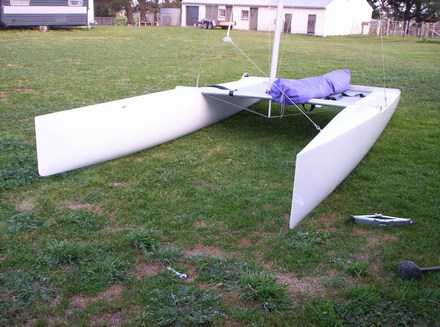
Hi Rolf
So, have you done the working out for strip planking or has Phill made alternate plans for you. I only ask as I wouldn't mind trying it out myself, I have access to ply, but have wanted to do some strip planking for a long time.
Regards
Matt,
I hope Rolf does not mind me answering this question.
I prepared something specific for Rolf.
Regards,
Phill
Not at all Phill, I hoped you would reply.
Hi Matt,
didn't think you had that much of a death wish.
I wouldn't mind trying it out myself, I have access to ply, but have wanted to do some strip planking for a long time.
Do you ever want to get out of your shed again <img src=

alt=
/>.
Strip planking sounds nice and soft and fuzzy. But it is the method of the DEVIL <img src=

alt=
/>. To much trying to deal with soft timber and hard glue lines and the fairing NEVER ENDS <img src=

alt=
/>.
ARGH! I am having flash backs, got to go sailing to get rid of them <img src=
alt=
/>.