
I know the 18s are having a little sticker shock.
Do we know for certain longer is better? Was there any testing done?

Pete, How many times we do have to cover this topic? It's been debated for a hundred years.
My skipper is emphatic that longer boards matter...

I only have qualitative evidence, but it was enough to convince me to pay the money (and I'm a student so it takes a lot!). Looking at the results from F18 NAs last year we were the first Infusion that didn't have upgraded boards... and we were 13th. I don't know which C2s in front of us had the long boards, but I'm pretty sure most, if not all did. Now was the lack of longs boards our only issue- absolutely not! But we decided if we are going to make the commitment to showing up in Long Beach for the Worlds, we don't want any excuse aside from our sailing.
The Thai regatta also gave me the same impression, all the top boats had long boards, and in the moderate conditions there I really felt it helped.
Pete, How many times we do have to cover this topic? It's been debated for a hundred years.
My skipper is emphatic that longer boards matter...
So when are you having your graft?
Jeff, I thought the reasoing went something along the lines that high aspect boards produce more lift but stall easier so lower aspect are easier to sail and more forgiving. But nothing out of the M.I.T. labs?

It's all about more lift. But once you are hiked out and the windward hull is out of the water, any additional lift is inefficient and requires managing (raising/lowering) the depth of your
longer
boards. With the F16's powerful sailplan, they already lift pretty quickly (especially solo) with the up-until-now
factory
standard depth.
Only time I've heard about the Taipan style (wide) daggers as being advantageous was during the starting sequence for non-pros (slow manuevering).
No first hand experience but from credible sources (resisting crude jokes).

I use the first generation C2 boards in my Viper. In light air, yeah, they definitely help, shortly after hopping on the wire you're pulling them up though.
I want to try the long C2 boards singlehanded, but I know there will be an extremely small window where there will be any benefit. Extremely small.....
Its not so much more lift, but less drag that is a big benefit. I can look for some references, but am computerless tonight.
I'm just curious, no point in paying for spiffy long boards if they don't do anything.
I thought Wouter went through this in the beginning...
In the beginning spake Wouter...
<img src="<>/laugh.gif" alt="laugh" title="laugh" height="15" width="15" />
I'm a bit squeamish on spending $2k on the C2 long boards, especially when they'd be borderline useless in a Viper. Those things a massive.
You certainly wouldn't want to be using F18 boards in the F16's, perhaps we should be thinking along the lines of longer length higher aspect ratios to get the drag down even further. If you are already lifting the baords on the Viper then that may be a good route to go.
Certainly on my A which was set up for a lighter weight guy at about 75kgs with very small High Aspect boards, I can over power those boards quite easily with my lardy 95kgs, so there is a balance there to be looked at and experimented with. Certainly most boats are set up for duals so for us Uni's there might be quite a bit of gain to be had.
Interesting input Wayne. There is length, width, and cord (thickness). Are you suggesting smaller width and cord? Don't know if my daggers can get much thinner without self-destructing!
yup smaller chord longer length seems to be where the A's have gone, but you can get to the stage where the slow speed handling becomes a real bind, certainly my A is a real pain wanting to go sideways rather than fowards until about 5 knots, I have to be ever so careful to not swing out on the trap until I'm well underway.
Just about to dig out Bitsa my F16 this weekend to get ready to join back into the fray, the A has been good fun but severely lacking in the downhill sections against the spinny boats. Probably my sailing skills and certainly easier to use the spinny on the F16 to get the right sailing lines, which is where I think the F16's score highly, most people can get 75% of the capability out of the F16's, most people can't get 75% capability out of the A's particularly downwind.
Anyway thats another thread.
Has anyone played around with asymetric boards?
General consensus has been not worth the extra hassles of having to lift one board on every tack and every jibe, also once one board is lifted then you are totally reliant on the board area of just one board meaning you will have to increase the surface area of the one board. Far better IMO to simply move your body weight back a few cm's to slew the boat a bit to get the same effect. As single handers we need less work not more.
I liked the boards on the H-17. Was thinking more along those lines.
Sorry, are you sure they are assymetric ?
No, they aren't. They're center boards with a very simple retracting mechanism.
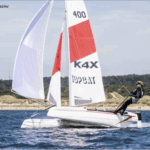
We have an H-17 at the sailing center for member use. Except I never get to use it because the boards are always jammed in their slots because of problems with that
simple retracting mechanism.
I'll stick with daggerboards. 🙂
It's probably just sand and shell, minimal maintenance will keep it operating freely.
Regarding board length on F16's and the F16 class rules.
In the beginning the daggerboards in the F16 class were largely left unregulated. Basically, each F16 had to have none or a pair of them and no part of the daggerboard may be angled to more then 6 degrees of the vertical when the boat is laying flat.
Everything else is allowed. For example canted boards are NOT included in the overall platform width rule.
A few year later some clarifications were issued but left the spirit of the daggerboard rules in tact.
Now we are face with a development in both the F18 and A-cat classes with respect to very high aspect daggerboards ( > 7 ) and their associated high costs and additional skills in handling them.
In that light I would like to provide the following points.
In the beginning, I analysed that there was no meaningful gains to be made in the drag to lift coefficients of a daggerboard beyond an aspect ratio of 5. From my experience with the FX-one I knew that oversized boards are rather a detriment to performance then a boost. So this made for a framework where the total area of the boards were limited and no real gains were to be made with higher aspect ratio's. I envisioned this framework to be self regulating and expect all board designs to end up somewhere around aspect ratio's of 4 and an area of 0.15 ( = mainsail area / 100 as is typical on performance beach cats)
This seemed to coincide with what could be done with modest use of carbon cloth, thus making the daggerboards performant but not overly expensive.
Additionally, experience with the first Stealth designs and comments by its designer (an established sailor and Olympic hopeful) suggested that short and wide boards (aspect ratio 3 and lower at the time) did NOT suffer in light winds or strong winds. The main benefit to long and narrow boards were found in the medium winds section. Additionally, long narrow boards made the craft hard to control at low speeds and on the start line. Loosing the start is about as bad as lacking 5% speed on the course. So by going to aspect ratio of around 4 we could strike a good optimize between costs and sufficient overall performance in all wind conditions and at the start.
I still hold to much of this viewpoint but with one important exception. I overlooked the importance of very skilled semi-professional sailors with respect to driving developments in this area.
Indeed, long narrow boards are just as much a disadvantage as they are an advantage but very skilled sailors with lots of practise time can overcome the drawbacks and make the advantages count. This is all good for the top of the fleet of course but the payback is spiralling cost over the whole fleet and not just the top. This aspect of the framework is sadly not self-regulating as we see in the F18 class.
This would all still be very acceptable if the long narrow boards (> aspect ratio 6) were not so expensive and driving up overall cost of the boats. A single F18 daggerboard is now twice as expensive as the bare aluminium F16 mast section and that is not right. Also remember that there is no top if there is no fleet (of amateurs swelling the numbers). A balance must be striken between the desires of both ends of the pyramid, if indeed the class is to be healthy.
I feel the time has come to limit board depth under the hull in the same way as we've limited the mast height in the past. For two reasons, to keep sailing of F16's accessible to amateurs in the way of handling and to increase our financial attractiveness with respect to the F18's and A-cats. The latter two are spiralling up in costs and here we have a chance at fixing our cost price while maintaining an excellent and generally acceptable performance around the race course.
My data suggest that the Viper is currently the F16 with the deepest boards at 0.85 mtr. Can Viper, Falcon, Aqua-cat, Stealth, Nacra etc owners please check this ? We are talking about wetted length here , that is the length of a fully extended board from the keel line to its very tip.
If so then the Viper board has an area of 0.180 with a wetted length of 0.850 this implies an aspect ratio of 4.01. Data taken from the ISAF SCHRS rating measurement sheet.
My own Taipan 4.9 boards are the smallest in the class at 0.162 sq.mtr. area and 0.56 mtr wetted length. They have an aspect ratio of 1.93 and pulling them up in any wind condition is bad. As a result Taipan sailors always keep these down and the Taipan is still surprisingly quick with them in both light and strong winds. Not so much in the medium stuff however.
Currently ISAF SCHRS handicap system quotes for the F16 daggerboards. Area = 0.200 with a wetted length of 0.900 mtr = aspect ratio of 4.05
A 0.1445 sq. mtr daggerboard with a wetted length of 0.85 mtr will have an aspect ratio of exactly 5. Such a board will have a width at its root of about 0.175 mm. This appears as the optimal F16 daggerboard when going on the math numbers.
When this board is pulled up by 0.15 mtr it will still have a good aspect ratio of 4. If it is raised by 30% or 0.255 mtr then it still has an good aspect ratio of 3.53. When in nuclear conditions it is raised by 50% or 0.425 mtr it will still have an acceptable aspect ratio of 2.58. Remember, low aspect boards maintain good performance at high speeds.
Therefore I personally feel that limiting the wetted surface area on the F16's to the largest curently in the fleet (= 0.85 mtr. I believe) to be a reasonable compromise to maintain sufficient performance but avoiding excessive costs. Also in comparison to the A-cats and the F18's !
Basically, we allow just enough inward canting and a high enough aspect ratio to cover our bases with respect to very high aspect boards and lifting foils. So, yes both F18 and A-cats may have an edge over F16's under some narrow set of conditions but not very much and we maintain a very competitive cost-to-performance ratio. Of course, a newbie will never tap into the additional performance provided by the extreme go-fast specs of an A-cat, a modern F18 or curved foiled cat. But he can tap rather quickly into the performance of the F16's. I feel that that is a better position in the market place.
With kind regards,
Wouter Hijink
+1
Thanks Wouter.
The price of the carbon boards is a bit artificial at the moment, the more manufacturers that get involved the cheaper they will become.
My worry about limiting the aspect ratio to less than 5 is that there is a fair bit of foil design going on at the moment and new foil shapes are appearing that give good handling with minimum drag at high aspect ratios. If we limit the aspect ratio, will we miss out on the benefits of these new foil shapes and become slower boats in comparison to the F18's etc.
The other factor is the SCHRS and Texel handicapping systems are very aware of the advantages of high aspect boards and steadily increasing the handicap attributed to the boards, very soon they will penalise these boards and we will all back to square one.
Another problem will be if the Viper is selected for the Olympics and goes immediately to longer high aspect boards ( they after all will be sailed by some of the worlds best ) then we immediately exclude them from the F16 class, I for one would love to at some stage compete against these guys just to learn how good you have to be.
I'm not sure it is a problem yet and think we could perhaps let things lie for a year or two.

Width 0.175mm?? Are you going supersonic <img src="<>/smile.gif" alt="smile" title="smile" height="15" width="15" />
Amateur contests are best for amateurs.
I'm thinking thats supposed to be 17.5mm. Crazy kids, and your silly french measuring systems.
I'm game for supersonic, though I think the winds would be a bit hairy.
I'm probably going to expose my ignorance here, but why not just put a hard limit on maximum draft? I mean, we have a limit on maximum length, maximum width, and maximum mast height so why not? That way designers can use any aspect ratio they want.
wetted length is basically the same as draft.
Your idea is the same as mine. I didn't propose any rule on aspect ratio although a limit on that is somewhat implied.