
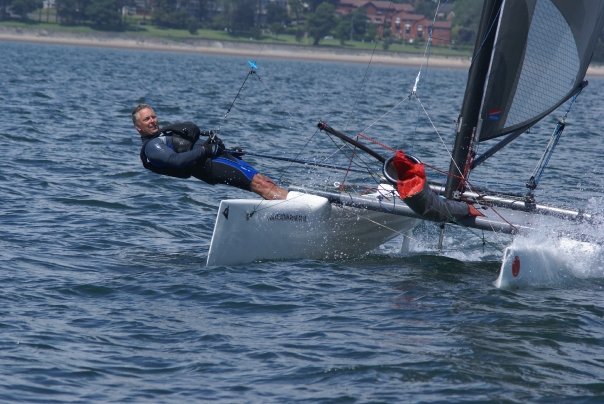
An A Class is 200mm (8
) narrower, 300mm (12
) longer, roughly 30kg (66lbs) lighter and mainsail area 2.25m smaller although the mast is 600m (24") longer. Why is it that a Cat rigged F16 is roughly 10% slower upwind?
I ask this question as last week it was astonishing at the speed at which an 'A' was passing me upwind. There was flat water and 10mph of wind speed we were both on the wire and the 'A' was capable of pointing a few degrees higher at times and yet still power past.
We are both decent Club Sailors with over 12yrs Cat sailing experience between us and I'm possibly 5kg lighter at 64-65kgs.
If anybody could break these stats down and come up with a reasonable conclusion/ solution I would be most grateful, or is it purely down to the different aspect ratios of the mainsails.

Mark,
Were you sailing with the Jib? Because I think it's normal you point higher with just the mainsail.
Regards,
Gill
No jib and my main is 12 months older than the 'A's, both Cats are under 1 year old.

Mark,
Length is king sailing up wind. Also, the A is 25% lighter and in that sort of wind the A will be very much in the ideal groove/setting. Also remember you have a Spi halyard and associated gubbins causing more windage uphill.

Mark,
Get the Texel rating spreadsheets at:
http:/
Download: Complete list with all details-04-0-2-2007.zip
Download: Easy calculator-04-02-2007.xls
Put the F16 (1) measurements into the Easy Calculator, then change the numbers 1 at a time to the
A
measurements.
It's kinda fun. It'll give you a rough idea where the
A
s gains are coming from.
Hint - change the weight first <img src=

alt=
/>
e
'Sailwave' also has a Calculator facility. However, I'm not totally convinced about the weight being a significant factor due to the F18 argument. I'm sailing the F16 all up at approx 170kgs (374lbs) F18's are likely to be in the region of 330kgs (726lbs). Therefore I'm roughly 50% lighter but I certainly don't pass a F18 upwind as quick as an 'A' passes me. Yes, the F18 has a lot more sail area and longer water line but realistically they are slightly faster boats in all but the lightest of wind conditions (upwind).
Mark, Agree with that, but they also have 2 on the wire and so have more righting moment(RM) and so can generate more power and more speed.

Mark,
Your data is not correct.
) narrower, 300mm (12
) longer, roughly 30kg (66lbs) lighter and mainsail area 2.25m smaller although the mast is 600m (24
) longer.
An A-class cat is actually.
200 mm narrower
490 mm longer (and not 300 mm)
35 kg lighter (on average)
1.20 sq. mtr. smaller in its mainsail area (and not 2.25 sq. mtr.)
600 mm shorter in mast length AND 700 mm longer in mainsail luff length.
Now that is a very interesting question.
Personally I think we must recognize that the A-class rig and platform has been developped over a long time and it is developped to be a very good upwind performers The F16's haven't had nearly the same amount of development in their rigs yet. Also we are losing some upwind performance because of the spinnaker package and the spi halyard running up the mast. I saw a good trick on a singlehanded F16 recently. The owner had moved the spi halyard so that it run up along the forestay instead of along side the mast. This will most definately improve flow in that very important spot, the mast. In the latest club race we had he nailed us all upwind, working up between 2.5 and 6 minutes lead. He lost some on the downwind legs, but he is still new to spi sailing.
Additionally our F16 hulls are a (good) compromise between diverging requirements. Afterall the A-cat hulls are designed to carry ONLY a single skipper while our F16 hulls are also designed a crew of 150 kg well and be a forgiving hullshape when crashing through waves under a spinnaker. Additionally our hulls are made to handle being a platform that is short and wide instead of being long and narrow. The penalty is drag. From a performance perspective, probabbly the best singlehander setup is a 5.5 mtr long by 2.75 mtr wide platform (18 feet by 9 feet) that weights under 100 kg, carries a 15 sq. mtr. mainsail on a 9 mtr carbon mast and a F16 size spinnaker. But that was not something we could get going in a commercial viable way.
In the end of the day the whoel A-class concept is optimized for a single purpose while the F16's necessarily are a compromise between 1-up and 2-up sailing and all the little aspects in which we are suboptimal add up. Especially on upwind legs as here efficiency is so important in the way of pointing without losing speed.
But also we must never forget that weight is a large factor in performance. Afterall, each time you travel ahead by a boatlength you will have pushed the overall weight in water volume out of the way. The A-cats just push 150/180 = 83.3 % => 17 % less weight aside. The F16's have 1.09 % more sailarea and
83.3 % times 1.09 %
equals 90.5 % in favour for the A-cat. So here they have about 10 % advantage. Naturally this is a rather crude calculation but suprisingly enough it comes really close your on the water experience. Sometimes things are that simple.
If you as a human being had to dig a hole that is 10 % larger then that of your neighbour then chances are that you'll take 10 % longer to do so.
But of course you should win all that back, AND MORE, on the downwind leg after deploying your spinnaker !
That is unless the A-cat sailors insist on running triangular courses of very modest length with alot of laps and you cave into that ! <img src=

alt=
" />
Wouter
Wouter,
any details on the spi halyard along the jib luff route? That is mighty interesting!
any details on the spi halyard along the jib luff route? That is mighty interesting!
Won't you (potentially) overload the bow areas running all that tension down to the forestay first ?
Interesting evolution I'd also be interested in hearing more about.
Everybody
It is, but I'm already on the edge of what I can say in public. This guy wants to make an impression on the upcoming F16 Global Challenge and has tweaked out his boat to do exactly that. I think it is most wise to not elaborate on this setup till after the Global Challenge so he can make maximal use of his
invention
. Afterward is a different matter of course !
But basically what I wanted to say with it is that F16 sailors still have some way to go to optimize the boats. And we should all be getting into that and progress the F16 performance just as the A-cat sailors have done with their boats (and are still doing).
Wouter
It is, but I'm already on the edge of what I can say in public. This guy wants to make an impression on the upcoming F16 Global Challenge and has tweaked out his boat to do exactly that. I think it is most wise to not elaborate on this setup till after the Global Challenge so he can make maximal use of his
invention
. Afterward is a different matter of course !
But basically what I wanted to say with it is that F16 sailors still have some way to go to optimize the boats. And we should all be getting into that and progress the F16 performance just as the A-cat sailors have done with their boats (and are still doing).
Wouter
Oh come on Wouter, if it's been in the dinghy park, it's public knowledge. I assume he (I assume it's a he) has just routed the halyard partly down the mast, then thru a block at the hounds, down the forestay to another block on the foestay by the podder and then to the cleat on the font beam.
Humm ! This is getting a little bit out of hand. I hope he will not be irritate at me for spilling the beans.
No, because any tension put on the spi halyard in this situation will lower the tension in the forestay by the same amount. In effect, the load on the bows will remain unaffected. That is just the beauty of it.
But I won't elaborate any further at this time beyond the point that I think it is a very interesting development myself and that I'm quite thrilled to see the EU importer of F16's boats engage in such efforts to evolve the F16 design. (And there are other idea's being tested as well)
How many importers/agents do that ?
I think we can consider ourselfs lucky with F16 agents like that.
If any of you want to scoop on things like this on the shortest possible time frame then I guess you guys just have to come over for the F16 Global Challenge in 10 weeks time !
And be sure to stay on for the long distance race (REM-race) that directly follows our week of bouy racing. It will be great to see a fleet of F16's participating in this 100+ boat race. There will be a very strong F18 fleet there for this distance race and if we can get 15-20 F16's participating then that would be absolutely perfect.
Wouter
No, because any tension put on the spi halyard in this situation will lower the tension in the forestay by the same amount. In effect, the load on the bows will remain unaffected. That is just the beauty of it.
Eh
Unloading the forestay how, if the Spi halyard is in some way replacing the forestay when the kite is up (I assume the forestay actually just sags a bit) then the load is INCREASING on the bows as the distance between the hounds (top end of the forestay) and the lower fixing (on the bows) is de-creasing, thus load is increasing.
You have totally lost me here Wouter.
Dear scooby,
There is an agreement in place that development and testing is done in a protected environment. This way the involved parties feel free to discuss these things in private among themselfs. Garanteeing this free discussion is important in advancing the F16 design. And the driving force under these development projects is achieving some gain in performance over competitors, even when only temporary. Such factors need to be nurtured, because without it sailors are less likely to do all the hard work and investments.
It is a balancing act but eventually we all benefit in the long run as nothing can be kept secret for long periods anyway.
Additionally, you guys can all try to work out a system yourself. Maybe we find the perfect setup afterwards when comparing all individual systems after the Global Challenge !
I know that I'm going to try and work out my own setup. I actually have to as my cleat/halyard situation is different from his requiring me to adjust the setup.
Good luck you all,
Wouter
I Understand that. But can you expalin how by adding extra load on the front of the boat you reduce the load at the front ?
Unloading the forestay how, if the Spi halyard is in some way replacing the forestay when the kite is up (I assume the forestay actually just sags a bit) then the load is INCREASING on the bows as the distance between the hounds (top end of the forestay) and the lower fixing (on the bows) is de-creasing, thus load is increasing.
You have totally lost me here Wouter.
Maybe a shock-cord take-up system is employed which pulls the loose halyard to the bridle, but when the halyard is tensioned it runs its normal course straight up the mast.
If it were running from beam to bridle and up the forestay the loads would be a bit strange...you'd think it would load up the bridle and unload the forestay, but then again, you are running downwind so the forestay/bridle isn't heavily loaded anyway.
If this person is that worried about the drag caused by a spi halyard running down the mast I think they should see a Doctor. As for keeping this new rigging technique 'Top Secret' thats not really F16. But it can't be that advantageous otherwise the Olympic Tornado's crews would all be doing it.
As for developments in rigging and upwind sailing techniques that was the purpose of this thread, people could be open with information which would in turn help the Class to be more competitive, and for me help understand the differences in power to weight ratios of my nearest competitors. I guess I'll have to wait 10 weeks now!!!

Guys,
This approach to the spin halyard routing is not new. There were Shearwaters with spin halyards running down the forestay 20 odd years ago. The Shearwater was one of the very earliest adopters of the wing mast and some owners tried to improve the airflow by re-routing their jib and spin halyards.
There are still Shearwaters today with external spin halyards running down the mast so I guess that even after all this time the jury's still out on the benefits?
One of the best solutions I've seen is to go internal and exit at the front of the mast above the gooseneck. The halyard then drops down to a spring loaded block at the base of the mast, runs forward, round a turning block and then back to a spinlock on the beam. From there it's the usual route back to a block/ring and then forward through the chute.
This is a possible line of reasoning for the conditions you described.
The lower weight of an A-class means less hull resistance (in general) and lower righting moment (in general).
Lower resistance directly influences speed at all points of sail.
Lower weight may also reduce their pitch radius of gyration (how easy/hard it is to rotate the boat in pitching) which has been shown to improve the performance of boats, particularly upwind.
Lower righting moment means that they can fly a hull with less pressure in the rig, which means they don't need as much draft in the sail (the sail is flatter in general), flatter sails have less drag and can also point higher. Both increase VMG.
A-classes also have less
stuff
dangling about in the wind creating drag. Items like spinnaker poles, chutes, bigger hulls and extra crew all increase the windage (drag from wind) of the boat, which is slower.
A-classes are lean, finely tuned, upwind dominating machines. In their condition, there is not much on the water that can touch them.

Post deleted by twicebitten
Thanks ncik. This is the kind of information I was looking for and will help put my mind to rest the next time an 'A' flies past. However, am I correct in thinking that a slightly narrower F16 could point higher? my last Stealth was 7'6
wide and on occasions did feel to be pointing higher than the 8'2
models although this was probably jeopardising my downwind performance.
Also, what are your thoughts about the F16 upwind performance against the F18. Here in the UK there are some extremely fast 18 sailors who just vanish into the distance but even at Club level I would have thought the F16 has enough in it to make more of an impact. In the light stuff the 18's momentum seems to carry them through the lulls and shifts and as expected when they're twin wiring I haven't much of a hope being single handed. The only saving grace is that at Mumbles Y.C we use Texel so the 'A', F18 and Solo F16 all sail off 1.01 and in the medium wind range the 16 is competitive.
Mark,
Having sailed against a very competitive F18 at Grafham a few times (BUT I was just on the boat so I was making loads of mistakes) I would say the following
1, Light winds the F16 is faster all around the course; this was also shown at the Datcht training weekend when we were sailing around with a couple of guys on a Tiger and I was just just about staying in front of them most of the time.
2, Medium winds Both boats have comparable speeds upwind and the F16 single handed is faster downwind, but they can tack and gybe quicker. The age old problem that the single hander runs out of hands and I was new to the boat. Thus, I need to get better
around the boat
.
3, Strong wind. I was making more mistakes, but I could almost stay with them upwind (Max DH, traveller out about 18 inches, plates up about 18 inches) but they were faster downwind as I was not wiring - again more practice in the boat to be able to wire in more wind downhill.
I believe we should still be aiming to be in touch with F18's and
beat them on our day
. We will struggle as there is a very great depth of talent in the UK/world F18 fleet. If you were to put yourself into the F18 fleet, where would you put yourself ? Top 20 maybe at the worlds, I bet no 20 is 300+ yards or 30 to 60 seconds behing the winners at the end of a 1 hour race.
Aren't we going a little bit over the top here ?
This guy does ALOT of development and pays for it out of his own pocket. Most of it has already been incorporated into the new boats sold.
He has expressed his desire that his endeavours be kept confidential till his testing has been completed. I think that he has a full right to desire that considering in how many ways he is advancing the F16 design on his own.
This desire is not the result of being unsportsman like or whatever, but by garanteeing a quick and free flow of development. Lets face it, nobody wants a crowd looking on their fingers when they are experimenting. 3rd party suppliers are hesitant to participate if such development projects are scrutinized in public.
Personally I think it to be bad taste by the others if they can't wait a couple of months till the experimenting has been completed.
I'm sorry, but I think some of us are reacting like little children here.
Wouter
Hi Wouter,
I have Deleted the post as I had a PM from the sailor and I had the wrong end of the stick. I didn't realise who you where talking about <img src=

alt=
/>. Would probably been better if you had said nothing, than to start talking about it and go no further.
No offence intended.
Well yes, It would indeed have been better if I had not written that initial paragraph :
Also we are losing some upwind performance because of the spinnaker package and the spi halyard running up the mast. I saw a good trick on a singlehanded F16 recently. The owner had moved the spi halyard so that it run up along the forestay instead of along side the mast.
Sadly I was too late to delete it when it became clear everybody was falling on it like a pack of starved wolves.
My mistake definately. I just wanted to point out that the F16 can go some way in optimizing the rig just as the A's have done over the last 30 years. Naturally each improvement will be very small but when you add up 30 years of it then the combined total can be quite large. We F16 sailors have only been at it for 6 years now.
My appologies to everyone. I should never have written down this example.
Alright, everything is fine now.
Wouter
Pointing ability is a tricky topic. It has a lot to do with sail shape, ability of the hull to be driven, conditions, foils, etc...
Righting moment is not just about hull beam, crew position is also critical. In the marginal stuff, maybe you could try sitting in off trapeze and flattening the sail shape, point a fraction higher, taking the form drag out of the rig...see what happens, it can't hurt to try it. Then again, I could be talking out of my butt, I'm just throwing up ideas here.
The best option is to find a similar boat with similar speed and do some two boat tuning. There's plenty of resources online to help develop a good testing regime. One day of useful two boat training will bring boat speed results, maybe even to the point of chasing that pesky A-class.
I had a great time yesterday afternoon chasing a farily new Tornado around the Bay. We did a 2.5 mile run on port then another 1.5 mile run on starboard and there was nothing between us apart from the fact they were both sitting in and I was on the wire. Upwind, astonishingly they were pointing higher but I was going lower and faster so after 2 miles I was in front (No Bulls**t) Needless to say I was quite pleased with the way things were going.
What I do want to experiment with whilst two boat tunning is the Mast rotation in light wind conditions, as people around here are talking about having the spanner pointing at the intersection of the rear beam and hull. In other words a lot tighter than I would normally have it.
What I do want to experiment with whilst two boat tunning is the Mast rotation in light wind conditions, as people around here are talking about having the spanner pointing at the intersection of the rear beam and hull. In other words a lot tighter than I would normally have it.
Mark,
There ARE 2 schools on mast position in light wind. Pointing as you say above, or fully rotated along the front beam. Needs 2 boat tuning to sort it out.
Also, just remembered that Haken had a kite on his A class as said the thinks it cost him about 2%ish upwind with all the extra gubbins floating around. Then factor in the extar windage of the 16, longer slimmer hulls on the A class, I think I'd be happy with a 10% difference upwind.
Would be interesting, did the OOD at the Nations cup record Lap times. I was catching up the A's on the first race (must remember to count laps). IIRC the last lap there was much less wind on the last run which kinka skewed the results to look at with the extra lap.

>> did the OOD at the Nations cup record Lap times.
>> I was catching up the A's on the first race (must
>> remember to count laps).
http:/
We do have lap times but they are not published - I could get them if you want...
Edited: I misread SSs post.