

http:/
Interesting. Allowed in the rules or not?
Still not lifting the boat out like a moth. But they say 25 knots in 20 knots of breeze. But are they sustaining those types of speeds for long periods of time or just spikes?

My standard Viper gets 10 sec averages over 20 kts so maybe it can.
I heard a rumour that these things will fit the old boats as well. You dont need to lift outof the water like a moth when you have as much power as an F16.
I wonder if there will be any more surprises before the trials.

And the next big new thing will be T foils on rudders to maintain the front foils AOA, making the boat feel like an 18fter.
Followed by variable AOA on the front so it doesn't hobby horse downwind. Can't imagine hobby horsing downwind is fast, but looks good for about 20secs.

I imagine a standard curved foil will stay in place just fine but what about these?
Are they locked or lashed in place somehow?

F16 Rule 1.6.4 says its prohibited...
It's not the shoal draft option? <img src="<>/grin.gif" alt="grin" title="grin" height="15" width="15" />
OK...so how did they get the L boards down into the hulls? Can they be slid up from underneath?
Hobie figured out how to 'foil' a long time ago, yet it never really caught on as a racing class.
Can any of you older guys who were active 'back in the day' of the Hobie Tri Foiler shed some light on some of the issues? I remember seeing a fleet of them, once, at the Wildcat regatta, but they looked like a real pita to put in the water, and weeds on the foils were always a problem.
http:/
Stick with it, at about 2:37 it shows some of the design concept and the L foils, and how the ski at the front adjusts the up/down lift. It also shows Russel Long going 43 knots in his
Long Shot
during a speed run in France, in the ditch and a two up regular version going 35knots at the end. But I notice all the video speed shots are done with good wind...on FLAT WATER. Great for a lake.
I'd love to have one here on my lake, but I'm not convinced a 'lifting' foil, if C boards or L boards, is going to be fast on lumpy water, in the kind of racing we do in the ocean or lage bay. All that porpoising up and down can't be fast. You may get a small burst of speed when you come up, but when you nose dive back down, it could get ugly. They'd have to come up with a device to controld the AOA to yeild a steady ride over rough seas.
Anyone know where Gregg Ketterman is today? I wonder what he's up to, design wise.

I'm sure you will see these at the Olympic trials.
Timbo,
Thats probably want they did, guessing here, but that isn't allowed in the F16 rules either. You have to be able to lift the board up out of the well. Again, F16 rule.
Mike

Would a board with a hinged tip be illegal? If you made the tip asymetric with a hing it could be pulled up the well and the shape would push the tip to the correct possition when under speed.
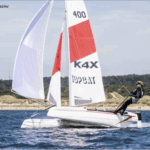
Yes, that is illegal. According to F16 rules:
End fences/horizontal appendages below the waterline will not be allowed.
In my opinion not allowed under current F16 rules:
7.13 Daggerboards and Centerboards
All lift producing elements that have as the pre-dominant purpose to resist sideways movement of the craft while sailing and that aren't canted at a greater angle than 6 degrees of the vertical when the boat is level on the waterline.
A centerboard is only different from a daggerboard in the sense that it is folded or rotated away rather than slid away when in danger of hitting submerged objects.
1.6 Daggerboards and rudders
1.6.1 The platform shall be equipped with a pair of rudders.
1.6.2 In addition to the rudders, the platform may also be equipped with a pair of daggerboards or centerboards.
1.6.3 All performance calculations, such as handicap ratings, shall be performed as if a platform has daggerboards or centerboards, even though a particular design may have neither of them.
1.6.4 (Added by vote, August 2007) For the avoidance of doubt, daggerboards/centerboards will conform to the following :
a) Curved/’Banana’ boards will not be allowed.
b) Assymetrical cross-section profile boards will be allowed.
c) Fore/aft movement of the boards when in the down position will not be allowed.
d) End fences/horizontal appendages below the waterline will not be allowed. The board shall be capable of removal, without tools, via the upper opening of the case.
e) There will be no limitation on the daggerboard/centerboard length
I dont see any interpretation that will allow for this on daggerboards. On rudders I read this in such a way that fences are allowed (like used on the Stealth).
Will be interesting to see if they send a boat with these daggers to the olympic trials. I dont know about any substantial two boat testing with this technology where the results are public.
I think it's safe to say that the f16 rules weren't a consideration when coming up with this new development. The Olympic trials are the aim.
As for the foils I had a conversation with Greg about curved foils and the like. He said that someone has done some serious work for them on this topic, and the conclusion was curved foils are quite draggy, and that straight assymetric boards is where the effort should be directed.
Oracle are also testing the same thing. I think we can draw our own conclusions from this.
WHAT IF....
Put the dagger slot in the hull at a 45 degree angle, so you'd have a long, straight dagger board, but on a 45 degree angle, which would provide some amount of lift, perhaps even more than a C board...yes? And you'd be within the rules, yes?
Has that been tried yet?

seven degrees max angle on boards
Ahh...well, we could change the rules. I think I'd rather have straight boards at a 45, than have to deal with C, or L boards, and I think that would provide more lift too.
except if you pull the board out and clip the boat next to you...

Agreed. Whatever the angle, I can't imagine that moving curved boards back and forth is as easy as straight boards (not to mention the obstruction when they are up).
I'm very curious to see how well the AC crew handles curved dagger boards on the AC72s.
I wonder if a removable T(orY) foil extending off the dolphin striker would provided enough lift or practical/doable?
That would be absolutely doable and thanks for that idea. I might steal it from you.
You could hinge it off the front beam, so you could retract it for launching/retrieving, then flip it down once in deep water. Might have to figure a way to work it around the spin pole, or have it pull up tight to the underside of the snuffer bag when up.
Timbo is on the right track here
Hinge it off the mainbeam with a retainer line of the spi pole. This line will allow the AoA to be set. Place the foil at the tip of a round alu tube and make a loose sitting fairing from foam that youbslide ove the tube. This fairing will weathervane around the tube and thus not act as a daggerboard. As a result this appendage will not be loaded up much in the sideways direction. Two dyneema line may be run from the mainbeam just inside the hulls to the tube just above the waterlevel and thus make for a low cost hinge mechanism and sideways support.
When traversing the surf and landing just pull the foil horinzontal towards the spi pole and clear of the water.
The T- foil may be made of a single 300 by 100 mm piece of multiplex shaped by hand and glassed over. Fit it to the end of the support tube in such a way that it can rotate freely downwards with its trailing edge but never upward past the horizontal. That way the foil can never pull you down. The hinge needs to relatively closevto the leading egde for this. About 25% - 30% down the foil.
A simple rubber end stop will suffice to prevent rotation upward.
At relatively slow speed you pull the assembly a little forward thus maximizing AoA, with increasing speed you relax the line progressively thus reducing AoA and preventing excessive drag and pranching. Fiddle about with a bungee in parallel with the retaining line and get an automated AoA sytem, one that also recognizes pranching by the excessive drag that is associated with it and adjusts the AoA accordingly.
Hell, this may actually work !
Note how even a small diameter tube will be able to withstand the 30-60 kg buckling load. And how a single foil in the middle off the boat with twice the area will have exactly the same overall behaviour with respecttomrighting moments etc as two foils half the size at the tips of the daggerboards.
With respect to foil area.
The total area of boat daggerboards will carry about 120 kg that is the sideways loading of the sails.
However it is best to start with relatively small assymetric foils.
Or make a
U
that just slides vertically in a cassette.

Ummmmm.......
Central mounted foil is a really bad idea. Any lift from it is going to act as negative righting moment against the leward hull so you have added a heap of drag and you have to depower sooner.. if it is tall enough to get both hulls out of the water, you have still almost halved your available righting moment and there for will need to carry much less power.
Having sailed a moth for a few years now, Wouter your T-foil solution won't be reliable. Once a boat is on foils, the pivot point for righting movement is now all on the foil as opposed to being on a 16ft hull touching the water. The foil has to be super strong and can't flex at all. Part of the reason why a Mach2 is faster than a Bladerider is due to the Bladerider foils flexing where Mach2 does not. Plus many many bladerider foils broke due to the loads. The mach2 foil can have a person jumping on them when suspending between 2 benches without any concern at all. And this is the lengths needed for a 30kg boat. Imagine now a boat that is 107kgs and has 2 persons onboard. Breakage city if not done correctly.
The other thing is that there can't be any slop in the system. Has to be rigid. The lengths we go to minimise slop is quite extensive. Reason is that slop means loss of control.
I'm figuring that the difference between full foiling a 30 + 70 kg moth and a partially lifted 107+ 140 kg F16 (for only < 30%) may be an important difference. The F16 will still be carried by the leeward hull for 70% and thus be stabilized. This is basically what the nacra20c and A-cats are doing as well.
Additionally what is the difference between the righting moment of a viper with both L- foils in the water and a single foil in the middle of the viper ? When it comes to righting moment both setups will result in the same overall moment.
Personally, I don't believe that foils are much of a performance gain in most conditions. Hwever the reason I'm interested in them is improved stability of my taipan under spi in big waves especially during long distance racing. For me it is either T-foil rudders or this. This is easier for me to make and try.
Apart from that I'm looking at th following calcs
170 kg crew on my 120 kg Taipan F16
45 kg lift of centrally placed foil
Combined weight carried by bouyancy will then be 245 kg or 110 kg + 135 kg crew.
New rightingmoment will be transformed from 170*3.5+120*2.5*0.5 = 745 kgm
Into 745-45 = 700 kgm = 157*3.5 + 120*2.5*0.5
basically by adding the central foil I expect to get a boat that will partially lift its bows at speed then without thus reduce the dependence of bouyancy to carry to sail loads and wave action.
Secondly I expect to get a boat that thinks that it sailed by a 45 kg lighter crew with the righting moment of a crew that is only 13 kg lighter. The reduction in overall weight ( by 15%) is more then the reduction in righting moment by ( by 6 %).
However, I still don't expect much if any perormance gain except for what is th result if increases stability under spi in waves/ chop
Consider the angle how the t-foil lifts. There is a reason why moths heel to windward. Heeling to leeward like a normal boat just doesn't work.
How about two cassettes(think rudder cassettes) on either side of the mast attached to the front cross bar, with a T foil between the two. You could use the dolphin striker for additional support. Just lower the foil down and raise it back up when not in use. Maybe using a V shaped foil to increase stability and allow the foil to shape around the spin pole.
Doesn't work or doesn't work as well ... ?
I feel flying moths have very little daggerboard in the water and dependent on the Veal-heel canting of the lifting foil to compensate for that.
Doesn't seem the partially lifted cats have the same issues (nacra 20c, A-cats, New Viper)