

Yesterday we capsized our Infusion during a gybe for reasons I still don't fully understand. As far as I can tell, our capsize looked exactly like this guy's:
http:/
Can anyone help me analyze what's going wrong here and how to avoid it next time?
In our case, I *think* I pulled gradually but firmly on the tiller and didn't luff up too high coming out of the gybe. Helm and crew both crossed the boat normally and were in position on the new windward side. Traveler was about halfway out and spinnaker was retrieved already (we were almost back to our beach). Medium strong wind. It *seemed* we were doing everything normally, but as soon as the boom went across, the stern of the new windward hull was up in the air and we were swimming.
Should I have done an
S
gybe (turned back down a bit as the boom came across)? Steered through the slow-go zone even more gradually? Let the traveler out all the way?
This is the second time we've capsized this way and we'd really prefer not to repeat our mistake. Any help from the old hands here is deeply appreciated.
Chris
Should I have done an
S
gybe (turned back down a bit as the boom came across)? Steered through the slow-go zone even more gradually? Let the traveler out all the way?
I should add, my own guess is the answer is
all of the above.
Chris

We just flipped this same way last weekend. Our 2 main mistakes:
Went into the gybe too low and slow (we had to give way coming into the lower mark) - speed is your best friend while gybing
And, if you are slow, and especially without spinnaker - definately perform an S gybe

I'd add, pull the main over by grabbing the sheets and swinging the boom to the new side. At the moment you feel it catching steer into your
S
Gybe.
And lastly I'd have the crew moving back.

In that video the only reason this boat capsizes is the lack of speed for a jybe in the given wind conditions. To jybe safely you need to aim to be as fast of the wind or even faster all the way through the jybe: In short, go faster!
I used to jybe slowly and gradually, limiting the angle on the tiller to avoid stopping the boat. I no longer do that, I now pull hard and crash jybe very quickly preferably right in a gust when I feel I reach the top speed I can get from it: the time spend in the go-slow zone is minimal, I don't lose that much speed and by the time the jybe is done I have enough of the gust left to pick up speed again.
Not to mention that the spi doesn't have time to flap, it goes from one side to the other in one big swich/bang noise, and when really well done (very rarely!) the telltales on the spi do not stop flying at all indicating that I was faster than the wind all the way through the jybe.
And you should leave your traveler centered downwind. The only time you need to let your traveller go away from the middle is when you drift waiting for the start or if you have to do a tight reach in strong winds.
Many thanks for the helpful comments. Much appreciated.
We were almost certainly sailing too slowly. Our beach is in a small bay with ferry traffic. To avoid a ferry we'd been forced to sail into the wind shadow of the windward headland. So we'd slowed down a lot. Possibly a slight gust hit us from around the other side of the headland, too.
If we get caught again in the same situation, I'll do an S-gybe or perhaps for safety just luff up, tack, and bear away instead. But above all we'll try to avoid the situation by keeping the spin up and sailing fast right into the bay.
Agree that speed is your friend. One of the first things I was told when I started sailing the F18 was that the faster you go, the safer you are. Opher's coined a good warning: Not too low, not too slow.
On a related topic: I reviewed Georges Tillard's Catamaran Sailing DVD last night and noticed that it recommends easing the main a bit during a gybe and then trimming in again after. I wasn't taught to do this and wonder if others regularly do it or not. (I was taught
Keep the main tight downwind, it's your backstay.
)
Keep the main tight downwind, it's your backstay.
)
I never release the main jybing, but it may be due to the fact that I sail mostly solo: not enough hands to handle yet another line! And I don't keep it *that* tight, there is a bit of twist in there.
This said your mast should be safe even if you release the main a bit while you jybe: the spi doesn't pull that hard as it is not sheeted in fully powered and as long as the mast rotation is fully off the diamond should hold the mast together. Plus F18 masts are bulletproof.
Incidentally I noticed in Carnac that both the Cirrus R, some of the top WildCat and the Phantom were equipped with a little line to force the rotation of the mast, no idea when they use it, but I could see it helping to protect your mast in rough conditions. Don't forget to release it when you jybe however <img src="<>/smile.gif" alt="smile" title="smile" height="15" width="15" />
If you can't sail fast because of traffic, beach etc. than heading up and tacking is definately a good alternative to a slow gybe. However, if it is just the strong conditions causing you to flip, beware - the bear-away in strong wind is way more dangerous than a fast gybe, and much more difficult to get right
Just got reminded of that this weekend - an hour and 2 races after flipping from the slow gybe in ~18knots, the wind had risen and was measured at 25 knots, gusting over 30. Did a gradual bear away at high speed at the top mark, easing mainsheet and traveller as we went...me aft on the trapeze, crew by the back beam ... all to no avail ...
We righted her easily, but she went straight over on the other side and turtled ... We decided to wait for the rescue boat before trying to right her, and ended up half an hour later with an upright boat and a shredded mainsail.
Main lesson remembered - don't let pride overcome judgement, head back in when it gets too hairy...

I've never seen one used in anything other than light air.
Either Ding, or the other Karl call it the anti-bing-banger. ( or something like that.)

I've never seen one used in anything other than light air.
Either Ding, or the other Karl call it the anti-bing-banger. ( or something like that.)
It's the anit-bing-bonger. A term coined by Jake Kohl. Seems to be catching on nicely.
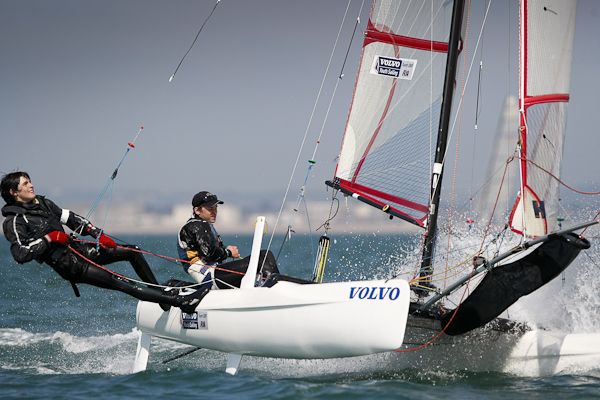
Like everyone has said you probably weren't going fast enough, but as imporant is keeping control over the main in a spinny-less gybe, if you just let it crash over it the force of the main suddlenly powering up will have you over. Always control the main, sheet in and travel in coming into the gybe and ease it out slowly coming out of the gybe, this means you have control to de-power out of the gybe and you don't have a large open head of the main shoving you down the mine.
Pepin i think you have the wrong approach to the traveler, it's a sail control that can be used very efficiently when racing. Upwind in big breeze and chop its often worth wile to ease some traveler to be able to bring the bow down slightly to punch through the chop while still retaining main tension. Also its not fast to go round the windward mark half submerged or taking a very wide berth, dropping some travler means you can turn more easily and quickly and have more control if the bow does go down and as important it's much easier to pull a few foot of trav up rather than metres of main back in.
Thanks for the suggestion. This is exactly what I started doing this week -- especially in spinnaker-less gybes while getting in position for a start -- and the boat feels much more in control.
it would seem that on today's high performance cats, the traveler is a more important sail control than that mainsheet...