

Bill:
I said no way !!! Getting a JCD to mount on crossbar or may make extra mount to go in front of mast if sight is a problem. It was only $35 plus shipping and reacher sheet won't tear it off. I have a squaretop and reacher on 17 that I use tacktick on also. NICE tactical compass and timer too.
Doug

Why would you have to drill holes in your hulls to mount a spinnaker on an A class cat? We were looking at putting a spinnaker on and older A a while back and to mount the spinnaker pole bridle we would have run it from the forestay bridle mounts on the hulls. This works just fine and it means that the spinnaker and all its fittings can be removed without leaving any trace of it ever being there.
Darryl:
That is what I thought. I don't know why Haken did it to his Marstrom. He used ski poles. I would not do that to a beautiful boat like the A2. Really like your Omega!! You guys did a great job. Have any in the US yet?
Doug
Pete:
Check out the new A in the other thread.
http://www.catsailor.com/forums/sho...
Added volume in hulls for us heavy weights and looks a lot like a A2.
Doug

A vs F-16:
Lotus Exige vs Porsche Carrera
Both will get you 'round the track quickly.
Lots of interesting engineering in both.
Neither are as common as Chevys and Fords.
That is the same way that we have the kite set up on the Alpha F14. We knew that it would work just fine as we had previously used the same system on three other cats that we made in the late seventy's and eighties with spinnakers (standard on the 18' and optional on the 5m and the 4,4m).
Regrettably no Alpha F14’s in the states, as yet, we either have to find some one there to build them or hope that the Australian dollar takes a nosedive against the US dollar.
If the A class was to adopt a spinnaker, then no problem to build the boats with holes in the bows like the Marstrom.
I am not a big fan of the snail snuffer..... Tears apart the kite and slower to set / drop.
Why not build a carbon bridle like a NACRA and run a sigle forestay. The bridle will spread the load more on the bows and you can attach the spin pole to it. Run the support lines from the tip of the pole to the outer ends of the bridle and the bridle takes the load. Then include a sock on the pole like other spin cats run.

I too don't see why you'd need additional holes/mounts for the pole bridle. On my Stealth (unlike the other Stealths)the wires for the spin pole simply attach to the existing forestay bridle tangs.
The only holes you'd have to drill would be in the front of the mainbeam to take the pole end fitting and, of course, any holes for the spin fittings themselves. These could be kept to a minimum by sheeting the spin either from the trampoline track or base of the shrouds. The mast fitting could be a dyneema line looped over the top of the mast but you'd still have to drill the track near the top to take the rotation loop.
Stephen,
I seem to remember that Hakan said the snail worked quite well when mounted just in front of the mainbeam. Bad things happened if it was mounted in front of the jib on Tornados..
It makes sense, as the edges/opening/radius of the snail is very similar to the Marstrøm Tornado snuffer.
Wouter or others: what platform will allow my 97kgs to get out on trapeze first?

Reason : The A-cat has a double forestay and so keeping the pole up is an issue. There is no bridle strop to tie a line off to that holds the pole up and because he wanted to use the snail snuffer system he could not have a third forestay that holds up the spi pole, it would interfere with the snuffing operation. Therefor Hakan (and marstrom) uses poles rather then lines. An additional issue with double (triple) forestays is that it can be more difficult to gybe the spinnaker around the stays. And in some cases the twin forestays can prevent the spinnaker from being sheeting in properly. This happens when the forestays are far forward on the boat or when the spi pole is relatively short.
In my experience a single forestay and a mid pole alu ring snuffer system is the best system available. You take a small hit in pointing ability with the midpole snuffer, that is true, but in the way of handling it is more dependable and smoother in operation. It also allows a greater range of sheeting.
Personally I don't ever expect to see double forestays in the F16 class, not even with dedicated singlehander F16 versions. The advantages of improved platform stiffness simply don't outweight the drawbacks in handling. The fact that F16's were always intend to fly a jib helped us out in this respect. Our bows are more then strong enough to take the bridle strop and allows the sailors to keep the single forestay. I don't think this modification can be done on modern A-cats.
Wouter
The 18HT of course 
I single hand my 18HT up to 4 Bft.
But I'm sure that you can trapeze earlier on the A-Cat than on the F16 (plattform is wider and has a shorter mast)![[Linked Image]](http://www.ehlers-media.com/EHLERS/shared/Galerien/Genf/images/EAGLE_1720.jpg)
![[Linked Image]](http://www.ehlers-media.com/EHLERS/shared/Galerien/Genf/images/18HT_1612.jpg)
copyright pictures: http://www.ehlers-media.com/
I'm not really sure actually. That is when limiting the comparison to F16 and A-cats.
I know for certain that on the downwind legs the F16 will have you trapezing first under spinnaker; as a matter of fact you hardly ever do the wildthing on the F16's, there is always enough power to keep you on the luff hull. Of course when the winds are too light to fill the spi properly then no catamaran will pull 97 kg on the trapeze on downwind legs.
On the upwind however I'm not too sure which of the two will put a man on the wire first (when singlehanding). The A-cat has a taller mast 9 mtr compared to 8.5 mtr but then again the F16 has more sailarea 15 sq. mtr. to 13.7 sq. mtr. These two aspect seem to balance one another quite well. Of course the A-cat is both lighter and narrower as well so maybe the A-cat goes to the trapeze sooner on the upwind legs. Having said this, the F16 comes standard with a double hander mainsail that can be trimmed for singlehanding by making it flatter. So in effect the standard F16 mainsails are cut to pull 120-150 kg on the wire in about 10 knots of wind. This means that a singlehander will be pulled to the trapeze alot sooner, even when the guy is 97 kg's. On the other hand both classes allow the owner to order a mainsail to suit his weight and style of sailing so in effect each boat can be made to pull a 97 kg sailor to the wire at exactly the same moment. So can do this even at quite low windspeeds even, when you are willing to accept that in the stronger winds you'll get hit more.
So I guess it all dependents on what kind of hardware you fly on either boat.
I personally use my doublehander mainsail, cut for 150 kg combined crew weight, both for singlehanded sailing and racing. I notice that I need to depower it pretty soon; I'm 85 kg. Up till now I haven't been able to see on the water when the A-cat could fly and I couldn't. Most often there was too much wind and we were both out; in addition the sailor on the A-cat in my club races is not really of the same sailing skills and he is considerably behind me in the races. Not his fault however. I'm 33 and he is 76 years of age. I have alot of respect that he is still sailing cats at that age. In other races where I shared the same course with A's of skill I was double handing.
Wouter
Rolf,
The only time I've come up against an A in marginal trapezing conditions, it was a 5-6 yr old Unicorn. Wind was about 5 - 8 knots and with the F16 I was out on the trapeze much more than the guy on the A. I'm just over 10 stone and I would guess that the A sailor was over 11 stone but about my height (5' 10").
Don't know if this really helps though..........
OK, I'll ask, for the rest of us who don't throw stones...what does a "Stone" weigh?? (10 Stone = how many Kg or lbs.?)

If I remember correctly, a stone is like 14 lbs.
.......  but a rolling stone will give you a hell of a bruise.

14 lbs. = 1 Stone
Sorry guys, showing my age.... I only work in proper measures, can't be bothered with all this new-fangled decimal stuff
Just my 2 groats worth....
A unicorn is quite a bit underpowered compared to a modern A-cat. I think they only have 12 sq.mtr of sailarea and a 8 mtr tall mast. Not too sure wether they are a good approximation.
Wouter
I was indeed wondering about what boat would allow my heavy butt out on the trapeze first, between an A and a F16.
Thank you for the answers. I understand that the question is undecided but pretty similar?
I was pretty certain that it would be the A, as it is lighter and have a longer mast, but what do I know..
In my view the 18HT is a two person boat. If the wind increases, you would be seriously overpowered on it. I 'do' the Tornado solo from time to time, and it's just insane in any kind of wind. Not something I want to risk on a regular basis.
The M-18 Marstrøm used to sell, was that the same boat as his A with longer beams?
Pete:
Maybe I can simplify this for you.
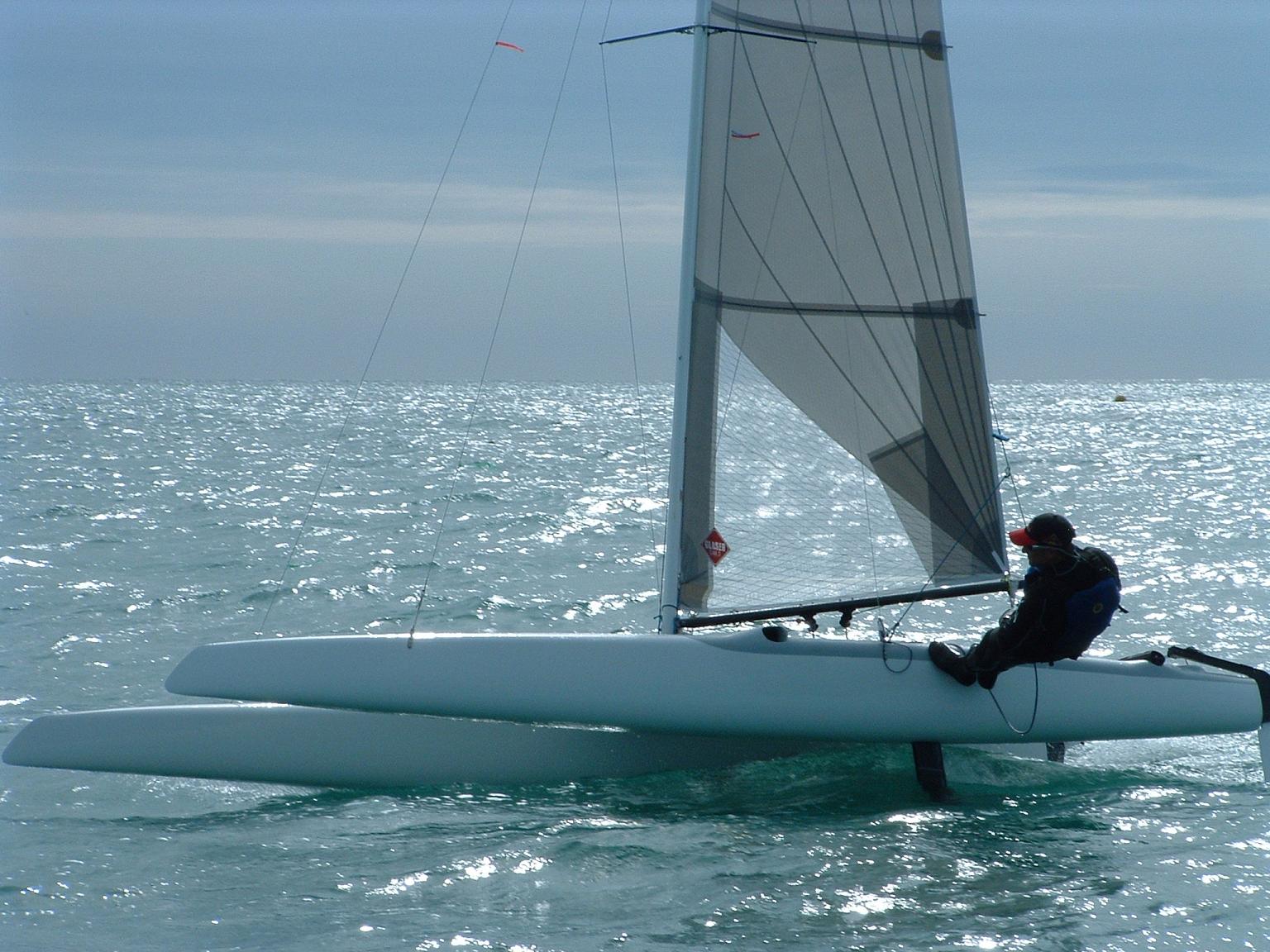
1. If you want the highest quality class racing, no question the A-class is the choice. Other than the Tornado class, you will not see as much depth in any other class. At our 42 boat US Midwinter race week, there were four Olympians (three were medalists), 3 world champions, at least 8 sailors who had won national or North American titles, and then a bunch who have consistently finished in the top echelon of various class championships. The racing is not boring at all!
2. The F-16 is a great package. As a two man sloop, I believe it has the potential with the right sailors to be faster than the F18 except in light air (the F18 pays a big penalty with its weight if the crew is not on the wire). Once the F-16 is powered up, it rolls. The A-cat is always faster upwind but is not as fast downwind in over 6-7 knots. Even though it is lighter, it cannot keep back over twice the sail area the F-18's and F-16's have at hand. If you want a boat that you can race with 1 or 2 persons and really want a spinnaker, the F-16 is probably the better choice for you.
3. An A-cat is as durable as an F-18 or F-16. The boat does not have to built as heavy because the loads are lighter due to the rig and it is designed for singlehanding. I've owned three boats and they were all excellent. You should get easily a minimum 5-7 year competitive life from your investment.
4. The A-class does not want spinnakers for class racing. The racing itself is very tactical without them and the class loves the simplicity. Jennifer Lindsey (an excellent F-16 sailor) got an A-cat because of that simplicity. Yes, spinnaker boats are great (I've sailed many) but I've never found the A-cat boring at all. You really have to put the time in the A-cat to be fast downwind and I love the challenge of refining my downwind technique in the boat. I've toyed with the idea of a spinnaker for my A-cat but am quite happy leaving the boat the way it is. I'd rather have the quick setup and rigging time and focus on refining my boatspeed for class racing which I enjoy the most.
Hope this viewpoint helps.
Bob Hodges
A2 USA 230
Rolf,
I sail the HT singlehanded and its awesome under 10knts - flat water, flying the spin. Every other boat in the harbor is standing still and the HT is cranking along. Very cool.
My only worry is righting it, I cant right it by using a righting line alone. And worrying about doing it with a bag or a pole takes some of the enjoyment out of it, I dont feel like I can press it as hard.
Thats one of the reasons I got the A cat, I wanted to be able to sail it alone, and be able to right it without any worries.
Bill
Wouter
The quite a few of the HT's went with the double forestays and didnt have a problem gybing the kite. Generally the pole is out in front of the bows and the forestays are attached a ways back on the bows, so I dont see how it will be an issue on an 18ft boat - A cat, HT, etc.
It might be an issue on an F16 because you have less bow, perhaps, but on an 18ft boat you wont have a problem. Keep the pole long and the luff long and you wont have to worry about the forestays interfering with the sheeting angle.
As far as keeping the pole supported, I think you could use sticks and mount them over the forestay eyes and make it removeable. This would support the pole and keep it in place without drilling holes in your bows. The other issue is on a modern A cat, the bows dont come to a point (XJ, A2, etc), so there is no perfect mounting spot, so I would move it back to the forestay eyes.
Bill
How 'bout surf? I like to sail at Daytona and would also like to do the JPOR again? Will either of these boats handle open water?
Ok, Tom. Why did you choose the Blade?
2005 version of JPOR: fleet of F16s and at least one A in the fleet (according to the pictures)
http:/
I went F16 for the versatility. My situation was/is: inland lake sailing most of the time (light air/flat water), buoy racing most of the time, no consistent crew on N5.5SL and young kids getting to the age where they'd enjoy sailing (ages 6 and 8). I was looking for these characteristics in a boat (in no particular order):
1. Lightweight, I need to be able to handle the boat by myself (8 year olds aren't that much help) in the water and out of the water (I weigh 155 lbs dripping wet)
2. Able to single-hand easily (even if racing in an F16 fleet). I'd give up 18 inches in mast height to N5.5 Unis from my N5.5 SL-to-Uni set up.
3. Good light air boat, see local conditions above (no class min weight either).
4. Fast out of the box, I don't have a ton of time to tinker (I'd like to but....)
5. Integrated class legal spinnaker
6. Ability to be "Competitive" at coastal regattas/distance racing from time to time. "Competitive" meaning the boat is potentially quick. Crew ultimately decides "competitive".
7. Production built, my wife wouldn't let me take "her" children on any boat I built.
8. Racing centric atmosphere. I enjoy the post race breakdown/bragging sessions as much as the racing. Being with like minded people is fun.
I had a tough time deciding between the Blade F16 and the Stealth F16. Both seem to be awesome boats, but the Blade has a "local" manufacturing presence lending to an assumption that it will proliferate quicker in the US (can you say Alter Cup boat in '07). Theoretically, parts will be easier to get, etc. I still may try the Stealth rudder system on the Blade .
That about sums it up. Thoughts?
Good thread
Pete, if you are ever in South FL area, let me know. I might be able to setup a test sail on the Blade.
Tom:
I've decided on the Blade, just waiting to hear back from Vectorworks.
The versatitility was the biggest factor.
The absolute final point in the decision process was the video, on the F-16 site, of the Blade being sailed solo! The slightly lower cost was also a factor. That difference will go a long way in experimenting with sails! I will still, almost certainly, buy an A cat. Just, not this time around.
Robi:
Thanks for the offer. Hopefully, by the time we set it up, you can give me some rigging tips!
Anyone know how long it takes to get delivery?
Way to go, Pete!! 

Pete,
I know you were down at Gulfport Yacht Club last weekend.
I didn't have my Taipan set up, but if you are wanting to sail F16 single handed let me know and come back to the club and you are welcome to take my boat out.
A cat vs. f16 is one thing. Spinnaker vs. non-spinnaker.
No reason to junk up an A Cat with a spinnaker. An A cat is what it is, a perfect single handed boat with no spinnaker. An F16 has pure versatility with a spinnaker.
Let me know and come on down.
Seth