

After 20 years of sailing cats I know absolutely nothing about spin flying.
So I have a question for all you spinnaker guys. While sailing aboard my buddy's mystere 5.5 he cranks in the main sheet while downwind then sets the chute, and keeps the main sheeted. He claims this is because the boat doesn't have a backstay and without a sheeted main we would demast.
My question is, the chain plates for the shrouds are aft of the forward beam...aren't they strong enough to hold the mast up by themselves?
For deep downwind sailing it makes more sense to me to ease way off on the main even with the spinnaker up.

Your friend is correct. Make sure you let off the downhaul as well.
Furthermore, your apparent wind is so far forward than sheeting in is actually the correct trim for the main.
The spinnaker bail is usually mounted well above the hounds so if you don't give the top of the mast some type of back-support via the mainsail leach being tight, in a good puff + stuff scenario, you could break the mast.

your shrouds don't go all the way to the top of the mast, so if you didn't sheet in when flying your spin you would probably pull the unsupported part of the mast(above the mast tang) forward till it failed... so wen you sheet in the sail acts like the backstay....
by the same logic, why do we
blow
the rotation downwind? It seems excessive to allow 90 degree rotation when the apparent wind is still ahead. I don't go to 90 deg, but you get my point.

They probably would do the job if the spin halyard sheave was at the same point as the shroud tang. However, most cats have the halyard somewhat to way above this point.
That causes the top part of the mast to go forward, inverting the mast, bending it the wrong way. When that happens, it may fail at the weakest point in it's column.
The mainsail through the mainsheet keeps the mast bend positive and the bend in the lower portion is restrained by the mainsail cloth.

by the same logic, why do we
blow
the rotation downwind? It seems excessive to allow 90 degree rotation when the apparent wind is still ahead. I don't go to 90 deg, but you get my point.
What an echo in here! 😉
What they said.
We rotate to 90 because although the apparent wind does move forward, it rarely comes much more forward than 70 degrees. It's still much more to the side than when you sail upwind.
In light air, you will find it necessary to induce a bit of twist in the main - particularly so the bit of sail above the spinnaker can still breath as it is mostly unaffected by the redirection of air over the main. In moderate to heavy air, being sheeted hard IS proper trim and the additional mast rotation helps induce some extra fullness in the mainsail for a little more power.

When you're sailing upwind efficiency = speed = height so you set the mast rotation to maximise the lift to drag ratio. When you turn downwind, power becomes king and efficiency is less important. Rotating the mast will increase the available power. Also note that the main is eased a little its not cranked hard like upwind.
The good guys (Bundy etc) play the main downwind but you have to be very confident in what you're doing because we mere mortals have a tendancy to dump main when we get in trouble and as noted above dumping main can equal dumping mast.

So, dump the downhaul, sheet in tight.
Can you move the traveller to optimize lift?
You can but its not as fast as playing main. Much safer though.
Ok...next nube chute driver question......
How tight?
tight enough.
there ya go with them dang technical terms again <img src="<>/wink.gif" alt="wink" title="wink" height="15" width="15" />
Most do ease the traveler when going downwind, maybe a foot or two depending on wind strength and headings to marks. If you don't have leach tell tales, get some, then trim to those.
Timbo, there are better sailors than me around and you might be one of them. But from a speed point of view I'd advise against dropping the traveller unless you're having trouble laying a mark.
Butch about a foot should be fine. Keep an eye on your rig and you'll soon get a feel for the correct setting with your rig. Timbo is right leach lines are very important for max performance.
Adjusting the traveller a foot or not would depend on the type of boat in my thinking. What angle is the boat sailing for best VMG, and how can the main be set to complement the spi. The speed and the telltales will give the answer. If you know the best angle for the conditions, it should be relatively easy to trim the main to the spi by looking at the telltales and the feel in the boat.
Saying that downwind power is everything is a bit.. rough? A kite with a lot of draft will give more power, and drag. It was when we moved to kites with less draft we really got speed. In line with the same thinking, not letting the mast all out will in my humble experience give more speed when sailing downwind with spi, but it is harder on the mast so be careful.
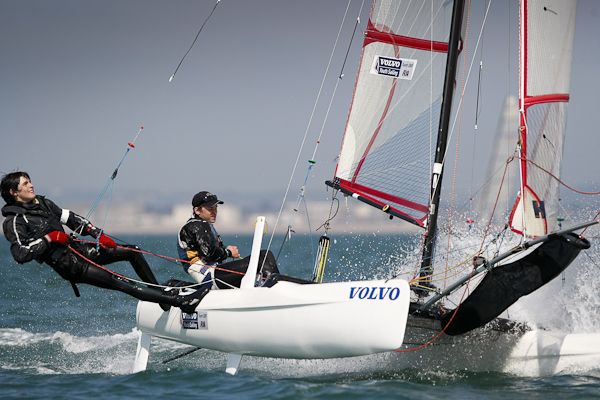
Getting how far you let the mast out downwind is very important, we let it a certain amount but not all the way, i think crew weight on a boat like the f18 effects how much you let the mast out alot.
Apology accepted!!! ... don't ever question me again.... OR ELSE!!!! <img src="<>/smile.gif" alt="smile" title="smile" height="15" width="15" />
Happy Birfday Andrew.
Thank you ...