
Quite a discussion on SA about the new A class. One of the posters states square edges cause too much drag.
I've always heard flat bottoms (I'm assuming square edges) are faster. Is there any PROOF one way or the other?

I've always heard flat bottoms (I'm assuming square edges) are faster. Is there any PROOF one way or the other?
We might as well start a discussion about wax vs. wet sanded hulls. It's hard ($) to put any real science behind it...it's really difficult to simulate the real world situations the cats go through and get any real discernible data.

Wax it, until you can't stay on it!

With R/C boats we have attached two boats to a teeter-tooter, one on each end to a teeter-totter in the water, then pull the middle of the teeter-totter, the boat with the most drag falls behind.
Any flat bottoms? I have it in my head that the Sharpie form would be a good way to build beach cats.
http://en.wikipedia.org/wiki/Sharpie_(boat)

A whole lot of variables in that test.No waves ,no current, no wind,Boats have to weigh the exact same and the tow rope has to be spot on dead center.
The flat bottom, square edge thing might work great, until the boat heels. I seriously doubt naval architects have been doing it that wrong all this time.

Question: Are water pipes square or are they round, and why??
If you have studied
Fluid Dynamics
there are cross-sectional flow diagrams in the textbooks that show that corners create drag ... along w/ adding surface area. It is the same for hull shapes moving through water/fluids.
Now, why would a flat bottom hull shape be more efficent?
It has to do w/ the fact that fluids are incompressable, with a specific viscosity ... so if you have a hull shape moving through a fluid, the fluid needs to move out of the way of the hull shape ... but ... it will only move so fast and no more. Now it has been discovered that if the hull shape is at the boundry layer (surface) between the fluid and gas/air and has a flat bottom (ie: planing hull shape), the hull shape will
rise
out of the fluid and into the air/gas since there is less friction/resistance when passing through the air/gas medium.
So at slow speeds, were fluids are in
laminar flow
a smooth round hull shape is more efficent ... now at higher speeds were the fluids are experiencing
turbulent flow
a planing hull shape will be more efficent as the hull shape rises up out of the fluid ... reducing the
wet surface area
and the associated resulting drag.
Now that is in ideal conditions w/ a smooooooth boundry layer between the two mediums (fluid/gas)..... now add waves ... waves of different amplitude and wavelength ... variations in speed/velocity of both the hull shape and waves ... materials used for the hull shape ... variations in hull shape attitude (pitch/roll) ... displacement of the hull shape ....
... very quickly you are dealing w/ engineering equations (calculus/diff eq) that are very long and complex ....
This is why it was easier from an engineering stand-point to get
a man
... to the moon ... walk on it ... and return safely to earth ...
Boundry Interface
problems are the toughest ....
Harry
Playing Devil's advocate, all I can offer is the history of the Sharpie. It performed very well in a variety of uses.
One argument I've heard in support of flat bottoms is that when they heel they present a V shape to the water.
For me, the Sharpie's main appeal is ease of construction. I often think beach cats have become too complex and expensive. In that regard, the market might support a less expensive type if performance remained good.
Then again, 5000 years of sailing and we're just now getting it figured out.
I'm still not convinced a boats ability to go to weather doesn't involve some measure of witchcraft.
Cheaper! less material per interior volume.
Then again, 5000 years of sailing and we're just now getting it figured out.
I'm still not convinced a boats ability to go to weather doesn't involve some measure of witchcraft.
The Polynesians figured it out a long time ago, people are just dense.
One argument I've heard in support of flat bottoms is that when they heel they present a V shape to the water.
For me, the Sharpie's main appeal is ease of construction. I often think beach cats have become too complex and expensive. In that regard, the market might support a less expensive type if performance remained good.
The Hobie 16 is still available....the wave....

Don't you have a 2nd and 3rd job to attend to. Get off the internet and get back to work... freaking slacker!
Pete,
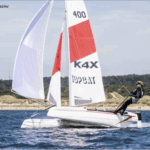
My guess is that you are correct, but nobody likes the look of the result. For example, look at the Itzacat design (http:/
As the writeup to the video says, it
... sold well to engineers and science teachers who understood why it worked so effectively.
The rest of us just said,
Eww.