
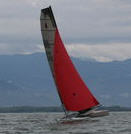
Hi
I'm thinking of increasing the rightingmoment of my ventilo F18HT for open class racing. I'm aming at a rightingmoment/sailarea between the f18 and the tornado.
I'm looking for confirmation that I'm on the right track!
So please feel free to post your opinions!
Wouter gave me some good hints and help to start with.
I'm using his formula to calculate the rightingmoment(RM) for my ventilo:
boatwidth=2.5m
boatweight=130kg
creweight=125kg
sailarea=20m^2
RM=boatweight * (boatwidth / 2) + (crewweight * (boatwidth + 1m))
RM=600 kg m
I calculated the RM for several boat's:
Ventilo F18HT=600
Ventilo F18HT with 0.5m wings=668.75
Ventilo F18HT 2.7m width=640
Ventilo F18HT 2.8m width=660
Ventilo F18HT 2.9m width=679
F18=684
Tornado=740
BIM F20=785
After that I put the RM in relation to the sailarea, (without calculating the height of the centre of effort CE)
rightingmoment/sailarea=
Ventilo F18HT=30
Ventilo F18HT with 0.5m wings=33.44
Ventilo F18HT 2.7m width=32
Ventilo F18HT 2.8m width=33
Ventilo F18HT 2.9m width=34
F18=32
Tornado=34
BIM F20=35
considering that my ventilo dosn't have a jib and a much higher sailplan, I'm thinking of increasing the width to 2.9mtr witch leads me to a relation (rightingmoment/sailarea) of 34, the same as the tornado. In this way, I guess because of the lower sailplan from the tornado, there should be still enough heeling force to sail the boat on one hull.
thanks for every post to the subject!
greetings from switzerland
Andi
Ventilo IF20 with wings (not my boat)![[Linked Image]](http://www.bst.ch/alutz/images/f18ht%20wings/Thunersee%20094.jpg)

I'm not sure about the righting moment but WOW that's an incredible boat.

New painting scheme idea formulated 
I agree, thats a seksy boat.
Huhh, no snuffer but a spi-bag ?
Looks really good tough! Are the wings extended, or are they really short ?

Looks like a tin can. Would be a good boat to carry Saporo beer (in the large tin can) sponsorship.
Hello Alutz,
I think you have calculated the numbers correctly but the equation you have shown is not correct.
The correct equation is: RiMo=Bwt X Bwd/2 + Crwt(Bwd + 1m) This equation will give the numbers, RiMo, you have calculated.
Don't worry about being able to fly a hull. It will happen! The dynamic pressure of the wind varies with wind speed squared, velocity**2. You are considering increasing the righting moment to sail area ratio on the F18ht from 30 to 34 or a 13.3% increase. When the wind speed is up by 6.5%, the wide boat has the same ratio of righting moment to overturning moment as the narrow boat. A 6.5% increase in wind speed at 12 knots is 0.78 knots or a little less than 13 knots total windspeed. This will make a big difference in boat speed as soon as you need to get out on the wing. The narrow boat will be luffing/feathering sail area when the wide boat can drive all of his sail area. Sailing to windward on the narrow boat, the drag from the luffing/feathering sail area will be subtracting from the forward force the sail is generating which is already compromised because the narrow boat cannot hold the boat down. The narrow boat takes a double hit. He cannot drive 100% of his sail area and the sail area that cannot be driven is producing drag. This drag is subtracting from the reduced sail force the narrow boat has to operate with in the first place because he cannot hold the boat down.
Go fast and watch those bows. Stand aft on the boat when necessary. You are putting a supercharger on your boat so be ready for more horsepower and speed.
Bill
Thank you Bill for your response!
I was not sure, how far I should increase the boat width.
My current beams are made of carbon pre-preg, are 2.5m wide and have diameter of 16cm, they come with no dolphin striker and are incredibel stiff.
I will build the new beams with carbon and a vacuumpump, by my own. I have never done that bevor. As much as I know is, that the strenght of pre-preg is higher than standard carbon laminate.
Now that I'm not a engineer and I can't calculate the forces and the strenght on the new beam.
I thought that applying so many layers of carbon, until I achieve a wall thickness of 115% to the old carbon pre-preg beam. In this way, there should be some reserve of stability.
Also the local supplier of carbon fibres, told me, that when I feel, that the new beams are not stiff enough, it is easy to apply some more carbon layers later, to increase the stiffness.
I'm thinking of mixing carbon-braids, the first layer standard carbon crosswoven, the inner layers undirectional and the outer layers crosswoven again.
What do you think? Will this work?
thanks again for your post!
greetings from switzerland
Andi

Be careful when making assumptions.
If you are increasing the righting moment with 15 % than the beam will be under 52 % higher loads (if my memory serves me right)
I can do the construction calculations for you; please take a look at them before you make-up your mind.
IF the free beam is to weak or to felxible than fitting a dolphinstriker will be a good alternative. These things make alot of difference.
WOuter
Dear Wouter
Thank you again for your usefull replies!
Some calculations would be very nice.
And when I hear that the forces go up by 52%, then I probarly go for a dolphin striker.
Greetings from Switzerland
Andi

Bill,
If its not a trade secret what safety factor do you use when designing the beams of your boats?
Same question to Wouter, although from your comment "Greg Goodall of AHPC indicated that the mainbeam was noticably overdimensioned" I guess yours was overdimensioned too, did he tell you what stress it could have been designed to?
All the best
Gareth

Andi,
Be very carefull using the data supplied by the manufacturers of the prepreg material. The conditions, techniques etc of how the laminate is laid and applied can change the end product physiscals by as much as 40%. The advantage as you said is that you can easily add additional material latter, but it will be difficult to know when, as the typical failure with a carbon laminate is catastophic.
The stiffness of the carbon fibers will probably easily give you enough stiffness, but the point of failure will be from compression along the top of the cross bar. Do what you can to maximixe the thickness of the laminate without adding too much weight, as thicker laminates provide better compression resistance.
Good Luck
Matt
Hi Andi,
If all the geometry of the boat/rig remained the same as a standard boat and somehow, magic, you increased the righting moment 15%, all loads in the system would go up by 15%. This not to say that all loads go up by the same number of Kgs, but all loads go up by the same percentage. For example, the axial load coming down the mast is a much greater force than the sail force, but if the sail force goes up by 15%, so does the mast axial load, compression, coming down the mast.
In your situation you have it better than that. The increased sail force is due to increased righting moment. The majority of that increase in righting moment is in the trapeze wire which intersects the mast at the most shallow angle of any wire connected to the mast. Therefore the increase in mast axial load and main beam bending load will be less than a 15% increase. Other loads that add to the total mast axial load are windward shroud tension, which could go down, forestay tension and mainsail leech tension, mainsheet tension. In a simplified analysis we could say that if the horrizontal sail force goes up by 15%, these other forces will also go up by 15% of their base value and we are on the safe side.
As far as your main beam goes: Uniform composite parts, beams, loaded in bending fail on the compression side first. Therefore it is important to add material to the top of the beam, under the mast step, and tapered as the additional laminate flows away from the center of the beam. Axial strands of carbon is all you need. The base beam can handle any axial cracking loads.
Good Sailing,
Bill
Hello Gareth,
The number I use is 2.5 and that is the Marine industry standard in the US.
Bill
Dear Bill and all others
Thanks allot for giving all your suggestions and information!
Really cool, what a great forum!
All the best
Andi
No greg didn't tell the stresses to which a beam can be designed too.
But when doing the math you quickly realize that stresses are not the real concern. Stiffness is. You can easily make a beam strong enough; but it is far more difficult to get enough stiffness into it to make the platform go well in waves.
Wouter
Why is stiffness so important and how much is enough?
I am not disputing what you are saying (I know what a difference a tight trampoline makes) but am wondering why a stiff boat is quicker, is it simply that if both hulls are pointing in the same direction there is less drag.

If your boat is stretching and squirming as it goes through waves, it's absorbing energy and taking away from speed.
A quick reply as one can write a book about this subject alone.
But the following main points are important
Stiffness allows a craft to be driven harder in rough conditions. Compare this with a car with insufficiently inflated tires. Sure it can take a bend with high speed but the flexing of the tire will give is a wobbly fell while rounding the corner. It feels like your not totally in controll. SUch wobbling can quickly cause the car to break out uncontrollably where properly inflated tires may also let the car slide but than in a controllable sense. THe improved behavoiur of the craft allows the drive to push it harder. It also feel more confortable.
Stiffness (for some reason) allows a craft to punch through waves better and sustain higher speeds here. I compare it with two hammers of equal weight one of rubber the other of steel. While both land the same weight on the nail we all know that the steel hammer drives the nail more comfortably into the wood. I guess it is the same with catamarans.
Stiffness allows such elements as the leech of a mainsail to be better controlled allowing the craft to point higher and make it more responsive to alterations in trim.
One dlophin striker less design behaved as follows : When janking non the mainsheet the mastfoot would be pushed down and the stays would lengthen together taking up large quatities of the applied mainsheet. The leech tension didn't really change that much. When the mainsheet was released a little bit the springness of the beam and stays would keep the leech tensioned up where a stiffer design would quickly have lowered the leech tension. Leech tension is an import trim factor on mainsails.
Stuff like that make stiffness important.
Wouter