

BACKGROUND
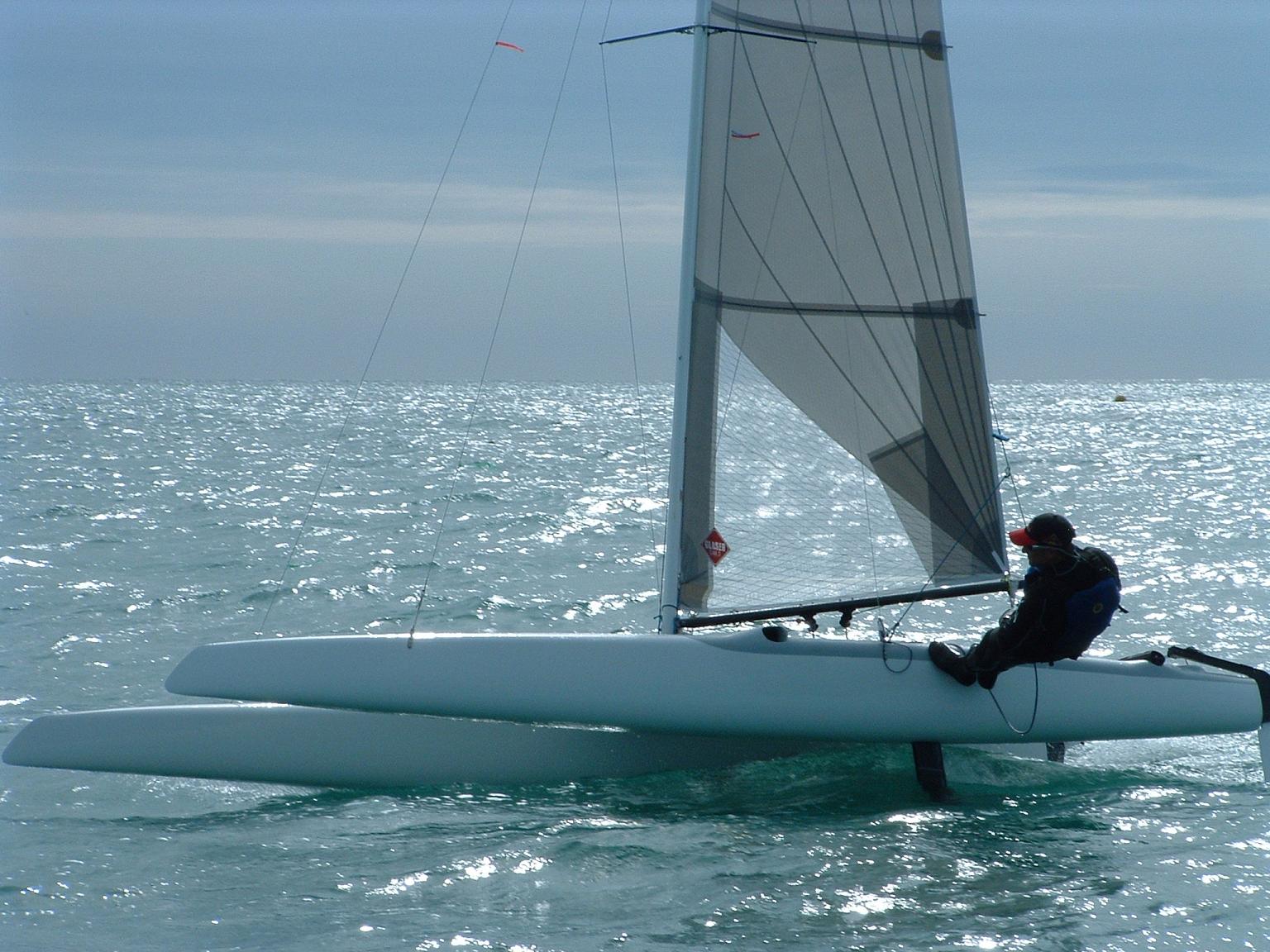
After Booth successfull rebuilt of the M18 I'm thinking about adding a second trapeze, a bigger mainsail and spi to my Marstrom A-cat. I know that Booth didn't win but my interest was focused on the fact that the boat could handle the extra loads without any failures!
Booth used the M18 with 150kg+ of on the wire and used a main beam that had a weight of 50 kg instead of 5kg. The reason for the heavy mainbeam was to reach the minimum weight of 130 kg. Booth used a cut down M20 mast, I will try to use the A-cat mast as it is.
Should I do it?
THE PROJECT
Crew
It will not be designed for "Team beef" but for teams around 130-140 kg, same as Hobie 16.
Sail
The area can be increased from 13.9 to maybe 16.5 m2 by adding more roach area to the main sail. The spi should be around 17 m2.
PROBLEMS
Mast
The top of the mast may be to bendy for the bigger roach and increased loads. The performance to windward in medium winds could suffer from this.
Increased compression of the mast by 30%, reason higher sheet load and another crew on the trapeze.
Main beam
Increased load on the mainbeam by 40%, reason higher sheet load and double trapeze. Booth had 50-60% more load on a WIDER main beam.
Hull
The hull needs to support 220 kg instead of 165 kg which means that the hull will be 4 cm lower in the water. The hull on Booth F18ht supported at least 280 kg and that hull was probably 10 cm lower in the water.
Performance
The boat is narrower than the F16 and 25 kg lighter but the sail area will be lower, 16.5 m2 instead of the F16 18 m2. The lower sail area will be compensated a bit by a 1 meter higher mast and uni rigg instead of main+jib.
/hakan
BACKGROUND
After Booth successfull rebuilt of the M18 I'm thinking about adding a second trapeze, a bigger mainsail and spi to my Marstrom A-cat. I know that Booth didn't win but my interest was focused on the fact that the boat could handle the extra loads without any failures!
Booth used the M18 with 330+ lbs of on the wire and used a main beam that had a weight of 110 lbs instead of 11 lbs. The reason for the heavy mainbeam was to reach the minimum weight of 286 lbs. Booth used a cut down M20 mast, I will try to use the A-cat mast as it is.
Should I do it?
THE PROJECT
Crew
It will not be designed for "Team beef" but for teams around 286 - 308 lbs, same as Hobie 16.
Sail
The area can be increased from 148 sq.ft to maybe 176 sq.ft by adding more roach area to the main sail. The spi should be around 180 sq.ft.
PROBLEMS
Mast
The top of the mast may be to bendy for the bigger roach and increased loads. The performance to windward in medium winds could suffer from this.
Increased compression of the mast by 30%, reason higher sheet load and another crew on the trapeze.
Main beam
Increased load on the mainbeam by 40%, reason higher sheet load and double trapeze. Booth had 50-60% more load on a WIDER main beam.
Hull
The hull needs to support 480 lbs instead of 363 lbs which means that the hull will be 1.5 inches lower in the water. The hull on Booth F18ht supported at least 616 lbs and that hull was probably 4 inches lower in the water than normal.
Performance
The boat is narrower than the F16 and 55 lbs lighter but the sail area will be lower, 176 sq.ft instead of the F16 192 sq.ft. The lower sail area will be compensated a bit by a 3 feet higher mast compared to the F16 and uni rigg instead of main+jib.
/hakan
Hello Hakan,
The max loads due to increased righting moment go up in small parts also. The max bending loads in daggerboards and daggerboard trunks go up directly directly with righting moment. Max rudderblade, rudderhead, pintles, gudgens, gudgen bolts and transom increase with righting moment. Max chainplate loads increase as well as chainplate bolts and the hull area immediately around the chainplate.
On a boat like an A class cat that has been through a major weight reduction program, all the fat has been taken out, there is little to no margin for increased loads anywhere. Taking a new/modern A class boat and adding a bigger rig and double trapeze is risky business. The devil is in the details.
Bill
PS If the mast bends too much, raise the hounds, ie 30% if the mainsheet loads are up by 30%. Also add double spreaders below to reduce the max unsupported mast span.

Hakan,
I might suggest (if you haven't already done so) you contact Goran on this project with your concerns. Since he built your boat, he is the one who can tell you the reality of your project. Good luck!!
Bob 

Hello Hakan-
Both Bill and Bobcat have good points. One factor I would take into account is the second crew/s height and weight. I saw two crew that were at least 120lbs apart [150 + 270] and both on the trap. Of course the heavy guy was forward and the bow was buring alot. What is the bouancy factor of your boat hull? I have heard there are two 22s in the Pcola area with a full load out sailing.
Send me a pic of what you're doing,
thom
I haven't done any real modifications to the boat yet, I'm still trying to get more facts.
The main reason for this idea is that the A-cat platform from Marstrom seems to be so strong that it could handle double trap and spi without breaking.
If we use the Booth configuration of his F18ht as an upper limit and remove 50 kg (110 lbs) of boat weight and 20 kg (44 lbs) of crew weight and reduce the beam from 2.5 to 2.3 meters it might work. All the racing Booth did was in flat water or? Bigger waves might lead to failure....
/håkan

The Marstrom A Class hulls are famous for their strength.
According to the Marstrom website:
The M18 uses the same hulls from the A Class,
Is 2.5m wide, instead of 2.3m,
The mainsail is 15sm instead of 13.94sm,
The boat weighs 78kg instead of 73 kg,
And of course it has a 15sm gennaker.
I doubt if Booth would even have tried to build his boat without checking every single modification with Goran Marstrom.
Supposedly the ICCT boat was made fron the same hulls and hardware with an M20 mast.
The hulls didn't break.
The mast didn't break.
The daggers didn't break.
The rudders didn't break.
The hardware didn't break.
I think the issue of strength has been resolved.

According to the Marstrom website:
The M18 uses the same hulls from the A Class,
Is 2.5m wide, instead of 2.3m,
The mainsail is 15sm instead of 13.94sm,
The boat weighs 78kg instead of 73 kg,
And of course it has a 15sm gennaker.
I doubt if Booth would even have tried to build his boat without checking every single modification with Goran Marstrom.
Supposedly the ICCT boat was made fron the same hulls and hardware with an M20 mast.
The hulls didn't break.
The mast didn't break.
The daggers didn't break.
The rudders didn't break.
The hardware didn't break.
I think the issue of strength has been resolved.
To all the above.........Yet......
The boat was used for a couple of weeks max and it has not broken yet.
I would urge caution and contact Goran Marstrom and discuss it with him.
And while you are talking to him, ask why they have not responed to my enquiries about the M18 

>>The Marstrom A Class hulls are famous for their strength.
This is not a correct conclusion from this test. As a matter of fact Booth made skilled use of how the design parameters behave when loading up a platform.
Let me run through the points
>>Is 2.5m wide, instead of 2.3m, : Does not seriously increase loads on the platform. the increases are accompanied by equal magnitude reductions.
>>The mainsail is 15sm instead of 13.94sm, ; Doesn't matter ; righting moment determines the laod on a platform not the sail area. Amount of sailarea only determines how much more you need to depower a rig at the same high wind conditions
>>The boat weighs 78kg instead of 73 kg, ; This is neglectable
>>And of course it has a 15sm gennaker. Spinnaker does not introduce higher loads on the sidestay than when sailing upwind. It does not load the hulls up more than a jib does on the same upwind course. I haven't done the calcs on mast compression yet. Mast foot and beam however are unimpressed by a spinnaker. The increase in load is simply to small when compared how much a beam is overdimensioned to get the optimal beam stiffness. Beam is never in risk of breaking only flexing to much.
>>The hulls didn't break. : The hulls are build to resist shock and point loads this make the hull alot stronger than necessary for the sailing loads. Only serious point of concern are the sidestay chainplates. These do experience increasd loads to 170% to 200 %
>>The mast didn't break. : It was a M20 mast ; it was designed for double trapeze spi use.
>>The daggers didn't break. : This is interesting, These see increased loads to again 170% - 200 %
>>The rudders didn't break. : Rudders are less critical than the daggerboards. so if the dagger hold ..
>>The hardware didn't break. : Yes well, that is because for small open boats there is pretty much one line of breakstrength used on all boats from 14 foot to 22 ft.
>>I think the issue of strength has been resolved.
Yet but the issue of flexing hasn't. For example It is not difficult to design a mast thatwon't break but it is difficult to design a mast that won't break and flexes in the right way and to the right amount to make a boat well behaved.
>>The boat was used for a couple of weeks max and it has not broken yet.
This is also interesting as indeed damage to beams and other stuff is nearly always the result of metal fatigue and low tension ruptures. These two do require above anything else "time". Still I trust Goran to design his products in such a way that both failing mechanism are unlikely to occure on his boats. Mostly these tow failing mechanisms are the result of lapses in design.
Wouter
Hakan,
I was a competitor at the LAC so had a close up look of the "M-18HT". I believe the reality was a world class talent sailing the boat resulted in it doing as well as it did.
The "M-18HT" simply did not float on her lines. Mitch felt that the boat could be fast in light air and flat water. As expected, the boat was difficult to sail downwind in breeze. The beams were slapping the waves and Herbie was having a difficult time staying on the wire. From our observation, the boat looked like it was pitching a lot and the waves and chop were not that big (offshore wind).
The boat was no faster than the Bimare boats. In the light air racing, it appeared to be no faster upwind. Downwind, Enrique and Jorge always seemed faster (Mitch lost the challenger berth on a downwind leg).
You do have to remember that nearly 50 kg of weight was added to the boat to make it measure in to the HT class rules. That did not help. Mitch did not know what he was going to do with the boat (I don't think he and Herbie plan to race it). He felt if he sold it, he would remove the 50 kg that was added to it. You could then no longer race it as an 18HT.
Bottom line - you can do it, the rig and platform may be able to handle the loads but you better keep that crew weight very light. I second others in you should consult Goran.
Bob Hodges
I talked to Goran today and he has the same opinion as Bob, the boat will not float on her lines and it will loose the A-cat feeling.
My calculations gave me a floating line that is 1.5 inches above the correct one and that might be enough to loose that A-cat feeling, but will the boat be slower?
To sum things up, the boat can handle it but it lacks volume in the hulls and the mast might be to flexible to handle more roach on the main.
I'll try to do some tests later on with a total crew weight of 130 kg (286 lbs) and see how it compares to a singel handed A-cat.
Thank you all for your input!
/hakan
You estimate 40 mm extra draft when putting some 140 kg (double) - 75 kg (single)= 65 KG extra on it.
My estimate would be at least 50 mm, probably more. (When sailing on one hull, the other just lifted clear of the water)
Typically I use as "an rough extra draft" estimate the following formula :
(Length hull * width at widest point deck * 2/3 * 1/1000) * extra draft in mtr = kg's extra
or
5.49 * 0.30 * 2/3 * 1/1000 * X = 65 This leads to an increase in draft of 59 mm. 50 % more than your 40 mm estimate.
Even when using a shape factor of 3/4 (instead of 2/3) I arrive at 53 mm Increase in draft. Theoretically the shape factor of 3/4 is linked to a hull that is rectangular in crossection and that from the top looks like it is made up of 1 rectangle of halve the hulls length and one triangle of the halve the hulls width. It can easily be argued that this is the most extreme case with the lowest increase in draft. Real draft figures MUST be higher than any estimate this 3/4 approach produces.
P.S. The 2/3 approach compensates for the roundings of the hull from the 3/4 basic shape but still can be regarded as a underestimating approach.
Wouter
Surely Booth and Marstrom knew before the A class hulls were put together as a two person boat with spin that the narrower hulls would sail lower in the water to find the displacement to support the total sailing weight. That is a given. What it comes down to is a trade off between friction drag, wetted area drag, and wave making drag. The finer A class hull will sit lower in the water and have more wetted area and have more friction drag. At speed where wave drag becomes important the finer A class hull will have a lower wave drag characteristic. A wider hull of the same length will float higher in the water and have less wetted area and therefore have less friction drag. At speed this wider hull will be pushing the water further sideways to move ahead each boat length and this makes more wave drag. So what it comes down to is that in light winds you want fatter hulls with less wetted area and in strong winds you want finer hulls with less wave making drag. Everything is a compromise.
Bill
Maybe that is why Shark catamarans do so well in light air?
billrob
Your arguement leaves out the rear beam slap factor. When a lightweight, tall rig boat, like the HT (or a modified 2 man A cat with a spin) is sailing in chop downwind the rear beam will hit the chop and cause the boat to pitch forward. Read Bob's discussion above, he witnessed this in action. The PUR boat was pitching in the chop and the crew had a hard time staying on board. If the boat is slapping and pitching in the waves, you are slowing the boat dramatically and if the crew doesnt have his wits about him, he will get thrown forward and then you are swimming. So your arguement is flawed unless you have flat water, which usually doesnt happen with higher winds.
A two man spin boat needs more freeboard, not less. The rear beam needs to be up out of the chop. Most the HT's have raised the rear beam and this solved the problem.
So I would argue that a wider hull - like the Bimare HT Hull would work better than a finer hull in practice.
Bill
Hi Bill,
The speed at which wave making resistance dominates is actually at the lower end of the speeds beach cats operate. Once they exceed about Fn=.5 viscous resistance is the largest term, and it quickly increases with increasing speed.
Talk to you later
-colin
Bill,
I was only trying to point out the difference in boat performance due to hull "Fineness Ratio". I was not attempting to explain the race results.
If the Booth boat had 100 pounds added to the main beam near the center of pitch rotation and the other boats have that same weight spread out over the entire length of the boat, there is going to be a very large difference in pitching moment of inertia between these two configurations. The boat with the centralized weight sailing downwind is going to pitch more and to a greater degree and more quickly and more violently than a boat with the weight distributed over its entire length. The low pitching moment of inertia boat is going to be more difficult to sail downwind than the standard boat.
The boat with the low pitching moment of inertia very well could find a slight speed advantage sailing to windward in a chop where it could respond more quickly to the changing slope of the surface of the water. The normal boat will tend to crash through the chop/waves more where the low pitching inertia boat will tend to ride up and over the waves and not crash through the waves as much.
This is not the first time the F18ht rear beam dragging problem has been brought up on this forum. Sounds like a design goof to me or a boat designed to sail on small lakes, small chop.
Bill
AS USUAL WEEZY IS ARGUING ABOUT SOMETHING THAT WAS NOT SAID OR IMPLIED. HE JUST DOESN'T UNDERSTAND ENGLISH VERY WELL.
>>The Marstrom A Class hulls are famous for their strength.
This is not a correct conclusion from this test. As a matter of fact Booth made skilled use of how the design parameters behave when loading up a platform.
WHO SAID IT WAS FROM THIS TEST? THE MARSTROM HAS BEEN FAMOUS FOR MANY YEARS FOR STRENGTH. WHY DON'T YOU KNOW THIS?
Let me run through the points
>>Is 2.5m wide, instead of 2.3m,
: Does not seriously increase loads on the platform.
I DIDN'T USE THE TERM "SERIOUS", YOU DID. BUT YOU AGREE THAT LOADS ARE INCREASED.
the increases are accompanied by equal magnitude reductions.
ONLY IF NOTHING ELSE CHANGES.
>>The mainsail is 15sm instead of 13.94sm,
; Doesn't matter ; righting moment determines the laod on a platform not the sail area.
WRONG! A SAIL IS SUBJECT TO INSTANTANEOUS LOADS FROM GUSTS AND OTHER SHOCKS. YOU NEED TO LEARN ABOUT "ACCELERATION". YOUR SIMPLETON STATIC CALCULATIONS DON'T DETERMINE MAXIMUM LOADS. COMPARE THE INSTANTANEOUS LOADS OF A SLOW FLIP TO A VIOLENT PITCHPOLE.
Amount of sailarea only determines how much more you need to depower a rig at the same high wind conditions
WRONG!! SEE ABOVE
>>The boat weighs 78kg instead of 73 kg,
; This is neglectable
NO DUH!!! THAT IS MY POINT. THE ONLY WEIGHT GAIN IS CAUSED BY THE ADDITIONAL EQUIPMENT.
>>And of course it has a 15sm gennaker.
;Spinnaker does not introduce higher loads on the sidestay than when sailing upwind.
I DIDN'T SAY "SIDESTAY". SUPPOSEDLY, WHEN SPINNAKERS HAVE BEEN TRIED ON SOME A CLASS BOATS THE SIDE LOADS RIPPED OFF THE WINDWARD BOW.
It does not load the hulls up more than a jib does on the same upwind course.
THE SIDE LOADS ON THE BOWS FROM A SELF-TACKING JIB ARE MICROSCOPIC COMPARED TO A SPINNAKER.
I haven't done the calcs on mast compression yet.
DON'T BOTHER, IT WILL BE WRONG.
Mast foot and beam however are unimpressed by a spinnaker. The increase in load is simply to small when compared how much a beam is overdimensioned to get the optimal beam stiffness. Beam is never in risk of breaking only flexing to much.
MARSTROM ALREADY CALCULATED THE LOADS AND BUILT THE BOATS AND THEY DIDN'T BREAK. WHO ARE YOU?
>>The hulls didn't break.
: The hulls are build to resist shock and point loads this make the hull alot stronger than necessary for the sailing loads.
NO DUH AGAIN!!! REMEMBER, I SAID "FAMOUS".
Only serious point of concern are the sidestay chainplates.
These do experience increasd loads to 170% to 200 %
WRONG, WRONG, WRONG!
>>The mast didn't break.
: It was a M20 mast ; it was designed for double trapeze spi use.
NO DUH THREE!!!
>>The daggers didn't break.
: This is interesting,
WHAT DOES THAT MEAN?
These see increased loads to again 170% - 200 %
>>The rudders didn't break.
: Rudders are less critical than the daggerboards. so if the dagger hold ..
WRONG!! YOU CAN'T RACE A BOAT VERY WELL WITH BROKEN RUDDERS.
>>The hardware didn't break.
: Yes well, that is because for small open boats there is pretty much one line of breakstrength used on all boats from 14 foot to 22 ft.
WRONG!! THAT IS YOUR MOST RIDICULOUS STATEMENT YET. IF YOU ATTENDED REGATTAS YOU WOULD SEE THE DIFFERENT SIZES OF HARDWARE ON THE DIFERENT BOATS.
>>I think the issue of strength has been resolved.
Yet but the issue of flexing hasn't.
WHO SAID THE MARSTROM HAD A FLEXING PROBLEM? EXCESSIVE FLEXING OF A COMPOSITE MATERIAL CAUSES EARLY STRUCTURAL FAILURES. WHEN HAVE MARSTROMS FAILED?
For example It is not difficult to design a mast thatwon't break but it is difficult to design a mast that won't break and flexes in the right way and to the right amount to make a boat well behaved.
DID YOU FIGURE THAT OUT YOURSELF OR DID YOU READ ONE OF THE HUNDRED DISCUSSIONS ABOUT THAT SUBJECT?
>>The boat was used for a couple of weeks max and it has not broken yet.
This is also interesting as indeed damage to beams and other stuff is nearly always the result of metal fatigue and low tension ruptures.
WHO SAID? WHAT ARE YOUR SOURCES FOR THIS STATEMENT?
These two do require above anything else "time". Still I trust Goran to design his products in such a way that both failing mechanism are unlikely to occure on his boats. Mostly these tow failing mechanisms are the result of lapses in design.
Wouter
PITIFUL, JUST PITIFUL!!!
>>MARSTROM ALREADY CALCULATED THE LOADS AND BUILT THE BOATS AND THEY DIDN'T BREAK. WHO ARE YOU?
Well, I'm actually the guy that took a lightweight design of smaller dimensions and modified in almost every way as described in these posts.
This "fantasy boat" as you like to call it, is sailing and still very much in one piece, is now being used by AHPC as the blue print for their new Taipan F16 and has improved on the older design in stiffness among other things.
I didn't just guess at what would happen, I worked it out before applying the mods to the boat.
Having gone through all the stages from conception to completion and validation I think I can claim a little knowlegde in this respect and with regards to the mods considered by Hakan.
However, the question that remains is :
SO WHO THE *%#$@ ARE YOU in this little pissing contest ?
Wouter

What is a Troll?
An Internet "troll" is a person who delights in sowing discord on the Internet. He (and it is usually he) tries to start arguments and upset people.
Trolls see Internet communications services as convenient venues for their bizarre game. For some reason, they don't "get" that they are hurting real people. To them, other Internet users are not quite human but are a kind of digital abstraction. As a result, they feel no sorrow whatsoever for the pain they inflict. Indeed, the greater the suffering they cause, the greater their 'achievement' (as they see it). At the moment, the relative anonymity of the net allows trolls to flourish.
Trolls are utterly impervious to criticism (constructive or otherwise). You cannot negotiate with them; you cannot cause them to feel shame or compassion; you cannot reason with them. They cannot be made to feel remorse. For some reason, trolls do not feel they are bound by the rules of courtesy or social responsibility.
Perhaps this sounds inconceivable. You may think, "Surely there is something I can write that will change them." But a true troll can not be changed by mere words.
Why Does it Matter?
Some people — particularly those who have been online for years — are not upset by trolls and consider them an inevitable hazard of using the net. As the saying goes, "You can't have a picnic without ants."
It would be nice if everybody was so easy-going, but the sad fact is that trolls do discourage people. Established posters may leave a message board because of the arguments that trolls ignite, and lurkers (people who read but do not post) may decide that they do not want to expose themselves to abuse and thus never get involved.
Another problem is that the negative emotions stirred up by trolls leak over into other discussions. Normally affable people can become bitter after reading an angry interchange between a troll and his victims, and this can poison previously friendly interactions between long-time users.
Finally, trolls create a paranoid environment, such that a casual criticism by a new arrival can elicit a ferocious and inappropriate backlash.
The Internet is a wonderful resource which is breaking down barriers and stripping away prejudice. Trolls threaten our continued enjoyment of this beautiful forum for ideas.
What Can be Done about Trolls?
When you suspect that somebody is a troll, you might try responding with a polite, mild message to see if it's just somebody in a bad mood. Internet users sometimes let their passions get away from them when seated safely behind their keyboard. If you ignore their bluster and respond in a pleasant manner, they usually calm down.
However, if the person persists in being beastly, and seems to enjoy being unpleasant, the only effective position is summed up as follows:
The only way to deal with trolls is to limit your reaction to reminding others not to respond to trolls.
When you try to reason with a troll, he wins. When you insult a troll, he wins. When you scream at a troll, he wins. The only thing that trolls can't handle is being ignored.
What Not to Do
As already stated, it is futile to try to "cure" a troll of his obsession. But perhaps you simply cannot bear the hostile environment that the troll is creating and want to go away for a while.
If you do that, then for the sake of the others on the system, please do not post a dramatic "Goodbye!" message. This convinces the troll that he is winning the battle. There is, perhaps, no message you can write on a message system that is as damaging as an announcement that you are leaving because of the hostility that the troll has kindled.
If you feel you must say something, a discreet message to the system operator (and some of the others users, if you have their email addresses) is the best course of action. Incidentally, if you are writing the letter in an agitated state, it is a good idea to wait an hour and then give it one last review before you actually send it. That might spare you the pain of saying things that you don't really mean to people you like.
For the people trully interested in catamaran design here are some explanation to undo the damaged caused by Evans spin.
>WHO SAID IT WAS FROM THIS TEST? THE MARSTROM HAS BEEN FAMOUS FOR MANY YEARS FOR STRENGTH. WHY DON'T YOU KNOW THIS?
Than all hulls are famous as the hulls are mostly designed for stiffness and their strength is never a serious issue when not changing the general layout of the boat. Example : replacing the double forestay with a single one and bridle strop IS a change in general layout and endangers the hulls but putting a larger rig on it isn't/doesn't. Booth was wise not to change the general layout of the boat, by doing this he limited the increased loads on the platform and in some cases pretty much keep the loads almost the same. Mastrom hulls may be famous for strength but Booth made excellent use of limits and freedoms that a catamaran design allows. To such a degree even that the same thing can succesfully be done to pretty much any platform by a respected builder like Hobie, Nacra, AHPC, etc.
The only true exception to this were the daggerboards. Although the same argument between designed for stiffness and not for strength could be used here as well. However here the two are not as widely spaced apart as with the hulls and beams.
>>Is 2.5m wide, instead of 2.3m,
: Does not seriously increase loads on the platform.
I DIDN'T USE THE TERM "SERIOUS", YOU DID. BUT YOU AGREE THAT LOADS ARE INCREASED.
the increases are accompanied by equal magnitude reductions.
ONLY IF NOTHING ELSE CHANGES.
With respect to only increases in width I can say that this does not significantlly increase loads on a platform. By far the largest component contributing to the loads is the mainsheet tension. Therefor a huge increase in width still only accounts for a small resulting increase in loads. Again the problem is not loads as some still seem to believe but stiffness. An huge increase in width may not change the loads but does decrease the resistance to flexing. A good example here are the beams. On my own boat for example the mast foot load increased by only 1 % as result of the increase in width from 2.34 to 2.50 mtr. With this the loads in the beam stay pretty much what they were. However if I were to use the same beams than the flexing would have increased by 22 %.
Indeed, I introduced the term "serious" to indicate that looking at changes in strength is the wrong thing to do here even when loads do increase, in this particular case neglectable. In most cases it is far more important to look at the calc related to stiffness.
>>The mainsail is 15sm instead of 13.94sm,
; Doesn't matter ; righting moment determines the laod on a platform not the sail area.
WRONG! A SAIL IS SUBJECT TO INSTANTANEOUS LOADS FROM GUSTS AND OTHER SHOCKS. YOU NEED TO LEARN ABOUT "ACCELERATION". YOUR SIMPLETON STATIC CALCULATIONS DON'T DETERMINE MAXIMUM LOADS.
I never said that righting moment calculation excluded dynamics. If anything these same calculations hold true when using derivatives as well. Righting moment is in basis a set of relations around a fulcrum and this translates easily into a set of enertia relations around the same fulcrum when multiplying the terms with angular accelerations. What do we take from from this ? That the ratio between static loads is the same as the ratio between dynamic loads for the same general describtion of the equations hold true for both. Therefor if a gust would hit the modified design that has about 30 % increased loads than the dynamically induced loads would be about 130 % as well. If a boat can stand this increase in static loads than the same boat can stand the same increase in dynamic loads when assuming that fatigue related failing is not applicable. Of course this last assumption can be made when the boat will only be used for a relatively short time. Afterall all fatigue processes take time to develop and result in an eventual failing. However the point of this is that in this case the estimates based on static equations may be assumed to give a good estimate on the dynamic loads as well. This isn't always the case but now it is. Remarkable ? Well, not really as the static equation is al about gravity, a thing that is alternatively expressed as an accelleration itself ! So the static equation is already a equation that links an accelleration (gravity) to a particular catamaran design. Why would it not continue to make sense when another accelleration than gravity is observed ?
There is also one other point. The increase in sail area proposed is 15/13.94 = 7.6 % So a 96.4 % gust that hits the 13.94 boat results in the same angular acceleration as the 100 % gust that hits the 15 sq. mtr. boat. This leads in both case to the same loads in the platform (if only the sail area was modified). What does this say about the maximum loads ? Only that boat with 15 sq. mtr. encouters them at NEGLECTABLY lower windspeeds/gusts than the 13.94 boat. And this only hold when assuming that the mast doesn't flex sooner as well and depowers as result of the same increase in sailarea.A good designer will not design a boat and say that no gust will ever pass this or that clearly defined treshold. He will therefor use a large safety factor (in order of 200 %) to be absolutely sure that the boat will hold even when a dummy takes it out in 35 knots with gusts like bullets.
Actually this increase in sailarea is similar to only an increase the crew weight by 7 %. I don't think anybody serious gets nervous when sailing any given catamaran at 7 % more weight than is regarded as optimal or as was used as the design crew weight. Therefor why are we all getting screamish about an similar neglectable increase in sailarea ?
Again when flexing of the mast is taken into account than it is easy to see that the loads are highly decoupled from the amount of sailarea featured. If it wasn't then a 18 HT with 20 sq. mtr. mainsail would be noticably far more nervous than any other comparable catamaran with a smaller rig. The fact that this isn't the case means that the mast is adjusted to flex more and depower proportionally when the same gust hits. This of course implies that the loads are "depowered" as a direct result as well. Now what is the dominant factor in determining the right amount of flexing ? Moment of enertia. And to what is this moment of enertia directly linked ? Destribution of weight along a radius from a given fulcrum. What other feature is fully determined by this distribution of weight ? Precisely, righting moment. From this observation a simple rule of thumb can be derived. Loads are hardly determined by changes in sailarea but rather follow changes in righting moment. The last is especially so when the mast is adjusted to the increased sailarea so that the boat retains its expected non-nervous feel. As was done to the 18Ht and M20 masts.
>>The boat weighs 78kg instead of 73 kg,
; This is neglectable
NO DUH!!! THAT IS MY POINT. THE ONLY WEIGHT GAIN IS CAUSED BY THE ADDITIONAL EQUIPMENT.
BS. That was not your point. In your original post you commented on the famous strength of the Marstrom designs and than followed by quoting all the "force increasing" mods that its A-cat design withstood succesfully. My reaction to it was that this increase in boat weight is all but neglectable.
>>And of course it has a 15sm gennaker.
;Spinnaker does not introduce higher loads on the sidestay than when sailing upwind.
I DIDN'T SAY "SIDESTAY". SUPPOSEDLY, WHEN SPINNAKERS HAVE BEEN TRIED ON SOME A CLASS BOATS THE SIDE LOADS RIPPED OFF THE WINDWARD BOW.
That is right, I SAID IT. Actually you didn't say anything about stays or other stuff for that matter so what gives ?
Of course my answer was split in two points both adressing the neglectable effect that adding a spinnaker has on the loads of most catamarans. Of course one has to stay within the general layout to make the last comment true. More on this later. Point to take away is that adding a spinnaker does not load up the boat more when looking at beams and sidestays. That was part 1.
>>It does not load the hulls up more than a jib does on the same upwind course.
THE SIDE LOADS ON THE BOWS FROM A SELF-TACKING JIB ARE MICROSCOPIC COMPARED TO A SPINNAKER.
They are not. I also don't understand why you propel this false hood that I know you understand to be false yourself. The sideloads that are put on the hulls as a result of the jib are considerable. In the order of 75% - 90% of the tension that is in the forestay. This is because you need to have a single forestay and bridle setup when sailing with a jib. AND you must load up the forestay more to prevent the luff of the jib from sagging to much. Often this means loading it up more than the forestay of a cat rig or uni rig. If you do the calcs you will find that the forestay tension by far most determined by mainsheet tension. This is arguably the highest on upwind courses as here the mainsheet loads are by far the highest. This loads up the hull (the bow halve) enormously at the main beam. It is this system that leads to breakages.
Of course you will come back saying that YOU where talking about the BOWs, as the most forward tip of the hulls, and not the hulls underneath the mainbeam. However, I never talked about anything other than the hulls in the part that YOU reacted to. So who has English language reading difficulties ?
With respect to A-cat breaking off their bows under spinnaker the following :
-1- give me example, so we can check the truth behind this claim. (I know of not one example)
-2- If the bow section broke off between the main beam and bridles than the hulls were designed weaker because of the decision to go with the double forestat setup. In this case the A-cat can not feature any headsail. Not a jib (as my statement included) or a spinnaker
-3- If the bow broke off between the bow and bridle than moving the spi support wires back to the bridle chainplates most likely would have prevented the damage.
-4- All this is pretty mute discussion with respect to the M18 -> 18HT as the M18 was already build to take the spinnaker and so by virtue of righting moment limits would also take the larger 18HT spinnaker. With respect to the Hakans A-cat it all comes down wether the M18 hulls are indentical to the A-cat hulls or wether the M18 hulls were reinforced to take the spi. The M18 push rods as supports do alter things a little when compared to wire supports but if a A-cat can survive jumping of a wave at speed and then landing in the water bow first than it can take the spi as well. If it can take teh single forestay arrangement than it can take the spi as well.
-5- Pretty much the A-cats are the exception if anything. For any single forestay boat the hulls WILL take the spi. All the designs that use double forestays can be counted on one hand.
No matter how you slice it my statements hold up and stands. A spi can be added to all boats that have not made use of the double forestay load situation by allowing the hulls to be designed weaker. I think Marstrom does not fit into the last group of designers. If anything he has used the double forestay to increase horizontal stiffness of this A-cat hulls.
>>I haven't done the calcs on mast compression yet.
DON'T BOTHER, IT WILL BE WRONG.
How do you know ? Makes we wonder what kind of background you have to be able to know this. If anything I've put my money where my mouth is. Remember the boat that I was never building according to you ? These same calcs proved to be right for that. All I know of you is that you are a very mediocrs sailor without any engineering projects under your belt. So tell me again, please how you just KNOW that it will be wrong.
>>The hulls didn't break.
: The hulls are build to resist shock and point loads this make the hull alot stronger than necessary for the sailing loads.
NO DUH AGAIN!!! REMEMBER, I SAID "FAMOUS".
Than why does this "DUH" moment make Marstrom hulls famous and not all others ?
>>Only serious point of concern are the sidestay chainplates.
These do experience increasd loads to 170% to 200 %
WRONG, WRONG, WRONG!
Please elaborate. Or is this just your record hanging on the same piece of music.
>>The mast didn't break.
: It was a M20 mast ; it was designed for double trapeze spi use.
NO DUH THREE!!!
So what is the use of anybody writing down " The mast didn't break" ?
>>The daggers didn't break.
: This is interesting,
WHAT DOES THAT MEAN?
These see increased loads to again 170% - 200 %
Means that I think these components to be suspect when making large mods like this (M18 -> 18HT). Like they will break or jam when put under these increased loads. Are we sure that Booth used standard M18 boards ?
>>The rudders didn't break.
: Rudders are less critical than the daggerboards. so if the dagger hold ..
WRONG!! YOU CAN'T RACE A BOAT VERY WELL WITH BROKEN RUDDERS.
Less critical as in less danger of breaking. One expects the daggers to break first. So if they don't break than the same layup for the rudders can be expected to hold as well.
>>The hardware didn't break.
: Yes well, that is because for small open boats there is pretty much one line of breakstrength used on all boats from 14 foot to 22 ft.
WRONG!! THAT IS YOUR MOST RIDICULOUS STATEMENT YET. IF YOU ATTENDED REGATTAS YOU WOULD SEE THE DIFFERENT SIZES OF HARDWARE ON THE DIFERENT BOATS.
Yes, but do the breakstrengths differ much between them. Hint, do some catalogue checking. I for one have never seen even the smallest blocks fail on a catamaran due to loads. Which afterall have not increased that much by the mods as was just shown. So no wonder the gear is holding up. With respect to specialized hardware like ratchets and swivel cleats, there is often only one item in the range that is available for open boats.
>>I think the issue of strength has been resolved.
Yet but the issue of flexing hasn't.
WHO SAID THE MARSTROM HAD A FLEXING PROBLEM? EXCESSIVE FLEXING OF A COMPOSITE MATERIAL CAUSES EARLY STRUCTURAL FAILURES. WHEN HAVE MARSTROMS FAILED?
The issue of flexing AFTER the mods have been applied. Man Sam, learn to recognize the context in which a statement is made.
>>The boat was used for a couple of weeks max and it has not broken yet.
This is also interesting as indeed damage to beams and other stuff is nearly always the result of metal fatigue and low tension ruptures.
WHO SAID? WHAT ARE YOUR SOURCES FOR THIS STATEMENT?
I said that, got a problem with it ? Answer 2 ; various university level sources of mechanics of materials. My own background as a schooled engineer. Realisation that the loads in these parts (beams etc) are way below breakstrengths. Therefor failing mechanism can only be of the low stress kind -> ergo low tension ruptures and fatigue processes.
What is your basis to question my sources ?
>>PITIFUL, JUST PITIFUL!!!
You said it (about) yourself.
Wouter
"What is your basis to question my sources ?"
Hmmm, sounds like John Kerry to me. Both of you obviously know something about this stuff. As for me, I'm gonna stop typing now and go sail!
Trey
velocitysailing.com

smarten up and act civilized.