

no you have it backwards... before the start.. you can only take them up to close hauled... after the start you can luff them to head to wind.
See above for proper course...
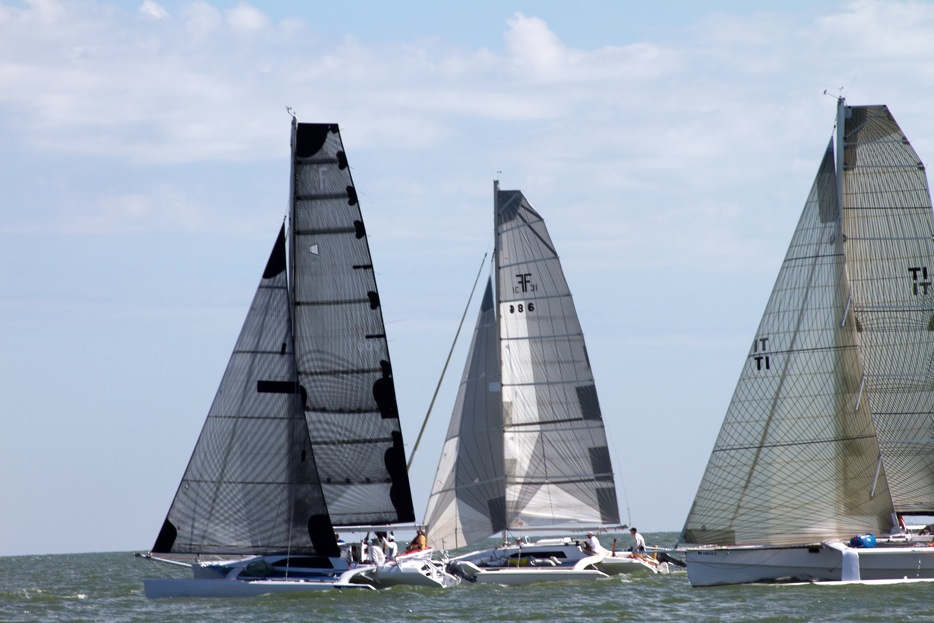
See above for proper course...
really? I know you have a lot more experience than me, but I thought I had that one down!
edit: just tried to look it up and didn't find anything specific about it and didn't see anything about prior to vs after the start

See above for proper course...
really? I know you have a lot more experience than me, but I thought I had that one down!
edit: just tried to look it up and didn't find anything specific about it and didn't see anything about prior to vs after the start
The relevant rule is 17:
If a boat clear astern becomes overlapped within two of her hull
lengths to leeward of a boat on the same tack, she shall not sail above
her proper course while they remain on the same tack and overlapped
within that distance, unless in doing so she promptly sails
astern of the other boat. This rule does not apply if the overlap
begins while the windward boat is required by rule 13 to keep clear.
So if you are racing and try to overtake from underneath (lee side) you cannot luff someone up. If you are being overtaken to windwards, then you can luff the windward boat up (provided you give them room to keep clear).
There is no 'proper course' before the start - so you can luff a boat head to wind. Once the gun goes off, your proper course is close hauled.
I'm not sure if Mark is not just yanking your chain.
Chris.
Chris.
Thanks Chris,
any difference between prior to and after start?
any difference between prior to and after start?
I just edited my reply to answer that. Pre start - luffing OK. Post start - not OK if overtaking from clear behind.

BUT remember the leeward boat will USUALLY define what proper course is. So if a high pointing boat is sailing up under you; it is THEIR proper course that defines what is Valid; thus if you are sailing a low pointing boat; be ready to tack away. Second; if you are windward boat and disagree with them on proper course; you still have to avoid them and take them too the room;
Finally remember that proper course is something that is REASONABLE and follws the definition of what proper course is (in summary the course you qould sail to get to the mark QUICKEST in the absence of other boats; this MIGHT include sailing to gusts!
Agreed. Hobie 16s would be wise to watch for A-Cats climbing up underneath them in mixed fleet racing for example.

Agreed. Hobie 16s would be wise to watch for A-Cats climbing up underneath them in mixed fleet racing for example.
Been there before....the
you don't want to be there
warning was followed by
why?
and after a quick pointing demonstration right after the gun goes off, the H16 says
holy crap, you weren't kidding!
.

OK, so I spoke with a Senior Judge (who happens to be an International Umpire) this weekend about the original scenario. He confirmed my original position on this.
He said that regardless of (and in part, especially because of) the handling characteristics of the spin boat, that does NOT entitle them to claim they were unable to keep clear if they capsize. Such a boat should expect to be headed up to the moon, and if they decide to overtake to windward, should leave enough space so they can avoid capsizing when the leeward boat brings them up.
Mike
Good news.... Common sense leads you to the proper answer (as well as a careful reading of the rules)
Boat's ahead of you have the right to protect their position. That's the game we play period. If you attempt a pass by going for their wind... you have to keep clear... Snuffing the chute (because you must to stay upright) is just part of the passing boat's move.
Mind you... the probability of this working is small.
So... figure out the timing of the dive move... or plan to set up high for a clear passing lane.

That begs for the question:
If a non-spin boat takes up a spin boat and the spin has to be dropped. If the head of the spin fouls the leeward boat when it blows off for the douse. Did the leeward boat give room for avoidance?
I think that question has been answered. You're focusing on the wrong part of the equation.
Mike
Playing devils advocate here.
As burdend boat does not have to anticipate what a ROW boat will do; Thus; you cannot ASSUME the leeward boat WILL luff; you just have to react to it; thus I would STILL argue that room means room to drop the kite if needed.
You're free to argue anything you'd like, but in this case, it appears that you would lose.
If you know your boat needs so much space to safely round up, you need to leave that much space if you pass someone to leeward (on their windward side). The rules are simply not intended to protect the passing boat.
Mike
If you know your boat needs so much space to safely round up, you need to leave that much space if you pass someone to leeward (on their windward side). The rules are simply not intended to protect the passing boat.
Mike
But the rules are there to avoid collissions; if the windward boat is FORCED to capsize on top of the leeward boat; the leeweard boat did not give them enough room to keep clear.....
Remember I am playing devils advocate...

Hi Scooby,
I have several points to make that I hope will help you and others understand this basic Right Of Way (R-O-W) rule 11; When boats on the same tack are overlapped, a windward boat shall keep clear of a leeward boat. (that is the actual wording) So the burden is mandatory on the windward boat. That is limited in this case by rule 16 which requires the R-O-W boat to give the other boat room to keep clear. This has all been pointed out already but since room is a defined word it is also a rule. It is
The space a boat needs in the existing conditions while manoeuvring PROMPTLY in a seamanlike way. I emphasized the word
promptly
because that seals the deal against your devil's advocate position. You must not only respond to the luff but you must do it promptly (no excuses). You must be prepared to handle your boat promptly in a seamanlike way at all times. It is not seamanlike to capsize, shrimp the spinnaker, teabag while trapeezing, steer erratically with your foot on the tiller, etc. That may happen at times with any of us, but it is not an
out" with the rules. They explicitly state what is required and that IS something that you need to anticipate no matter what your course.
The first and main purpose for the RRS is to make racing safe. It is not safe to require a R-O-W sailor to know how every different boat on the race course may handle. It IS safe to require every sailor to know how his own boat may handle so it is up to that sailor to allow himself the room necessary in the existing conditions to maneuver safely and responsibly near R-O-W boats.
In rereading the earlier posts, it still strikes me that several racers thought that the windward boat in this scenario was O.K. to pass close to weather of the leeward boat. I hope everyone now understands that to be a high risk maneuver. Matt McDonald described the classic tactic for the faster boat to qickly pass through to leeward but it seems to have escaped attention. Most experienced racers WOULD anticipate a sloop rigged boat luffing an overtaking spinnaker rigged boat even though the rules do not require that as you correctly wrote. The rules also do not require the leeward boat from anticipating that the windward boat may not manoeuver promptly in a seamanlike fashion but, again, most experienced racers WOULD so that they can be ready for the consequences (read rule 14). I hope this helps.

I did this maneuver in low wind. In higher where a gust can force you to bear away without warning I would never have attempted to get that close.
The main reason I was too close is that we just both passed the mark and there was not enough distance between the mark and the passing point for me to separate on any side. My choices were to make a speedy run on top of him, or stop below him because there was no way I was going to build enough speed to pass through the wind shadow: have you seen the size of the P19 sails?
In retrospect I should have delayed my mark rounding, by going further away before jybing, building separation so I could go under him outside his wind shadow.
... It is
The space a boat needs in the existing conditions while manoeuvring PROMPTLY in a seamanlike way. I emphasized the word
promptly
because that seals the deal against your devil's advocate position. You must not only respond to the luff but you must do it promptly (no excuses). You must be prepared to handle your boat promptly in a seamanlike way at all times. It is not seamanlike to capsize, shrimp the spinnaker, teabag while trapeezing, steer erratically with your foot on the tiller, etc. That may happen at times with any of us, but it is not an
out" with the rules. They explicitly state what is required and that IS something that you need to anticipate no matter what your course....
OK, but I would argue that to maneuver a spinnaker so you can sail to windward in a seamanlike way would be to drop said spinnaker...not flip the sucker.
I think this is a 50/50 proposition...maybe 60/40 in favor of the leeward non-spin boat. It's going to come down to the judge until we have an exemplified interpretation.
... It is
The space a boat needs in the existing conditions while manoeuvring PROMPTLY in a seamanlike way. I emphasized the word
promptly
because that seals the deal against your devil's advocate position. You must not only respond to the luff but you must do it promptly (no excuses). You must be prepared to handle your boat promptly in a seamanlike way at all times. It is not seamanlike to capsize, shrimp the spinnaker, teabag while trapeezing, steer erratically with your foot on the tiller, etc. That may happen at times with any of us, but it is not an
out" with the rules. They explicitly state what is required and that IS something that you need to anticipate no matter what your course....
OK, but I would argue that to maneuver a spinnaker so you can sail to windward in a seamanlike way would be to drop said spinnaker...not flip the sucker.
I think this is a 50/50 proposition...maybe 60/40 in favor of the leeward non-spin boat. It's going to come down to the judge until we have an exemplified interpretation.
I'm with Jake on this - unless someone can pull a relevant example out the casebook.
Most experienced racers WOULD anticipate a sloop rigged boat luffing an overtaking spinnaker rigged boat even though the rules do not require that as you correctly wrote. The rules also do not require the leeward boat from anticipating that the windward boat may not manoeuvre promptly in a seamanlike fashion but, again, most experienced racers WOULD so that they can be ready for the consequences (read rule 14). I hope this helps.
Where in the rules does it state a boat has to anticipate what another might do and PLAN for avoiding action?
You state yourself that the wording is “promptly”; not “anticipate”
IF I got into the position(and I would try not to, remember I am playing devils advocate), I would still be saying “to manoeuvre promptly, the first thing I will need to do is PROPTLY drop my Spi ONCE THE LUFF HAS STARTED”
Indulge me for a moment please.
Not long ago we had a serious port/starboard collision at my club. One boat was damaged to the point of having a hull replaced, one person was injured so badly he is still under a physicians care. The ensuing sh!t storm was so bad there was much talk of Rule 69 complaints, and one of the injured parties has left sailing, probably for good.
The potential for a similar occurence is present when trying to pass a sloop to windward while under spin. Arguing rules when you've knowingly put yourself in a capsize position is inherently unseaman like, imo.
In the port/starboard case the port tacker was so blatantly wrong, the damange so severe, imo, he should be thrown out of sailing! I see this spin v sloop matter headed in the same direction.
Pepin, I think you found the best solution, and it isn't relying on the rules. I was able to get by the P19 without a luffing contest, but it took a long time. Tactically, the best solution begins with the mark rounding.
btw- Matt was able to punch through the P19's lee.

Jake,
I don't really see much difference in opinion about the interpretation of the rules here. I think the arguments are not about the boats' obligations, but about the facts of the incident. If boat(s) didn't keep clear, or give enough room, then one (or both) are being too aggessive. The crux of deciding such a protest is determining which boat that was.
What were the conditions? What was the wind velocity? What was the sea state? What course were the boats on? How fast were they going?
Did the windward boat attempt to pass so close that her own actions made her unable to keep clear? That is, was she too close to respond if L maneuvered? Did she not keep a good lookout? Did she not respond promptly to actions of the leeward boat? Was her boathandling in any way unseamanlike?
What were the actions of the leeward boat? Did she make a hard turn into the windward boat or did she come up gradually? Did she keep a good lookout? Was she attempting simply to defend her wind, or was she trying to trip the other boat? Did she reasonably attempt to avoid contact, damage, and injury?
Now, I'll admit that there's a pretty big gray area there. When the situation is clear one way or the other, then the decision is easy, but otherwise, that's where judgement comes into play. There are differences of opinon between judges as to how much room is enough, and even what level of boathandling qualifies as
seamanlike
. At the SAYRA Judges Committee meeting earlier this year, we had an hour-long discussion of what skill level constituted
seamanlike
- without reaching a consensus.
I think we'd all agree that it's better to pass far enough away to avoid that gray area. Dave Perry suggests that a boat closer than two boatlengths of a leeward boat is in jeopardy of not keeping clear. If a boat flying a spinnaker attemps a reaching pass to windward within two boatlengths of a boat not flying one, she should be prepared to douse, or even douse ahead of time. Best of all would be to pass with enough separation that the leeward boat doesn't try to defend against it.
The rules place no burden of proof on either boat. See ISAF Case 50. Protest Committee must find the facts and base their decision them. Therefore, it is critical that you present your facts as clearly and as convincingly as possible.
Regards,
Eric

Not long ago we had a serious port/starboard collision at my club. One boat was damaged to the point of having a hull replaced, one person was injured so badly he is still under a physicians care. The ensuing sh!t storm was so bad there was much talk of Rule 69 complaints, and one of the injured parties has left sailing, probably for good.
It's just a race, people. I don't care if I have 10 rules on my side that say I'm the ROW boat. If some ***hole looks like he's going to hit my boat, I'm going to manouver to avoid a collision first, worry about how that affects my position second, and protest last. Waving a drivers handbook at the idiot coming at you on the wrong side of the highway is the very definition of futility.
Not long ago we had a serious port/starboard collision at my club. One boat was damaged to the point of having a hull replaced, one person was injured so badly he is still under a physicians care. The ensuing sh!t storm was so bad there was much talk of Rule 69 complaints, and one of the injured parties has left sailing, probably for good.
It's just a race, people. I don't care if I have 10 rules on my side that say I'm the ROW boat. If some ***hole looks like he's going to hit my boat, I'm going to manouver to avoid a collision first, worry about how that affects my position second, and protest last. Waving a drivers handbook at the idiot coming at you on the wrong side of the highway is the very definition of futility.
In this case the port tacker was hailed repeatedly and made no attempt to alter course. Contact occurred as the starboard tack boat attempted to avoid the collision.
The port tacker subsequently received a dsq for the race. Is that sufficient punishment for causing personal injury and property damage?
Yes
But what the hell.... What would you prefer?...
Shunning by the club members forcing him to resign?
public flogging?
arrest and conviction for assault and battery or some other Fl crime?
The injured party can take it up in civil court.
As far as the game of sailing is concerned... he is DSQ
Here are some relevant ISAF Cases. The first two illustrate that a Leeward boat can break rule 16.1 in passing situations.
ISAF Case 60:
ISAF Case 92:
The third case underscores that a Windward boat can break rule 11 simply by getting too close.
ISAF Case 88:
Regards,
Eric
Was there evidence that the Port-tack boat (P) acted in an unsportsmanlike manner? If so, Rule 2 may apply. The penalty for a breach of Rule 2 is DND (DSQ, Non-Discardable). Did the Protest Committee observe or receive evidence that there may have been a
gross breach of a rule, good manners, or sportsmanship
? If so, PC may call a hearing under rule 69
ALLEGATIONS OF GROSS MISCONDUCT
. Additional sanctions can be imposed (up to the international level) as a result.
In the United States, liability for property damage and personal injury is a legal matter. US SAILING Prescription 68(b) states (in part):
Regards,
Eric

But what the hell.... What would you prefer?...
Shunning by the club members forcing him to resign?
public flogging?
arrest and conviction for assault and battery or some other Fl crime?
The injured party can take it up in civil court.
As far as the game of sailing is concerned... he is DSQ
I vote for option 2 (public flogging)
I love this forum. You start from a simple question about a club race situation in the UK with a friend where you did end up jousting a bit on the way.
Add a few days of imprecisions, miscommunications, generic remarks not related to the issue at hand: you end up with a political discussion about the possibility of public flogging in Florida <img src="<>/smile.gif" alt="smile" title="smile" height="15" width="15" />
Another few days and this thread will turn into yet another
drill, baby, drill
thread <img src="<>/cry.gif" alt="cry" title="cry" height="15" width="15" />
pepin
had you flipped your boat on top of the P19 because you were unable to keep clear (jury finding) ... What should have been your penalty? What would have been your liability? What would have been your responsibility?
(I am sure you know the answer to the rhetorical question)
It's important to understand and be clear on the entire process.... that's the point of replying to PGP.