

We had to alter to avoid contact with you while you were still on port and before you flopped onto starboard. If we had not altered you would not have been able to start your jibe and would been forced into a head on situation with us and the fleet on our hip and behind us. You could not have continued on port because you were already at the boat, you couldn't tack because you would have been over early, your only out was to jibe and foul us and hope you got a pass, and you did get a pass. Although you fouled us you really screwed the boats behind us because you plugged up the boat end nicely.
Pete when you completed your jibe you were never clear ahead you were at our beam and the situation went from P/S to W/L, if you were clear ahead you would have been over early and we would not have had to alter course to avoid you. All this took please at t-20.
If this had been a crowded agressive start and you attempted to jibe down into an oncoming starboard fleet at the boat there would have been mucho contact. There would have been no place for the starboard boats to go.

No case for a protest; also; he only has to give you ROOM to keep clear; “Room and opportunity” was binned in the last iteration of the rules; it’s just ROOM to keep clear.
It could get interesting if he pushed you high enough to threaten a capsize; at that point I would call the following “If you want to take me higher; you will need to give me ROOM to take my Spi down”; if the helm of the other boat is at all switched on they will realise that the game is up.
Also, as stated; if you can get +2 boat lengths to windward; they cannot attack in the same way (cannot find the rules at the moment). Simple thing is to establish your passing lane and stay in it.
What rule says a leeward boat has to give a windward boat with the spin up room to take it down?
NONE; however, The leeward boat needs to give room; if I’m already sailing as high as possible to pass and they want take me higher; I MIGHT argue that once they start to luff; In order for ME to luff I need to take the kite down. It would be a moot point. IT COULD get interesting if the windward boat did capsize and landed on the leeward boat in insurance terms.
Simple solution is to get in a decent passing lane and pass to leeward; or sail extra high and pop the kite and sail over them.

seamanlike
. If a leeward non-spin boat rounds a windward spin-boat up so high that she capsizes, then the leeward boat breaks rule 16.1.
If this is in fact the case, then I would agree with others that have stated during previous threads that spin & non-spin boats should not race, or perhaps even be on the same course together. In fact, any boats that have grossly varying downwind sailing characteristics should probably not be on the same course. Clearly, this interpretation of Rule 16.1 would give the windward boat a serious advantage when passing a leeward boat - the leeward boat has no defense.
sm

I think we've beaten that horse to death already. I don't see how rule 16 changes things any.
Regards,
Eric
Pete when you completed your jibe you were never clear ahead you were at our beam and the situation went from P/S to W/L, if you were clear ahead you would have been over early and we would not have had to alter course to avoid you. All this took please at t-20.
If this had been a crowded agressive start and you attempted to jibe down into an oncoming starboard fleet at the boat there would have been mucho contact. There would have been no place for the starboard boats to go.
court adjourned. I'll bring rum, what flavor?

Eric,
Great post - thanks. I would agree that it is not seamanlike to capsize.
Maybe Ding is referring to the fact you had no rights as you first fouled us barging down the start line.
<img src="<>/blush.gif" alt="blush" title="blush" height="15" width="15" /> Jeez! I'll bring a BIG bottle of rum.
I had no idea. We need to go back to protest flags.

Not the easiest of scenarios to analyse properly. Yellow has one more position point than blue!
Regards,
Eric
Well in the context of this scenario, it means that the leeward, right of way boat, must have a thorough understanding of the handling limitations of the windward, give-way boat. If she does not, then she must expect that any alteration of course could cause the give way boat to have to act in a non-seamanlike manner.
Not saying you're wrong (clearly, you are most certainly right), just that the interpretations that you've cited effectively put serious limitations on the the right-of-way boat. The windward boat doesn't have to anticipate that the leeward boat will try to luff her, yet the leeward boat has to anticipate that her luffing could cause the windward boat to capsize- hence the leeward boat has virtually no defense against a boat passing to windward. Something about that doesn't seem right to me.
sm
Rule 16 is a shield, not a sword.
It limits the actions that a right-of-way boat can take. It does not bestow any tactical advantage on the give-way boat. If a windward boat (W) establishes an overlap on a leeward boat (L) such that L cannot change course without making contact, then W is clearly breaking rule 11. If L luffs up to protect her position, she must do so in a way that allows W to keep clear. As long as she does, W must respond promptly and in a seamanlike way.
My statement was that L cannot luff up so hard and so suddenly that W has to do something unseamanlike, such as crash-tack or capsize. If L luffs high enough, W might have to douse her chute - in which case L must give her room to do it.
The rules do not prevent a boat from sailing into an untenable position. If W allows herself to get so close that she cannot respond to a luff, then she's out of luck. She can't use rule 16 as a weapon against L.
That holds true no matter what kind of boats are sailing, and no matter how little or how much each skipper knows about the characteristics of the other boat.
Sincerely,
Eric

Thanks all for all you input, especially Eric with his detailed analysis.
My take home lesson: If you attempt a pass to windward, make sure you have the room and the speed to finish the maneuver without being impaired by anything the passed boat does. I'll give myself more room next time.
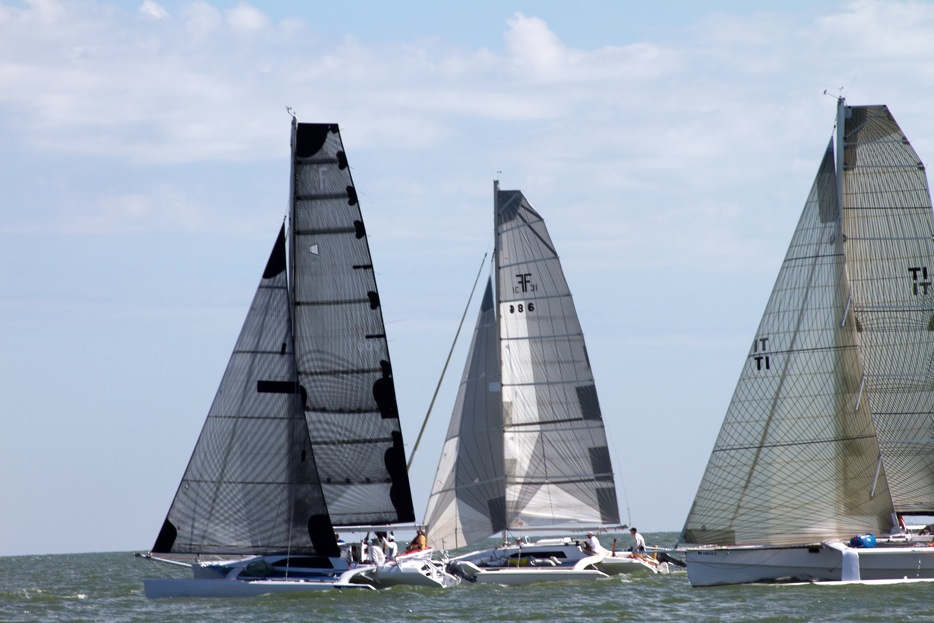
I hope someone says something to me if I foul them... the problem is if someone else fouls me I wonder whether they were just being punks or didn't understand that they were fouling me. If I know someone on the course and I think I may have fouled them (or that they fouled me) I try to find them at the end and ask what their interpretation was. It is hard to make that confrontation sometimes but it is honestly the only way I will learn (or they will learn).
For example... I was driving one time and felt I had the right of way at a mark. They screamed at me and I was like W.T.F.? I found that person at the end because I honestly wondered whether I had truly fouled them as they have a lot more experience than I do racing. They replied to me when I asked what was up:
no problem, you totally had me.
Why were they yelling to start with.... they were having a bad race....
hence the leeward boat has virtually no defense against a boat passing to windward. Something about that doesn't seem right to me.
sm
Not exactly - It's saying that a leeward boat with much slower speed potential should expect to get passed to windward by the boat with much higher speed potential and should have rights only to a point.
I think the term
rights
is unfortunate. The phrase
right of way
is also misleading. We see those words and think of the rules as entitlements. Then we get upset when people violate our
rights
.
If you turn that around and read the rules as obligations, then things get simpler and less heated. A port-tack boat is obligated to keep clear of a starboard-tack boat. A windward boat is obligated to keep clear of a leeward boat on the same tack. A boat clear astern is obligated to keep clear of a boat clear ahead on the same tack. A boat that is changing course is obligated to give a keep-clear boat room to keep clear. All boats are obligated to avoid contact if reasonably possible, and so on.
A boat may be
right-of-way
and still have several other obligations.
I hope that helps,
Eric

Hi Eric. Why did you say
Yellow did not become overlapped from astern (she was ahead).
? Blue came from astern to pass to windward, at some point they were overlapped. What am I missing?
Also, why is there all this debate about allowing blue
room
to drop her chute? Why can't a spin boat round up all the way to irons with the chute up, especially in light air?
Mike
room
to drop her chute? Why can't a spin boat round up all the way to irons with the chute up, especially in light air?
Mike
Mike,
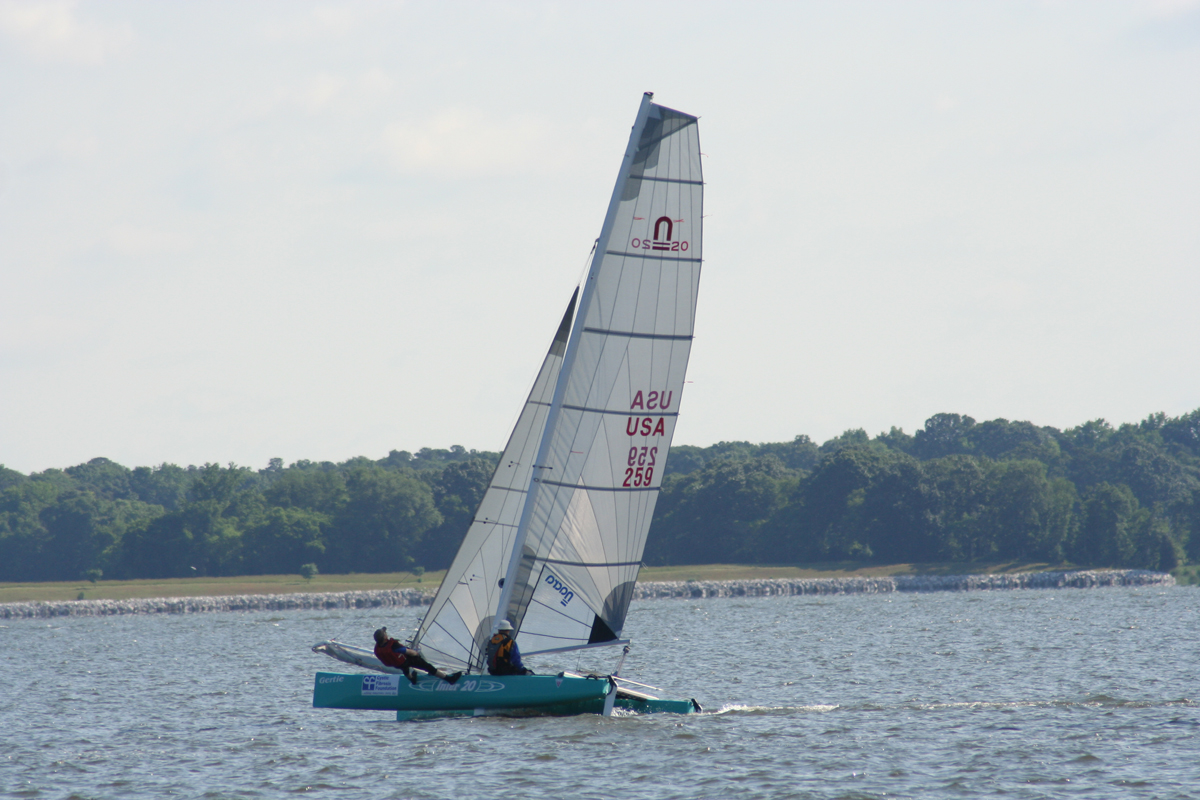
Because in anything above about 5 kts; a single handed F16 will capsize with the kite up if you head up too high; even with the traveller and mainsheet dumped
Really? Even with the spinnaker sheet dumped?
Mike
Eric,
That is a very helpful point you are making. Claiming “No rights” is an overused and miss-used short cut. On Tuesday night we were having a rules discussion at the bars end and the
no rights
statement came up. And I started to respond they have the right to not be collided with, so although they are in the wrong they still have at least one
right
or entitlement. It would not have helped. At least Mast-abeam didn’t come up, we are making progress…
Yellow did not become overlapped from astern (she was ahead).
? Blue came from astern to pass to windward, at some point they were overlapped. What am I missing?
The boats became overlapped, but Yellow was not astern - she was ahead. Let's take a look at the rule in question:
ON THE SAME TACK; PROPER COURSE
Yellow was not clear astern before she became overlapped, so rule 17 does not apply to her. Blue was clear astern before becoming overlapped, but she became overlapped to windward (not leeward) of Yellow, so rule 17 does not apply to her either. Neither boat was restricted from sailing above her proper course.
I hope that helps,
Eric
Yellow did not become overlapped from astern (she was ahead).
? Blue came from astern to pass to windward, at some point they were overlapped. What am I missing?
You should read RRS 17
ON THE SAME TACK; PROPER COURSE
with rapt attention to understand that sentence <img src="<>/smile.gif" alt="smile" title="smile" height="15" width="15" />
In that particular case RRS 17 doesn't apply because the leeward boat didn't get there by overtaking.
You can also say, phrasing it differenty, that RRS 17 doesn't apply as it could be only triggered by the overtaking boat passing to leeward.
Same thing. This rule cannot apply.
Trust me, the problem isn't that I don't understand RRS 17. The reason Rule 17 doesn't apply is because she was originally clear ahead.
I think I read Eric's original sentence out of context of Rule 17. I've read his post again, makes more sense to me now.
I'm really not sold that a spin boat can't go upwind with the chute up and flogging without capsizing (especially in light air). I think I'd need to see that in person.
Mike
ditto

on my 5.5, i might be able to point the bows upwind but i sure couldn't sail with my spin floggin me in the face... it would be all over the deck, in the spreaders, in the halyard, in the jib and there would be no way it would snuff.
i am sure i would capsize (or break) with any decent gust around 9 or soooo
i am sure i would capsize (or break) with any decent gust around 9 or soooo
I agree with that, in most instances, you probably could luff the kite and let it flog and sail higher...is that seamanlike? (I'm just asking the question).
i am sure i would capsize (or break) with any decent gust around 9 or soooo
I agree with that, in most instances, you probably could luff the kite and let it flog and sail higher...is that seamanlike? (I'm just asking the question).
I spent a lot of time 2 summers ago experimenting sailing with the spi up at high angles to see if I could make it pay to sail lower; but much faster upwind in very light conditions with plans to use it if it worked at that years Piers race; I could sail about 15 degrees lower(but it took ages to get going and I did not have a lot of control).
It was fast in about 2kts of wind; 3kts the traveller was at the end stop and 3-4+ the mainsheet was dumped; anymore and the kite would tip me in. The transition from “some control” to “must bear off RIGHT NOW” was a very small difference in apparent wind; I’m sure sometimes my own speed caused me to have to bear off as the apparent built to the point I was no longer under control!
Sometimes the rudders would stall and I would do an uncontrolled bear off; sometimes the plates would stall and the boat would slide sideways; sometimes the rudders would stall and the boat would slam tack - I COULD tack the boat WITH planning up to about 3-4kts; but not hold head-to or close to wind – it’s a one shot deal to tack.
Not safe to be done around other boats!

Wow... you guys need to race some mono's.
You defend your wind at all costs. You make it clear that you will take a competitor up to head to wind if necessary... should they try that kind of pass. You may lose that race to others who laugh and say... have at it boys and happily sail to the next mark. ... BUT... they won't try the same stunt on you in the next race.. Even boats in different class's won't let you take their wind (cause they get crushed in their class sailing in your dirt... pain is in the eye of the leeward boat).
IMO, Take a boat head to wind... this is a seaman like maneuver that everyone should be able to execute. . .... If the crew on the attacking boat... can't manage to execute the maneuver and capsize in the process... They will foul and take the penalty. Nothing says that the round up maneuver on your particular boat won't mean that you won't have to snuff your chute as a standard practice.
The reality is... the boat clear ahead is looking at the spin boat and coming up to defend and coming up to defend and coming up to defend. If the spin boat doesn't get the message... don't go there... I will luff you up... the spin boat is clueless about racing or simply trying to bully the non spin boat.
As many have said... if you want to pass to windward.. you need to get to your passing lane early... Sailing up on a boats hip... is NOT the proper passing lane.
I would say yes. Not ideal, or tactical, but it is a seamanlike maneuver. Like Mark said, don't they do this all the time on monohulls (particularly in match races)?
Scooby, from your responses it seems like you're hell-bent on the windward boat retaining some right to keep the spinnaker trimmed while being headed up. I think it has to be blown it as part of heading up, if that's what's needed to stay upright. Again, the leeward boat is trying to force windward to sail upwind, which is normally done without a spinnaker, so I think the onus is on the windward boat to trim AND maneuver (not just maneuver).
Mike
I would say yes. Not ideal, or tactical, but it is a seamanlike maneuver. Like Mark said, don't they do this all the time on monohulls (particularly in match races)?
Scooby, from your responses it seems like you're hell-bent on the windward boat retaining some right to keep the spinnaker trimmed while being headed up. I think it has to be blown it as part of heading up, if that's what's needed to stay upright. Again, the leeward boat is trying to force windward to sail upwind, which is normally done without a spinnaker, so I think the onus is on the windward boat to trim AND maneuver (not just maneuver).
Mike
Flog the kite and you go over quicker. Simples.
Have you ever sailed a light boat with a kite?
That's the part I'm trying to understand. Thank you Scooby.
If that is true, I agree with you, forcing up a boat in such a way is not going to make any friends...
EDIT: BTW, this is exactly why, when I'm serving on a protest committee for a class I'm unfamiliar with, I ask other jurors (or a disinterested sailor) with class-specific familiarity to confirm or deny the boat-handling testimony given by the parties. You'd be amazed at how effective this is at derailing a lot of nonsense.
Mike
I thought you can't take someone head to wind (fully
luff
them up) unless it is prior to the start. Doesn't proper course come in here somewhere too?