
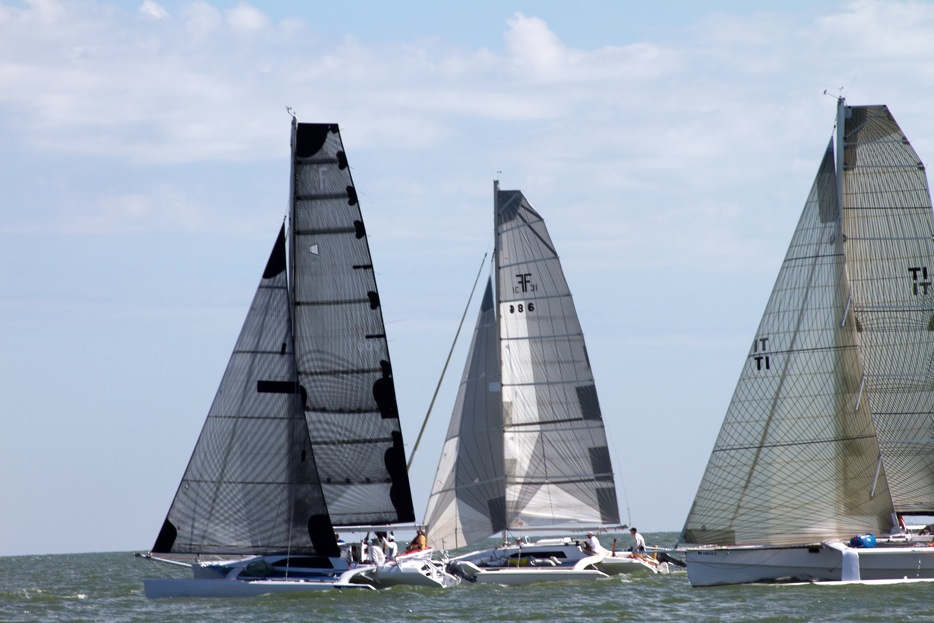
Whenever discussion of how to design a new main- or whether the sailmaker knows his/her stuff- is undertaken people always quickly say the luff curve needs to match the mast's curve. I have asked this before but not sure I ever got a good response:
If the main matches the prebend when no downhaul is on, doesn't that sort of make the sail maximally depowered from the start?
I suppose the nuance is that if you make the sail's luff curve match that of the mast with the downhaul fully on then you might risk leach hook unless the downhaul is on significantly. We had a sail on an HT that had severe leach hook and it was a POS.
Of course this is likely really oversimplifying the question, but....
Thoughts?

My answer - it needs to match somewhat. I think you're right that if it matches exact you'll start out too flat. The other side is what happened when the main on my boat was purchased - the luff curve on this sail is more than the other mains I have, when it was first raised max downhaul was required just to get the wrinkles out. Obviously a case where more prebend was required to match the sail. Actually it was more of a case of the sail needed to be sent back, but you get the idea.

Luff curve needs to match the maximum attainable mast bend ( fully depowered)

Luff curve is just one of the methods of adding draft (shape) to the sail. When the sail material is laid out across the sail, shape is cut into the edge of each panel also. That is fairly straightforward; it gets much more complex when you add that shape into a biradial or triradial design.
BTW, it is fairly easy to relieve a hooking leach. A much harder problem to correct is leach gutter which looks just like a gutter running parralel to, and just inside, the leach. This is common in underbuilt sails which is more often encountered in high aspect ratio sail, such as self-tacking jibs.

So, does the sail builder have to know the characteristics of the mast prior to cutting the sail?

He certainly should. For the a-cats, some builders will have you support the mast, hang weights, and take measurements to give them a better idea for the type and stiffness of your mast prior to building a sail.

He certainly should. For the a-cats, some builders will have you support the mast, hang weights, and take measurements to give them a better idea for the type and stiffness of your mast prior to building a sail.
couldn't the mast be viewed (by the sail maker) while rigged with the old sail (assuming you have one) to see it's characteristics for a new sail build?
would a comprehensive set of images and videos (of sed mast/old sail) help a sail maker?
He certainly should. For the a-cats, some builders will have you support the mast, hang weights, and take measurements to give them a better idea for the type and stiffness of your mast prior to building a sail.
couldn't the mast be viewed (by the sail maker) while rigged with the old sail (assuming you have one) to see it's characteristics for a new sail build?
would a comprehensive set of images and videos (of sed mast/old sail) help a sail maker?
If he was in the same country, perhaps!...I'm not sure how much science really happens between measuring the mast bend characteristics and the sail design. They can only be using that information to put the mast into a three or four deep category (bend type A, type B, type C, etc.). I imagine it would cost a fortune to build a digitally modeled mast and design a sail around each one.
I don't have much experience with this end of the business...but I can see some real technical hurdles to getting so precise with everything (unless you are someone like Glen Ashby, Glaser, etc.).
+1. Matching the luff as almost well as possible to the fully tensioned downhaul and fully sheeted main allows you to trim for the maximum range of draft depth for the chord. (Having owned a defective mast, I learned this in some detail from some European guys). The wild card in this equation is that the mast bends due to wind force, too, (esp at the top of the rig) and that can absorb some of the luff.
There is nothing like hoisting a new sail, then take it down, peel off the luff tape and do a re-cut of the luff to get that perfect shape and trim. <img src="<>/smile.gif" alt="smile" title="smile" height="15" width="15" />
Only if he cares how the sail turns out! If you are trying to determine what is important to order a new sail with specific attributes, then you should discuss this with the sailmaker you are interested in using. Especially helpful is to send him your current sail that you want to replace along with your input about that sail - what you like and dislike. Not only will that help him produce a better sail, he may be able to recut your old one (if it has life left in it) to be more like you want so that you will have a nicer practice / fun sail to use. Since this is Rick's site, I'm throwing him a bone. Get his book(s) and read about his 3 Ws method of determining the basic sail shape you want in varying conditions. Ideally, you have a mast with enough movement to allow you to shape the sail to the conditions. If it works well, you just need to be able to recreate that shape when needed. If not, then try to notice what shapes are doing well and see if you can recreate those. Sometimes seemingly minor adjustments, like batten stiffness, can make big differences. If you cannot create a fast shape compared to others on a given day, make sure you discuss it with THEM. Ask them to describe what they were doing, and to show you, and then see if you can get your sail to a similar shape and performance. When it becomes clear that a shape is too full, for example, to be fast in heavy air, and you race a lot in heavy air, then you can let your sailmaker know that you need a flatter main, and ideally, suggest how much flatter. There is a lot to learn about sail shape and that is just a little of what helps keep it interesting after 35 years of racing!