
Wouter, you are without a doubt a world class clown.
I don't think i could have made it any clearer in my statement: the price/size ratio is comparable to the F18... pretty freaking simple really! The F20 boards are clearly bigger so they are more expensive but not 4 times the cost etc..

I have to side with Wouter on this, Macca you do have such a subtle way of avoiding direct dialogue, with words which direct sideways any real meaning. You should be a politician, mind you there is a problem, no one any longer believes a politician. <img src="<>/wink.gif" alt="wink" title="wink" height="15" width="15" />
Wayne, I am not going to quote spare parts prices in here for the simple fact that there are different prices in each country due to local variations and taxes etc. So I think its pretty reasonable to make a comparison between the F18 board costs and the F20 to point out that the board is not stupidly expensive compared to a
normal board
So where did the personal attack on Wouter come into it.
Macca you always have a smoke and mirrors message with everything you write, we have simply become used to it. When people are asking you straight questions, give a straight answer and we would all be better off.
If Nacra design the board correctly, there is little in extra cost in materials and time to produce it over a normal board ( the surface area is not unsimilar ), in theory then it should be a similar price to a normal F18 ? My bet is that won't be the case.
Wayne, again you simply just don't understand how stuff is built. The material costs in building the curved boards correctly is more than a straight board, the time is more also. The internal structure is very hard to build. Consider this: to have a high density stringer inside an F18 board is pretty easy, you just insert a straight spar in the build process. Now how do you do that for the curved f20? You have to make the stringer pre curved and the loads (as you can see from onboard video) are very high. So you need to make the board suitably strong.
keeping that in mind, the price of a F20 Carbon board is not drastically different from a F18 board, especially when you consider that the board is larger as well.
Macca you come straight back with the above statment, you know full well that I know more than most about this sort of thing and yet you still put it in writing. This is typical, time you put a bit of thought into things before putting it out on the net.
A curved spar is no more costly nor time consuming to make in mould than a straight spar. May I also remind you that a curved structure is always stronger in one direction than a straight structure which is inherantly weak in both directions, I think the Romans proved that a good few years ago.
As I said earlier you are all smoke and mirrors.
Wayne, I have no idea how much you do or don't know about the subject. But your statements on the matter to date have led me to believe that you have little knowledge. and it has been said that there is nothing more dangerous than someone with a little knowledge of a subject... If you can build curved foils for the same cost as a set of straight boards then please tell us all how to do it. But remember they have to be strong enough...
Macca like yourself, compared to some on this forum I know very little, what I do know is that a dagger board is simply built in a process which is no different whether it is curved or not.
Yes you are correct, there will be additional loads requiring additional layers of strengthening fibres, but those fibres will cost little in the comparison to the materials over all costs. I'm talking 10's of dollars rather than 100's.
The highest cost of these type of products is the R & D but over a volume product then most of these costs can be absorbed into quite small numbers per item produced.
Its time we took the ohhhh factor out of curved boards, they have been around a very long time ( the very early Farriers had them way back in the 80's ) and got on with the job of learning how to sail with them as one thing for certain, the marketing boys and girls have them in their sights as the next holy grail and will push them hard in the next few years, what ever their worth.
As I have said before, I will reserve judgement on their worth until classes such as the A class, where the light weight of the platform should enhance this type of structures useage, have firmly come on side.
Macca,
I'll put a break in the exchange between you and Wayne. In the test video, it looks like it's a bit too easy to get a
wheelie
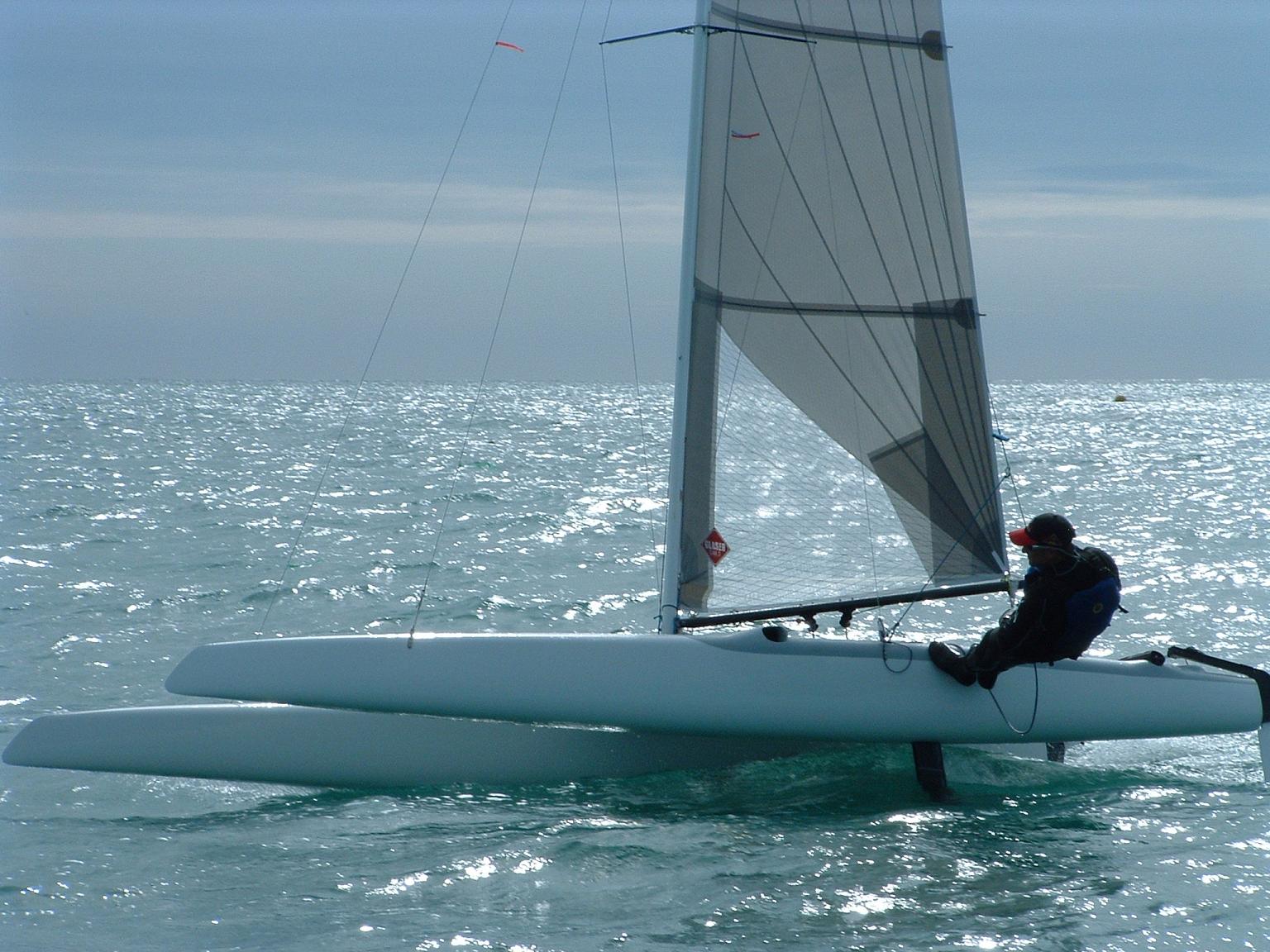
with the boat which while cool to watch, does not seem fast in a straight line. Our experience with the curved boards in the A-Class is to fine tune to get just enough lift to keep the bows up but not much more. Some of the A-Cats are using trunks that allow adjustment of the daggerboard fore and aft rake for different conditions.
It looks like you are always sailing with the windward board at least half up both upwind and downwind. Towards the end of the video, there is a shot of the boat sailing upwind on port tack with the leeward board up about 4-6 inches. Do you think the boards may have too much lift potential (like they experienced with the first iteration for the M-20)? Just curious if there might be more fine tuning.
There is still a lot to be learned about curved daggerboards for sure.
Bob Hodges
A-Class USA 230
Yes you are correct, there will be additional loads requiring additional layers of strengthening fibres, but those fibres will cost little in the comparison to the materials over all costs. I'm talking 10's of dollars rather than 100's.
The highest cost of these type of products is the R & D but over a volume product then most of these costs can be absorbed into quite small numbers per item produced.
Its time we took the ohhhh factor out of curved boards, they have been around a very long time ( the very early Farriers had them way back in the 80's ) and got on with the job of learning how to sail with them as one thing for certain, the marketing boys and girls have them in their sights as the next holy grail and will push them hard in the next few years, what ever their worth.
As I have said before, I will reserve judgement on their worth until classes such as the A class, where the light weight of the platform should enhance this type of structures useage, have firmly come on side.
Wayne, you can think what you like, but its pretty stupid to try and tell me the component cost breakdown of developing and building these things. I know because I have been involved from concept to production. You are making assumptions without any practical application or first hand knowledge.
And to use the A class as a measure of the boards viability is a fallacy as I have pointed out in another thread. But if thats the measure you want to use then go ahead...
I'll put a break in the exchange between you and Wayne. In the test video, it looks like it's a bit too easy to get a
wheelie
with the boat which while cool to watch, does not seem fast in a straight line. Our experience with the curved boards in the A-Class is to fine tune to get just enough lift to keep the bows up but not much more. Some of the A-Cats are using trunks that allow adjustment of the daggerboard fore and aft rake for different conditions.
It looks like you are always sailing with the windward board at least half up both upwind and downwind. Towards the end of the video, there is a shot of the boat sailing upwind on port tack with the leeward board up about 4-6 inches. Do you think the boards may have too much lift potential (like they experienced with the first iteration for the M-20)? Just curious if there might be more fine tuning.
There is still a lot to be learned about curved daggerboards for sure.
Bob Hodges
A-Class USA 230
Bob,
Its not too easy to get the boat to foil in the extreme, it takes a specific set of circumstances controlled by the sailors in order to make the boat do that trick. In racing conditions the crew have total control over the behaviour and the boat just simply goes faster than you could expect a boat to go.
The windward board will generate lift on the windward side and aid hull flying, so its good to have it down when you want to get the hull up, but after that its quicker to have the board up a little to reduce the windward hull lift.

are the dagger trunks on the new Nacra curved, or are they a big empty box that allows for the curvature of the board?
Curved
Now thats another rash statement, without knowing my history I might just have a bit more knowledge than what you think, have a look at http:/
Oh, ok then. Its clear to me now that you are very experienced in curved foil development and production.
I might be very experianced, then again in your words
But your statements on the matter to date have led me to believe that you have little knowledge. and it has been said that there is nothing more dangerous than someone with a little knowledge of a subject...
And by showing me that link you are displaying your knowledge of foil development and production? I thought they looked like Stealth foils in the photo's. So I am yet to see anywhere that you have knowledge of foil design, development or production.
correct me if i'm wrong though...

I'll put a break in the exchange between you and Wayne. In the test video, it looks like it's a bit too easy to get a
wheelie
with the boat which while cool to watch, does not seem fast in a straight line. Our experience with the curved boards in the A-Class is to fine tune to get just enough lift to keep the bows up but not much more. Some of the A-Cats are using trunks that allow adjustment of the daggerboard fore and aft rake for different conditions.
It looks like you are always sailing with the windward board at least half up both upwind and downwind. Towards the end of the video, there is a shot of the boat sailing upwind on port tack with the leeward board up about 4-6 inches. Do you think the boards may have too much lift potential (like they experienced with the first iteration for the M-20)? Just curious if there might be more fine tuning.
There is still a lot to be learned about curved daggerboards for sure.
Bob Hodges
A-Class USA 230
Bob,
The F20 boards can go under the boat more than the A providing more lift than the A boards. You have to get pretty far back on the boat to make it wheelie.
Wayne,
You know they make a PM button so you and Andrew can have your disagreement offline and the rest of us don't have to wade through all your post to see what is going on in this thread.
Macca only does things to raise publicity, a PM message would be wasted
whats the warranty like for the boards?
he probably should
buy an ad
really... however, it is a new design that we are all interested in to some extent. The price of replacement parts is important. I suppose when a boat costs close to 30k then it is understood everything will be more expensive- akin to the the 200k car that gets 5mpg. If you can afford the car you can afford the gas.

he probably should
buy an ad
really... however, it is a new design that we are all interested in to some extent. The price of replacement parts is important. I suppose when a boat costs close to 30k then it is understood everything will be more expensive- akin to the the 200k car that gets 5mpg. If you can afford the car you can afford the gas.
Macca didn't start this thread, Mike Krantz did.
Why are there F-16 sailors chafing at the bit to give him a hard time. Thinking of trading up or do you have some kind of envy or agenda? Ye doth protest too much.
I like having a factory insider willing to come on here and give us the scoop, sales spiel or not.
Wayne,
By your comment about Pm's ,it rather appears you want this in the public eye ,not Macca.
If you break a board in normal sailing then its covered. If you run into a whale, beach, rock or other object etc then its not covered!
Oh, and the F20C dagger board is approx 20% more expensive to buy (retail) than a new F18 dagger board.
he probably should
buy an ad
really... however, it is a new design that we are all interested in to some extent. The price of replacement parts is important. I suppose when a boat costs close to 30k then it is understood everything will be more expensive- akin to the the 200k car that gets 5mpg. If you can afford the car you can afford the gas.
Macca didn't start this thread, Mike Krantz did.
Why are there F-16 sailors chafing at the bit to give him a hard time. Thinking of trading up or do you have some kind of envy or agenda? Ye doth protest too much.
I like having a factory insider willing to come on here and give us the scoop, sales spiel or not.
Wayne,
By your comment about Pm's ,it rather appears you want this in the public eye ,not Macca.
Thanks Todd
That was the same as I was thinking. If you don't have a positive comment to make just keep it to yourself. Andrew has been very helpful with the setup and learning to sail the new boat for us.

I like having a factory insider willing to come on here and give us the scoop...
Absolutely.
Macca interjected here to set the record straight, and to just give some information. I'm glad when any industry rep does that, it raises the quality of the discussion.
If the reps and industry folks don't get out here on the forums, every single freaking time the thread turns into a bunch of garage speculators, whose boat design and industry experience was attained from a gutter boat that they drunkenly built and raced at some regatta.
I'd rather hear Macca.
j
Macca has a well documented history of relentlessly (understatement) pissing off many on the F16 forum. What goes around, comes around I guess. Nacra should take note that if anyone else was delivering the message, there probably would not be the animosity as a result of Macca alienating so many.
Many in the A-Class believe most of our boats in the future will either have curved daggerboards or straight boards that have canted trunks within the hulls (like the Flyer II). A straight board in a canted trunk produces a lift component similar to a curved board. Then there is a fast boat like the A3 with straight boards and non-canted trunks.
Curved boards are not necessarily faster, they just allow you to continue to push the boat in conditions where you might be backing off with straight boards. In light air, straight boards are probably better.
Any manufacturer would be wise to not overhype (the new DNA A-Class builder has a promising boat but is big on marketing spin). The curved boards are sexy and cool looking but if not executed properly, could be slower. There is no Nacra F-20C with straight boards or straight canted boards to compare to my knowledge. The only curved boards at the LAC were on the ill fated Aethon and while they felt there was an edge in breeze, they were not sure if they would have the same pace in lighter air.
Fun stuff.
Catsailing Anarchy anyone? <img src="<>/grin.gif" alt="grin" title="grin" height="15" width="15" />
Mike, Dave, macca - cool boat, deserves to be BOTY. It's a shame that this thread has degenerated. As Kris said, it's probably a direct result of previous posts by macca elsewhere. Personally, I'd just like us all to pull in the same direction for the benefit of catsailing and not piss on each others choices of boat. There are a lot of monoslug sailors out there to convert!

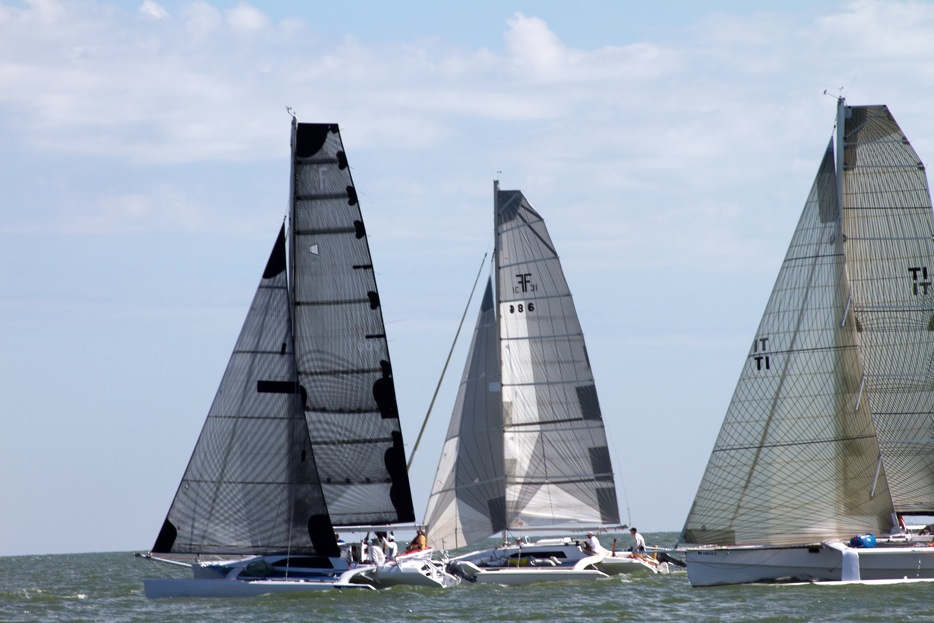
Here's some pics that Walter Cooper took last Wed. I'm sure some of these will make into print at Sailing World.
http:/