

Your sponsor is a little understated. Ya think <img src="<>/smirk.gif" alt="smirk" title="smirk" height="15" width="15" />

can hardly tell who's sponsering... <img src="<>/smile.gif" alt="smile" title="smile" height="15" width="15" />
the pictures are great btw

Really?

Why are there F-16 sailors chafing at the bit to give him a hard time.
Pay back.

Sorry, I hadn't been on the f-16 forum and didn't realize he had all of y'all's panties in a bunch. I hope it stays over there from here on out, but I doubt it.
Why are there F-16 sailors chafing at the bit to give him a hard time.
Pay back.
Maybe it's time they grew up...

I don't want to continue to prolong this fight - but making a quality symmetric curved foil is incredibly more difficult than making a straight one. The tooling alone requires a lot more material, engineering (with quality software tools), and time. The foils on the F20c are truly a piece of art. They're very very light (they float!) and they're obviously very strong. I've not yet seen an early generation a-cat with curved boards that doesn't have some sort of issues with the fit/function of the curved boards in the trunks either. These boards fit very well in their trunks. They come up so easily (and float), you have to watch that you don't hit your forehead when raising the board because of the radius that it travels!
The fact that they can make these boards available within 20% the price of an F18 straight board is pretty good.
They
?

Macca didn't you say that there is a twist in the foils as well? Can you post some close up shots of them?
Its a secret <img src="<>/smile.gif" alt="smile" title="smile" height="15" width="15" />
But I will see what I can find, there is nothing on my laptop but maybe, just maybe I can take a photo next time i have a board in my hands.

Has there been any on the water research of how boards actually behave during sailing in terms of twist and curve?
I saw a wildcat board a while ago which got a permanent curve after a few months of sailing (board was always used on one side).
What about making a small peekhole just in front of the daggerboard well and mount a gopro-like camera?
Could give some interesting information.

'There is no Nacra F-20C with straight boards or straight canted boards to compare to my knowledge.'
I remember reading a thread and post by Macca that they built two prototypes, straight and curved boards. He had stated that in all the conditions the curved boards were faster. Right?
Anyways, cool boat, continuing to 'push the envelope'.

can hardly tell who's sponsering... <img src="<>/smile.gif" alt="smile" title="smile" height="15" width="15" />
the pictures are great btw
Note that Mike (the owner of said F20C) is also the Zhik NA distributor. So he's sponsoring himself - and does a damn fine job of it I may add.
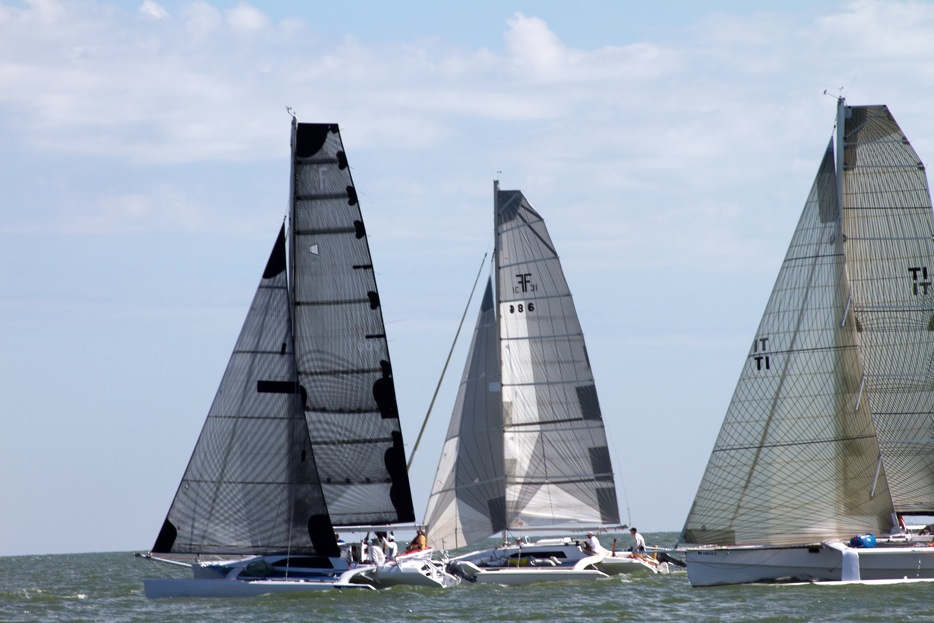
No doubt. Gets to write the expense of the boat off too I think.
Who did the graphics?

From my limited experience:
- An asymetrical foil is slightly more difficult/expensive to make than a symetrical one. The same goes for its trunk.
- A curved foil is a little more difficult/expensive to make than a straight one, if built from female molds. The same goes for the trunk. Making the plugs and molds is obviously more expensive, though.
- A curved foil built over CNC machined foam can be extremely expensive, although easier to laminate, if the reinforcements are smartly designed.
- The number of localized reinforcement layers in a lifting foil increase as the vertical load grows as % of displacement.
Each of my boat's straight assymetric boards was designed to lift 50% of displacement, which is probably close enough to the F20c foils, from what I saw on the video.
My foils were built about eight years ago in a small Brazilian shipyard in foam/glass/estervinylic - and they also float. In view of that, the fact that the F20c carbon boards can float is meaningless.
If they are building the F20c foils from female molds as we did, its price depends on the materials, weight and number of layers, labour following the number of layers.
It seems reasonable to charge 20% over the price of a straight symetric foil of similar build (female moulds, same materials, same technique).
However, if they are not building over CNC machined foam, the prices should be a lot lower. I hope this is what is going on, for the quoted prices are outrageous.
Just my opinion, of course.

The graphic
design
was done by the design staff at Zhik working from a line drawing of the boat.
Fellow catsailor Jake at Green Room Graphics supplied the vinyls for the main and jib, I used a local source for the hull wrap, and the spin was done at Performance Sails.
I don't understand this. Yeah you'll have a bit more aluminum(or whatever metal they make molds out of), and a bit more time into drawing it, but 4 axis machining is nothing new. The actual laminating tools themselves can't be that different. You will pay a premium for the machining as not every hick machine shop with cnc capacity can do it.
I realize you're covering the cost of all the R+D to come up with a final product with all of subsequent parts that come out that mold as well.
What could be more complicated about laying up material in a curve, vs in a straight line?
I honestly know next to nothing about boat construction, so there's my disclaimer.
I don't understand this. Yeah you'll have a bit more aluminum(or whatever metal they make molds out of), and a bit more time into drawing it, but 4 axis machining is nothing new. The actual laminating tools themselves can't be that different. You will pay a premium for the machining as not every hick machine shop with cnc capacity can do it.
I realize you're covering the cost of all the R+D to come up with a final product with all of subsequent parts that come out that mold as well.
What could be more complicated about laying up material in a curve, vs in a straight line?
I honestly know next to nothing about boat construction, so there's my disclaimer.
Imagine the larger size of the machined plug required to make a curved board. The material between the curvature in the plugs has to be solid. The plugs are quite large this way. The molds will be much larger in comparison to a flat board so they have a flat surface on which to sit while being worked on. Rigidity is also quite important in any mold and it will require more consideration for the curved item. I wouldn't be surprised if the tooling cost for a curved board wasn't 3 or 4 times the cost of a straight board's tooling not considering the trunk.
These boards are also quite long. Considering how heavy the I20 boards are and the different kinds of loads the F20c boards are under, I think they're pretty marvelous.
OK, so floating isn't THAT special...but a board that can lift a 360lb boat and two sailors while under sailing load and still be light enough to easily float in water is pretty cool.
Wow. I ask a little question about the price of a board and......
How many of the people that are arguing with Macca are considering buying a F20c? If your not then.........
The reality is if I bought this boat I would get a second set of sails and a spare set of boards and rudders. That's the reality of racing a boat like this.
I think the boat from what I've seen and read is awesome. Nacra (and that means everyone involved) should be proud of what they created and I'm glad to be able to learn about it here.
It would be better without the background noise though.
No it doesn't! dowel it, bolt it together in parts. If machined well, it would need zero touch up work at the seams beyond the polishing that would have to be done regardless. If Uncle Larry can have a Cobra chassis built out of billet aluminum, something simple like a dagger mold can't be that bad, (size wise). And have a billet aluminum chassis that can hole up to a 600hp side oiler.
The loads can't be that bad. When I bend up laminations for curved parts I do them on particle board molds and I'm putting a huge load on the mold when its getting clamped up. I'm not sure what it actually would be, but 20 pipe clamps cranked on hard is a whole mess of pressure. If particleboard can handle the loads, something stiff like aluminum, not being loaded up at all during layup should be fine. And if it is an issue, bolt or weld some bracing to it then bolt or weld it to a stand.
That is cool. Especially when other boards (all manufactures) have had issues with normal boards breaking.
Sorry Jake, but a density below 1 is not really a feat, especially if it is achieved using carbon/epoxy/honeycomb cured in an autoclave (supposing that this is how they are built).
My not-post-cured glass/estervinylic/foam foils lift a boat that is over 2000 lb (approaching 3000 lb fully loaded) at less than $1300 each. I don't think their density is remarkable, if anything I would bragg about their price <img src="<>/smile.gif" alt="smile" title="smile" height="15" width="15" /> <img src="<>/smile.gif" alt="smile" title="smile" height="15" width="15" /> <img src="<>/smile.gif" alt="smile" title="smile" height="15" width="15" />
No it doesn't! dowel it, bolt it together in parts. If machined well, it would need zero touch up work at the seams beyond the polishing that would have to be done regardless. If Uncle Larry can have a Cobra chassis built out of billet aluminum, something simple like a dagger mold can't be that bad, (size wise). And have a billet aluminum chassis that can hole up to a 600hp side oiler.
The loads can't be that bad. When I bend up laminations for curved parts I do them on particle board molds and I'm putting a huge load on the mold when its getting clamped up. I'm not sure what it actually would be, but 20 pipe clamps cranked on hard is a whole mess of pressure. If particleboard can handle the loads, something stiff like aluminum, not being loaded up at all during layup should be fine. And if it is an issue, bolt or weld some bracing to it then bolt or weld it to a stand.
That is cool. Especially when other boards (all manufactures) have had issues with normal boards breaking.
Karl, I dont understand why a ferrari costs more than a hyundai, I mean they both have 4 wheels and an engine...
And let me assure you that its not possible to have a flat pack mould that bolts together... next we will have Ikea doing them!
Sure, its possible to build a curved board in your backyard, but to do a production quality run with repeatability, control and warranty is not such an easy task.
Look at it this way: If it was so easy then why isn't everyone out there doing it?

What?? Is it gang up on Macca Week???
Did I miss something???;)
Go faster goodies without a light weight boat = witchcraft.
Must be why the F16 deity won't allow themselves near them.
At only 20% greater cost than an F18 board?

At only 20% greater cost than an F18 board?
I really really hope Nacra will stick with that bit of marketing by Macca, my guess there must be a few bean counters running over profit margins and thinking someone really screwed that one up.
At the sort of cost being promoted, a number of the bigger boats ( think Nacra F20 for one ) must be thinking about buying and converting to this style as the performance gain being advertised would be a huge gain for not a lot of cost.
Hey all the knockers of F16 boat owners being on an open forum, this is an open forum after all and we might be just interested in the F20 to take more than a passing glance.
I have no problem with Nacra producing a boat like this as my feelings are why buy a F18 which is over weight and out of date in a couple of years.
At only 20% greater cost than an F18 board?
I really really hope Nacra will stick with that bit of marketing by Macca, my guess there must be a few bean counters running over profit margins and thinking someone really screwed that one up.
At the sort of cost being promoted, a number of the bigger boats ( think Nacra F20 for one ) must be thinking about buying and converting to this style as the performance gain being advertised would be a huge gain for not a lot of cost.
Hey all the knockers of F16 boat owners being on an open forum, this is an open forum after all and we might be just interested in the F20 to take more than a passing glance.
I have no problem with Nacra producing a boat like this as my feelings are why buy a F18 which is over weight and out of date in a couple of years.
At only 20% greater cost than an F18 board?
Wayne, I said the board was 20% more than a new F18 board, and that's correct. Bean counters did their job and thats the price.

A top of the line autoclaved carbon daggerboard for the WildCat made by Reverie UK cost €1000/£880/$1400 plus tax.
Add the 20% greater cost quoted by Macca to that and the target price for a curved board on the Nacra 20 should be around €1200/£1060/$1660 plus tax.
A set of Reverie boards costs a bit less then that at £1906 (€2168) per set incl.VAT
http:/
Hey all the knockers of F16 boat owners being on an open forum, this is an open forum after all and we might be just interested in the F20 to take more than a passing glance.
Keep that in mind while you're bitchin' about Macca commenting on F-16s in an
Open Forum
. You sound like you're quite the hypocrite.
Personally, I like knockers.(.)(.)