
Mike,
The boat looks sweet, but the sail looks like the graphic on a designer pocketbook, its awful, I threw up in my mouth a little.
Bill

Width is 8'6"?
Is the mast carbon or aluminum?
Sorry for being lazy and not looking this up.
Bill
360lbs (give or take)
carbon stick (narrow wing section ala scaled up F16/F18)
10.5 foot beam
and, for the record, I'm going to end this post lightly insulted on the sail comment!
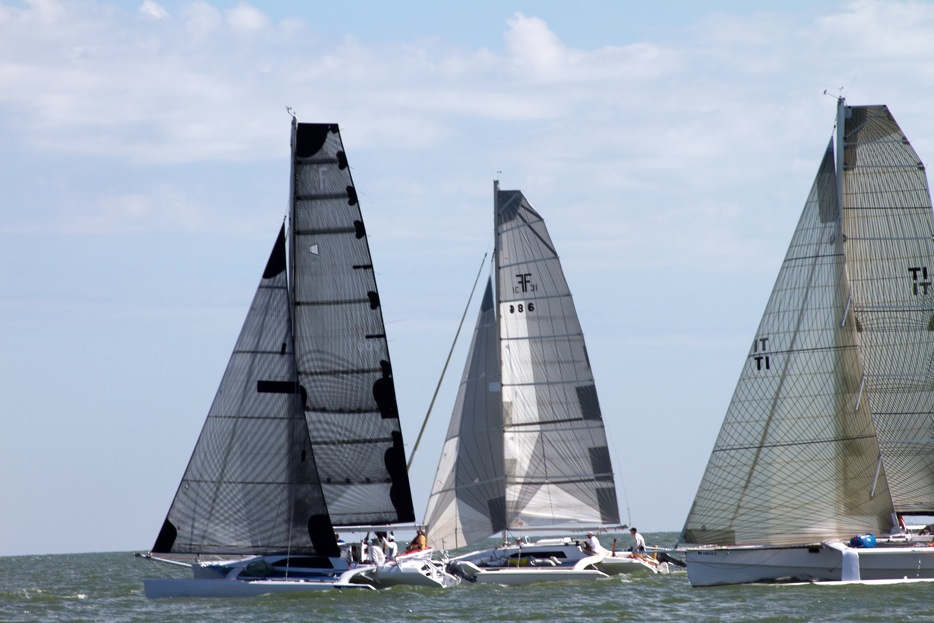
who makes the mast?

Funny how wider than 8'-6
beam is suddenly acceptable...somewhere behind the scenes, Bill Roberts is probably saying something like
Welcome to the party...I have been trying to tell you this for the last 40 years"...

We ain't comparing Hyundai's and Ferrari's. We're comparing Hyundai's to Hyundai's. Its a slight variation, not a whole new frickin' breed of animal. I said it before, I don't know much about boat building. As far as I know you're laying a pliable material into a mold, whether its got a curve or not, I don't see the difference, but I would like too.
Okay if you say so, plenty of things are bolted together that hold up just dandy under some very extreme loads. But I still would like to know why. I like to learn things, and just saying
no
wrapped up in your ****/kunt like attitude isn't enough info for me. What Jake was getting at is that a giant block of material can get expensive, especially when most of it is going into the recycling bin. Furthermore if it is really big then there are issues of finding people that can deal with it, which if you're in a niche market you get to charge pretty much what you want and tell people to go screw themselves with a smile while they pay you knowing they'll be back because there just isn't any other options. Like I said, if a billet aluminum race car chassis can be machined and assembled and hold up to what a track and a whole mess of hp can throw at it, I don't see why something simple like this can't be done that way as well. Or, perhaps its something that hasn't been explored yet in this application and should be? There's always a better mousetrap to be built, or a better way to build it(whether it improves the product or the production), regardless of what you manufacture.
Never said anything different. I'm just curious why you say the boards are soooo inexpensive, yet say production is soooo costly. That business model doesn't hold up for too long.
Give it time and it probably will be, right now its still in the voodoo magic category. Sailing has been around for how many thousands of years? How long did it take to just be able to go to weather? How far has it come in the past 50-25-10-5 years? I'm in the camp where I'd like to see the A-cats, F18's, and F16's (or whatever) take advantage of everything they can in both material and design.
You know,
Not that you wouldn't think so, but Karl is actually a nice guy when you meet him in person; ;-).

beam is suddenly acceptable...somewhere behind the scenes, Bill Roberts is probably saying something like
Welcome to the party...I have been trying to tell you this for the last 40 years
...
Well Bill Roberts should probably get that chip off his shoulder. The only reason that its
suddenly become acceptable" is because the dealer in North America is offering a turn-key tilt trailer that literally adds 30 seconds to setup and breakdown time over your traditional-width cats.
The extra width is also needed for the curved boards since the lift forces on the curved boards decrease righting moment via the leward board.

The F20c is no more difficult to get up to speed than any of the others. There are some nuances that you need to be aware of, fore/aft weight placement and board height are significant adjustments. However the boat provides lots of feedback to help you make those corrections. Anyone that has spent enough time most other cats will recognize this, and pick up on it right away.
Just my .02 cents worth...
So, in your opinion, would you say the
peak performance envelope
is more narrow than an identical platform (pick one) with straight boards?
For the purpose of this side discussion, we'll presume that while operating within this
envelope
the curved boards are faster...
Undecided....make sure you understand that I was saying what
I thought his reaction would be
....not anything that Bill Roberts actually said...don't attribute anything I said on the subject to him...to my knowledge he hasn't said a word about it.

Some boats are just more sensitive to weight placement. The 18HT was extremely sensitive to fore/aft weight position. We used to joke about needing running shoes to help our feet for all the miles we walked up and down that hull during the T500.
Sorry Jake, I wont make fun of the graphics any more today.
two more questions - how tall is the mast? Is it $30k all up?
I like it. Except for the ugly graphics - (ooops forgot my promise)
And nice video Macca, made me want one. The sailing one, not the one in the dark showing off one hull, that sucked.
34 ft mast (10.5m upper measurement band to beam)
$26.5k ready to sail - FOB Buford, GA
two more questions - how tall is the mast? Is it $30k all up?
I like it. Except for the ugly graphics - (ooops forgot my promise)
And nice video Macca, made me want one. The sailing one, not the one in the dark showing off one hull, that sucked.
Well, aren't you in a brutally honest mood today! 😉
Thx Mike. I'd assume it depowers pretty effectively, so a wide range of weights could be accomodated. Time will tell where the sweet spot lies.
Do you see similarities with the Infusion sail cut and the F20c sail cut? That is a big update from the N20, I'd guess.
To be fair, Jake just cut the vinyl, he didn't design the graphics 😛
Both sets of sails come from Performance Sails. We have always been happy with their quality and design. The main on the F20c really looks similar to a big A-cat main. It's 8ft across at the foot, and 4ft across at the head.

Eh? The leeward board is pushing the hull up, thus increasing RM!!!
Eh? The leeward board is pushing the hull up, thus increasing RM!!!
Yeah but since the board is also curved - some of that force directed upwards at the tip end of the board is going to result in a
torquing
of the hull, meaning that its effectively going to rotate the leward hull outboards.. increasing the amount of capsize moment.
You might be right though that the effect of the board lifting overall would equalize the effect of the boat spinning the leward hull outwards.
Those interested in the construction process of curved boards should go look at the DNA A-cat web site. While NACRA may be using an entirely different process, it does give one possible way of building state of the art pre-preg curved carbon boards using autoclave technology. Their molds are made of high temperature composites and appear to be much less complex than those which have been speculated about, on this thread, and others touching on the subject.
DNA is refreshing transparent about their building process. Rather than dodging questions and shrouding their design/construction in ambiguity and mystery, they lay it all out on the table for everyone to see and give their reasoning behind their design decisions.
Eh? The leeward board is pushing the hull up, thus increasing RM!!!
reduced RM... look where the COE of the board is in relation to the hull centerline.
DNA is refreshing transparent about their building process. Rather than dodging questions and shrouding their design/construction in ambiguity and mystery, they lay it all out on the table for everyone to see and give their reasoning behind their design decisions.
A lot of builders don't even care to grace this forum, and its entirely up to them if they wish to share information at all. I am more than happy to update and give info from my point of view. but if you don't like it I can stop?
I will put a story on the development together in the next day or so. I am on my way to Australia today and i'm sure to have time to write it up on the trip...
At the moment we have a lot of heavier crews sailing the boat, but Fergie and I are just on 150kg combined and have been sailing a lot on the boat in all sorts of weather. Recently we sailed in Hyeres in full mistal conditions (30-40kts) and despite the terrifying ride we were really happy with the control we had over the boat.
As for competitive weight ranges I think in time we will see the weights come down to just above the ideal F18 weight. The hulls can for sure carry more volume than an F18 and the rig is massive when you compare them, but the 3.2m beam is a lot of RM to play with and as such the lighter teams can keep the boat moving even in the big wind.
macca,
how about 200kg crews?
For sure it will handle 200kg crew better than an F18, or I20. Simply due to the larger volume hulls, lifting foils and bigger rig.
As to the best crew weight once we have all worked out how to sail these things at full pace all the time.... We have to wait and see.

Eh? The leeward board is pushing the hull up, thus increasing RM!!!
Yeah but since the board is also curved - some of that force directed upwards at the tip end of the board is going to result in a
torquing
of the hull, meaning that its effectively going to rotate the leward hull outboards.. increasing the amount of capsize moment.
You might be right though that the effect of the board lifting overall would equalize the effect of the boat spinning the leward hull outwards.
AFAIK, the issue here is the balance between transversal and longitudinal stability.
Suppose we start with a traditional 2/1 L/B ratio catamaran, that reaches both stability limits simultaneously at a given wind speed.
We can increase its righting moment by making it wider and then it will be able to carry more sail area. However, since its longitudinal stability remained the same, the extra sail area will make it pitchpole earlier then before, so it will not reach the full speed potential of the enlarged sailplan.
Lifting foils placed forward of the CG increase the longitudinal stability at speed, solving the problem - granted, at the expense of a fraction of the extra righting moment.
Conclusion: keeping hull shapes unchanged, curved foils allow a cat to be wider and to carry more sail area, so it becomes faster then before.
Check: the new AC cats have curved foils and their L/B is 1.5:1
Check: the tris with even smaller L/B (1:1) are where curved foils were developed, for they need them badly. Without those foils they reach their longitudinal stability limit a lot earlier than their capsize limit. You certainly remember how the first 1:1 tris were pitchpole prone.
Cheers,
Eh? The leeward board is pushing the hull up, thus increasing RM!!!
reduced RM... look where the COE of the board is in relation to the hull centerline.
OK: can understand that once the foils are starting to lift the boat will pivot about (or roughly about) the COE of the board; but is this still true in
non flying modes
as the boat is then pivoting about the leeward hull.
I'm no boat builder, just keen to understand this bit that I do not appear to....

Macca,
You said Nacra tested with straight and curved. Did they ever test with curved being moved foward of the center of effort? The idea to provide lift without the balance issues.
There are no
balance issues
you simply have to sail the boat and not just stand anywhere you like. Its the same as any other cat with the exception that when you get it wrong on the F20 its clearly wrong.
The Board position was decided from the testing on the original test platforms and also calculating the effect of the wider beam from what was tested.
As for Simon's question: as soon as there is load on the foil then the COE is part of the RM equation. Load is on the foil very early, even on straight foils.
OK: can understand that once the foils are starting to lift the boat will pivot about (or roughly about) the COE of the board; but is this still true in
non flying modes
as the boat is then pivoting about the leeward hull.
I'm no boat builder, just keen to understand this bit that I do not appear to....
Erase all this.
Lift from the foil replaces part of hull flotation at speed, so righting moment drops with speed simply because the foil's center of lift is more inboard (closer to the mast) than the float.
Cheers,
Luiz
Macca, (Kevin)
What's the latest?
YOu still 'down under'?
Speaking for myself, It would be cool if you posted your latest excursion, events, etc. on a regular basis. It would be nice if some of the other 'Rock Stars' would as well.
For me, being in WI now, winter is beginning to set in. I did get to do some excellent one design racing in Milwaukee harbor last Sunday. It was nice, even though it was on a Pearson Ensign!
http:/