

I talked to some people about sailing the spinaker, and they did not seem to agree on a question we're asking. We're a light team sailing an Inter 18 with spi. The spot where we are sailing often is having gusty winds. That means that we're making slalom over the water trying to not flip over when the wind comes in.
Of course sometimes the wind comes in a little to quick (or we're sleeping/lack of experience) mainly on half wind, and then the boat is quickly coming up. Without spi you would let go of the main sheet, and my first reaction is always to let go of the spi sheet. But it seems that this action is not helping the situation. Because we're sailing a half wind course, the spi is rather flat, and when letting go it blows up like a balloon, and still flips us over. Some people are telling us now that it's even better to get more power on the spi sheet in that situation then letting it go.
Can anybody explain? What is the best way to go when your already making an inclination with spi?

You should be steering that slalom course in gusty winds, that's normal.
With every big gust, you have to bear off and run deeper, or, as you did, you'll flip, even if you are flogging the spinnaker, it's still a lot of drag up there pulling you over.
So just bear away in every big gust, and go fast with the spin trimmed in.
You should be looking back over your shoulder all the time, looking for the next gust so you'll be ready to bear away when it arrives. Do not wait until you are already nearly flipped over.

Sailing a spin boat (with Spin hoisted) is a little counter intuitive to the new sailor.
One thinks that going slow is
safe
... but it is not. You need to keep maximum boat speed to minimize the differential between your boats apparent wind and the upcoming gusts.
Example:
Let's say the wind is blowing at 15k gusting to 23k. If you go slow and only achieve 8-9k the difference between your boat speed and the upcoming gust is 14-15k (additional) on your sail plan.
On the other hand, if you achieve 15-17k then the differential between your boat speed and the upcoming gust is 6-8k -- alot more manageable.

Like Tback said speed is your friend.
By dumping the spin sheet you are reducing/eliminating your boats ability to bearaway (go deeper downwind) so by doing so you are powering the boat up by slowing down and bringing your apparent wind more to the beam. Trimming on the kite ,if you are at speed, can increase your speed and get the boat downwind to a safe power zone faster if the helm and skipper are in tune with each other . If not ,often the rudders will cavitate due to the sudden addition of extra power and without depowering to get them connected up again, you will have no steerage.
Blowing your main can break your mast, dumping some traveler may be an option as long as tension remains on your mast in a proper alignment to act as a backstay.

+1 on easing the traveler and driving down in a puff. You can bring it back up once you get organized or the puff runs out
Also, try not to head too high up between gusts... it makes the boat heel further when the puff hits, as well as making it harder to drive all the way back down.
Don't worry about being light. Because you are trying to go downwind as deeply and quickly as possible you don't need to maximize lateral resistance with your weight.
You can fix the rudder cavitation issues if when the puff comes, the crew first eases the sheet then sheets in. Ideally its a 4-6 inch ease followed by sheeting on until the shape is right. This allows the spi to open up to the gust and curls the leading edge a little more. Once the crew sheets on again, the boat will be essentially pushed downwind by the action of the spi flattening back out. The helm will actually feel a pull downwind. The reason is the boat will accelerate slightly because of the increased wind velocity and the sheeting on, which will shift the apparent wind forward. The skipper then turns down in response, sailing a deeper course at the same or a slightly faster speed.
The only other way to smooth out the ride is anticipation. If the gust hits before the skipper turns down and the crew eases then the boat will become overpowered. The goal is to ease the spi slightly at the same time the gust is just starting. Then sheet on as the gust hits. Then as the skipper feels the acceleration and apparent wind shift turn down. This way the boat is constantly in sync with the increasing breeze.
As the puff ends, ease the sheet and turn up until the boat accelerates. Repeat.
Hope this helps. Now i want to go sailing.
Thanks a lot for all the reply's! Very helpfull!
And yes, after reading these comments, I want to go sailing today!
And if you pull your dagger boards up half way, it won't fly the hull as quickly, so if you're having trouble with it popping up in every gust, try pulling the bords up, see how that works for you.
Also this year we're still working on the spi control. I think it's realistic to say that we experience no problem what so ever in a wind up to 18 knots. But when the gusts are getting bigger or the basic wind is increasing, there are still moments that we are loosing the control once in a while. Last saturday we went out sailing again, and it happened a few times again, but we caught it on video. I made a video of that day, and left two moments in on purpose, to show you. I hope you can tell me what we are doing wrong here. Two times after eachother we experience a gust of around 20 knots. You see the cat's diving in the water with the bow. Of course the hull is getting up, and therefore my natural reaction is to let go of the sheet. We already were sailing with the traveler far out.
http:/
The questions we have:
1) Of course what are we doing wrong here. Should we anticipate better/earlier, or do we anticipate in the wrong manner?
2) We've been told that we should keep the sheet at such length just before the point that the spi collapses. When the wind increases the length of the sheet increases. But just that is making that the spi will sometimes collapses hard. (hope my English is explaining right) Is it right to lengthen the sheet when the wind increases?
3) And probably the most stupid question of the day: In September we participated in a long distance race, where we eventually sailed 40 km to the wind, and 40 km downwind. The wind was 5 bft, and when going back the wind force was increasing with gusts of 6 bft. We were tired, and had multiple moments where the spi was taking off with us. Also the new spi course was not very helpfull, so we decided to take it in, and proceed without. However we were not used at all to sail downwind, with this kind of windpower, we never did it before, and had to figure it out when tired and water was flying around our heads. We managed to get back, but lost a lot of time (and places) the last 20 km. We didn't know if we should sail the main with the traveler wide open with such wind, and if we should keep the sheet tight, or let is go? In trapeze or not? Can anybody explain these basics to us?
Thanks in advance, and I wish you all many good sailing hours in 2014!

It could be an effect of the camera but it looks like your spinnaker luff is too loose. This will cause you to have to sail higher into the wind in order to get wind into the kite and cause it to be more powerful over a wider range of wind angles. With the luff too loose, it will be less powerful on deep angles leaving you slower when you are trying to sail deep to get around a race course efficiently. The soft luff / fuller kite will also carry power over a wider angle of apparent wind which makes it less sensitive to helm corrections as you change your course reacting increased wind pressure and additional boat speed. The fuller kite means you have to steer more dramatically causing lost speed and distance. Tighten the luff and you can sail deeper and make smaller changes in the helm to accommodate the changing wind / boat speed.
When setting up the spinnaker on shore, you should hoist it fully and with the sheet loose, you should grab the luff of the spinnaker making a fist with the luff on the interior of your fist and rotate your hand 45 to 90 degrees before the spinnaker is tight and prevents your hand from rotating further. You want the spinnaker luff to be almost tight when hoisted fully. I bet this will help make the boat easier to sail downwind.

x2
and at the 0:38 mark (no spinaker) and onwards the entire rigging is flapping about, the leeward shroud looks to have 10" of movement mid length.
it might be my eyesight or the camera view, but the mast looks to move as well as the shroud slackens and tightens, I think that's also visible as the guys on the trap seem to momentarily bob up n down in the heavier chop
Everything looks too loose to me......
<img src="<>/cool.gif" alt="cool" title="cool" height="15" width="15" />
ok .... I gotta ask....
how does lifting the daggers alter the speed in which the hull lifts
<img src="<>/confused.gif" alt="confused" title="confused" height="15" width="15" />
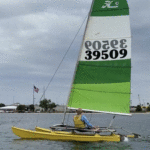
X3, it looks to me like the spinnaker was not fully hoisted. If you mark the halyard at the block when it is fully hoisted on the beach, you will know on the water if you have it fully hoisted. I have on many occasions thought that I had the spin fully up due to pressure when I was still 2 feet short. The skipper then had to go lower to release the pressure so that I could hoist the last bit. I'd personally pull that tack line a little tighter, too.
-Rob V.
ok .... I gotta ask....
how does lifting the daggers alter the speed in which the hull lifts
<img src="<>/confused.gif" alt="confused" title="confused" height="15" width="15" />
It raises the center of rotation of the boat higher. With boards in the water resisting the sideways motion of the boat, the boat hinges around a point somewhere under the water where the lateral resistance of the boards resist the side force from the sails. If you raise the boards, you raise that pivot point closer to the surface of the water giving the sails less leverage to heel the boat. When you raise the boards, you trade off a little resistance to sideways travel for a higher center of rotation and less wetted surface. This helps increase your speed potential downwind because of two things: 1) your speed increases so the boards are generating more lateral resistance and 2) a ~little~ side slip downwind isn't hurting you as it is taking you deeper down the course*
*you might think that a ton of side slip downwind would get you to the mark faster but you also have to consider that a hull sliding sideways in the water is MUCH more draggy than a hull traveling in a straight line. If you raise your boards completely out of the water you will get a lot of side slip and speed will be reduced.
@ Jake, Pirate and Redtwin, thanks for the comments on the luff. To be honest we also got a comment from a fellow sailor during the earlier mentioned competition. He was asking about the
full
sail, but we never got to the part of how to check it on shore and on the water. We will most certainly check with both mentioned methods. (And yes, the tack should be a little tighter.)
@Pirate, I agree with you the shroud seems loose. However pleae believe me if I say our rigging is rather tight. On this type of boat we do not have the ajustable system yet (as on the Infusion) so we use the main sheet and traps to set the tension on the shrouds. They feel
hard
, especially compared to many other boats. (but who sais they know?) Maybe we should check anyway when we have somebody with a gauge available.
And just in case we get in the same situation again: Is there anybody who wants to react to the question from point 3? Downwind without the spi? It would be appreciated!
your strategy for point #3 above (downwind without spin) would likely vary
In your situation, it would seem that you were more concerned with keeping the boat manageable (by dropping the spin) rather than maximum VMG. In that case, I'd keep some traveler in for the
reserve
should a sudden puff or something pick the boat up and you need to reduce power (in combination with a heading change). Weight should be all the way on the back of the bus, and boards up somewhat depending on conditions. The strategy would be to reduce lift and avoid knockdowns.
If it's really honking, some advise to sheet main/traveler in tight and go really deep. This reduces the mainsail's
profile
to the wind, thereby reducing power/heeling force.
I think many here on the forum have experiences with the
death reach
zone, where you really don't know what option (heading up or down) will cause the least amount of collateral damage.
The consensus is deep reach = drive down / tight reach = head up when overpowered. Between those two is the problem... <img src="<>/smile.gif" alt="smile" title="smile" height="15" width="15" />
And I think all agree with your spin luff being too lose, with the boards being a bit too deep. From your dramatic steering when hit with the puffs, you were likely heading up too high to hunt them, and didn't have the boatspeed/apparent wind to turn that heeling into forward propulsion.

You are doing it mostly right.
Keep the luff tight.
Don't travel out much unless you have too. Travel in and sail lower and faster. When the gust hits big then travel out, hike harder (skipper)., and drive down. I didn't see any hiking by the skipper or travelling out.

here is my answer to point#3. may be relevant or not...
Sailing downwind in 27 knots on an 18-spi up, is prolly near the limit for even the really good teams. How smoothly the run goes would depend on how big the seas are, and how gusty it is . You would have to land the jump off the back of one wave to the wave in front every time that issue came up..
We have 27 knts regularly here and i have no spi on an old TheMightyHobie18. i use old school technique and just sail low with the crew playing the jib and me playing the main with the traveler set out where i like it for that particular run. You can get going pretty fast by surfing and there is a trick to steering over the wave in front. Speed is your freind. When you are sailing low in that wind the crew needs to sit on the ream beam near the middle of the boat quite often. It helps to have an strong agile crew that really knows what they are doing trim wise.
hard
, especially compared to many other boats. (but who sais they know?) Maybe we should check anyway when we have somebody with a gauge available.
another one I'd check would be the dolphin striker's tension......
years ago I had an adjuster bolt failure on the striker, on the beach and rigged it wasn't noticeable at all and my home made shroud tensioner at the time said all was as usual when it was checked.
on the water in a good wind it was a different case, on a reach I actually saw the leeward shroud adjuster flopping around, once back on the beach all the rig was reset and I went out for race 2.... again the shroud adjuster was flopping around on that reach although not as badly as it was when I first noticed it.
It wasn't until I was pointing hard that I noticed the huge bend in the front beam <img src="<>/shocked.gif" alt="shocked" title="shocked" height="15" width="15" />
its a wild shot in the dark but still worth checking and crossing off the list
<img src="<>/wink.gif" alt="wink" title="wink" height="15" width="15" />
Last weekend we sailed again, and of course it was the opportunity to try some things. We had the perfect wheater with wind around 18 knots. First of all we found out that in the past we eased the spi sheet when the puff hits. This weekend we tried to do it as explained by easing a little bit and then sheet in again. We also decided to keep the travelar in. We had a hard time seeing the puffs coming, and decided to keep the sheet as it was for some time. We experienced that this was already much better. more direct steering and control, no collapsing of the spin, and less agresive steering. We still have to learn, but this was a step forward.
We also measured the spinaker as suggested before, and came to the conclusion it is rather big?? See below photograps:
![[Linked Image]](http://i40.tinypic.com/2en84g0.jpg)
![[Linked Image]](http://i39.tinypic.com/2hpj97d.jpg)
![[Linked Image]](http://i39.tinypic.com/14nfbsh.jpg)
We had to turn over the cat due to the strong wind, so we measured once at the mast, and once at the luff (don't let the extra pole mislead you, we use it for our camera) At both positions it's clear that we have some extra length compared to what was said / explained earlier. We checked the spi but it's original, and however its old, it isn't used too much. So is it streched? Or is this normal with our boat? (inter 18) Should we be worried?
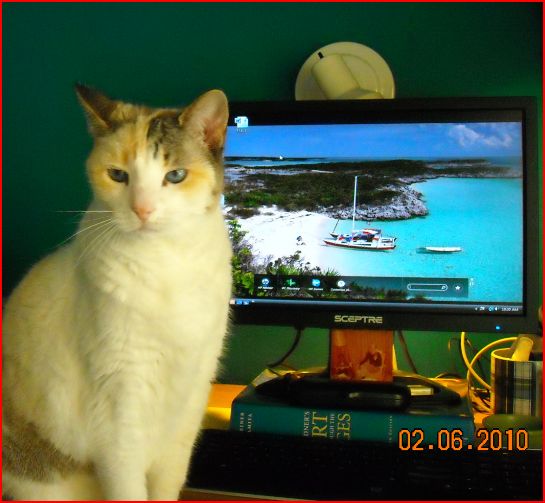
Is the pole itself set properly?

You may need to lower your spin pole by shortening the stays. We had to do this on a Tiger a while back.

What kinda mast rake do you have?
See underneath a recent photo from our boat
![[Linked Image]](http://i41.tinypic.com/29f759h.jpg)
In our opinion the pole is set up ok?
The mast rake is a little backwards
Set the spin and adjust the pole until you're happy with it.
Spin luff is definitely too long. WAY too long.
You can correct this by lowering the tip of the spinnaker pole by shortening the rigging. We went through a period where the spinnaker luffs got longer on the Nacra 20 and we ended up with so much prebend on the poles that they would break if you looked at them wrong. I ended up rigging the middle part of my pole to extend it lower at the forstay bridles so it wouldn't have to have so much prebend.
If leaving the spinnaker sheeted through the puffs helped with boat control, you are probably over sheeted...which is not fast. That said, it is good to keep the spinnaker properly trimmed through the puffs and not ease it to depower it unless
all is lost!
. Fix the spin luff issue and you'll find the boat will be very different downwind.
<img src="<>/shocked.gif" alt="shocked" title="shocked" height="15" width="15" />
when I enlarged the pic it looks worse .... <img src="<>/eek.gif" alt="eek" title="eek" height="15" width="15" />
mast needs to rake further forward but that will only give you more issues with the spinnaker luff, so lowering the pole is about the only option you have.
it does look to be sitting high in the bridal
<img src="<>/cool.gif" alt="cool" title="cool" height="15" width="15" />
did you photo-chop the pic ???
someone has shot a bloody great hole in the middle of your boom !!!
<img src="<>/grin.gif" alt="grin" title="grin" height="15" width="15" />
LOL Kingy, looks more like a white paddle strapped to the boom to me.
Spin pole has to come down, no way around it. looks like you have plenty of room to move, just put a small rope loop around the pole under the bridal to facilitate.
Ok, everybody seems to agree on the pole 🙂
But the loop is already in place, so that would mean to shorten the rigging? Just to be absolutely sure (do not want to make more damage the necessary) please see the below pic. Is this the way to do that? (please do not look at everything else, this is an old picture with old snuffer bag, without self tacker, and with totally different setting)
![[Linked Image]](http://i41.tinypic.com/2eg8bhx.jpg)
Please enlarge the picture (right mouse button) to read the text
Maybe a stupid question, but why not move up, by replacing the
spi bracket
(how is the thing called up in the mast?)
And pirate, no did not photoshop 😉 Indeed there are two paddles there which were obligated with a long distance race (Texel), and we've never took them off, after.
Ok, it is important not to tamper with the length of the wires labled
shorten these?
under any circumstances. the bridal wires are set at a structural length, any shorter and there will be a greater load on the bows pulling inwards. you don't want to stress your bows more than you have to.
so the
ladder
or chainplate shouldn't have to move at all. unless your not happy with your mast rake.
the wires
what about these
they are the whiskers, (very feline aye) are exactly what you want to shorten. by the looks of the previous photos your coming down about 150mm/6in which will be a lot of bend in the pole, if your worried about breaking the pole then you can suspend the pole below the bridal to make it straighter. does that make sense or would a photo help?
and no you cant raise the height of the spin bracket (spinnaker bale) because it is set a height not to break the top of the mast off. its a safety thing.