

Just had my first day with a spinnaker on my (new to me) Marstrom Tornado. Everything went great...what a ride!
However, we noted that the spinny sheet (mafioli sp?) running thru a Harken Ratchamatic at 180 degrees still didn't take enough of the load off the line to keep the crew from complaining  . This was in 7-10 knots of wind, flat water and only for a short period of time. I do regular round the island trips that have 1-2 hours between gybes...and I'm sure hte crew will be squawking quite loudly by then.
Is there a recommended solution to reduce the load (a 2:1 setup perhaps) or would a cleat be the way to go?
Cheers!
Mike Dobbs
'95 Marstrom Tornado "Full Tilt"
'81 SailCraft Tornado "DoubleMint"
Check out the Old Forum site where this was discussed about two weeks ago. Look for a topic titled Spinnaker Blocks dated around 11/15/03. This should help you out some.

I never understood how the doubler worked until this thread...Chris, from Team Accelerated Chaos, posted this on the old forum - refer to the following link to Rick's Wave stuff for photos. 'perty neat!
Another option to consider is using a 2:1 spin sheet often called a 'doubler'. In this case a set of blocks is tied in the sail @ the clew that the spin sheet is run though and a stop knot tied on the other side. When you need the extra power, the crew reaches up the the stop knot and pulls it back to a cam cleat on the rear beam. When its time to jibe, release the sheet from the cam cleat and you are back to a 1:1 sheet so you don't need ten thousand feet of line.
hope this helps...
Chris
http:/
Here is a picture of the current setup:
![[Linked Image]](http://www.pbase.com/image/22080628.jpg)
So, from what you're saying...make the forward turning block into another Ratchematic (or Carbomatic)? Hmmmm.
One other thing that's different...the position of the ratchamatic is quite forward, about 6 inches ahead of the shrouds. Does anyone know if this is special to Tornado or do other classes use this sheeting position? Wouldn't the leech on the sail be much tighter and the slot smaller than compared with rear-beam sheet setups?
Mike.
You gotta remember that the NE6.0 Chute in question is a pretty big dude (340sq ft I think). I think the I20's sheet to the shroud as do most of the factory spinnaker boats. I have a ratchematic like yours on my rear beam and plan to install, like Chris, a ratchet block (that can manually be turned on and off) forward on my jib traveler track. My crew is confident that that should be plenty.

If you want two to one purchase you could just hang two bullet blocks from your chute clew. Then run your spinnaker sheets like normal and put them threw the blocks with a stopper knot so that there is a tail. You need to attach a camcleat close to your rear spinnaker block. Then after you jibe just reach up and grab the tail and put it threw the camcleat. I only recommend this for long distance races where you are going to be on one tack for a long time.
For triangles you can try two Harken Rachamatics. It seems to work well for me but others have different experences.
Mike Hill
H20 #907

I'd imagine hanging any kind of blocks from the spinnaker clew wouldn't react well with the snuffer system.

A few thoughts here. If you place a large free-wheeling block outboard on your aft cross beam, lead the line through it then to a ratematic cheek block on your front crossbeam, the angle from the crew to the cheek block should allow the teeth of the block to nicely grab the sheet while keeping it out of the way of the driver.
Second. Why would you put stopper knots on a chute sheet? That's an accident waiting to happen it would seem.
Third. The block on the clew of the sail will reduce the loads, but as mentioned elsewhere provide issues with snuffers and produce additional lengths of sheet to be delt with. Also, it would not take up as much load as the above mentioned approach.

The stopper knot is at the tail ends of the spin sheets where they come through the blocks that are attached to the clew of the spin. To make it 2 to 1 you pull the tail end with knot through the block and attach it to a jam cleat or V cleat near the block by your shroud or rear beam. You must release this before you jibe. The blocks attached to the clew do not seem to get in the way of the snuffer. I made a pigtail for the blocks and made one side longer than the other so the blocks would not foul each other.
Wow, some people sure can get mixed up by trying to picture rigging when you type about it!
What David L. said is right.
On my Nacra 6.0, from the spin clew I use a ratchamatic off the shroud tang. Then the line goes forward, allowing a contant nearly 180 degree turn, then thru a block that was the bottom block of a prindle 16 mainsheet system. (sorry, no part number).
This block has the switch to turn on or off the ratchet, so in light air, it freewheels, and when needed, it has alot of drag being only unidirectional with the ratchet on. This really takes alot of the loads off the sheet, and still allows for good spin control. Face it, especially in a distance race, you pretty much leave the spin sheeted to it's sweet spot for the course and conditions, and control things with the tiller, and alittle main traveler-at least I do anyway.
ON my 6.0, to get the spin sheet out of the spaghetti bowl of sheets with the 4-way jib system, I then route it thru a third block on each side, just a turning block, to get the spin sheet back behind the 4-way jib lines. With a smaller chute, (ideal for these boats-sorry Randy), the two block system is needed anyway to get the sheet around the daggerboards, then I use a third to get it back behind the jib sheets.
After tailking to many I-20 sailors, and Tornado sailers, such as J. Tomko, and C. Ogletree, their advice was to have either two blocks that you could turn the ratchet on/off, or one and a ratchamatic.
The doubler is another good idea, and I've used that set-up in the past, but with my current set-up, it's not needed. When I get around to it (ever say that?), I'll also put a cleat on the windward side for the spin sheet in distance races.
To make a long story short, get a ratchet for the second block, with a switch to turn on or off when needed.
It helps to snuff, when the ratchet freewheels, so there isn't much tension on the spin sheets while going in.
My 50 cents.
Todd Bouton
Nacra 6.0na
#111
with I-20 chute, and mid pole snuffer, square top main, ...
This is a little off the subject, but I see you arre using Mafioli Swiftcord. How is that for grip? My big complaint with Samson Ultralite is poor grip, so I was wondering what you thought of Mafioli.
Todd,
What size spinnaker are you using? I think all the New England guys sheet to the rear beam - my 320 sq ft sail likes to be sheated to the rear beam - however, the clew of the sail is pretty high (While I may loose a little performance, I can see to leward under the chute).
Well, I guess I'm kind of a renegade,
The spin rigged boats that I used as a template, mainly the I20, and Tornado, DON'T sheet back there on the butt end of the boat.
I simply bought a I20 spin, new, for about 950. USD, and rigged that to my boat. IN races I've done with other 6.0's with larger chutes, during the long chute runs, I wasn't loosing anything, and often being faster. The 270 sq ft chute, In my opinion, is ideal for this boat. Gee, I wonder why the Tornado guys didn't go with a bigger chute with all that beam width? Why didn't the I20 come with a larger chute?
I don't live in NE, and I'm glad you can see under your chute, that is oftentimes important, especially on the 6.ona, with it's low jib.
Todd
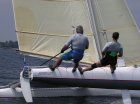
We were running a little deeper than we should have been in this photo - the spin is pretty far released (after a horrible start due to someone untying the spinnaker overnight we elected to run the rhumb line and were trying to stay off the beach - it worked)...but you get the idea. I really like being able to see under the thing.
![[Linked Image]](http://webpages.charter.net/jakekohl/photogallery/images/roundtheisland2002/img_rti.jpg)
Mike
I think you will find that the sheet load will decrease as you learn more on how to sail under spinnaker. I have helped some first timers out and found this out. When the boat is trimed perfectly there will be less loads.
Jake,
That was from RTI right?
I've got a pic very similar, I'll try to scan and attach it.
Todd
Mike,
If you read my post, actually the block you have last to the clew, looks like the one I use, are you sure that isn't a switch to turn on/off a ratchet?
Ir you put the ratchamatic as last before it goes to the clew, you get a better near 180 wrap, which helps. I think someone said that already though, if so, sorry.
Todd, the ratchet on the block closest to the clew is definately on...it is a load sensing type, much like the newer type Carbomatics have.
Based on what has been discussed here, I think I will swap out the turning block with another ratchamatic (or a carbomatic) to help take more of the load on the sheet. Seems like the most straightforward setup with no drawback like more line lenght, snuffing issues, cleating dangers etc.
As for the other question asked about the Maffoli (sp?) line, it's what came with boat, and seems to most popular on the Olympic circuit team boats. It's a nice, very light material and doesn't absorb water. Seems to grip the ratchet well compared to "harder" coated lines. Stuff is quite expensive...so I'm told.
Mike.
If you read my post, actually the block you have last to the clew, looks like the one I use, are you sure that isn't a switch to turn on/off a ratchet?
Ir you put the ratchamatic as last before it goes to the clew, you get a better near 180 wrap, which helps. I think someone said that already though, if so, sorry.
Todd,
Stan Schreyer, the guy I purchased the tornado from, has told me the Tornado actually performs better with the smaller spinnaker than the class rule actually permits. I also asked about the sheeting position, angle...he said the sail is cut to allow for the fairly steep angle that tends to keep the leech tighter. The sail is also quite flat relative to others I have seen on different classes.
So I guess, the sail is cut to sail at higher, faster angles without getting drag a bigger, fuller sail might cause.
Mike.