
A little bit of history:
Back in the "old days" catamarans always sailed straight downwind, just like the monohulls. We were sailing Sharks at the time. Then along came Nick Stan, who started tacking downwind and was beating the pants off the rest of the Sharks.
Nick left the class soon after, but Rick White was very impressed by this new technique of tacking downwind and worked to perfect it and said he was never going to go straight downwind again. Tacking downwind is a heck of a lot more fun.
However, the slower the boat, the less it pays off to tack downwind (e.g. the Hobie Wave and the Hobie 14).
And the slower the boats that DO tack downwind, the deeper the angles they have to sail (e.g. the Hobie 16).
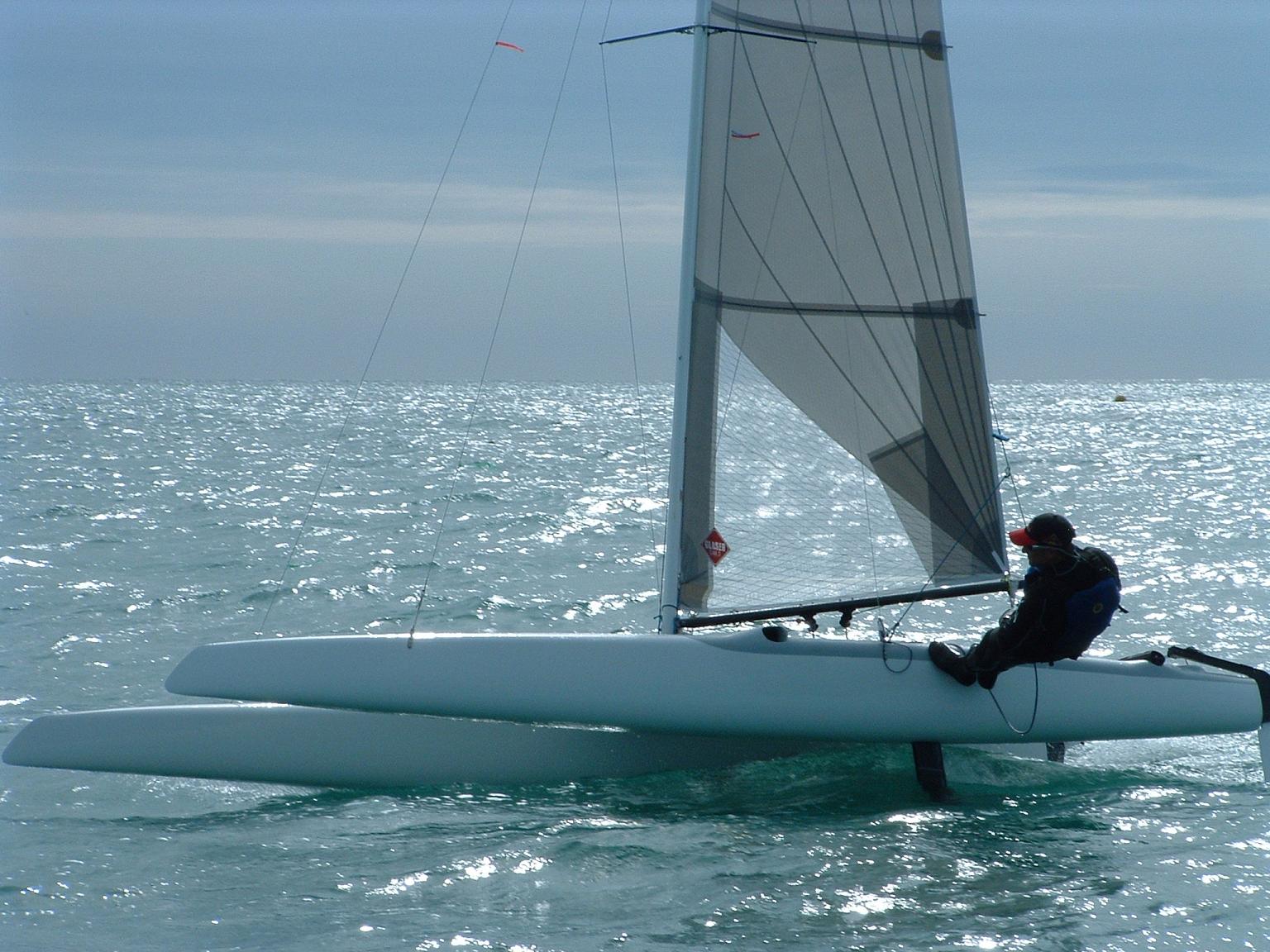
And the boats that are fastest upwind, like the A-Class cats, have to sail really high angles when tacking downwind, especially since they don't have jibs.
Now, I know that nobody wants to sail straight downwind because it is BORING. But I am just wondering whether any of the one-design or formula classes have ever tested it (in various wind conditions) to see whether a boat sailing straight downwind gets to the leeward mark before the boats tacking downwind.
Also, does anybody know what the differences are in angles that different boats sail when tacking downwind? Like, the difference between the angle for a Hobie 16, a Hobie 17, a Nacra 6.0, an A-Class, etc.?
P.S. I guess I should add spinnaker boats in here, and I would assume they can go deeper than non-spinnaker boats, but, still, have they done tests to see whether they would be able to get to that mark faster sailing almost straight downwind than tacking downwind?

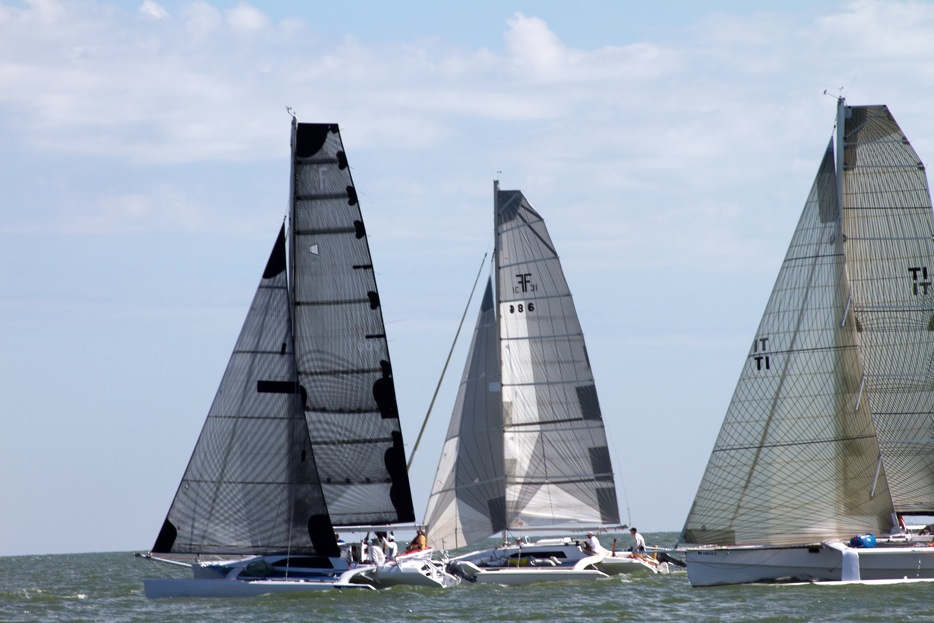
I have yet to experience a situation where running dead downwind on a catamaran (F18 mostly) is an advantage. As the wind gets stronger, you have to run deeper - I think while still being able to 'race' with the wind bumping above 20knots we're still gybing through about 60 degrees. The speed difference is still so incredible between carrying some height and trying to go downwind.
At the F18 North Americans when the squall came through right at the start (day 3?) we fell back in the pack through a big mistake on the first upwind leg. We were trying to pick our way through a fleet of boats running dead downwind and although we were jibing a LOT to get clear we were outrunning them by a large margin. I think the winds were at about 18knots there for a bit.
P.S. we were jybing away because I didn't want to push someone higher that obviously felt uncomfortable WHILE they were to windward of me and I would be very prone to suffer from their mistakes.
Mary,
The following is based on my experience sailing A-cats and F-18HT's.
The jibing angle of an A-cat downwind is typically around 95-100 degrees in light air (mild thing) and that is about the same as any two man sloop without a chute. From my experience racing F-18HT with chute, it was also about that same angle in light air.
As the wind increases and you start doing Wild Thing (flying the windward hull), the angle gets bigger at first. In marginal hull flying conditions, the angle probably increases at least 20-30 degrees. As it gets windier (around 15 knots), the angle gets closer to 90 degrees and when it is approaching our wind limit for racing, is typically less than 90 degrees. Most spinnaker boats follow the same transition and will have even deeper angles as the breeze increases.
IMO, tacking downwind is what makes catamaran racing fun and challenging!
Bob Hodges
when comign back through the ICW during the RTI, we gybed so many times that I had continually convince myself that that is what we needed to do to get the DAM- thing over with sooner... it was painful in such a narrow channel with the wind almost directly behind us. I find that painful, not so much fun. There weren't any boats around us for the most part- at least no other non-spinboats to play with.
Jake,
What I am wondering is whether, within a particular class of boats, a good sailor actually has tried going straight downwind in a race just to see what the difference is. I am wondering whether people just ASSUME that it is always faster to tack downwind.
We had a GPS that would tell us boat speed and velocity made good to the finish. it was clearly faster (both speed and VMG) to tack downwind.

Well, the "good sailor" part is always debatable, but I did try going dead downwind (wing-on-wing) once while racing an Isotope. Let's just say it didn't pay off.
On a Tanzer 16, however, straight down the rhumbline is the way to go.
Regards,
Eric

When I sailed the 5.5Uni at the Nacra Nationals I discovered something pretty interesting. I had rounded the weather mark just behind the defending National Champ and started to heat it up when the mainsheet shackle exploded.
I always carry a few extras on the boat, so headed straight downwind and went to the rear of the boat to replace the shackle.
It wouldn't fit, so went back forward and got another.., it didn't fit either.
I was starting to panic as the leeward mark was coming up fast.
Finally, I found a stamped shackle, replaced it just before the leeward mark, and rounded a few inches behind the champ.
Hmmmmm! I said.
After that day, I put telltales at different spots than the typical 9 inches back from the luff. I put telltales just aft of the mast, almost touching the bolt rope.
My downwind speed in lighter winds was just as fast as it was while keeping the 9
back telltales flowing and I sailed at least 10 degrees deeper.
After that I pretty much owned the downwind legs.Wow, I might try that on the Wave. <img src=

alt=
" />
Rick

Back in the "old days" catamarans always sailed straight downwind, just like the monohulls. We were sailing Sharks at the time. Then along came Nick Stan, who started tacking downwind and was beating the pants off the rest of the Sharks.
Bit more History.....
The Wild Thing technique was pioneered by Mitch Booth and John Forbes in the mid to late 80s..... in the 89 Tornado World Champs, Houston Texas, They used it to devistating effect to win the World Championships.... Finishing some races by more than 5 minutes in front of 2nd place......
The boat used was AUS-260 which happened to be the T I later bought and converted. Forbes has the shot gun cartridges from the start gun used, mounted on a plaque in his workshop.