

Ok I know i'll catch of a lot of it for this post but i'm curious to build a trimaran from a tornado hull and two nacra 18sq meter hulls. I'm currently sailing a fully restored '81 sqare which has the light hulls.. no foam core, just glass and longitudinal ribs for stiffness. I also have a tornado hull mold and thought the combo may make a decent tri. I was thinking of a 14-16 ft beam with the outter hulls canted and offset vertically about 2 ft...anyone have any thoughts on this one?

Yeah...
sell us the Sq and choose another boat for the amas.
Jay
18sq Cat.1
tami
18sq Cat.II

I rode a tri very similar to what you're proposing, a few years ago on Lake Minnetonka, MN. He was a budding naval architect, and custom built the center hull, either 20 or 22', quite low profile, very similar to a tornado design. He used 2 Nacra hulls, I'm not sure which ones. Round aluminum crossbeams, maybe 18' beam. The rig was from the Nacra, if I recall, and as such seemed a bit undersized, until we took it out. I was quite impressed, mostly with the whole different feel than the cats I've experienced. Very stable, not twitchy, accelerated easily, little heel (not sure I'd ultimately like a boat that didn't fly a hull) . It seemed deceptively fast, even with what I thought was an undersized rig.
Only got that one ride, an hour in maybe 12 to 15 kts of wind, less than a 1' lake chop. I remember it well, I was intrigued. I think you should give it a go, and keep us posted.
Dave
SC20
Flight Risk
How about getting a Nacra 6.0 hull as mainhull? We justed switched beams between a 1989 Nacra 5.5.18 sq and a 1992 6.0. The 6.0 is now 3.3 m wide and the 5.5 down to 2.6 m.
Not sure about the non-sandwich 5.5 you have, but the later sandwich models have the same distance between front and rearbeam than the 6.0 making it a very easy operation as even the tramps did not need any modifications.
Regarding your trimaran project, the overall appearance of the tri would look much more harmonious than what you achieve with a tornado shaped mainhull.
Maybe you can find a damaged 6.0 hull so it would safe quite some money and time.
Carbon tubes could be a good idea to join the three hulls.
Can't really comment on the proposes angles and height differences. If you go with a 6.0 mainhull (and the distance between front and rearbeam is identical with the 18sq), would probably connect the three hulls with long aluminium tubes and go for a ride. This experience would probably give you a good feeling how much you want to cant the outside hulls.
How much money do you want to spend?
If you have the cash, I'd do a foam core, carbon tornado main hull, (using your tornado mold) with a couple of Acat foam core carbon ama's. The whole package would be much lighter and stiffer than some old hulls. It would probably have better resale value as well.
Forte mast, he can make a pear shaped mast in sections and you could glue it together. He could ship it to you in two parts.
Forte carbon beams
Thats the way I'd go....
But I've been accused of having a carbon fetish.
Bill

As long as theres a layer of kevlar in there somewhere, its perfectly fine to have such a disorder <img src=

alt=
/>

I agree with the A-hulls, but do not know where you will find a
carbon
main hull since the last time that I read the Tornado Rules and specs, I do not believe carbon hulls are allowed yet.

The main problem with what you are designing is the rudder controls, beam boxes, assembly time, and insurance. I saw a one off tri similar to what you are speaking in SF Bay in the late 1970s. It was a Sailcraft T hull with two 5.2 Nacra hulls. external beam boxes had to be adapted due to the experimental issue asd the fact that two boats were used. The rigging position became an issue [Tornado tapered non-sealed aluminum mast section] as well as holding the front of the 5.2 hulls in alignment. Heavy whisker stays helped with the alignment. The rudder controls kept breaking as well. The assembly time were excessive... anywhere from 3 hours to 5 hours. That's what stopped him from proceding with the development. He grew tired of spending so much time on the beach and not on the water. Also no insurance was to be had at that time... He eventually reassembled both boats.
fair winds,
thom
thanks for everyones input.....so assuming i can handle all the design and building of the associated parts, hull alignment etc and the appearance of the different hull designs doesnt bother me, and I can get the sail area correct... how does everyone feel the performance would be? any other comments on my proposed vertical offset and canting of the amas? beam width?
oh and does anyone have or can tell me where to get a 3-D surface model for the nacra 5.5 hull and the tornado hull? I can handle most formats but would prefer a pro-e, mastercam x, or an iges file.

Worse than building a catamaran of similar specification. If I am wrong, then I think we will see a number of A-Class trimarans.
The thing about trimarans is that you always have two hulls in the water and you have three hulls. Both of these factors will make the trimaran slower, I think.
Why Trimaran? Is there some other reason why you prefer the tri over the cat?

sparky is right, don't break up that 18square!
Bishop, I'm serious. Contact us. Sell us your Sq. We'll work out some hull trading or something. I'm working on building our local fleet and have some interest...

Worse than building a catamaran of similar specification. If I am wrong, then I think we will see a number of A-Class trimarans.
The thing about trimarans is that you always have two hulls in the water and you have three hulls. Both of these factors will make the trimaran slower, I think.
Why Trimaran? Is there some other reason why you prefer the tri over the cat?
I seem to recall that the designer's take on this is that if you want the overall best performance without worrying about cost, build a tri. If you want the best performance for a certain budget build a cat. This is in respect to the big class of boats.
Depending on the design of the tri, the main hull may not in the water, or in other designs may plane (Farrier), depending on conditions.
A-cats being restricted to a 7.5' beam would preclude any benefit from doing a tri.
the limit of your performance are the 5.5 hulls. the advantage of the tri versus the cat is the rightning moment. early tris were known for sinking the floats before they could fly the mainhull. perfect turtle machines. but only when you fly the mainhull free a tri would significantly profit from the increased rightning power.
modern tris like the 35ft division tris sailed on lake geneva have a very tiny mainhull and large floats.
if you want a fast boat, build large floats. unfortunately the 5.5 hulls cant carry much weight. i assume the performance of your tri with 6.0 floats would increase significantly.

I both a tri and a cat have the same overall weight and are of the same overall width, then which one has the largest righting moment ?
Beware this is a trick question.
Wouter
another div 35 pic
well, tris are mostly wider than cats... and heavier.
I like tris... when they capsize it looks pretty sexy! LOL
So why not build the cat wider and heavier as well ?
That should not be a difficult thing to do.
Wouter

That's not actually a trimaran. It's a cat with a center stiffening pod to help stiffen up the rigging. From what I read of the design, the center pod is not intended to provide any flotation in the water.
![[Linked Image]](http://www.catsailor.com/bb_files/96973-AlinghitopmarkDS.jpg)
Those bows remind me of the beloved Nacra 20 bows.
I both a tri and a cat have the same overall weight and are of the same overall width, then which one has the largest righting moment ?
Beware this is a trick question.
Wouter
Given that they are equal weight, the cat will have more weight to windward which would result in increased righting moment. The tri has the weight spread out more.
JMO
Clayton
I beieve the swiss boats are not tris.. they have a centre pod, but it doesn't touch the water..It is just for structural reasons to reduce costs.
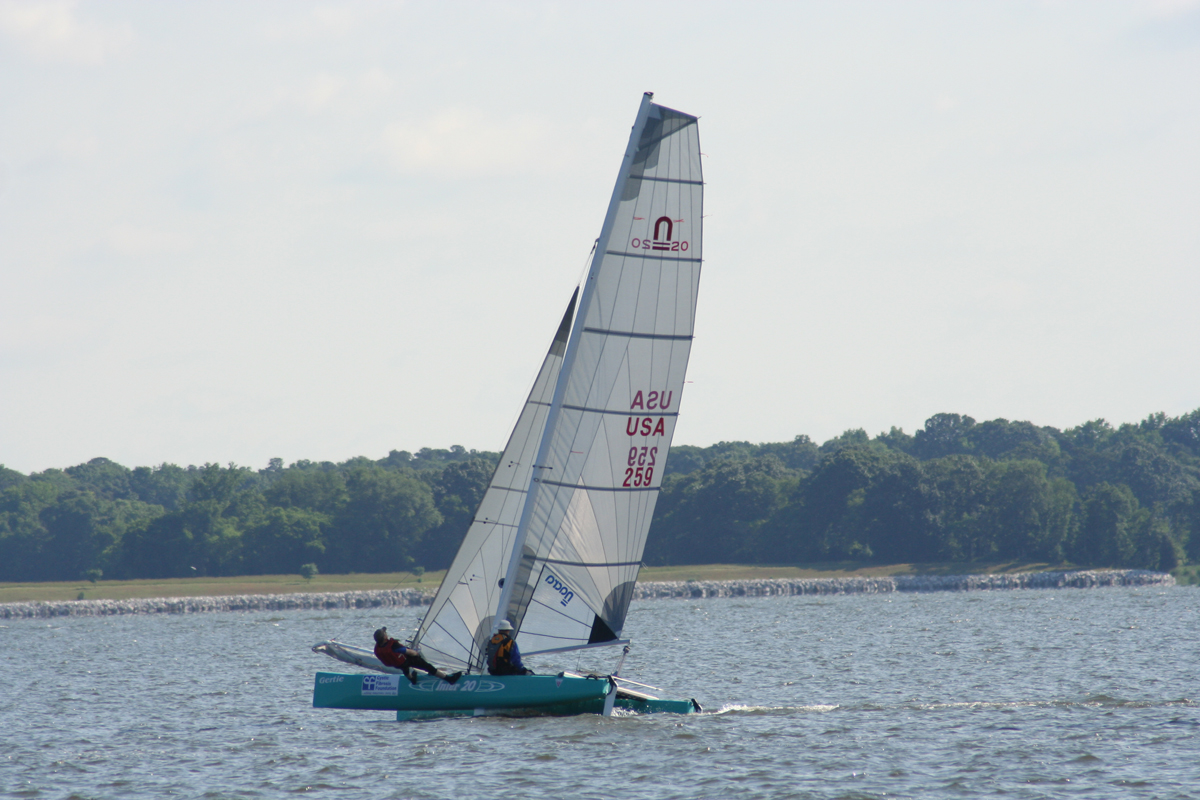
wow thanks for all the responses.... first off for everyone freaking out about the 18sq.... I have NO intention of breaking up my boat. I love the square. If I do this project I will have an either-or arrangement. My reasoning for the interest in the tri is more of a multi-person fast party barge. I often have 2 or 3 tag-alongs when i go sailing and the sq sucks above single-handed. To be honest I'd love to rig a tornado, but cant really afford to have two fully rigged boats. so to all interested in the sq make me an offer. send me a pm and i'll give you all the details of the boat. but anyway.. heres a pic of the sq.
how do i post a pic directly to the post?
Sorry that answer is incorrect.
Both boats are symmetical relative to their centerline and as such the centre of gravity lies at the same point with both designs and as they are equally heavy and equally wide both design will have exactly the same righting moment.
The reasons why tris are build and use have nothing to do with any differences in righting moment.
The real reasons are that a tri (of equal specs) has less wetted surface area in light winds then a catamaran. In the really light stuff the tri can be balanced on its centre hull only while keeping its rig straight up. This is the most effective sail power to wetted surface such a boat can attain. A catamaran can not in any way achieve this. It either heels to sail on only one hull but also heels the rig or the rig is straight up but both hulls are in the water.
The other reason for building tri's is that the largest portions of the rig loads (which are fore-aft) are taking up by the centre hull instead of a beam structure. The first is much easier to build strong and stiff. Building cats at the same size requires more engineering and more use of exceptional material like carbon. In effect LARGE tris could be build cheaper and with less exotic materials. When done right they could also be lighter overall, but with the new material the building of large cats in now really held back by this anymore.
So now we are seeing much more large catamarans build. In the past it used to be trimarans.
For small sailboats there is no advantage is building a tri over a catamaran; here is will be both more expensive and heavier because of the third hull. The advantage of better light wind performance is too rare to really compensate for the drawbacks.
The only reasons to still build racing tri's is that they can be build wider then a catamaran with less effort and stiffness problems. So in the French ORMA we still see tri's as the class rules allow these boats to be as wide as they are long.
Wouter
Make the post and attachment just as you did. Then view your post' attachment and copy its url. Edit the post and use the image function in the instant UBB Code. Paste the copied url in and you are set.![[Linked Image]](http://www.catsailor.com/bb_files/97085-18sq.jpg)
OK my thinking is incorrect, so if more weight further away from the center doesn't help with righting moment, why do sailors hike out or trap out for that matter????
Clayton
I'm trying to get my head around it too, but I can see that trapezing is actually shifting the CG. You are moveable ballast.
The thing to understand here is both trimarans and catamarans are symmetric relative to their centre lines. Meaning one side of the boat is a mirror image of the other side when viewed from the centreline. If weight is moved away from the centre then an equal amount will be moved away in the other direction. The net result is that the centre of gravity remains were it was, on the centreline itself. So nothing changes in the righting moment of the total craft.
Crews on the other hand do not follow this Mirror image principle. They are either on one side or the other and so DO affect the total amount of righting moment.
Wouter