

Finally got it all posted.., go to the Headline/Welcome Page at www.catsailor.com or click on the Logo in the upper left corner.
Rick

Nice Photos,I am envious.Mean while -28C here in balmy Thunder Bay.

Did you really run some triangle courses? A 'B' mark?
Around here, that mark is extinct. It's been extinct for years. My N6.0na loved reaching to 'B'.
Around here, that mark is extinct. It's been extinct for years. My N6.0na loved reaching to 'B'.
I think Rick digs them.
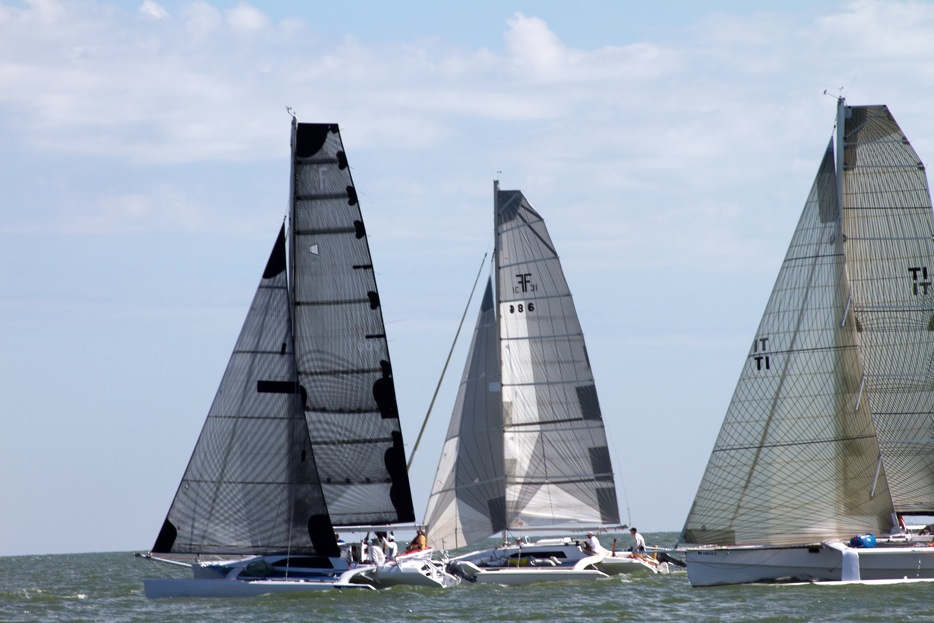
The B mark was more of an offset mark to keep the spinnaker boats away from the inside H16/Wave course, it was too high to fly the kite and it was a deep run from there to C which usually required a gybe. Second and third laps were from C to A and back only, no B.
1/2 mi away
Yes, but it went by so quickly! <img src=

alt=
/>
A dorito and two hot dogs.
A B C
A C
A C
You have the theory correct. We start the fast boats first on the outer course, then the slower boats on the inside course.
The first reach get the big, hairy spin boats off to the side the first time around, allowing the small boats a fresh course.
By the way, W/Ls came about mostly because of the use of spinnakers. There are lots of boats without spins that love reaches. Nothing old fashioned about that.
And the Waves hate downwind legs, thus the adopted course for the Wave Class is triangle, windward, leeward -- give the boats two upwinds, two reaches and one downnwind.
Hope this doesn't make me old fashioned. <img src=

alt=
/> Seems to me I got the same **** from Matt Bounds last year.
Rick

DISCLAIMER: These comments are directed at the reach/no reach debate overall, not a specific person or event...
In my experience, reaches started going the way of the dodo several years ago, mainly because they were considered to be
non-strategical.
In other words, reaching legs tend to be follow-the-leader. The only way boats can pass one another is by better boathandling, and the assumption is, everyone at a championship is excellent at boathandling. Note the word
assumption.
<img src=

alt=
/>
Spinnakers have been around for much longer than this mindset, so I don't attribute that as the cause.
The other consideration about reaches is that they require additional safety and mark boats. You have a mark at a different place on the water, so making a change in response to a wind shift will require another mark boat. Competitors are far more likely to capsize on a reach, so you need more safety boats.
Personally, I agree with this idea for major events, but we all sail cats because we like to go fast, and reaching is the fastest point of sail. I feel pretty strongly that reaches should be used at all normal (non-championship) regattas, especially if the sailors want them.
Which is another thing that can't be understated, a good PRO really needs to listen to the OA and fleet reps to be sure he is providing the racing they desire, not the racing he prefers to provide. Sometimes, this is hard to watch, for example, I have no idea why big mono sailors want to race two or three races per day and throw away several hours of beautiful wind and racing conditions. But, as their PRO, I'm not going to start a fourth race just because that's what I'd want as a sailor. That's how you don't get invited back (on a good day), or get ripped apart on an open forum... <img src=

alt=
/>
Mike

For some additional detail about the reaching leg at Tradewinds, checkout the photo sequence posted this morning at www.teamseacats.com We sure passed a lot of boats on the reach!
Nice! Like I said...
better boathandling...
<img src=
alt=
/>
Mike
But how do you learn that
boat-handling
on a reach if you never get to do reaches in a racing situation?
If you want to read a great story, go to the CABB forum and read
Tradewinds, the rescue.
See my prior message Mary, I'm in favor of reaches.
Devil's advocate: if you're never going to see a reach in a race, why would you care?
Mike
Because someday the devil might be chasing you and you are going to need to go like hell to avoid ending up there. <img src=

alt=
/>
Well, I'm not usually ahead anyway, so there's little chance of that... <img src=

alt=
/>

Windshifts happen...

Hey, I resemble that remark! (Actually, it was two years ago.)
I don't have anything against reaches either, it's just that one time I was at Tradewinds (2005, the last year at Gilbert's) it felt like a time warp. Old starting sequences, old courses. NTTAWWT <img src=
alt=
/>
I like reaches . . . when I'm ahead. Nothing better for stretching out the fleet.

I like 'em ! its all about balance.

Yeah...balance.
In the old days
I recall downwind finishes as very rare but the 'B' mark was always judiciously mixed in. While the gate and downwind finishes are interesting it seems some RC's get
stuck
on calling one course, for the day. In 15 events sailed in the past two seasons I recall an upwind finish at three events, and at two of those it was only the last race of the day. I'm happy to hear the comments in favor of the reaching mark. And even if not a B mark, how about more 6's and 7's?<img src=
alt=
/>

Spinnakers made the reaching legs even more unattractive in the
non-strategical
aspect.
Spinnakers can run pretty deep and so even a mildly spaces reaching leg quickly turns the
downwind
leg into a single spinnaker reach to the bottom-mark without a gybe. This means that, with the exception of the upwind beat, the course has become a parade. And one where the guys winning the first upwind leg has by far the best cards as overtaking other boats in a parade is difficult and will slow you down sufficiently to see the leader walk away.
Something the reaching leg was so long that the spinnaker boats would have to drop the spi on the following broad reach and reach to the bottom mark.
Both these make spinnaker sailing very unattractive c.q. unenjoyable. As most racers were gravitating towards spinnaker cats they actively pushed for a race course without a significant reaching leg. As such the reaching leg became an rather short offset leg (max 200 meters) to maintain some seperation and avoid conflicts at the A-mark. Without that benefit it would have died altogether.
Spinnaker did do that to catamaran race courses; it finished off the triangular race-course in a very short time-frame where it had been struggling to maintain itself under pressure of tactics. It was the sharp and final blow that did it in.
Wouter
Hey Matt, maybe you're having a bad day with cut-and-paste, but that was not a quote from me. I intentionally omitted names from my disertation on my understanding of the subject. <img src=
alt=
/>
Wouter, I disagree that
most racers were gravitating towards spinnaker cats
at least in the US. Yes, there are more than there were 10 years ago, but the far and wide majority of racing cats in the US are still uni or sloop rigs. I do agree that the offset came about because of spinnaker boats, but that is a completely different issue.
I recall this issue of removing reaches from championships as originating from the Olympic level, many years before the Tornado had a spinnaker.
At most of the cat events that I run, we either have too few mark boats to run a reach (at the
fun
races), or fleets of sailors who don't want them because they prefer to use points regattas to train for major events, where they never see reach marks anymore (for the strategic reasons in my prior message).
Mike
That was Rick I was quoting, not you, Mike.
From a PRO perspective, you give the sailors what they want, not necessarily what you think is
best
for them. If they want a reach or two, and you've got the resources to pull it off, then you need to give them a reach.
If there's going to be a reach, it should not be the second leg of the race (which just stretches out the fleet). If the wind is up, the next to last leg (before an upwind finish) is optimal for a tight, double-trapeze reach. Good for some crash and burn action. <img src=
alt=
/>
A way to separate fleets of differing performance profiles (which is what Rick was trying to accomplish) is to use a trapezoidal course. Takes more resources, though.
I know, but you can't tell from that post.
Anyway, traps are GREAT! Best thing ever for separating fleets. You're right, they're hugely resource-intensive. Adjusting for wind shifts is a major PIA...
Mike