

Take NO offense,......just a 'I wanna know" thing.
1. Is it true,.....A-Cat race rules dictate a STOP in racing at winds 22 mph or higher.
2. If true. ...then,....is it a mechanical thing?
( ...stuff starts breaking....)
....is it a technology/design thing?
(...that is the upper limits of the design...)
or....is it a human thing?
(....too much to deal with, all things considered..)
..all input requested.......like I said,..looking for info and insight,.........no negative comments please!
Bruce
St.Croix

Boat damage = expensive.
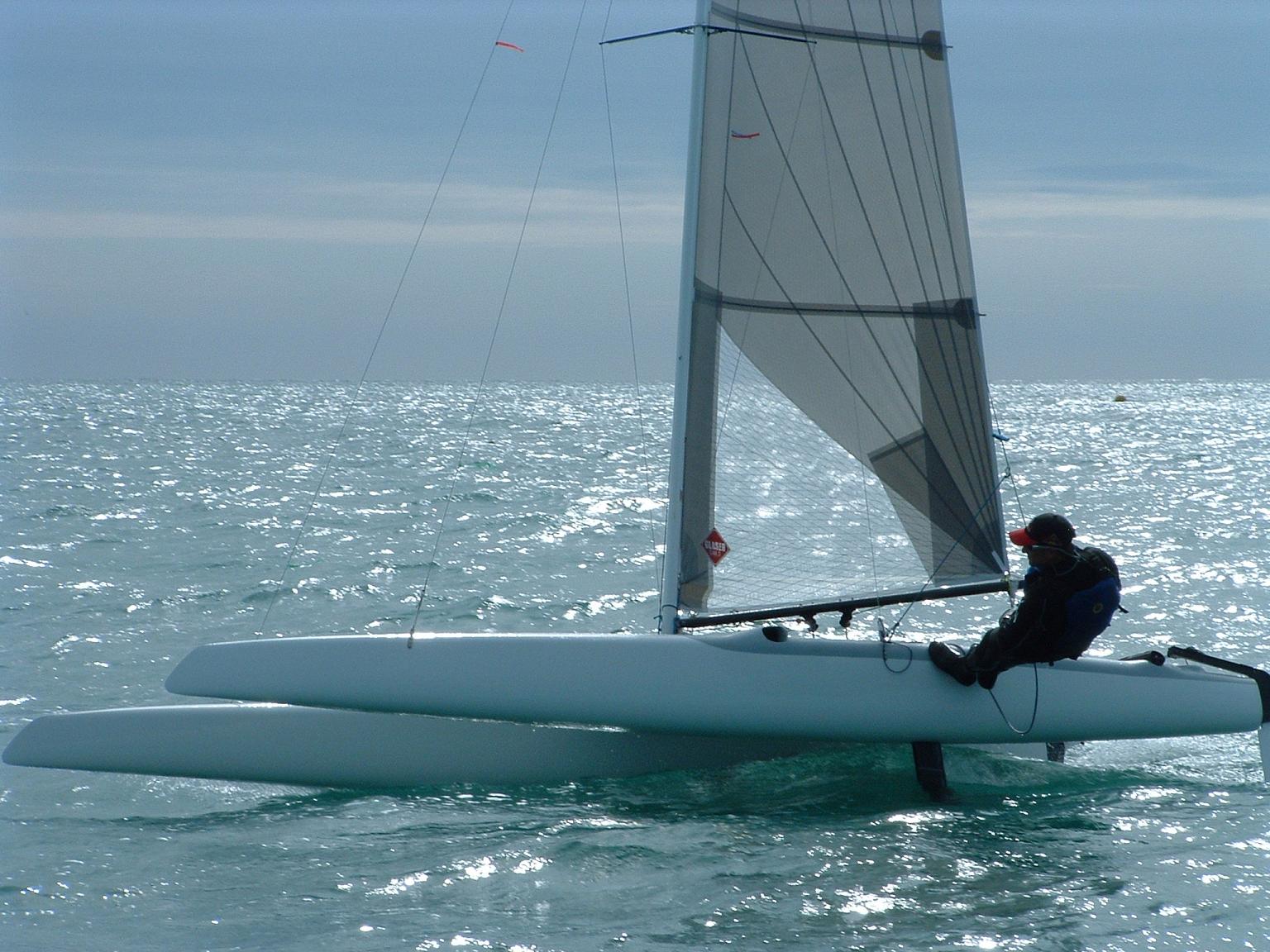
The 22 knot sustained max (it was knots, not mph as your post indicates) was used for both the A-cats and Tornados at the recent World Championship at Martha's Vineyard.
Most race committees understand that there is a threshold for FAIR and SAFE racing. Many national and world championship events in both multihulls and monohulls recognize that this threshold is somewhere around 22-25 knots of wind and use this in their racing instructions.
You should remember that you live in an area with warm water and warm consistent trade winds. That gives you an advantage many of us don't have in that you get alot of time sailing in heavy breeze and most of it you could do in a rash guard and shorts. Many championships are held in areas with much colder conditions. This is typically a weighing factor in establishing a safe maximum threshold for the SAFETY of the competitors.
Based on my experience at local, regional, national, and international events it seems that the average weekend warrior cat sailor crews have their hands full in 15-20 knots of breeze.
I think the sustained wind max of 22 knots is a very smart and wise race management rule that looks out for the best interests of the competitors.
Bob Hodges
A-class USA 147

22 kts=25.3 mph.
That's a LOT of wind. It's NOT an A-class thing...the sailors at the H20 champ's last year were bitching (understandably) about the conditions, and they were NOT 22 kts sustained. I think that a class-determined max. would be a great idea, because it keeps competitors from feeling that the decision was arbitrary on the RC's part (or worse yet, biased), and makes the RC's job easier, since they don't have to weigh life and limb vs. fun.
Frankly, in the lawsuit-happy U.S., I wouldn't want to be on RC and start a race in 26mph or more (i.e. above 22 kts) of wind.
Michael Coffman
P.S.
You can take this discussion as a compliment to the abilities of sailors in the BVI's, etc, that are great heavy-air sailors 😉
What is the "wind speed limit" for sailing with spi up, for an above average sailor, sailing say an F18 F20 or HT's ?

It gets pretty hairy at 22 knots on my A-cat, besides I'd like to keep this sail for a while! Actually I haven't seen one break yet because of wind. At the Hobie 20 Nationals last November 2001 it never got over about 20 and it was a lot of work but fun. The 2000 Hobie 20s/ Pensacola one morning it was close to 22 knots and many did not go out to race: those that did were doing repeated cartwheels including Woodie Cope. Tough conditions.
Hi Guys,
In Austalia we are ment to stop racing if the wind exceeds 22.5 knots for a sustained period of time. Many insurance policies do not cover us in winds over this, therefore clubs and classes have adopted this as their wind limits.
Had the kite up on our Tornado twice in winds in excess of 30 knots and reaching as high as 36 knots. Very scary, very exciting, bent the mast and broke battens in a HUGE catwheel the last week. Time to ring Marstrom.
Go Hard
Stephen Medwell
Team Tornado 'ALIVE'

Just a couple of thoughts about the "wind". For one thing most people usually overstate what the wind is
really blowing----22 mph is a lot of wind! Also, the sustained wind is one thing, but often it's the gusts
that get you! In Tampa last fall at the Hobie 20 nationals Mr Davis (PRO) made his famous statement about the sustained wind not exceeding 18.7 knots----no doubt that was true, but the gusts were well into the
high 20's and those big gusts were what was taking so many people down!
I think you hit it on the head! Cat sailors are a bit like fishermen when it comes to judging wind and hull speed. We talk about the 30 knot gust when in fact it might be a small...tad bit...less? If you want to see what these winds look like go to floridamultihullsailor.com and look at the pictures of the IRCA campout.

I can tell you from experience (like many of you can) that sailing in a LOT of air is pretty dern risky... when we left the beach the last day of the Worrell, it was blowing +/-30 with the gusts well beyond that... We were reaching and I can tell you from the GPS that we broke 30 mph SEVERAL times (like during every puff). We had the sails eased and were on the edge of out of controll even in the lulls....lets not talk about what happened when the storm hit (National Weather Service Measured gusts above 60mph). It bewilders me that an I-20 can handle that sort of abuse, but I know that there are boats that are not built nearly as well as Inters are.
I enjoy big air... i also enjoy REALLY BIG air, but unless you can do it safely (boat and sailors), you should not be out there. I don't know if the SI's should dictate upper wind velocites. I do think, you should know your limits and not go out unless you can handle yourself.
If you are going to win a major regatta and prove yourself as one of "the best", you should be able to handle whatever is thrown at you. I will go sail in 35+, but consider 30mph the upper limit of what is truly sailable...it just becomes a "game" of survival after that.
Will R

I think there is another valid, and more charitable, reason that sailors seem to persistently overestimate the wind speed. They are feeling the apparent windspeed while sailing, not the true wind speed. So when they are going upwind at ten mph in a 20 mph breeze, they feel something close to 30 mph and that is what they report. You can easily "prove" this yourself by taking windspeed readings while stopped, then sheeting in while continuing to read the windspeed while trapped out and going full tilt. Quite a difference! Now add in the spray and it seems like even more! So they go in and report what they felt without mentally subtracting the boat speed to arrive at the true wind speed. It is a natural, understandable effect. All we need to do is to ask the question if that was apparent wind speed or true wind speed and most sailors will realize what they have been doing subconciously. Sailing on "big boats" with all the high tech electronics gives one the advantage of knowing exactly what the windspeed is but the mistake commonly made there is to not adjust for height off the water. A masthead wind instrument on a forty footer is often more than 60 feet off the water where the air can be moving significantly faster than close to the water surface. So even with good instruments the wind speeds are often over reported unintentionally. So I think the most useful reporting often is not wind speed but rather specifics describing the effect of the wind. (e.g. "we were double trapped with 320 pounds combined flying a hull while playing the 16/1downhaul to the max setting in puffs"). BTW, for regatta reporting purposes, I think the same principle applies for temperature because of the combination of effects caused by air and water temps. (e.g. "we were cold in our shorty wetsuits in the 80 degree sunny air because of the drenching we took every time the boat crashed through the 3 footers churned up by the wind against the current"). Tells you a whole lot more than "it was 80 and sunny", doesn't it?!
Mike

I know its unhealthy to hold such opinions, but I don't consider it worth sailing unless its blowing at least 15mph, and I don't have fun unless SOMETHING breaks on my boat 😛
At the Performance Nationals a few years back at Roton Point Connecticut the wind was blowing a stead 20-21 knots with gust into the upper 20s. At least a third of the 6.0 fleet stayed on the beach because it was scary windy. Most people I know would have described it as 30 knots plus if there had not been a wind meter present. To the best of my recollection the wind meter was about 10 feet above the dock, or about 13 feet above the water.
The other memorable wind reading was standing on a beach at Muskegon MI with the Hobie 16 fleet quite a few years back. It was blowing really hard, 20 to 25 knots. The kind of wind where you get dressed before you raise the sails on your boat because you won't even consider leaving your boat unattended in that much wind. The boats were just shaking on the beach. Matt Bounds went back to his car and got a wind-meter. It was blowing 14 knots with gusts as high as 17.
To All,
I want to thank all of you for a great thresd here.
.....info,....
...international,..
...helpfull,...
...and the funny one about ' not being happy unless something breaks"..!
...don't you know the squall line ALWAYS appears on the race course after a clear-sky start!!! So, it is a little late to call the race when you are in the middle.
...I would rather be on a racing cat in 30 than a monohull,...the last time I raced my Hobie 33, a 30-ish blast put her spreaders in the water,....I know it is a Hobie but the chapter in the manual about 'righting a 33' was left out...
Bruce
St. Croix
I had the opportunity once this summer to do screaming reaches and deeper in 25 gusting to 30. All that was going thru my mind was, "At least I'll die happy!!!"
With regards to the regatta where we had winds in some races in excess of 30 knots and a peak gust of 36 knots, this was measured from a wind meter on the start boat. The winds slowly built (Strong sea breeze) and the proceeding races were cancelled.
We flew our kites in these winds along with Nacra 5.8s and F-18s and all made it around the race course - some with a few swims. A class boats were also racing and survived without damage.
And as far a prefering to be on a cat than a mono when a sqall hits, I agree. Was caught out in a 60 knot front (offically recorded by the Beuro of Meterology) during a race and was forced to ride it out on the top of the up turned cat. Try hanging onto the top of an upturned mono in these conditions.

The Version 2.0 Labor Day Race had a front blow through with sustained winds of 26-28 knots (confirmed by weather station on Chesapeake Bay Bridge Tunnel). I was on a Bim A cat, survived with no damage and only capsized once, but it was not what I would consider fun sailing. Per the GPS, I was able to only maintain an average of 8 MPH headway upwind. At times, the confused seas would launch the boat airborne and the boat would literally fly five feet to leeward before hitting the water again. To say the least, these conditions were not conducive to racing as a majority of effort was spent keeping the boat under control, not navigating the course or keeping track of the competition. Forget the concern of the integrity of A cats as many committee boats should not even be on the water in these conditions.

Jim, you mention one point that many seem to forget, that it is not just us cat sailors on the water, but the committee and crash boats.
We can usually survive and even race in conditions which very few crash boats could. And even if they could survive, the conditions would prevent them from being able to help anyone.
The high windage of most committe boats makes it very diffcult for them to anchor and the committe members have to take a lot of physical abuse.
The large inflatable marks can make it very difficult to "set" an anchor. What is more depressing than working your butt off in a race and then to have it thrown out because the marks shifted!!
Some people should look at the big picture.

I know the safe way to go is stopping at 22knots on a A cat,
But there are some smaller sails available for 22knots+
I myself stop at +/- 30 knots on my Nacra 6.0 .
Anything above there is almost no one on the water to rescue you in case of an emergency.
Also you should consider are you sailing on a lake or at Sea there is a big difference from the impact of the waves to your material.