

Rick,
what do the class rules say about having a speedpuck?

Nothing. What would you do with it?
Rick
What's a speedpuck? <img src="<>/confused.gif" alt="confused" title="confused" height="15" width="15" />
Electronic device we sell
https:/
Rick

Rick
Air Hockey?
Yeah! SOmething like that. What I didn't understand is the class legal thing. If you use compasses, GPs and the like while racing a Wave, you will be left in the dust. You HAVE to get your head OUT of the boat, not be looking at electronics. Just my opinion, but I am sticking with it.
Rick
Just trying to make the change from larger keel and multihulls to the Wave. A bunch of money gets spent on electronics for the bigger boats, but I figured out by your initial reaction to my question what your take on it would be. I will call it the acoustic version of sailing as opposed to the electric version.
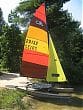
I agree with Rick. No time to look at this thing when you are racing. But it is very cool to review your race afterwards.
You can upload the file to your computer and watch the whole race again. I reviewed my tacks after my last outing and they were pretty sloooooow.
If anyone does have a problem with you having this on your boat, you can set it to datalogging only - no display of speed, etc. but you have to change this setting with your computer.
That might be helpful -- finding out when you went the wrong way after the fact, but useful for the future.
I get asked to race on big boats quite often. Most have a fortune tied up in electronics. When I get on the boat, I take my 8-Track tape (presently using a very fast tape --
Abba
) and tied on both side stays, and the end of the bow sprit.
Then I never look at the electronics.
If a night time distance race then I use the electronics. I always try to keep my head out of the boat at all times.
Rick
When practicing, you can also use the feedback to make adjustments on the water. I mainly use telltales and my Barney video tape on the spin bridles, but I am still figuring out how to sail this boat and I appreciate all the feedback I can get on mast rotation, downhaul/mainsheet, etc.
Mast rotation is not a biggy, since it is almost round (not tear drop shaped). Of course, it should be rotated. But, in sail designing we have treated the mast as a fixed stick, building the main draft in the sail farther aft than you would with a high-tech boat with a wing-type mast.
Downhaul to get the wrinkles out and then some more. I actually downhaul hard even in light air with my sails -- I am using the Calvert Color-Load design which we have found to be very fast.
Sheeting upwind is an artform in itself. Here is a good way to find a good slot. With the boat at 45 degrees to the wind on shore, downhaul applied, sheet in from directly behind the boat.
Eyeball and line up the sheet block and the mast base. Then sheet in until the leech of the sail lines up with the mast vertically. Now, that is too tight. So, ease the sheet off until the leech is a bit off the mast.
Cleat the sheet and go mark the Sheet with non-washable ink. I mark the sheet between the upper and lower block in the front.
That is my starting point. If the wind puffs, I sheet in a bit more. If it lightens up, I ease it a bit. But, I use that mark as my base.
This is really handy after any maneuver, i.e., tack, start or mark rounding. While most are in and out looking for the sweet spot, I already know where mine is.
Hope this helps,
Rick
Good information Rick. I have marked my spin halyard but hadn't done the main. I also have marked other lines as well to speed up setup.
Rick,
I would suppose that the same thought process would apply a to a wave as far as marking the mainsheet?
That is what I was talking about --marking the mainsheet. I mark almost every line on every boat. With the Wave you only have two strings -- the halyard and mainsheet. My description was of the mainsheet.
Rick
Rick,
My Wave just got delivered yesterday and I had a great time out on the water. My new question is, why is there not a downhaul like a H16.I realized after I was out that it was too loose and it was difficult to adjust at 15knts.
Do you mark mast rotation on your taipan? I think it has a wingmast, doesn't it?
My Wave just got delivered yesterday and I had a great time out on the water. My new question is, why is there not a downhaul like a H16.I realized after I was out that it was too loose and it was difficult to adjust at 15knts.
The Wave has a very good downhaul system, with 4-1 purchase, which is plenty to bend the mast as much as necessary to flatten and depower the sail.
The downhaul line is 8 feet long. You tie it to the grommet at the tack of the sail. You should have two horn cleats on the back side of your mast. You run the line from the grommet down and around the lower horn cleat and back up and through the center hole in the upper horn cleat, and back down and through the center hole in the bottom cleat, back up through the hole in the upper horn cleat, and back down and around the bottom of the lower horn cleat and then just do a half-hitch around the batch.
There are variations on that scenario, but you should somehow end up with two sections of line going up and two going down, giving four-part purchase.
I can adjust mine on the water with no difficulty -- but I have to stop the boat, of course, to do it, and have it headed up into the wind, since I am singlehanding.
Usually, it is easiest to set the downhaul on shore before you go out, depending on the kind of wind you expect. But you definitely CAN change it on the water.
Mary,
Thank you. It might have helped if I read the rigging manual or watched the DVD.
We set the class rules up similar to the early Lasers. You are allowed 8' of line to downhaul. Mary described it quite nicely.
We have finally talked Calvert sails into using a large grommete for the tack of the sail in order to accomodate the line going through it three times.
Calvert might start using a device similar to windsurfers in the future where there will be no overlay of line.
While the Wave appears to have a wing-type mast, it is not much larger on the major axis than it is on the minor axis, making it almost round
When we first did R&D for Calvert we treated the mast as a we would any other cat with a rotating mast -- rotate the mast so it is a part and extension of the sail area.
However, the almost round mast of the Wave it not very effective in doing this. So, we started making sails as if it had a fixed stick -- moving the draft a bit farther aft, and voila! It was much faster and better.
So, while the mast should be rotated, it does not really help the speed of the boat.
I made the mistake of putting Mclube on the rotator ball. Then when I sheeted it straigtened out the mast fore and aft. Now I just leave it sticky. Works better that way,
Rick