

That is the question.
Is it just something you have to get used to with the chute up, or is it even really neccessary? Right now the only time I trap out with the kite is when I screw up and overstand the mark and need to hold the boat down. I know for me its faster to be either sitting on the hull or the wing, (depending if they're on or not), than it is to trap out, but that is only because I screw up more when I'm on the wire.
Is there really any difference running a higher/faster/longer course VS a lower/slower/shorter course?

Good morning Karl!
Very good question and one that has been bounced around here for some time. Here's my take on the subject.
1. Course racing; upwind-downwind. The best way to get to C mark is staying in on the tramp and to keep the hull flying. We did a test of this back in 2003 at key Sailing with a course laid out in the sound. One boat trapped and the other did not. At the time the school of thought was to trap. Winds were about 6-12 for the test. The boat that sailed non-trapped won every time by a lot; minutes. Like you have already said, if you overstand then trapping is the solution. Trapping makes for very wide angles and non-trapping makes for a much smaller
box
(inside laylines). Best way to know what your boat can do is to set up a small course and get out there and gybe away to your hearts content! Take your knew found knowledge to a race and see what happens!!
For me, sitting on the hull is much faster in the gybes. It also allows me to make a better call on the laylines and keep me inside the box.
Hope this helps,
Bob <img src="<>/wink.gif" alt="wink" title="wink" height="15" width="15" />
I'm semi surprised at those results, but things are way easier to deal with when sitting.
Ok, now to add another factor. When the wind is lighter, I'll scoot myself to the center of the trap to try and keep a hull flying. Would this pay out in more moderate conditions? Once again with the thinking that a lower course can be had while still keep a hull out of the water?

It would be interesting to hear of similar
tests
in 12-18 knots. The rule of thumb we used to use on the F18 was if fully powered up upwind (about 10-11 knots) then one on trap down wind so our cross over lands right at one end of your test.

I think the majority in the F16 1-up class have the exact same experience as Bob here. I know that I do. Personally I also feel that the much faster gybes when sitting in is a significant advantage.
On the other hand trapping under spi is very cool !
But I hardly ever do it in a race, last time probably was 2 years ago.
Wouter
Karl,
You are correct. In lighter winds, move your weight inboard and forward to help promote the hull flying. In moderate winds, move back and outboard to keep the leeward hull from submerging. Keep the hull out of the water as much as possible but don't fly it too high!
Bob <img src="<>/wink.gif" alt="wink" title="wink" height="15" width="15" />
S-C,
I guess all our racing in those conditions could be considered a test! On a singlehanded cat, you must sail the smallest course possible due to lack of sailplan and weight leverage. Your F18 technique is right on for that boat and the uni-rigged spin boats must find a different approach.
In 03-04, the F17 class champion was one of those who trapped in most conditions downwind. He was very good at it (he was a Worrell veteran) and we managed to convert him over to the smaller downwind course. It was a hard habit to break but soon he was with us again at mark roundings and made for very exciting racing. Simply put, the single hander just doesn't have all the tools at their disposal, crew and more sailarea, and must find another way(s) to go fast. Thanks for the thumbs up Wout!
If you have overstood a mark, you have only 2 options. One is to trap and the other is to continue to sail until a reaching angle is obtained to lower the spin. Getting out and sailing will help with processing the information.
Bob <img src="<>/wink.gif" alt="wink" title="wink" height="15" width="15" />
You're welcome !
Same overhere. With the seastate we have overhere I tend to almost exclusively for the
continue then reach
solution. Everything is better then stuffing it. Sadly it is not a solution that can correct an earlier mistake only minimize the hit you take.
Again this refers directly to the need to plan well ahead when doing 1-up spi sailing.
Fair winds to you all,
Wouter
So if you overstand the mark, and continue on until you are in a position to reach, what is the procedure for dropping the spin? For me its dropping the traveler, and turning down then snuffing. Are you dropping it on the reach? I think that would turn out poorly for me, perhaps it just takes practice.

I'm one of the F16 sailors that disagree! John P who won the F16 GC this year also wires down wind to great effect.
If I am wiring upwind, I Will wire downwind, up to about 20kts(I fall off too much above that!!!), but if it is a small course or there are lots of boats, you need to be able to manover more and so wiring makes it too difficult to gybe quickly.
I've also sailed the EU Spec Inter 17 and would also wire SOMETIMES; but because the boat is 55kg heavier than the F16, you are almost supplying the same righting moment by NOT wiring on the I17 as you are when wiring on the F16.
Karl,
Once you get to the reaching point, douse the spin like you normally do. Then get on to the mark. It does take time on the water.
Bob <img src="<>/wink.gif" alt="wink" title="wink" height="15" width="15" />
Simon,
What I detect here is different techniques for different waterline boats. Remember, we are 12 to 17 inches longer than 16' and we have more bow forward of the main beam. So, our downwind technique will be different for the boats.
Bob <img src="<>/wink.gif" alt="wink" title="wink" height="15" width="15" />

With the Taipan F16 uni, I was much faster VMG sitting on the tramp, always keeping the hull up while sailing deep as possible. Keeping the hull up while sailing deep is really key factor, and I imagine that's just as true with the nacra 17. Trapping downwind on the Taipan did not offer a net gain because you could only push it so hard until you ran out of bow volume. For tactical reasons, I have occasionally found it helpful to trap w/spinnaker; eg if the course has a reach and the wind is light enough to carry the spinnaker.
Looks like I won't be on the wire unless I absolutely have to from now on.
What I detect here is different techniques for different waterline boats. Remember, we are 12 to 17 inches longer than 16' and we have more bow forward of the main beam. So, our downwind technique will be different for the boats.
Bob <img src="<>/wink.gif" alt="wink" title="wink" height="15" width="15" />
I have T foils and so my boat behaves even better down wind than my Inter 17; I assume there is not that much difference between the EU17 and the current F17.
It maybe that fleets just go with skills that suit that fleet and the skills within it.
It has to be said that the F16 fleet is split on it. Some do; some don't!
That is probably the best desciption of the 16" situation.
I sail the (modified) Taipan and I have the same experience as Eric Poulsen. Of course the Taipan is known to be a boat that reacts very well to wildthinging (keeping luff hull out of the water), so that may be a factor as well.
Bob is right of course that small differences in boat design can lead to different outcomes in this field, but I also value strongly the much improved manouvrebility when sitting in. You can make a (crash) gybe much faster and that is also a big reason why I favour this approach.
Wouter
On every boat I have sailed there is always a crossover point in thewind range where your VMG (spped to next mark) is better by wiring downwind.
the issue with a singlehander is of course control, but once you learn how to deal with that you will be faster to wire it.
Sitting in so you can
crash
gybe faster is not really giving you the best VMG...
crash
gybe faster is not really giving you the best VMG...
Non but it does allow for tactics and better positioning when approaching C-mark. Very important things in themselves.
Wouter
I think you will find yourself in a better position at C mark if you go fast towards it rather than plan for what will happen when you get there and therfore go slower than you could be
Guys,
Here's what I've learned about the F17 downhill after 5 years.... <img src="<>/cool.gif" alt="cool" title="cool" height="15" width="15" />
It is faster to C mark not trapezing downwind on this platform. By the time you get adjusted to get on the wire and handle the sheets, I'm an easy 8-10 boat lengths further along the route and I'm sailing a much smaller box. Yes, it might be just a tad slower but the height gained more than offsets the speed of the trapped boat. Then when you have to gybe, I've gained another 20 because of all the in and out of the trapeze work. Then at the C mark, I've gained more because the trapper has to come in and situate before the douse. Keep adding the boat lengths for 3 downwind legs and you have quite a sizeable lead! <img src="<>/grin.gif" alt="grin" title="grin" height="15" width="15" /> We did a whole day of testing the concept and the trapped boat NEVER gained an advantage in the buoy race tests. This again is only about the way the F17 sails and in competition. The whole point of this exercise is control; whoever has the most control will be the fastest. Distance racing and overstanding are trap happy! I would imagine (and after sailing one) that Karl's boat will react the same way.
Bob <img src="<>/wink.gif" alt="wink" title="wink" height="15" width="15" />
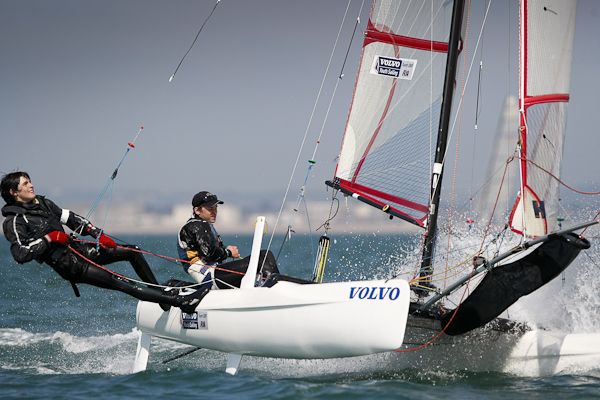
In strong winds u want to trap, the boat will then be less prone to nose diving and u will be more in control and more powered up, also u will be in a better position for over taking people.
getting out on wire with the kite is easy, dont use the handle of your trap just go out on the toe straps, then uve got 2 hands to control the boat with.
NK,
Please engage a few regattas with the F17 racing against a top fleet and tell me what you come up with. It sounds like you sail a F18 in EU where the F17 sailors are way behind in techniques. They will catch up quicker if they read certain posts on this forum.
Let us know what races you plan to attend and provide pics please! Besides, Q: if it's faster then why isn't the USA fleet doing it? A: It's because we tested and saw the light years ago. And that's why we post here; to share the knowledge.
Have a nice day,
Bob <img src="<>/wink.gif" alt="wink" title="wink" height="15" width="15" />
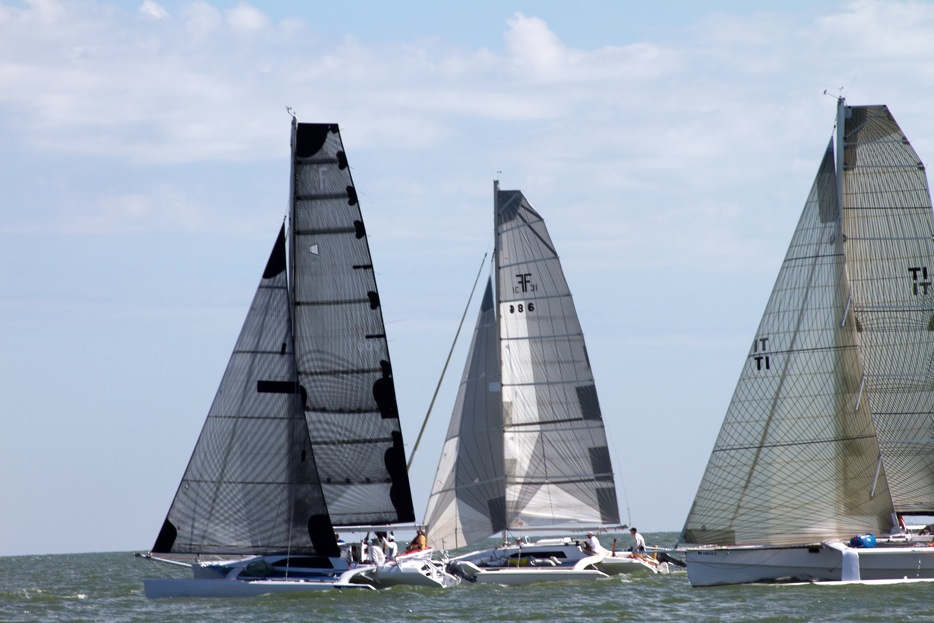
yeah Kid...
didn't you notice that the Master Unirig Sailor had spoken?!!?
All I know is that it is really slow when you're dragging behind the boat. Our when you haven't added footstraps and you stuff it hard and dance to the front of the boat. Which sometimes plays out. Since your going forward, and are hanging onto the spin sheat it'll pull out. Sometimes...
When its getting windy I throw the wings on. Trapping off of them going upwind is sweet, downwind not so much. The wings do extend past the transom a couple of inches so I can really get my weight back that way. Somewhere in there it doesn't matter and it still sticks the bows more than I'd like. Hence the other thread about pulling the boards up. I'm learning, slowly, and I'm getting real good at righting the boat. <img src="<>/smile.gif" alt="smile" title="smile" height="15" width="15" /> I'm a bit in limbo about the wings. The extra weight is definatly noticeable in the lighter stuff. Dragging the extra weight around isn't a good thing no matter what, but I'm right at minimum weight and in any wind over 15 I have alot of trouble holding it down going to weather anyway, and the added leverage helps alot. I did sail it one day with out the chute, or the wings. Wow, very responsive when you ditch probably 50lbs of hardware!
Bob- How long is the F17? The FXone is 17', 2-5/8"

Rather than one rule of thumb, doesn't sea state have quite a lot to do with it too? I mean, if you need to head up a little and get out on the trap so the boat takes a better angle to the waves, wouldn't that be faster than sitting in and running the bow into the backside of the waves and slowing on every wave? just curious because where we sail the waves are short, steep and really close together.
Please engage a few regattas with the F17 racing against a top fleet and tell me what you come up with. It sounds like you sail a F18 in EU where the F17 sailors are way behind in techniques. They will catch up quicker if they read certain posts on this forum.
Let us know what races you plan to attend and provide pics please! Besides, Q: if it's faster then why isn't the USA fleet doing it? A: It's because we tested and saw the light years ago. And that's why we post here; to share the knowledge.
Have a nice day,
Bob <img src="<>/wink.gif" alt="wink" title="wink" height="15" width="15" />
Guys...
Remember we are talking about 17 foot singlehanders here....
Bob <img src="<>/wink.gif" alt="wink" title="wink" height="15" width="15" />
What I meant to say is we just get the hull flying and the hull length takes care of the rest.
Bob <img src="<>/wink.gif" alt="wink" title="wink" height="15" width="15" />
Remember we are talking about 17 foot singlehanders here....
Bob <img src="<>/wink.gif" alt="wink" title="wink" height="15" width="15" />
Agreed.; But my Inter 17 was far worse down wind than my F16 with T foils when it's howling. I pitched by 17 in a few times, but this was in loads of wind, I've sailed the F16 in similar without problems.
My view that it is partly due to how a fleet evolves.
My F16 is better downwind in marginal conditions simply because it has T's.
Remember we are talking about 17 foot singlehanders here....
Bob <img src="<>/wink.gif" alt="wink" title="wink" height="15" width="15" />
Agreed.; But my Inter 17 was far worse down wind than my F16 with T foils when it's howling. I pitched by 17 in a few times, but this was in loads of wind, I've sailed the F16 in similar without problems.
My view that it is partly due to how a fleet evolves.
My F16 is better downwind in marginal conditions simply because it has T's.
Hmmm... apples to oranges. Your former Nacra 17 had the smaller alum mast and bigger spin than what we are running now in the USA, taller mast, higher aspect mainsail and smaller spin. It is quite balanced and easy to push when the breeze is on. It really is
when the competition backs off we keep going
!!! <img src="<>/grin.gif" alt="grin" title="grin" height="15" width="15" /> I'm glad to hear your T foils work so well.
Happy Holidays!!
Bob <img src="<>/wink.gif" alt="wink" title="wink" height="15" width="15" />