

How effective are the anti dive foils on a H16? Anyone made their own? Any hints on attachment? Sorry if this is over posted, my searching skills here are elementary.

Back in the 80's I made some symmetrical 13" foils the cord was about 9" and mounted them on the bows. They were Hard wood. they were cut half way through the back side and mounted onto the lip at the front. they worked extremely well, I drove the bows onto them and they never let the bows go under. I would do it again if I had a 16.
Banjo13. Allen.

It's been a while since I ran a 16, but I certainly remember the pitchpoles vividly. I've no experience with the anti dive foils, but with experience I learned to move crew weight way aft in risky conditions, substantially reducing the amount of time spent in the water. Not saying you don't need them, but you may outgrow them with time.
Dave

Those things are useless

Totally agree. Learn to sail the boat fast by staying back in heavy air, forward in light air (especially), and having main sheet cleat angle at correct angle for fast release as well as getting rid of half inch sheet for 3/8 or 7/16 . This is not a sailboat, but a catamaran. Pete
Good advice there, when you are tightened down all the way, you should be sitting on the very back corner of the trampoline. Crew should be as far back as possible.

just u-tube and you will see that even world class professional sailors get pitchpoled when out in xs wind.
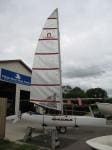
Honestly I would look at them as insurance. Yes you should learn to drive your boat but the proclivity of the h16 to pitchpole is notorious and can be dangerous. If it will help you recover from a screwup without firing you and your crew out the front that can't be anything but a good thing!
i think if you ever get the bows down past these things, they will help induce the pitchpole and make it harder to "save it" and recover
I think everyone needs to learn the limits of their boat and skills, even if that means learning the hard (and wet) way - I have done a few glorious peter-pans in my day, and flew threw several windows on my main in capsizes.
Now i know my limits better (both skills and when to stay on land) and it happens less these days .
Edited by MN3 on Jan 22, 2016 - 12:53 PM.

Just my opinion, but I think in some ways, a lot of what attracts people to the H16 is the fact that it CAN pitchpole somewhat easily. Let's face it, you can get a faster, higher-tech, more modern design than a H16, but a big part of what makes the 16 a fun boat to sail is the fact that in a breeze, the thing is always in danger of going over one way or the other - be it a knock down, pitchpole, or blowing over backwards. If you want to reduce your chances of pitchpoling, get a H18 (or any other of the countless high-volume cats out there).
sm
The way the foils are positioned they will always provide upforce but the doesn't mean you can't pitchpole it. THe only purpose of the foils is basically like training wheels while you are learning. After a while you shouldn't really need them. But everyone plows the bows on occasion. Having sailed both an H16 with how twitchy it is and my two nacras if I ever had and H16 again I would get the foils.
Pretty sure that what mostly attracts people to the 16 is the fact that they are synonymous with catamarans and there is one H16 for all the other boats made combined. They are about a simple as a cat can get when it comes to setup (excluding the wave and getaway) but a lot of people don't realize that they are also high performance boats very fast and very twitchy. That is the reason there are piles of them sitting rotting on peoples properties. I had to rescue a guy who bought one fore $200 last year. He almost killed his daughter on the stupid thing. IN any case its now back sitting in the bush.

I would suggest as others to forgo the foils and learn to depower the boat in heavy air. Maybe start by reefing the main until you get more comfortable. You will be stepping up to a Tornado so you had better learn to handle the boat. The 10 foot beam of the T is super stable to a point and then it becomes quite the powerful ride as the air picks up. I personally love the way the H16 behaves as built. You just need to be aware at all times where those bows are and even then it can bite you. That is the fun of it all!
Thanks for the good feedback. My pitch pole was 10 years ago when i was new to cats, and it made an impression. Have been super aware of the bow position and haven't gone swimming since, as weight is way back Just looking for some insurance. The adeniline zone has a sharp edge! Anyway the conditions on LI Sound we have been out the past few years have been a challenge, every time the crew gathered it would be 15 to 20 kts and swells of 3 to 5 feet. Usually we go over the swells which keeps speed slow but not sure if punching through one might induce a nose dive. In retrospect some of those days would be best to leave it on the beach, but my mid life crisis mentality precludes that.
Regarding line size, the sheet is 1/2 inch. Do the smaller lines release faster?
Certainly. Thicker line bears on the sidewalls of the crummy Seaway blocks causing slower release of sheet in a puff. Use Tornado blocks if they're Harkens. Pete2u-
7/16 inch was the original main sheet spec, I had that on my first cat also but quickly switched to 3/16" and it was much better. SOme people are even going down to 5/16 but I find it hard to grip on a mainsheet. I also like some of the modern blends for mainsheets like New England Salsa line, it has really good hand feel and cleating.
D.

Hello everyone, best advice as Peter says is to learn your cat. Every cat is different, a smooth responsive handle on the tiller is always your best bet against the infamous pitch-pole of doom. My best advise even before the main sheet release, is to react instantly to the situation and read the boat's behavior through each heavy puff or sustained wind.
Learn to read and anticipate the winds on the water, look over your shoulder. What do the waters tell you? React accordingly by instantly rounding the cat into the wind a degree or two if it looks too heavy :-O , this can be mildly gentle with a man on the trap, or slightly more aggressive response with nobody on the trap. Saves my butt all the time. If your lee bow is skimming between life and death, come to weather a few degrees. Unknowingly to most, you are effectively de-powering your cat.
There are times when you just can't react quickly enough by releasing either the jib/main sheet to relieve the bow. However, you can react quickly enough with the tiller in hand, just a quick adjustment in most cases. Try it, save yourself the the ugly anti-pitch foils, learn to read you cat in all wind conditions and simply react accordingly--simple!
Life is better on the edge!
-Catmann
Edited by catmann on Feb 04, 2016 - 09:30 AM.

To share my thoughts from 45+ years of beach catting: No sheet lines beyond 3/8", teach your crew to 'play' the jib in over-powered conditions, learn how to de-power your at, and get more practice in such conditions.
Bring it on!