

I thought that some one may be interested in the relative performances of the first 4.3 cat built to the Australian F!4 "box rule" was competing against its "bigger" brothers. This is still in the stage of sorting out its best settings.
Results for “The Classic” – Goolwa to Milang yacht race 26th February 2005
(results from the combined Victor Harbour yacht club and the Milang Regatta Club)
Division H Start Time 11:40:00 AM
Class Y/S Helm Finish time Elapsed Pos
AO F14 84 A Barrett 2:07:24 PM 02:27:24 1
Yvonne 86.5 P Hawkins 2:08:54 PM 02:28:54 2
Hobie16 81 B Schahinger2:20:50 PM 02:40:50 3
Mosquito84 S Barrow 2:30:56 PM 02:50:56 4
Mosquito84 P Nicholson 2:32:20 PM 02:52:20 5
Yvonne 86.5P Michelmore2:37:51 PM 02:57:51 6
Nacra5.2 79 N Cuthbertson 2:43:12 03:03:12 7
Hobie 16 81 J Ahern 2:46:10 PM 03:06:10 8
Mosquito 84 R Tuohy 2:48:54 PM 03:08:54 9
Hobie 16 81 R Woodward 2:50:55 PM 03:10:55 10
----------------------------------------------------------------------------------------------------- Results from the “Adelaide Sailing Club” Saturday 19th March 2005.
Division 1 Catamarans Start Time 14:00:00
Class Y/S Helm Finish Elapsed Corrected Place
AO F14 84 A Barrett 16:02:16 02:02:16 02:25.33 1 Nacra 5.8 72 J Wright 15:46:22 01:46:22 02:27:44 2
F18 70 D James 15:47:05 01:47:05 02:32:59 3
Taipan4.9 74 R Cameron 15:53:41 01:53:41 02:33:38 4
Taipan4.9 74 Hallsworth15:53:51 01:53:51 02:33:51 5
Taipan4.9 74 I Nadebaum15:55:30 01:55:30 02:36:05 6
Nacra5.8 72 M Vaughan 15:52:27 01:52:27 02:36:11 7
F18 70 C Dean 15:52:20 01:52:20 02:40:29 8
Taipan4.9 74 H Tucker 16:04:28 02:04:28 02:48:12 9
Taipan4.9 76.5 B Clough16:12:13 02:12:13 02:52:50 10
----------------------------------------------------------------------------------------------------
Results from the Milang Regatta Club “Easter Regatta” Sunday 27th March 2005
Catamarans Start Time 14:29:00 no of starters 18
Class Y/S Helm Finish Elapsed Corrected Place
AO F14 80 A Barrett 15:06:27 00:37:27 00:46:49 1
Taipan 76.5 D Peters 15:05:20 00:36:20 00:47:30 2
Taipan 74 P Edwards 15:04:48 00:35:48 00:48:23 3
F18 70 R Stewart 15:02:58 00:33:58 00:48:31 4
Taipan 74 P Hallsworth15:05:0200:36:02 00:48:42 5
Taipan 76.5 P Short 15:07:14 00:38:14 00:49:59 6
A Class 71.5 J Faturic15:04:47 00:35:47 00:50:03 7
Taipan 76.5 B Clough 15:08:19 00:39:19 00:51:24 8
Taipan5.7,70 M Attwood15:05:33 00:36:33 00:52:13 9
Taipan 76.5 J Bannister15:09:07 00:40:07 00:52:26 10

Looks like you've got a little demon there, Darryl

BTW what were the weather conditions for each?
The Milang to Goolwa started very shifty travelling up river with beats and shy reach's and 40 degree wind shifts average about 5 to 10 knots (variable typical river), from the turn into lake Alexandrina it was broad reach, shy reach, and running at about 8 to 12 knots, once again very shifty.
The race at Adelaide Sailing club started in a SW sea breeze of approx' 5 to 8 knots then settled in at 12 to 15 knots good water almost perfect conditions
the race at the Milang Regatta club at Easter started in 8 or 9 knots and gradually built to about 15 plus with nasty choppy fresh water.
All in all the three races although totally different from each other were all good, "fair for every one" racing conditions conditions
If any one is interested the yardstick that we have been sailing on has reduced from 88 when we launched the Alpha down to 84 for the Goolwa to Milang and at Easter we sailed on a Yardstick of 80, and it is still winning on yardstick!! At this rate we will soon be down around the same as the 4.9 cat rigged Taipans (76.5)! not very far to go for that one

That F14 sails with a 13 sq. mtr main right and a 14 sq.mtr spi ?
Sure enough it will need a rating equal or lower than the Taipan 4.9 cat rigged (no spi). You got only 1.5 sq.mtr. less on the upwind and 12.5 sq.mtr. more area on the downwind. What was the F14 overall weight again. 50 or 60 kg 's ? 2.15 mtr width ?
Mathematics suggest that it will end up quite near to the F18's in real performance. In light airs certainly. That rating of 88 was a joke. I expect it to drop to 75 or below that in time. Physics predict that.
So when will your F16 be ready ?
Wouter
Did AO show a clear advantage in the lighter stuff? Was she a handful off the wind in the stronger breezes and did she show any tendency to dive? or did the spinnaker help to lift the bows?
BTW what was the general reaction from everyone else that got beaten? 
The configuration of the Alpha Omega F14 Wouter, is all up sailing weight, less crew, 76Kgs, the area of the mainsail, including half the area of the mast, is 13sqm, the "spinnaker” that we are using at this stage is actually cut from a Genoa pattern, but using spinnaker cloth so that we can set and retrieve it from the spinnaker chute and it is only 9sqm. This gives us a very versatile, very forgiving, spinnaker that we can set, with advantage over a wide range of sailing points, The tack of the spinnaker is set only a few cm in front of the bows and it is sheeted from the rear beam. Later we will have cut two or three different types and sized spinnakers as we have a lot of latitude in area that we can go to within the “box rule”. Downwind the videos that we have taken to document the performance show that in all winds, it has a speed more than 2 times that of a 4.9 Taipan sloop without spinnaker. Every time we compete with it in a mixed fleet of A class, Taipans, F18’s, 5.8 NACRA’s, Hobies, etc, we creep up a little more on them, don’t know where it will eventually settle out but we obviously still have a lot more performance to “wring” out of it.
The results to date show that the performance compared to "other' cats stays the same over the entire range of sailing conditions, there seems to be no "best" or "worse" wind conditions, . It is very managable in all conditions with no "bad" manners. There is no more or no less "nose dive" tendencies with or without the spinnaker (and the ALPHA does not nose dive anyway. All in all it is an absolute joy to sail.
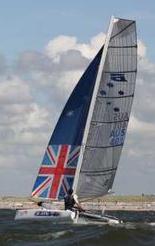
G'day All,
I have seen the AO14 in action & it's a well presented boat. I'm sure that when the correct size kite ( 14m2 you say Wouter ??), there will be some nose dive action occuring. The AO14 certainly has some sail area upwind & performs really well. Somehow I dont think it will be a direct match to the F18's, but wont be far off the mark.
Looking forward to seeing it in action with the big kite on board!!!.

Marcus

This is a pretty funny story.., David and Goliath sort of thing.
At the Spring Fever, I was sailing my pseudo F-14 (Wave with a Hooter). There was no wind.., just glassy water. Then a tiny bit of wind came from the south. So, the RC quickly set the marks to that wind. But, I noticed by the time they had set the marks the wind had already shifted to the southwest.
I never strayed more than 10 boat lengths from the RC Boat and could not believe they started the sequence and the smaller boats (Mystere 4.3, H14 Turbo, and F14) were the first group.
When the 5 minute signal went off I immediately headed for the stern of the RC Boat, knowing the wind had already gone right and the RC end was heavily favored.
In that 5-minute period I just made it past the start line, jibed, unfurled my Hooter, sheeted in and was 8 seconds late for the start, but the only one there.
The course was once around and a close reach to the weather mark, broad reach to the leeward mark and close reach to the finish.
I beat all the boats in my group. But the funniest thing is the wind completely died after my finish. After an hour there were still fleets of boats trying to get to the A Mark.
The funny overall result of this terrible race is that this lowly little Wave (F14) beat every boat at the regatta on a boat-for-boat basis.., including I-20, H20, F18s, etc. <img src=
alt=
/>
Of course the reason was that each class starting after the first group had less and less wind, and the F18s and I20s had less than anyone.
Still a pretty crazy story, eh?
Rick, Congratulations on the victory, it pays to hang by the committee boat!
Since you wrote the book, I have a question for you on downwind technique. There are at least two ways to get downwind (A mark to C mark, no F'n B marks!) with a spinnaker boat. (by that I mean Inter 20's, F18's, Tai Pan 4.9's, etc...but not a Wave with a hooter ) Go high on the wire or go low, on the tramp.
Obvioulsy in high winds you will be going low, maybe on the wire, maybe not, but at what point (wind wise) is it faster (I should say "quicker to C mark") to stay on the tramp vs. get out on the wire? Is the "go high on the wire" technique only good for light to medium wind? (5-15)?
Anyone with an opinion is welcome to reply. Seems the Tornados and A cats like to go wild more than wire.
PS, when are you going to write "Catamaran Sailing for the new Millenium?"
10 years from now we may all be sailing foilers at 30 knots! 
The Taipan cat rigged main sail Wouter, is 13.7 sqm or 147.5 sq ft OF SAIL! that is without half the area of the mast, the mainsail area of the Alpha F14 without the mast area is an actual 132 sq ft, 15.5 sq ft less than the Taipan, and on a mast approx' a metre shorter. The beam of the AO F14 is also much narrower being only 7' or 2.13m wide and using a 9 sqm spinnaker as we are at the moment and a sailor who tips the scales at 87kgs, all go to make the AO F14 a MUCH MUCH smaller package than the Taipan ON PAPER and IN THE WATER, yet by the results from last Saturdays racing, sailing at a VYC yardstick of 78 (down again in a week from 80, when most 14'cats are in the high 80's or low 90's), at the Adelaide Sailing Club (included below), its performance speaks for itself
Division 1 Catamarans Start Time 15:10:00
Class Y/S Sail Finish Elapsed Corr'd Place
AO F14 78 01 16:17:46 01:07:46 01:26:53 1
F18 70 1463 16:11:50 01:01:50 01:28:20 2
Taipan 74 160 16:15:47 01:05:47 01:28:54 3
4.9 Mk 2
Taipan 74 246 16:18:36 01:08:36 01:32:42 4
4.9 Mk 2
Nacra 72 1492 16:20:19 01:10:19 01:37:40 5
5.8
AO is walking down the square-cube law just like we F16's did and so it should end up close to F18 performance.
I'll explain :
Ratio lengths
AO/F18 = 4.3/5.52 = 0.7790
F16/F18 = 5/5.52 = 0.9057
Displacement ratios when assuming all hulls are a downsize F18 hulls
A0/F18 = 0.7790^3 = 0.4727
F16/F18 = 0.9057^2 = 0.7429
Real combined weight ratios
AO/F18 = (76 + 80) kg/ (180 + 150) kg = 0.4727
F16/F18 = (107 + 140) kg / (180 + 150) kg = 0.7485
Are you noticing something here ?
The ratio's as good as identical ! Meaning that one could just scale down an F18 hull to get an F16 or AO hull. Physics models now predict that wetted surface area's and wavemaking drag (hull related drag) will be related roughly by the following ratio's
Length ratio^2 =>
OA/F18 = 0.7790^2 = 0.6068
F16/F18 = 0.9057^2 = 0.8203
The size of the rig determines the drag magnitude of the daggerboards and of course of the drag of the rig itself. These three main components (hull drag, daggerboard drag, rig drag) dominate the total drag of a catamaran. So if the size of the rigs are close to the ratio's given above for hull drag than all considered boats will have very comparable drive to drag ratio's. And this leads directly to the conclusion that all considered boats will have similar speed potential.
F16/F18 (rig) = (jib) 3.65/4.15 = 0.8795 (main) = 14.85/17 = 0.8736 (spi) = 17.5/21 = 0.8333 (They are all relatively close to 0.8203
AO/F18 (rig) = (rough combined jib + main) (13+0)/17+4.15) = 0.6146 (spi) 9/21 = 0.4286 (Drag ratio was 0.6068)
Note how the upwind area of the AO and F18 are very close to their respective drag ratio's. Only the spi ratio is significantly lower.
First conclusion is that the AO and F18 (as well F16) will have very comparable upwind speed as long as sea state and wind conditions don't hinder the short hulled AO to much. This simply because they all share the same "drive to drag" ratio. Downwind the AO is expected to be a little disadvantaged
So it is not at all surprising that the AO is achieving these results. Actually if you remember I wrote you that in an e-mail two years ago. You are walking down the length-area-volume path that the F16's have taken several years ago and the results once again underline the thruthfulness of this approach. Before the F16's , Frank Bethwaite wrote about this path and he called it the square-cube law. It is a very powerful design law in sailboats. Especially catamarans as they don't plane well.
The reason why this result surprises so many people is because for years designs made 14 and 16 footer without understanding a damn what makes these boats "tick". If you go shorter you have to lighter. If you go lighter you have to go shorter. Or else you'll risk overdosing on wetted surface area and kill performance.
The only drawback of this law is that pitching stability is reduced while keeping the same performance. The shorter boats tend to sail more "lively" and you'll have to move more about as a result on shorter hulled boats.
So in short on these physics models I predict that the AO F14 will end up with a rating close to the F18's and F16's as long as the AO design can keep the single drawback (increased pitching) within acceptable bounds. I for one think that the F16's have already pretty much maximized on that when looking at sustained periods of racing. At a certain point the human mind grows tired and concentration drops leading to delayed reactions and thus sub optimal speed in "maximized" designs. The 49-er skiff is a good example of that and I'm told their cup races are relatively short as a result.
Sorry about this all but the engineer in my wanted to have a say. I hope you all found this interesting reading
Wouter
Wouter,
Doesn't crew weight/load carrying ability factor in somewhere? Light crews for 14's, med weight for 16's and heavy for 18's?
Your observations are very interesting and I follow your argument, but in lightweight boats, as already identified, weight is a MAJOR factor.
A heavy crew would surely kill a 14? So to be competitive F14 to 16 to 18 each would have to be sailed by a crew with the correct ratio of weight to required righting ability for that size of boat?
(A short heavy crew on an 18 need not apply )
very much so that is why I used the following data :
AO/F18 = (76 + 80) kg/ (180 + 150) kg = 0.4727
F16/F18 = (107 + 140) kg / (180 + 150) kg = 0.7485
You should recognise the boat weights resp. 76 kg , 107 kg and 180 kg = AO, F16 and F18 as well as the related crew weights 80 kg, 140 kg, 150 kg's
The only only thing I did not include was the righting moment (crew) to capsize moment (sails) of each boat so the comparison may start to differ when the wind really picks up. In case of the F16 to F18 however the rightting ratio = 657/774 = 0.8488 and the capsize ratio = mast ratio * sail area ratio = 8.5/9.15 * 0.8750 (see earlier post) = 0.8128 Therefor the righting to capsize moment ratio between F16 and F18 is = 0.8488/0.8128 = 1.0442 = 104 % in the advantage of the F16's. But that is good as we have some smaller disadvantages here and there and these compensate for eachother now.
Wouter
Now I know why they are called "formula" classes.
"AO/F18 = (76 + 80) kg/ (180 + 150) kg = 0.4727
F16/F18 = (107 + 140) kg / (180 + 150) kg = 0.7485 "
We should all do more sailing, and less maths !!
Cheers
Steve
While I agree that the AO F14's performance looks very promising, there is another practical consideration when attempting to make direct performance comparison between dissimilar classes in only 1 or 2 races. I sailed my taipan in one of the races that Darryl refers to. The AO was the only 14 ft boat in a fleet of 16 and 18 fters. The course was quite short, probably only 1 km windward and return, I think it only took about 35 minutes to do 3 laps. There was a bunch of about 8 to 12 boats all within a minute or so of each other, and clean air was at a premium. On such a short windward leg, tacking off before the layline was not an option. Meanwhile, the AO F14 was 2 or 3 minutes behind the main fleet enjoying lovely clean air.
I am sure this factor improved the F14's time relative to the rest of the fleet. To what degree, I cannot say.
Phil
Phil, we have now kept the results of seven greatly varying races, ranging from the Goolwa to Milang, Milang Easter regatta, and races at Adelaide. These races have been over the extreme of conditions and distances/times, so that overall there is a distinct pattern emerging that, hopefully after we have accumulated another ten or so representative results we can say with some certainty just what yardstick is applicable. All these results have been posted to the VYC to use to set an accurate yardstick for the F14's that should be included in next years book, but at this point in time, it would appear that the appropriate yardstick should be around VYC 77 - 78. That is not to say that this may or may not raise or lower when there is a larger bank of documented results available.
Mind you as to Wouters assertion that mathamatically, the F14 could be competing on an equal footing (or there abouts) with the F18's, I personally don't think that will ever come to pass. Theory is one thing but the proof of the pudding is in the eating.
I have just checked the race that I think that you are refering to Phil, and while there were six larger cats to cross the finish line ahead of the Alpha, there were also six (larger cats than the Alpha) that finished across the finish line behind the Alpha! So the Alpha also had its fair share of "foul airs" around the course.
If you are refering to the last race (the 3rd) of that Sunday, we haven't used those results as the Alpha started over five minutes behind at the start, so that those results are "non representative" for the purpose of establishing an accurate yardstick.