

...Sourcing out your own parts, how and what would you get and why? <img src=

alt=
/>
I hope this gets good <img src=

alt=
/>

Rum. These things take lots of thought.
Robi:
IF I had the expertise, which O DON'T!!! <img src=

alt=
/> <img src=

alt=
/> I would go with the Blade design. Seems to have the best design of the bunch. Right? Don't you like the planning hulls? And the weight. I can't wait to get one and join you guys.
Doug
I've got to go with Pete here, a bottle of Rum, and go watch Matt build my boat... <img src=
alt=
/>
I would not source it out: http://woodastic.blogspot.com/ I would also prefer to buy a finished boat if I had the budget <img src=

alt=
/>
But then, if I were to source it out and had a good budget, I would get:
Hulls and foils from formulacatamarans.com. I like these the best and know Marcus. Might have to order a set of T-foils from Darryl as well just to compare, as long as we are dreaming up boats.
Mast, preferably a carbon wingmast. Less weight is always good.
Beams from the dies Wouter and Phill did. I have only heard secondhand rumours and hints about this, but knowing both of them it would be good stuff.
Fittings from Riley, to test them out and see what they are like.
Sails from formulatamatarans.com, becouse Marcus is active in the class and optimizes his shapes for the boat instead of scaling down e.g. Tornado or F-18 spis.
Now, in the real world it is homebuildt hulls, cut down Tornado masts, alu-tubes for beams, homebuildt working sails and tramps and possibly homebuildt foils as well. Cheapest workable fittings (probably Riley, dont want to go too cheap and buy junk). All to save some money both in the short and the long run.
Tim,
I have built a number of boats and drunk a lot of rum.
It's a close call but I think I'd bring my rum along and watch too. <img src=
alt=
/>
Regards,
Phill
Guys, im not building one myself. I am going to put it all together. I am most probably just purchasing hulls, mast beams and the spin pole. Everything else will probably all put together from different sources. All standing and running rigging, sails, blocks, tramp, tiller extension, rudders, boards, etc is going to be purchased separately.
Rum. These things take lots of thought.
The biggest pita on my boat is raising the main. Buy a halyard that doesn't chew the blocks up, and rig a swiveling block to the mast.
I would not replace the alu parts with carbon. It's overkill.
When are you going to announce the new owner of your old boat. It's your job to welcome him to the club! <img src=
alt=
/>

Basically what the other people said but I would put T-foil rudders on the top of my listing.
Even relatively small foils will take care of the last remaining issue with F16's; going downwind in a big blow.
Hey Rolf, you guys should really consider doing T-foil rudders.
Will make the rudder board design alot simpler as well as you would no longer need a taper at the end. Basically, you can make a 0.95 mtr. long prismatic rudderblade (square side profile) then cut the bottom 30 cm off and screw is to the bottom of the 65 cm long rudderboard made from the other section.. By using two screws and the natural curvature of (the top) of the T-foil you can fine-tune the angle of attack of the T-foil in a range of -4 to +4 degrees. Once the right angle is found you'll just fill up the openings with resin and filler.
It will be a relatively low aspect T-foil (aspect ratio of 2) but at least this one won't stall easily. Added drag is less then 2 kg on the total (when doing 12 knots of speed).
Wouter
You never put it so concisely before <img src=

alt=
/> <img src=
alt=
/>! So that's what it's all about!
Okay, how do I modify the rudders I have? Stock VWM.
Wouter, we are discussing building T-foils. Both time and cost is a big part of that discussion, cost of buying a finished solution vs. the time it takes to build something decent. But let's not turn this into yet another T-foil thread. The next global challenge will probably be a T-foil vs. normal rudder showdown as people will have had time to experiment a bit more by then.
Well, I'm really seriously considering putting T-foil rudders on my F12 design (actually I have already decided doing that). As I have insufficient funds to buy T-foils I'm considering building my own over this winter. Sanding and glassing a rudderboard over is something I can do at my small appartment (highrise building).
I seem to remember having a 19 mm piece of ply wood laying around. With planing and sanding I should be able to get it to mirror a NACA010 or NACA012 profile. Then glass or carbon over the outside and cut the bottom off to become the T-foil. Sail with it for a while on my F16 and when satisfied with the potential make a proper one or buy a commercially made one.
I have to do this as I have AHPC rudders and they have a Shark Fin ending. Basically I have to saw off the bottom 3 inches to even get a surface area large and wide enough to take the T-foil and screws. I think my rudders are at the bare minimum of length anyway, they do stall on me now and then. So that doesn't seem like an attractive route.
I think your VWM rudder blades are alot better in this respect. You have a tapered ending right, with a square tip ? Matt, told me he that he makes the Blade F16 rudders longer then AHPC (a good decision in my opinion). I guess you could just take the bottom egde off to get a flat surface area and prepare the foam to take the screws and the loadings. Probably take a bit of foam out and fill it up again with resin and filler. Ask Matt what you should do here or have him do it for you. Maybe Matt is interested in doing it as an experiment where you cover part of the costs I don't know.
The T-foil can be fitted to this prepared rudder tip. How you make the T-foil is varied, whatever suits you best.
Wouter

Never had a problem downhill on my Stealth!
Better than my Inter 17 and comparable with my Hurricane 5.9!
I wanted to put Darryl's T foils on my Taipan but when we measured the stocks they are around 50-70mm to big and would mean building a new stock mold just to fit the Taipan.would be justified if there were more takers than just me.

What about the loads on the stern? Does the Blade stern support that?
Regards,
Gill
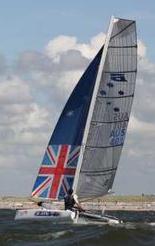
Wouter,
It seems to me that you are one of the only ones that has an issue with the F16's not having T-foils.
After sailing the Aus Blade at Zandvoort - i was very content with out them. The only serious nosedive i had was when my stupidity took over.
The only time I would consider a t-foil would be for stabilisation of upwind sailing in choppy water.
Maybe you should organise a test sail of Aus-401 before wasting your time on the t-foils.
Marcus
Marcus
Marcus, interesting that you say
wasting your time on the t-foils
Why do you consider it a waste of time?
Well, we are not sailing the same boat are we ?
I can either justify 13.500 Euro for the Aussie Blade or less then 500 Euro's for a T-foil upgrade. Same applies to a score of other F16 owners. Of course I understand that you prefer them to all upgrade to an Aussie Blade, but that may be a bit unrealistic at this time.
I think 500 bucks is a reasonable sum to pay for giving my current F16 a new lease on life.
As such I don't really think T-foils are a waste of time irrespectibally or a test ride on the Blade 401. Actually I also believe T-foils are an excellent why to further equalize alu masts with the carbon variety (much reduced pitching in either setup). In the long run this may proof very useful in the F16 future as alu masts are indeed a [censored] load cheaper. Besides the T-foils are someting that can easily be explained to interested parties new to the F16's. You don't need many words at all to convince them that the last remaining benefit of the carbon masts is the ability to alter it stiffness along its length. Same with regard to short hull length and the assumed pitchpole happyness.
No, I actually feel many are underestimating the potential of the T-foil rudder setup. It has considerable advantages in many respects.
I wonder, have you had a test sail with the T-foil rudders yet ? If not then, maybe you should try it.
Wouter
Gilo,
The way I look at it is this.
When you jank your tillers over by say 20 degrees when sailing at 10 knots then the sideways load on the rudder blades is easily in the order of 100 kg. The loads on the pintles will be heigher still as they will have to resist the resulting moment on the rudder while having a relative small leverage.
The T-foil winglets are only 1/3rd the area of the rudderblades and so the forces they generate will be about 1/3rd as well. I don't see how the sterns will fail under those loads when they won't under the much higher loads generated with abrupt steering.
The only situation where you increase the loads is when you steer very abruptly during a full on pitchpole as then both loadings will be on the stern simultaniously. But they will also be perpendicular to eachother making the resulting force only 104.4% higher then the load without T-foils. (remember the law of Pythagoras)
I really don't see this as any cause for worry.
But if anybody thinks it is then the sterns can be reinforced from the inside, relatively easily I imagine even. Just glue a extra plate to the stern and two
angles
securing the stern more forcefully to the keel line and deck. I think this can be done with 5 mm ply after being saturated with resin. There are enough solutions and I don't see any of them as particulary difficult to perform.
Darryl has been experimenting with them in AUS where he simply used to old kick-up system of his old rudders. He report that the kick-up mechanism work just as it would with conventional rudders and he has had no damage yet. Getting back to to beach even in heavy surf should not be a problem with these kick-up T-foils. Basically I sailing my boat in with rudders down but lock down arms disconnected in these conditions anyway. As soon as I reach depths of less the 60 cm the rudders kick-up against the friction of the rudder stocks. By that time the breakers are behind you as no large wave can come as 60 cm shallow water without breaking. Been doing this for 3 years as well, no problems here. Sure the T-foils will add drag when kicked-up but when I sail in 60 cm deep water I want to slow down before hitting the beach anyway.
The only remaining
issue
is getting out through a big surf, although as soon as you reach water deeper then 60 cm you can just rotate them them down fully and have the stock friction keep them in place. I sail out through big surf in the same way with my conventional rudders and it is the best approach anyway. Again the big breakers are encountered over deeper water then 60 cm.
So I feel that a kick-up mechanism as we have now can easily be used for T-foils rudders, There is not really a need to have them slide up and down. Sliding up and down may well be an advantage on its own but it is not needed. That is also what Darryl told me about his experience with kick-up T-foils
I've also an idea to have the T-foil rudderboards use all the same hardware as we are using now, this includes the locking down the rudderstock in the vertical direction and I'm not refering to the litte clip. I discovered that simple solution by accident when trying to dismount my my AHPC rudders. At one time I tried to take my rudders off when the rudderboards were in their down positions, but I couldn't. See the attached picture of why that was (and I don't have that black retaining clip fitted ! ) :
![[Linked Image]](http://www.catsailor.com/bb_files/126682-TaipanruddersetupSideViewCloseUp.jpg)
The part of the rudderboard that is in front of the pintle axis, in order to balance the rudders, achieves a full lock of the stock/rudder on the lower rudderpintle, preventing it from slide up or down. With my rudders there is hardly any spacing between the rudder and pintle at all and the stock was held into place very firmly. I don't have even the retaining little clips on my sterns and I've been sailing like this succesfully for 3 years now. I only have small split rings through the little hole at the top of the pintles to keep my rudders attached to the sterns when going in and out through the surf with the rudders trailing behind the boat. That is all that is needed. Others can continue using the little clips for this purpose.
We can make use of the same principle to have fully locked T-foil rudders using all the hardware that our current rudders use, we only need to add little foils to their tips or have new rudders with T-foils made.
My presonal problem with using my current AHPC rudders is that they are not easily modified to take T-foils because of their shark fin tips. I have to cut off too much board to get a large enough area to fit the T-foils too. So I will have to get new boards. I think your rudders with their tapered by square head tips are alot more easily modified.
It is a wild idea but do you want to give this a try ?
I will ask Frank and Martien the same thing, maybe we can work together and get one demo set made by Hans that we can all use for a while, gether some experience with it, before we all spend some money on it. With the 4 of use the costs could be low enough to just give it a shot.
I don't know, this may well be the trick that gets stuff rolling.
Wouter
I think it is interesting that you think T foils will help solve your nose diving problems. Don't you think you could get just as much benefit from redesigning you spinnaker? from my experience getting a spinnaker that creates more lift works very well and it's what i have done on my Taipan I also did this on my F18.Most kites are just cut down Tornado or F18 designs so you need to tell you sail maker what you want not just get what they say is everyone else has got.
Danny
why trade forward drive for lift when fitting T foils is (IMO) a better solution?

Danny
That's a great point--my new spinnaker (Glaser) has my bows riding a noticable 2-3 inches higher; that a nice added cushion going downwind.
No, mostly because I'm also aiming at improving my boat on two points where I don't fly a spinnaker.
Beam reaching my F16 is kinda sensitive in the fore-aft direction, I have to back off in a blow or make sure I'm really on top of thing. I do sail/race in light but gusty winds now and then and my boat significantly drops it bows everytime a gust comes along while I sit near the mainbeam for proper balance. A Blade does this significantly less. No spinnaker is hoisted on these course and so it can't be a factor
The third area of improvement is spinnaker sailing in steep chop. In flat water i don't have much issues at all keeping the spinnaker drawing and the boat at speed. In severe chop it is become really sensitiv, partly because of the relatively small rudders by AHPC and the fact that they can stall on the worst moment of all.
But I do think it is a little bit of everything. Both a newer spin and T-foils will help and combined the result will be better then just having only one.
Wouter
Robi,
At Zandvoort the conditions were well suited for testing out t-foil effectiveness. AS Mark P had injured his knee, this only left John Alani to show off how the t-foils could help. I personally noted how much smoother the older Stealth was thru the water upwind compared to the majority - mind you John Alani's boat was one of the heaviest boats too.
I personally did not feel the need for the t-foil off the wind. IF the boat doesn't nose dive - why do you need the t-foil.?
Sure the t-foil has that look that attracts many people, but the items also need to be effective. The F14's that sail here in Adelaide need the t-foil as they have a higher power to weight/waterline ratio's that the F16 and their hull design is very different to the Aussie Blade.
As i said in a previous post, upwind is where they might help the Aussie Blade F16. And given the t-foils are fragile, difficult to make any adjustments, awkward with beach rollers, create difficulty in the surf - I for one will approach them with caution & a last resort.
Wouter - I understand the dollar implications, but the reality is you are generating a lot of hype over t-foils for boats that were not designed for the F16 rule in the first place. Your boat is 20kgs over weight & wrong hydrodynamics for spinnaker sailing.
Marcus
Marcus:
Thanks for the simple reply. You got a PM.
Well it isn't 20 kg overweight really, just 15 kg (= rounded off upwards). Yours was 5 kg overweight before adding a jib setup so the difference between our boats is somewhat smaller then we may think.
And as far as I can tell my boat is a pure F16 in every respect, got the measurement form to proof it.
I also noticed some Blade owners putting their bows in. Maybe the Aussie Blade doesn't need it but that doesn't proof that T-foils are unattractive to the other boats (majority) out there.
And why is it that everytime a new development is discussed we get the
hype
counterargument ?
Now I'll say that I'm deeply impressed by the T-foils after having raced with them a few times on a Stealth. They really do seem like a very simple and cheap improvement for some of our
unoptimized
boats. If you don't need them then the more power to you. Arguably, they can never make a boat more performant then the boat that doesn't need them right ? It is not like we getting them is upsetting the class or giving us an unfair advantage in any way, right ?
Wouter
Wouter,
I seem to recall your boat weighing in at around 123kgs. Ok then thats 18kgs over weight - still a lot of extra weight combined with hulls not designed with spinnaker sailing in mind.?
Ok the Aussie Blade was 111.7kgs - not bad for first attempt. The current boat we are building is currently 108kgs - only 3 more kgs to find without going to carbon mast.!
I dont disagree that you boat is not as F16, but your hulls originally were not & this is the main point.
From first hand experience & discussion with other Blade owners it is clear the two blades are behaing very differently down wind.
I never commented on the t-foils being unatractive - just difficult to operate, maintain & adjust. Not the recommended equipment for first timers.
My personal belief is this group should only push/sell rudder systems that are the standard t-foil arrangement that is currently on the stealth / Alpha F14 and to not make them too complicated - otherwise you will turn prospective F16 sailors away.?
The system you propose sounds too expensive for manufacture & expensive to maintain.
Marcus

Marcus
Good points Marcus.
In looking at how I sail my boat, the platform angle of attack changes constantly with the conditions. Up wind from a medium condition with flat water, I will drop the nose and try to drive it, while in a blow I will be back with the knuckle out going for speed and foil lift or keeping the beams clear when it is very rough. Foils as currently allowed try to keep a constant attitude. All changes is attitiude including normal wave pitching add drag to the platform. Even if adjustemnts were allowed no human is fast enough to to keep it perfectly alligned while sailing at the speed we go. I have some experience with this and have worked with a number of people who have tried them on larger boats and the reomendation from all is,
good luck if you decide to try
Wouter, I have to disagree with your push on this issue. Insinuating that the F16 is not optimized without T-foils is BS. I am not saying that they do not work to some extent when developed properly like on the AO14 or the Stealth. I would hazzard to bet though that the fact John was sailing smoother than everyone else in Zaandvort's waves was due to his his sailing skill much more than the fact he had foils on his boat.
For the new sailor anything that is not off the shelf or automatic is a huge distraction to thier learning curve. These boats are complicated enough to drive. You would be a lot better off worrying about driving the boat than constant tinkering with appendages of questionable benefit.
M2C
Matt
I personally feel this subject have been pretty well covered.
It is time for some real world testing boat on boat, or perhaps someone takes a gamble for our next GC? Seeing is believing!
Other opinions on Robis original question
Robi, if you are looking to build up your boat from hulls, do you want to save money or make it somehow
better
than a factory boat, by using different parts?
I think it would be very hard to save money if you have to pay retail for all the parts, most builders get a discount by ordering in bulk.