
Yesterday, I capsized twice (actually turtled ...) during the attempt to change my course from up- to downwinds. Wind was > 20kts with appropriate waves, we had jib, main sheet/ traveller/ cunningham fully open. Everything else was like upwinds. Everytime I tried to bear away, the boat accelerated frightingly and started to nose dive. What's the trick?
And, by the way, the mast of the Capricorn is 100% sealed - the boat rights itself from the turtled to the normal capsized position. No further action needed ...

Good to hear about the mast.... It'd always good to hear our products are doing their job.
I guess the most important question is did you cartwheel (pitch pole) or just roll over. The causes and solutions wil vary.

Pages 25 and 26, Catamaran Sailing for the 90s.
First you need a good bit of speed - when the wind is up, you need to decrease the differential between how fast you're moving once you've made the turn and how fast the wind is moving. Once you're going upwind pretty well, pick a flat spot (i.e., not a wave crest) to start the turn down - skipper and crew fully aft. Traveller and mainsheet are eased in the turn, but not dumped all at once, so that you preserve speed in the turn. Crew is easing jib through the turn slightly slower than the main to keep speed, but keeping the nose up. Make a smooth carve down. Picking your spot to bear off is kinda key, and honestly I think the faster the boat is moving, the better. Keep the boat flat and use the buoyancy of both hulls through the turn. It is a small jib, so at some point in the turn it will be blanketed by the main and you can ignore it, though you'll need to trim again once you're headed downhill with speed. Likewise, once the 'chute is up, your main will be traveled back up and sheeted on pretty hard to trim to the apparent wind. Make sure you've blown the cunningham off completely if you're flying the 'chute to keep the wingmast in column.
Exciting stuff, eh?
WOW!!! Good response... even if some of did come from the book it's perfect.
The real trick, as John said, is to not dump everything too early, because the boat will slow and then when you turn down the sails will suddenly re-power and it'll take off like a rocket. It's a hoot for about 5 seconds before you go swimming.

As mentioned in John's book report keep the speed up. As you come into a mark for a downwind rounding try not to turn the boat too fast. You like to take kind of an large arcing turn. If you come to the mark while keeping about a boat length or more high of the mark you will be able to make this turn and not lose too much distance passed the mark. I like to ease the jib, a bit, first while the crew goes in to set up for the downwind, counteracting their weight on the wire. That should keep the boat more in control.
Keep your weight back. If there is something you need to adjust that requires any weight forward wait until you are settled on your downwind run. Everything is a bit calmer then.
Dan
... so sufficent speed is the key, interesting.Indeed we were almost standing as we decided to go downwind. It was just a training, not a regatta - and actually we didn't had these problems rounding the marks at a regatta, with similar wind conditions, some weeks ago.
Thanks guys, this was very helpful,
Kai
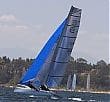
Do you alter your mast rake? we set ours 100mm below the top of the transom for light-moderate breezes and then up one hole on the forestay for fresh to frightening conditions. Its a noticeable improvement.
Actually, I am too lazy to do this - may be I should in the future. I adjusted (= increased) the tension on the side stays and diamonds, actually I do this every time before I go sailing. Another recommendation was to change the two top battens to harder ones, do you do this?
On the advice of Steve Brewin and Scott Anderson I swap out no2 and no3 battens for x-hard fiberfoams. doesn't help with nose diving but makes the boat faster to windward. the rest of the battens are hard fiberfoam.

The other trick I used to use (back when I had a boat <img src="<>/cry.gif" alt="cry" title="cry" height="15" width="15" /> ) was to stay on the trap until the first gybe. As we approached the top mark I would grab the tail of the main sheet of my crew so I could ease the traveller for the down hill turn and then make my way back to the transom foot strap. If the wind was up like you've said the crew would stay out for the turn as well and then go in to hoist the kite (the tack would be pulled out before we got to the mark as our boat was set up to allow us to do this anywhere on the stbd hull).